

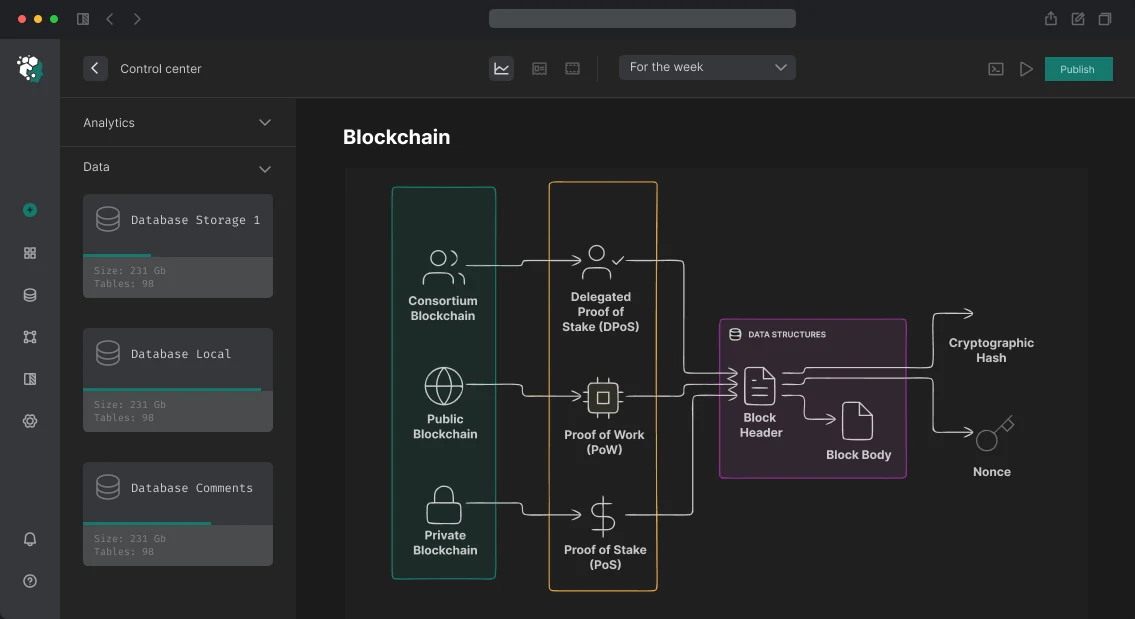






We develop blockchain accounting systems for carbon credits that tackle the core technical problem—double counting. According to research by the World Bank, double counting remains a major barrier. One credit can be sold twice, and old credits are passed off as new. Existing registries (Verra, Gold Standard) suffer from information asymmetry: verification of actual CO₂ sequestration relies on auditors with conflicts of interest. Carbon credits are assets: one credit equals one tonne of CO₂. Our system ensures transparency and immutability, cutting verification costs by up to 40%. Blockchain accounting is 3 times faster during audits—confirmed by our case studies. With over 7 years of blockchain development and 30+ carbon market projects, we deliver robust systems.
How Blockchain Eliminates Double Counting of Carbon Credits
The core issue is double counting. Without unique identifiers, a carbon offset can be sold twice. The fix: mandatory on-chain retirement (burning). This operation is irreversible and public. The smart contract tracks balances and prohibits reuse. We use ERC-1155 for vintages: credits of the same vintage are fungible, of different vintages are not. This reflects the market more accurately. The second problem is credit quality: old projects are sold as new. On-chain metadata with dates and reports solves this. The third is interoperability with legacy registries: bridging via oracles is necessary.
Tokenization Standards and Data Architecture
Before writing contracts, we need to understand existing standards. Toucan Protocol—TCO2, ties Verra credits to ERC-20. Moss Earth (MCO2)—only Amazon projects. Regen Network on Cosmos with data modules—advanced verification. We recommend compatibility with Toucan + ERC-721 for projects + our own verification layer.
Data Hierarchy of a Carbon Credit—Building the Accounting System
A single credit carries many attributes. For a complete accounting:
struct CarbonProject {
    bytes32 projectId;
    string methodology; // VM0007, AR-ACM0003 etc.
    string registry; // Verra, Gold Standard, ACR
    string externalId;
    uint256 startDate;
    uint256 endDate;
    int256 latitude;
    int256 longitude;
    ProjectType projectType; // Forestry, Renewable, Methane etc.
    address projectDeveloper;
    uint256 totalIssuable;
    uint256 totalIssued;
    ProjectStatus status;
}

struct CarbonVintage {
    bytes32 vintageId;
    bytes32 projectId;
    uint256 year;
    uint256 quantity;
    string verificationReport; // IPFS CID of report
    address verifier;
    bytes32 serialNumber;
    bool retired;
}Retirement—a critical operation. When a company offsets emissions, it burns the credit. On blockchain, this is irreversible with a public record:
event CreditRetired(
    bytes32 indexed vintageId,
    address indexed beneficiary,
    string retirementReason,
    uint256 amount,
    uint256 retiredAt
);

function retireCredits(
    bytes32 vintageId,
    uint256 amount,
    string calldata reason,
    address beneficiary
) external {
    CarbonVintage storage vintage = vintages[vintageId];
    require(!vintage.retired, "Already retired");
    require(balanceOf(msg.sender, uint256(vintageId)) >= amount, "Insufficient balance");
    _burn(msg.sender, uint256(vintageId), amount);
    retiredAmounts[vintageId] += amount;
    if (retiredAmounts[vintageId] == vintage.quantity) {
        vintage.retired = true;
    }
    emit CreditRetired(vintageId, beneficiary, reason, amount, block.timestamp);
}
MRV: Measurement, Reporting, Verification On-Chain
Verification of actual CO₂ sequestration is an oracle task. We use satellite data (NDVI) via Chainlink Functions or IoT sensors for methane projects. Example:
const projectId = args[0];
const coordinates = args[1];
const response = await Functions.makeHttpRequest({
  url: `https://api.planet.com/data/v1/quick-search`,
  method: "POST",
  headers: {
    Authorization: `api-key ${secrets.planetApiKey}`
  },
  data: {
    item_types: ["PSScene"],
    filter: {
      type: "AndFilter",
      config: [
        {
          type: "GeometryFilter",
          field_name: "geometry",
          config: parseCoords(coordinates)
        },
        {
          type: "DateRangeFilter",
          field_name: "acquired",
          config: {
            gte: startDate,
            lte: endDate
          }
        }
      ]
    }
  }
});
const ndviAverage = calculateNDVI(response.data);
return Functions.encodeUint256(Math.round(ndviAverage * 10000));
We also use a system of trusted verifiers with multi-signature—less decentralized but compliant with regulatory requirements. In a recent project for a Latin American reforestation initiative, we integrated satellite-based NDVI verification via Chainlink Functions and implemented a hybrid ERC-721/1155 token model. Audit time dropped from 8 weeks to 2.5 weeks, and verification costs decreased by 38%, saving an estimated $15,000 to $25,000 per audit cycle.
System Architecture
MRV Methodology
MRV (Measurement, Reporting, Verification) is key. We combine oracles and formal verification.Why On-Chain Verification Is Critical for the Market?
Without it, the market remains opaque. On-chain retirement eliminates double counting, and the public transaction history allows auditors and regulators to check every tonne of CO₂. This increases trust and reduces audit costs—blockchain accounting is 3 times faster than traditional. Operational expense savings reach 35–40%.
Tokenization and Registry Integration
A debated topic: fungible vs non-fungible. ERC-20 is convenient for liquidity but mixes "good" and "bad" credits. ERC-1155 reflects the market more accurately but has lower liquidity. ERC-721 for project tokens—each project unique. We recommend: ERC-721 for projects → ERC-1155 for vintages → ERC-20 pool for liquidity (analogous to Toucan pools).
Integration with legacy registries is mandatory. Bridging process: credit retired in registry → certificate generated → oracle verifies → tokens minted. Until Verra provides an API, the process requires manual verification or involvement of an accredited broker. Official APIs are expected soon. Approximate development cost for an MVP without registry integration starts at $50,000.
Trading, DeFi, and Regulation
AMM pool on Uniswap V3 or custom AMM accounting for asset specifics. Forward contracts—selling future credits with escrow. Reporting API for ESG: full ownership chain from generation to retirement, export to SAP/Oracle.
Accounting systems operate in a heavily regulated space. Key standards: UNFCCC Paris Agreement Article 6 (international trading), ISO 14064 (quantification), CORSIA (aviation). KYC/AML is mandatory—built in via whitelist with on-chain identity verification.
Work Process and Timelines
| Phase | Content | Duration |
|---|---|---|
| Architectural design | Standards, token model, oracle strategy | 2–3 weeks |
| Core contracts | Project registry, vintage minting, retirement | 4–6 weeks |
| Oracle integration | Verifier system or Chainlink Functions | 3–4 weeks |
| Bridge with legacy registries | API integration with Verra/Gold Standard | 4–8 weeks |
| Trading layer | Carbon pool AMM, forward contracts | 4–6 weeks |
| Reporting API + dashboard | ESG reporting, public explorer | 3–4 weeks |
| Audit | Focus on retirement integrity, double-spend | 4–6 weeks |
Full MVP (without bridge): 4–5 months. With full integration: 8–12 months. Cost is determined after a detailed analysis—contact us to evaluate your project.
Step-by-Step Action Plan
- Requirements analysis: choose standards, define token model and oracle strategy.
- Architecture design: create documentation and data schemas.
- Smart contract development: write contracts for project registry, minting, and retirement.
- Oracle integration: connect Chainlink Functions or custom verifier.
- Testing and audit: check for reentrancy, double-spend, formal verification.
- Deployment and training: deploy to mainnet, hand over documentation, conduct webinars.
Deliverables
| Component | Description |
|---|---|
| Analysis and architecture | Documentation, standard selection |
| Smart contracts | Project registry, mint, retirement |
| Oracle integration | Chainlink or custom verifier |
| Dashboard | Web interface with reports |
| Security audit | Check for reentrancy and double-spend |
| Team training | Documentation and webinars |
Get an engineer’s consultation—contact us to evaluate your project.