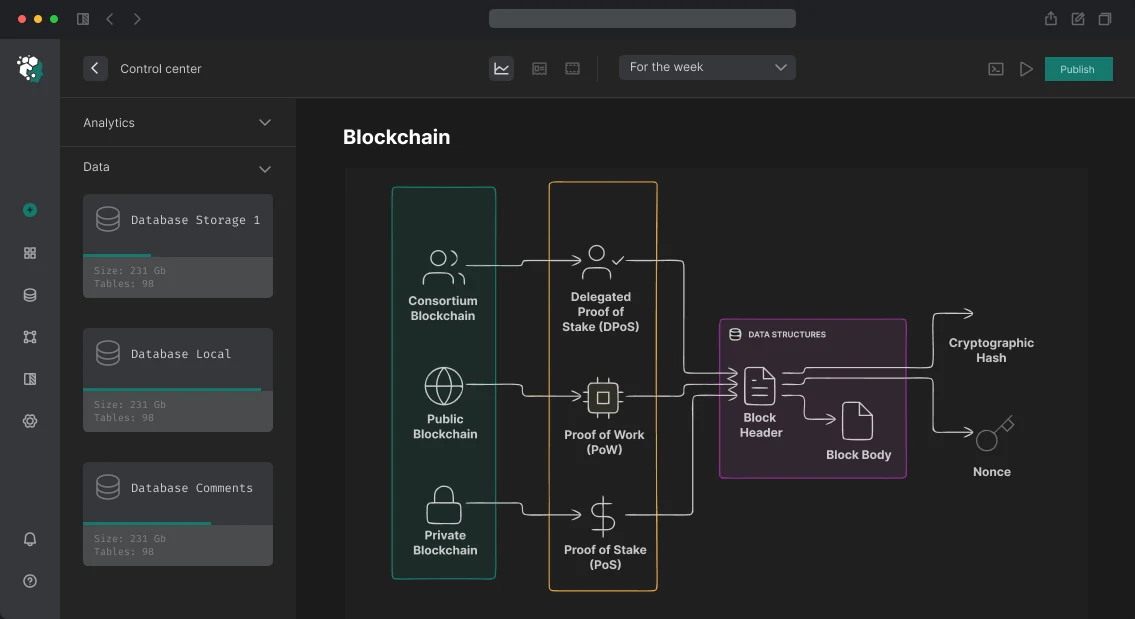
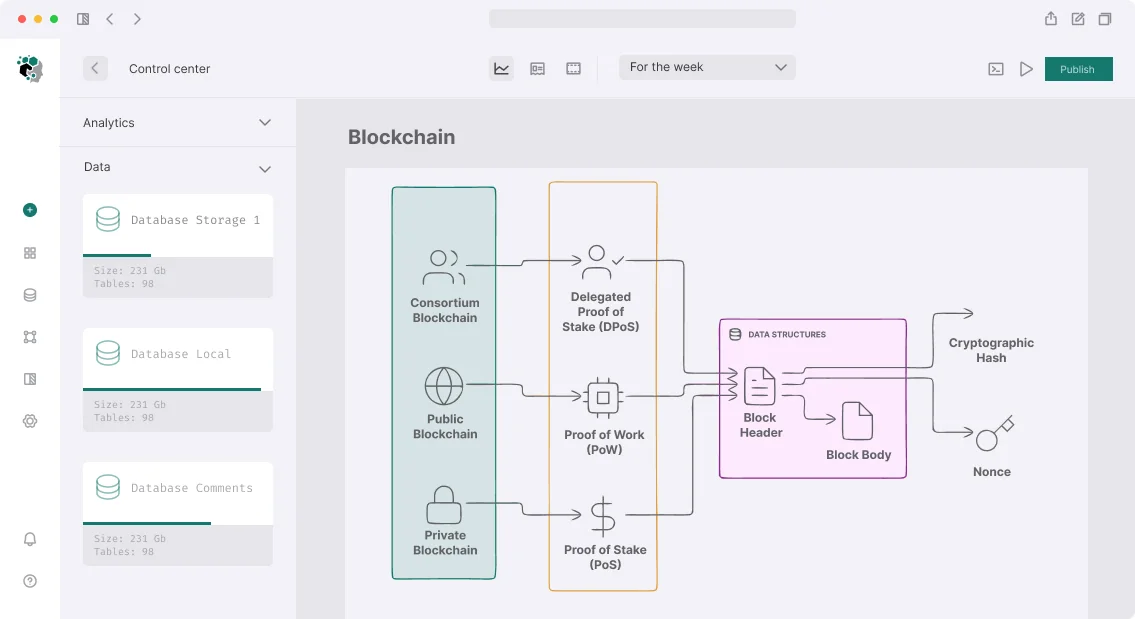
Imagine your project needs fast Bitcoin settlements with transaction privacy, but standard Bitcoin is too slow and Lightning Network offers no confidentiality. Liquid Network solves this. We develop solutions on Liquid — a federated Bitcoin sidechain by Blockstream that finalizes transactions in ~2 minutes and hides amounts via Confidential Transactions. Liquid is especially in demand on exchanges where settlement time is critical, and among asset issuers requiring privacy. For instance, when issuing security tokens with confidential balances — it's the only practical solution.
| Parameter |
Bitcoin Mainnet |
Lightning Network |
Liquid Network |
| Finality |
~60 minutes (6 blocks) |
Seconds (depends on channel) |
~2 minutes (2 blocks) |
| Confidentiality |
No (all amounts visible) |
No (amounts visible in channel) |
Yes (Pedersen Commitments) |
| Asset issuance |
No (only BTC) |
No |
Yes (custom tokens) |
| Atomic Swaps |
Complex (via HTLC) |
Simple (Submarine Swaps) |
Built-in (HTLC + PSBT) |
How Do Confidential Transactions Work?
Liquid uses Pedersen Commitments to hide amounts and asset surjection proofs to mask the asset type. Only the sender and receiver know the real values. Verification of correctness (no inflation) is performed mathematically without revealing data. This is the key feature for which financial institutions choose Liquid.
Why Is Liquid Faster Than Bitcoin?
Liquid does not use PoW and has no public mining. Blocks are created by functionaries — 15+ major exchanges and service providers (Bitfinex, Kraken, OKX, and others). Consensus via threshold multisig: a 2/3 functionary signature is required to create a block. This gives ~2 minute finality — 30 times faster than Bitcoin mainnet. You trust the federation, but in return you get speed and confidentiality.
Peg-in/peg-out — the mechanism for exchanging BTC ↔ L-BTC:
- Peg-in: send BTC to a federated peg address → after ~100 Bitcoin blocks (≈16 hours) you receive L-BTC
- Peg-out: burn L-BTC via the federation → after ~2 hours you receive BTC
How to Issue Your Own Asset on Liquid?
To issue an asset, follow these steps:
- Install an Elements Core node and run it in regtest or testnet mode with parameters
-chain=elementsregtest -validatepegin=0.
- Via RPC, call the
issueasset method, specifying the asset amount and the number of tokens for reissuance.
- Save the resulting 32-byte asset ID — it is needed for all subsequent transactions.
- Register the asset in the Liquid Asset Registry with the name, ticker, and issuer domain — without registration, wallets will display only the hex identifier.
Example asset issuance via Python:
import requests
def rpc_call(method, params):
    resp = requests.post('http://localhost:18884',
        json={'method': method, 'params': params},
        auth=('user', 'password'))
    return resp.json()['result']

issuance = rpc_call('issueasset', [1000000, 1, False])
print(f"Asset ID: {issuance['asset']}")
After issuance, you can confidentially transfer assets using confidential addresses.
Development Tools for Liquid
Modern projects use the following stack:
| Tool |
Purpose |
Language |
| Elements Core |
Main node daemon |
C++ |
| libwally-core |
Cryptographic library with Liquid support |
C (bindings to Python/JS/Java) |
| GDK |
Green Development Kit for wallets |
C (bindings) |
| Liquid JS |
JavaScript SDK for integration |
JavaScript |
Our engineers work with these tools daily — accumulated experience allows us to implement any task, from simple asset issuance to building a DEX with atomic swaps. Request a consultation — our engineers will help determine the optimal architecture for your project.
Atomic Swaps on Liquid
Liquid supports atomic swaps between different assets without an intermediary — via HTLC. Example: exchange 100 USDT-Liquid for 0.001 L-BTC. Both parties sign a PSBT transaction that atomically swaps the assets: either both receive, or neither. A DEX on Liquid is a reality.
Exchange Integration: Liquid as Settlement Layer
Exchanges use Liquid to accelerate cross-platform settlements. An L-BTC transaction settles in ~2 minutes versus 60 minutes on Bitcoin. The scheme: traders deposit L-BTC, off-chain matching, settlement via Liquid. Withdrawal via peg-out when necessary. This architecture reduces operational costs and improves user experience.
Case Study: Settlement Integration for a Cryptocurrency Exchange
We worked with a mid-tier exchange that needed to speed up cross-exchange settlements. They were using Bitcoin mainnet, leading to 60-minute confirmation times and visible transaction amounts. We integrated Liquid as their settlement layer. After deploying a federated node and implementing peg-in/peg-out, settlement time dropped to ~2 minutes. Additionally, by using Confidential Transactions, all settlement amounts became private, increasing their competitive advantage. The integration included asset issuance for their native token on Liquid to enable internal transfers. The project was delivered in 3 weeks, with ongoing support.
What's Included in the Development
- Architecture analysis and privacy requirements review
- Peg-in/peg-out integration with your exchange or wallet
- Asset issuance with registration in the Liquid Asset Registry
- Implementation of atomic swaps (if needed)
- Deployment of an Elements Core node and RPC configuration
- Testing in regtest and testnet (with peg simulation)
- Documentation on working with APIs and scripts
- Training for the client's team
- Technical support for 3 months after delivery
Timeline and Cost
Development of basic integration (asset issuance/receiving) takes from 2 weeks. A full DEX with confidential atomic swaps and asset registry takes 2 to 3 months. Cost is calculated individually based on complexity. We guarantee stable operation of the integration and provide technical support. Request a project assessment — we'll prepare a proposal tailored to your requirements.
Blockstream Liquid Documentation
Blockchain Infrastructure Deployment: Nodes, RPC, Indexing
Subgraph fell at 3:47 AM. By morning users saw outdated balances, transactions "hung" in the UI, support received 47 tickets in an hour. Cause: the handler in the subgraph failed on a transaction with a non-standard event log — and the entire index stopped. We have encountered such situations dozens of times. Our experience shows: blockchain infrastructure does not forgive gaps in observability. Guaranteeing uptime without multi-layered monitoring and fault-tolerant architecture is impossible. Over 8 years working with Ethereum, Polygon, and Solana, we have developed an approach that allows predictable deployment of infrastructure of any scale — from a single node to a multichain grid with dozens of subgraphs.
RPC Layer Architecture
Every dApp interaction with the blockchain goes through RPC — the JSON-RPC API provided by a node. Three options:
Managed providers — Alchemy, QuickNode, Infura, Ankr. Minimal operational costs, SLA, built-in monitoring. Limits: rate limits (Alchemy Free: 300 RU/sec), vendor lock, potential downtime during provider incidents. For most projects — the right choice at the start.
Self-owned nodes — full control, no rate limits, no third-party dependence. Cost: archive Ethereum node requires 2.5–3TB SSD, a strong server, and DevOps support. Sync from scratch on Ethereum via Geth/Nethermind — 3–7 days. Justified under high load or latency requirements.
Hybrid — self-owned node as primary, managed provider as fallback. Standard for protocols with high TVL. Proper load balancing can reduce costs by 20–30% compared to pure managed setup. Under high monthly request volume, hybrid saves significantly.
| Provider |
Strength |
Limitation |
| Alchemy |
Supernode, Enhanced APIs, webhooks |
Expensive on high-volume |
| QuickNode |
Low latency, multi-chain |
More expensive than Alchemy on basic plan |
| Infura |
Historical reliability |
Rate limits on free, one major incident halted half of DeFi |
| Ankr |
Cheap, 40+ chains |
Less stable |
How to Set Up an RPC Layer Without a Single Point of Failure?
At least two providers, DNS round-robin with health check every 5 seconds, automatic fallback when latency >500 ms. In practice, this gives 99.99% availability during any provider failure. For protocols with high TVL, we recommend a custom HA-proxy (nginx or Envoy) in front of two managed providers.
Why Is a Hybrid RPC Scheme More Cost-Effective Than Pure Managed?
At high request volumes, managed providers can be very expensive; a hybrid using a self-owned node as primary and a managed fallback cuts costs significantly without losing SLA.
Ethereum Node Clients
Execution clients: Geth (most used), Nethermind (C#, fast sync), Besu (Java, enterprise), Erigon (fastest sync, efficient archive mode ~2TB instead of 3TB).
Consensus clients (post-Merge): Lighthouse (Rust), Prysm (Go), Teku (Java), Nimbus (Nim). Each node after The Merge requires a pair of execution + consensus clients.
For DevOps: eth-docker — Docker Compose configurations for all client combinations. Setting up monitoring via Grafana + Prometheus is mandatory; a standard dashboard is available in each client's repository.
The Graph: Event Indexing
The Graph Protocol — decentralized indexing. A subgraph describes which events from which contracts to index and how to transform them into a GraphQL schema.
Subgraph structure:
-
subgraph.yaml — manifest: contract addresses, startBlock, events to handle
-
schema.graphql — GraphQL schema of entities
-
src/mapping.ts — AssemblyScript event handlers
dataSources:
  - kind: ethereum
    name: UniswapV3Pool
    network: mainnet
    source:
      address: "0x88e6A0c2dDD26FEEb64F039a2c41296FcB3f5640"
      abi: UniswapV3Pool
      startBlock: 12370624
    mapping:
      eventHandlers:
        - event: Swap(indexed address,indexed address,int256,int256,uint160,uint128,int24)
          handler: handleSwap
AssemblyScript handlers — not TypeScript. No nullable types, no closures, no many standard APIs. An error in the handler stops the subgraph indexing on that transaction. Important: add try-catch for operations that can fail (e.g., store.get() for an entity that may not exist).
How to Avoid Subgraph Indexing Stops?
Graph Node logs are monitored in real-time; on hasIndexingErrors = true an alert fires and an automatic node restart (via systemd or Kubernetes). Typical downtime on error — 150–300 seconds to recover. Additionally, for production we set up a watchdog that restarts Graph Node if subgraph lag exceeds 50 blocks.
Choosing Between Hosted Service and Decentralized Network
Graph Hosted Service (free, centralized) is deprecated in favor of Subgraph Studio + Graph Network. For production: deploy on Graph Network with GRT curation signal — the subgraph gets indexers proportional to curation.
Alternatives to The Graph: Ponder (TypeScript, self-hosted, easier to debug), Envio (ultra-fast indexer, supports EVM + non-EVM), Subsquid (TypeScript, own network), Moralis Streams (managed, webhook-based). Our experience shows: for high-load projects with unique logic, Ponder or Envio are more effective — they give full control over the process and do not require GRT tokenomics.
Webhooks and Real-Time Notifications
Alchemy Webhooks and QuickNode Streams allow receiving events in real-time via HTTP webhook or WebSocket. For monitoring addresses, new transactions, mints — this is faster than polling RPC.
Tenderly — platform for monitoring and alerts. You can set up an alert for a specific contract event, balance change, function call with certain parameters. Transaction simulation via Tenderly API is invaluable for debugging.
Monitoring and Observability
Minimum monitoring stack for a protocol:
On-chain: OpenZeppelin Defender Sentinel — watches contract events, triggers webhook or Autotask when conditions are met. Forta Network — community-maintained bots detect anomalies (large withdrawals, flash loans, governance attacks).
Infrastructure: Grafana + Prometheus for nodes, Datadog or Grafana Cloud for managed metrics. Alerts on: node is 10+ blocks behind, RPC latency >500ms, subgraph lag >100 blocks.
Uptime: Better Uptime or PagerDuty on RPC endpoint and subgraph health endpoint (The Graph provides _meta { hasIndexingErrors, block { number } }).
Why Is Monitoring Without Tenderly Insufficient?
Tenderly provides transaction simulation and detailed traces — critical for debugging subgraph and smart contract errors. Forta focuses on network anomalies, not your infrastructure. The combination of Tenderly plus a custom Grafana dashboard covers 90% of incident scenarios.
Multichain Infrastructure
A protocol on 5 chains = 5 separate RPC endpoints, 5 subgraphs, 5 monitoring configs. Manageable but requires deployment automation.
For subgraph multi-network deployment: graph deploy --network mainnet, graph deploy --network arbitrum-one etc. with a unified codebase and network-specific addresses in separate config files.
Chainlink CCIP and LayerZero for cross-chain messaging require monitoring of both chains and transactions on intermediate relayers. A reorg on the source chain after a confirmed mint on the target chain is a classic bridge problem. Solution: wait for finality (on Ethereum ~15 minutes after Merge for economic finality) before confirming on the target chain.
Infrastructure Setup Process
- Audit current stack — determine chains, request volume, latency and availability requirements.
- Architecture design — select providers, load balancing, redundancy.
- Subgraph development — manifest → schema → handlers → testing on local Graph Node → deploy to testnet → mainnet.
- Monitoring configuration — Tenderly alerts, Grafana dashboard, PagerDuty integration.
- Documentation and runbook — what to do when: subgraph falls behind, RPC downtime, node desync.
- Handover to operations — team training, access transfer, first month support.
What's Included
- Deployment of managed or self-hosted Ethereum, Polygon, BNB Chain nodes
- RPC layer setup with primary/fallback and load balancing
- Subgraph development and deployment for your protocol
- Monitoring connection (Tenderly, Grafana, alerts)
- Runbook and operations documentation
- Team training (up to 4 hours online)
- 30-day support after delivery
Timeline
| Task |
Duration |
| RPC and basic monitoring setup |
1–2 weeks |
| Subgraph for one protocol |
2–4 weeks |
| Self-hosted node with monitoring |
2–3 weeks |
| Full infrastructure (multi-chain, monitoring, runbooks) |
6–10 weeks |
All projects are managed in a GitHub/GitLab repository with CI/CD; configuration code stays with you. Order infrastructure deployment — we'll show how to cut costs by 20–30% without losing reliability. Get a consultation — we'll demonstrate how we deployed infrastructure for a protocol with large TVL on Ethereum and Arbitrum. Contact us.