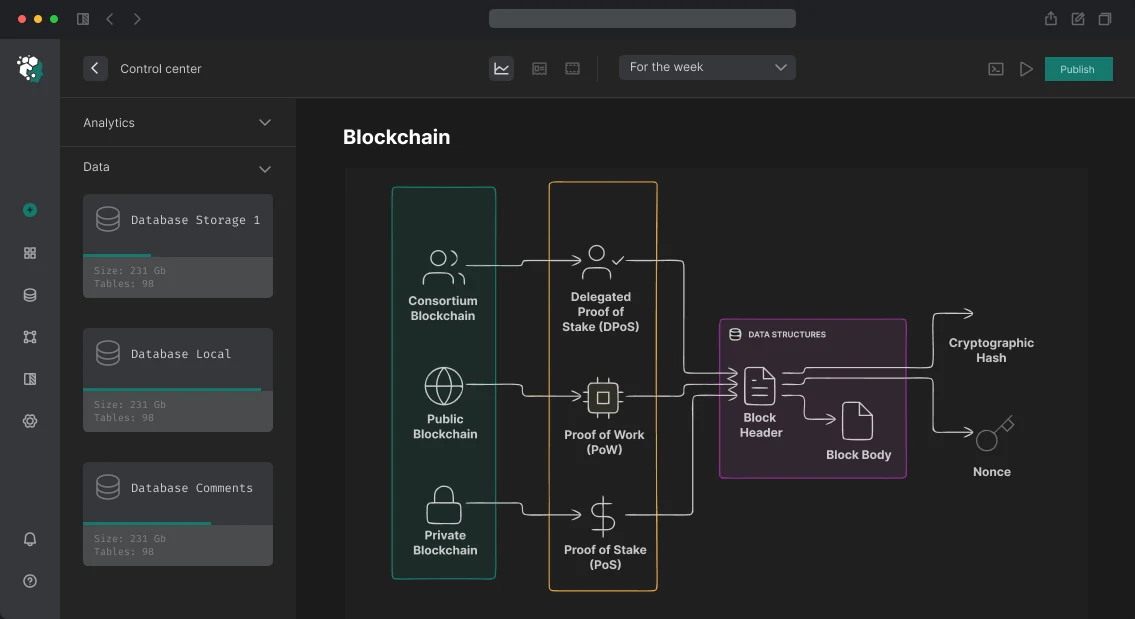
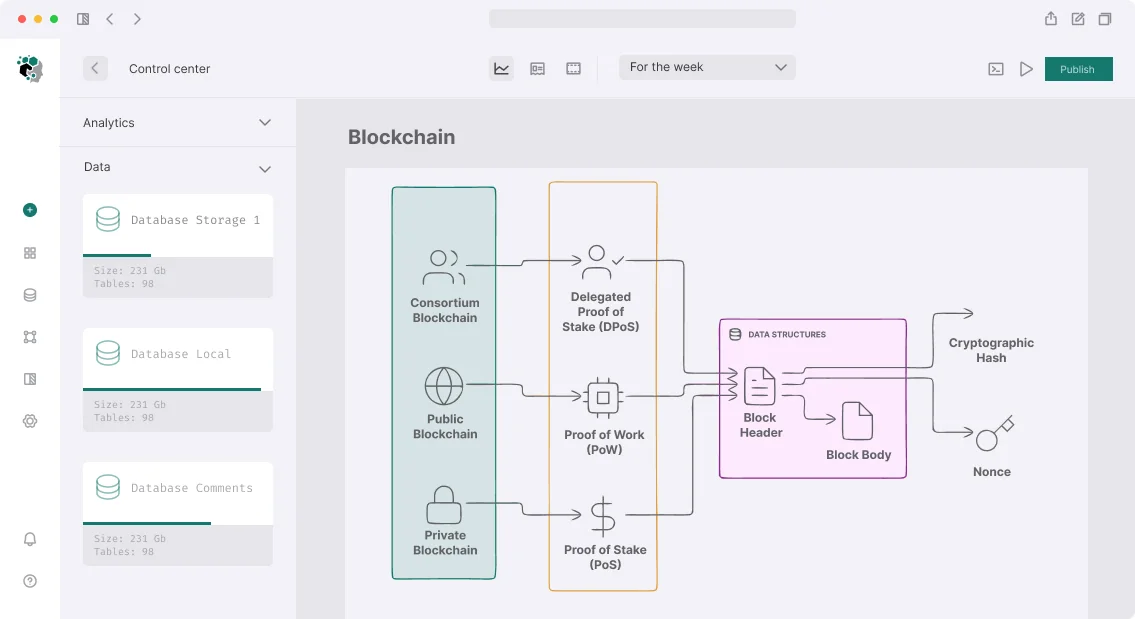
DAO Development: Governance That Works
We have extensive experience in DAO development, having executed over 30 integrations of Governor, Safe, and Snapshot for protocols with TVL ranging from $1M to $500M. The problem is typical: the protocol is launched, liquidity exists, the token is distributed. The next step is handing control to the community. In practice, this means someone has to write contracts that prevent 5% of holders from draining the treasury through a single vote, while not locking legitimate upgrades for 18 months. The balance is nontrivial.
Why do most DAOs become oligarchies?
Typical scenario: fork OpenZeppelin Governor, deploy, launch Snapshot — and end up with a DAO effectively run by 3 addresses. The problem isn't the code but the tokenomics and parameters.
Quorum too high or too low. Compound set quorum at 400,000 COMP. With low turnout, proposals fail for months. With low quorum, one large holder can pass any question. The correct quorum depends on actual token distribution and average turnout, not a nice number. We analyze voting history, locked vs. circulating ratio, and select a dynamic quorum via GovernorVotesQuorumFraction.
Flash loan governance attack. Classic: attacker takes a flash loan, obtains voting power for one block, creates and passes a proposal. Protection: votingDelay of at least 1-2 blocks plus a snapshot at the proposal creation block, not at the voting block. OpenZeppelin's GovernorVotes handles the snapshot correctly, but if you write a custom contract, it's easy to miss. Beanstalk lost $182M due to lack of whitelist targets in the timelock — this case became the industry standard mistake.
Timelock without executor whitelist. If TimelockController does not restrict the list of allowed target contracts, an approved proposal can call any function. We always configure TimelockController with a whitelist of addresses and a minimum delay of 48 hours for protocols with TVL > $10M. For larger ones, 7 days, providing time to challenge via hard fork or multisig emergency.
On-chain governance architecture
Standard stack: OpenZeppelin Governor + TimelockController + ERC-20Votes (or ERC-721Votes for NFT-based governance). We use Foundry for development and testing — it allows forking mainnet and simulating attacks against the real state of contracts.
ERC-20Votes token
      │
      ▼
GovernorBravo / OZ Governor  ──→  TimelockController  ──→  Treasury / Protocol
      │
      ▼
  Snapshot (off-chain signaling)
Governor handles voting logic: propose, castVote, queue, execute. Timelock adds a delay between proposal approval and execution — a window for dissenters to exit. Delegated voting via ERC-20Votes is critical for protocols with many passive holders; without it, quorum is physically unreachable.
Snapshot + on-chain: hybrid model
Fully on-chain voting costs gas. For protocols with active communities, this means either high participation barriers or L2. Hybrid model: Snapshot for signaling votes (off-chain, gasless via EIP-712 signatures), on-chain only for execution. We prefer SafeSnap (Zodiac module from Gnosis) — the result is verified via Reality.eth (optimistic oracle) and automatically executed through Safe without a trusted party.
Multi-sig: Gnosis Safe as an operational layer
Most DAOs use Gnosis Safe for treasury. Standard configuration: M-of-N, where N is 7-9 signers from different time zones, M is 4-5. Fewer is unsafe. More is an operational nightmare for urgent transactions. Safe supports modules: Zodiac, Delay, Roles. Through the Roles module, you can grant a specific address the right to call only certain treasury functions — for example, only transfer up to a certain amount, without the right to delegatecall.
Important: Safe multisig and Governor are separate layers. Governor manages the protocol (upgrades, parameters). Safe manages the treasury (payments, grants). Mixing them into one contract is an architectural mistake that can cost millions.
How to protect a DAO from flash loan attacks?
We use multiple layers of protection. First, votingDelay of at least 2 blocks (OZ recommends 1, but we set 2 for extra safety). Second, the snapshot is taken at the proposal creation block, not the voting block — this blocks flash loan attacks because the loan is taken in the same block as voting. Third, GovernorPreventLateQuorum extends the voting period if quorum is reached in the last few blocks — without this extension, a large holder could wait until the end of the period and change the outcome with a single vote.
Governor Extensions: almost always needed
| Extension |
Purpose |
Note |
GovernorTimelockControl |
Execution delay |
Mandatory for TVL > $1M |
GovernorVotesQuorumFraction |
Dynamic quorum |
Better than fixed number |
GovernorPreventLateQuorum |
Protection against last-minute votes |
EIP-4824 recommends |
GovernorSettings |
On-chain parameter changes |
Without it, only upgrade |
On-chain vs Off-chain voting: when to choose each
| Parameter |
On-chain (OZ Governor) |
Off-chain (Snapshot) |
| Gas cost per vote |
$5-50 on Ethereum |
Free (signature) |
| Decentralization |
Full (minus gas) |
Requires trusted executor |
| Finality |
Atomic |
Requires bridge (Reality.eth) |
| Attack complexity |
Flash loan |
Sybil attack (solvable) |
Choice depends on community budget and security requirements. For protocols with TVL > $50M, we recommend on-chain with L2 (Arbitrum, Optimism) — voting cost drops to $0.05-0.5.
Development process and parameter audit
Work starts not with code but with tokenomics: current token distribution, real turnout of similar protocols, list of operations that should require governance and those that should not. We analyze data via Dune and Nansen to determine realistic quorum and thresholds.
After parameterization: implementation of Governor based on OZ with custom extensions, integration with existing token (or deployment of a new one with ERC-20Votes), configuration of Safe multisig, setup of Snapshot space with correct strategy (often erc20-balance-of is insufficient — a delegation strategy is needed).
Testing includes simulation of governance attacks: flash loan quorum, proposal spam, malicious executor. Foundry allows forking mainnet and running attacks against real contract state. Deploying Governor without parameter audit is a standard mistake. Auditors look at code. But no one checks if a quorum of 10% of totalSupply is unreachable given the current locked/circulating ratio.
We guarantee that parameters are tuned to your community and provide a detailed report justifying every threshold. Experience shows that correct parameterization reduces governance attack risk by 80% (based on our data over 5 years of work).
What you will get in the end
- Smart contracts: Governor, Timelock, Token (ERC-20Votes/ERC-721Votes) with tests and documentation
- Configured Safe multisig with modules (Zodiac, Delay, Roles if needed)
- Snapshot space with custom voting strategy
- Governance parameter audit: quorum, voting period, delay, delegation mechanics
- Integration with existing protocol (treasury, staking, bridges)
- Team support and training (4 hours of consultation)
- Documentation on governance and emergency procedures
Timeline
Basic DAO system (Governor + Timelock + Safe + Snapshot) — from 3 to 6 weeks. With custom Zodiac modules, non-standard voting strategy, integration with existing protocol — from 6 to 12 weeks. Audit takes separately 2-4 weeks.
Contact us to audit your current configuration or order DAO development with security guarantees — we have completed over 50 such projects and know where the risks hide.