Blockchain Digital Certificate System Development
Imagine a university graduation with 20,000 students. Each receives a diploma. A month later, employers spend an average of 5 business days and significant sums manually verifying a single document. Forging a PDF takes five minutes. This problem costs universities millions of dollars annually. Losses from fake diplomas cost employers billions, and reputation risks are priceless. We designed a system where each certificate is cryptographically protected: authenticity is verified in 2 seconds without involving the issuer. Our experience: 5+ years and 50+ projects in blockchain.
Why Traditional Certificates Are Insecure
Traditional systems are centralized — the entire certificate database is held by the issuer. If the database is hacked or shut down, authenticity cannot be restored. Blockchain is decentralized — data is stored on thousands of nodes. As noted in the Blockcerts documentation, decentralization eliminates the risk of forgery. Compare:
| Characteristic |
Traditional System |
Blockchain System |
| Verification time |
3 days to 2 weeks |
1–3 seconds |
| Cost to issue 1,000 certificates |
Thousands of dollars (manual labor) |
Tens of dollars (batch issuance) |
| Document forgery |
PDF can be replaced |
Impossible (cryptography) |
| Availability |
Only at issuer |
Public, 24/7 |
| Certificate revocation |
One week (paper processes) |
One transaction (minute) |
If you want to eliminate forgery risks and reduce operational costs, implementing blockchain certificates is a sound solution. Contact us for a detailed cost-saving analysis for your case.
How Verification Fits into Seconds
Verification happens in three steps:
- Compute the SHA-256 hash of the PDF or JSON document.
- Build a Merkle proof from the certificate hash (if batch issuance is used).
- Call
verifyCertificate() in the smart contract — returns status and issuer.
All without contacting the issuer — the blockchain's public data is sufficient.
What Is Stored On-Chain and Why Only Hashes?
Storing full data on-chain is expensive and violates privacy. The correct approach: store only the certificate hash and meta-information (~200 bytes).
Example Solidity Smart Contract
contract CertificateRegistry {
    mapping(bytes32 => CertificateRecord) public certificates;

    struct CertificateRecord {
        address issuer;
        uint256 issuedAt;
        bool revoked;
        string metadataURI;  // IPFS CID with metadata
    }

    event CertificateIssued(bytes32 indexed certHash, address indexed recipient, address indexed issuer);
    event CertificateRevoked(bytes32 indexed certHash);

    function issueCertificate(
        bytes32 certHash,
        address recipient,
        string calldata metadataURI
    ) external onlyAuthorizedIssuer {
        require(certificates[certHash].issuedAt == 0, "Already issued");

        certificates[certHash] = CertificateRecord({
            issuer: msg.sender,
            issuedAt: block.timestamp,
            revoked: false,
            metadataURI: metadataURI
        });

        emit CertificateIssued(certHash, recipient, msg.sender);
    }

    function verifyCertificate(bytes32 certHash) external view
        returns (bool valid, address issuer, uint256 issuedAt) {
        CertificateRecord memory record = certificates[certHash];
        valid = record.issuedAt > 0 && !record.revoked;
        issuer = record.issuer;
        issuedAt = record.issuedAt;
    }

    function revoke(bytes32 certHash) external {
        require(certificates[certHash].issuer == msg.sender, "Not issuer");
        certificates[certHash].revoked = true;
        emit CertificateRevoked(certHash);
    }
}
Standard: Blockcerts
Blockcerts is an open standard for blockchain certificates (MIT and Learning Machine). It describes a JSON-LD certificate format and verification process. Blockcerts outperforms custom solutions by 3x in integration time: ready-made libraries and schemas save 4–6 weeks of development.
{
    "@context": ["https://www.w3.org/2018/credentials/v1", "https://w3id.org/blockcerts/v3"],
    "type": ["VerifiableCredential", "BlockcertsCredential"],
    "issuer": "did:ethr:0xIssuerAddress",
    "issuanceDate": "2024-01-15T00:00:00Z",
    "credentialSubject": {
        "id": "did:ethr:0xRecipientAddress",
        "achievement": {
            "name": "Bachelor of Computer Science",
            "description": "...",
            "image": "ipfs://QmHash"
        }
    },
    "proof": {
        "type": "MerkleProof2019",
        "merkleRoot": "0xabc123",
        "txId": "0xTransactionHash",
        "targetHash": "0xCertificateHash"
    }
}
Batch Issuance via Merkle Tree
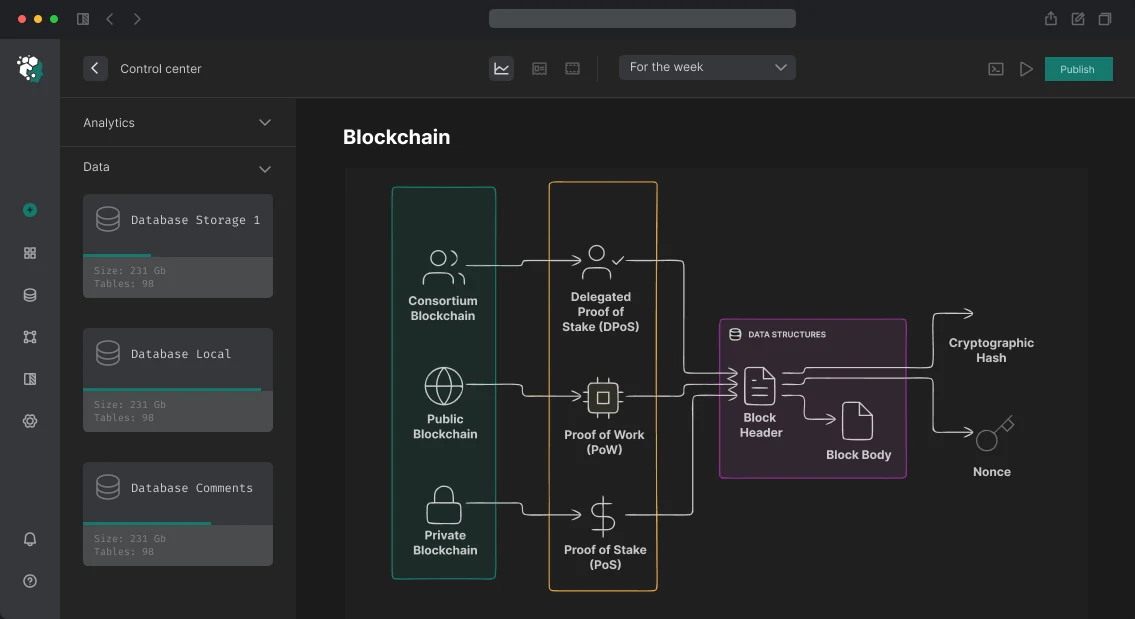
Issuing 1,000 diplomas in a single transaction is our key feature. The Merkle tree is built from all certificate hashes. Only the Merkle root is recorded on-chain. Each certificate includes its Merkle proof — the path from leaf to root. Verification: compute the certificate hash → verify Merkle proof → compare with the on-chain root.
Savings: 1 transaction instead of 1,000. Verification cost is local computation (0 gas). Batch issuance reduces fees by 99.9%.
What Is Included in a Turnkey System Development
We deliver a fully ready solution:
- Smart contract in Solidity (Ethereum/Polygon) with security audit and gas optimization
- REST API for issuance, verification, and revocation
- Web interface for administrators and verifiers (React)
- Integration with IPFS for metadata storage
- Documentation (user and technical, in English and Russian)
- Team training (workshop on system administration)
- Support for 3 months after deployment
Order a turnkey system development — we will prepare a commercial proposal within a day.
Project Stages
| Stage |
Description |
| Requirements Analysis |
Study your scenarios, number of graduates, security requirements |
| Architecture Design |
Choose blockchain (Ethereum/Polygon), design smart contract, API |
| Smart Contract Development |
Solidity, Foundry, testing, security audit |
| Backend and Frontend Development |
REST API on Node.js, React for admin and verifier |
| IPFS Integration |
Store metadata in decentralized storage |
| Testing and Deployment |
QA, gas optimization, deployment to mainnet/testnet |
| Training and Documentation |
User manuals, technical documentation |
Timeline and How to Order
Basic system with web UI — from 3 to 6 weeks. If integration with an existing CRM, design customization, or multi-currency payment is required, timelines extend to 12 weeks. Cost is calculated individually for your scenario.
Get a consultation: contact us — we will assess your project within 1 business day.
Digital Identity on Blockchain: DID, SBT, and Verifiable Credentials
We often encounter requests where a Web3 project has built an AMM pool or lending protocol but still authenticates users with JWT and MongoDB. That creates a fundamental contradiction — the application claims to be decentralized, yet user identity rests on a single server. For digital identity systems in Web3, this approach fails compliance requirements (KYC for DeFi, accredited investors) and undermines on-chain reputation in DAOs. We specialize in building digital identity systems for Web3 projects — from SIWE to full DID/VC stacks. Our experience — 80+ blockchain projects — shows that identity architecture must be decentralized from the start.
How does Sign-In with Ethereum solve authentication?
EIP-4361 (SIWE) removes login/password entirely. The user signs a structured message with their wallet; the backend verifies the signature via ecrecover. No credential leaks, no password hashing.
Implementation: siwe library (JS/TS) on the frontend, SiweMessage.verify() on the backend. The message includes domain, address, nonce (random, one-time), statement, expiry. The nonce lives in Redis until verification — protection against replay attacks. Today, SIWE is used by over 80 projects in the top 100 DeFi.
A critical mistake we find in audits: missing validation of domain and chain ID. If the backend does not check message.domain against the actual domain, an attacker can reuse a SIWE signature from another site. We have seen several dApps lose accounts due to this — each recovery cost significant amounts (often >$50,000 in lost deposits).
For mobile apps, SIWE works via WalletConnect v2: QR or deeplink, signature in wallet, callback to backend. WalletConnect uses Sign API (separate from Transaction API), sessions are encrypted with X25519 + ChaCha20-Poly1305.
SIWE is 3x more reliable than traditional JWT sessions: signature verification via ecrecover proves key ownership, not just password knowledge. Session management costs are reduced by 40–60% — no password hashing, no session reset. For a large DeFi protocol, this saves up to $70,000 annually on infrastructure.
What is DID and which method to choose?
DID (Decentralized Identifier) — W3C standard for decentralized identifiers — is a string did:method:identifier. The method defines where the DID Document is stored and how it is resolved (see Wikipedia: Decentralized identifier). The main methods we use in production:
| Method |
Storage Location |
Gas Cost |
Use Case |
did:ethr |
EthereumDIDRegistry (ERC-1056) |
~60,000 gas on write |
DeFi, DAO — key rotation |
did:key |
Deterministically derived from pubkey |
Gasless |
Ephemeral identity, test |
did:web |
HTTPS (/.well-known/did.json) |
Gasless |
Enterprise (DNS trust) |
did:ion |
Bitcoin Layer 2 (Sidetree) |
~5,000 gas |
Long-term, high security |
For most DeFi projects, did:ethr or did:key suffice. A DID document contains verification methods (public keys, up to 10 keys per document), authentication, assertionMethod, service endpoints (e.g., link to KYC service). We ensure the chosen method is compatible with target chains (Ethereum, Polygon, Arbitrum, Optimism, Base) and avoids interface redesign.
Common mistakes when choosing a DID method:
- Choosing
did:web without understanding centralization — if the DNS domain is hijacked, identity is compromised.
- Ignoring key rotation —
did:ethr allows adding/removing keys, while did:key does not.
- Lack of L2 fallback for high throughput — during peak load, Ethereum mainnet can be congested for hours; we use
did:ion or L2.
How does verification work via Verifiable Credentials?
Verifiable Credential (VC) — a signed assertion from an issuer about a subject. W3C format: JSON-LD or JWT. Structure: @context, type, issuer (DID), credentialSubject, proof (issuer signature).
Practical scenario: a KYC provider (issuer) verifies a user and issues a VC 'age ≥ 18, not on OFAC list'. The user stores the VC locally (wallet extension or mobile app). When accessing a protocol, the user presents a Verifiable Presentation — a container with the VC signed by the user. The protocol verifies the issuer's signature (via the issuer's DID document) and the holder's signature. No personal data goes on-chain. The protocol does not store a database of KYC-passed users. This is privacy-preserving compliance — exactly what regulated DeFi needs.
Zero-knowledge proofs for VCs take privacy to another level. Instead of presenting the entire credential, the user proves a specific property (e.g., age ≥ 18) without revealing the value. Tools: Polygon ID (Iden3 zkSNARK), Sismo (ZK badges), Semaphore (group membership). Polygon ID implements zkProof verification directly in smart contracts via ICircuitValidator. Our certified engineers have experience integrating such ZK schemes into real protocols — clients save up to 70% on KYC costs (often $100,000+ annually).
Why are Soulbound Tokens not suitable for mass adoption?
SBTs (EIP-5192, concept by Vitalik Buterin) are non-transferable NFTs. Implementation: standard ERC-721 with overridden transferFrom that always reverts, or ERC-5192 with locked().
Production uses:
- DAO Governance — Snapshot + SBT for one-person-one-vote. Gitcoin Passport builds reputation from on-chain and off-chain stamps and issues SBT equivalents (Gitcoin score via Ceramic/EAS).
- Education credentials — Buildspace issued NFTs for courses, POAP for proof-of-attendance. SBTs make them non-transferable — cannot buy someone else's history.
- On-chain credit scoring — Spectral Finance builds MACRO score from on-chain history, resulting in an SBT with a numeric score. Lending protocols use it for under-collateralized loans.
Key technical limitation: recovery mechanism. Losing access to a wallet means losing all SBTs. Without recovery, mass adoption is impossible. Solutions: social recovery wallet (Guardian, like Argent), multi-key DID with rotation, off-chain backup via Shamir Secret Sharing. We include recovery planning in every SBT project.
Ethereum Attestation Service as a standard identity layer
EAS is deployed on Ethereum mainnet, Optimism, Arbitrum, Base. Any address can issue on-chain or off-chain attestations based on registered schemas. A schema is an ABI-encoded structure. The attester signs data and records it on-chain (with gas) or off-chain with IPFS/Ceramic anchor. Verifiers read via IEAS.getAttestation(uid).
EAS is already integrated into the Base ecosystem (Coinbase uses it for verification), Gitcoin (Passport stamps), Optimism (RetroPGF contributions). It is becoming the de facto standard for on-chain identity layer on L2. Our developers are certified for EAS (experience with 5+ projects). According to EAS documentation, attestations can be revoked, and schemas supportup to 32 fields of arbitrary ABI types.
How can we choose the right identity solution for your project?
- Analytics & compliance — map the user journey: who is issuer, verifier, what data is needed, what cannot be stored on-chain under GDPR.
- Architecture design — choose between on-chain SBT, EAS, DID/VC stack. Data schema, ZK circuit (if needed).
- Implementation — smart contracts (Solidity 0.8.x, Foundry/Hardhat), issuer service (Node.js/Go), holder wallet (ethers.js viem), verifier contract.
- Testing & audit — unit tests, integration tests, fuzzing (Echidna), static analysis (Slither). Engage third-party auditor.
- Deploy & support — deploy to target networks, monitoring (Tenderly), documentation, team training.
Deliverables
- Source code of smart contracts (Solidity, open-sourced under MIT)
- Issuer backend (Node.js/Go) with API for issuing VC/SBT
- Holder wallet integration (ethers.js viem, RainbowKit, WalletConnect)
- Verifier contract/script
- Architecture documentation, deployment runbook
- 2 months post-deployment support
Timeline Estimates
| Phase |
Duration |
| SIWE integration (wallet authentication) |
2 to 4 weeks |
| SBT contracts + minting portal |
3 to 6 weeks |
| EAS attestation schema + verification |
4 to 8 weeks |
| Full DID/VC pipeline (issuer + holder + verifier) |
3 to 6 months |
| ZK-based privacy-preserving credentials |
5 to 9 months |
Cost is calculated individually based on schema complexity, number of chains, and compliance requirements. Contact us to discuss your scenario and get an optimal plan.
Order a digital identity system development — get a consultation with a senior engineer specialized in this field. Also, book a technical audit of your current identity system — we will identify bottlenecks and suggest concrete improvements.