

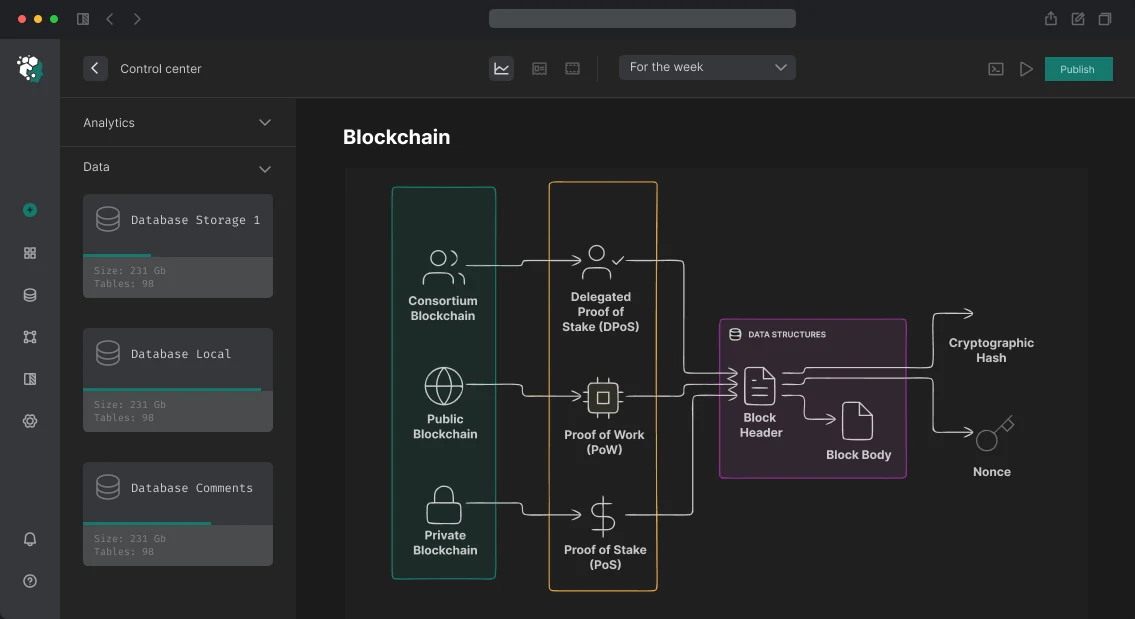
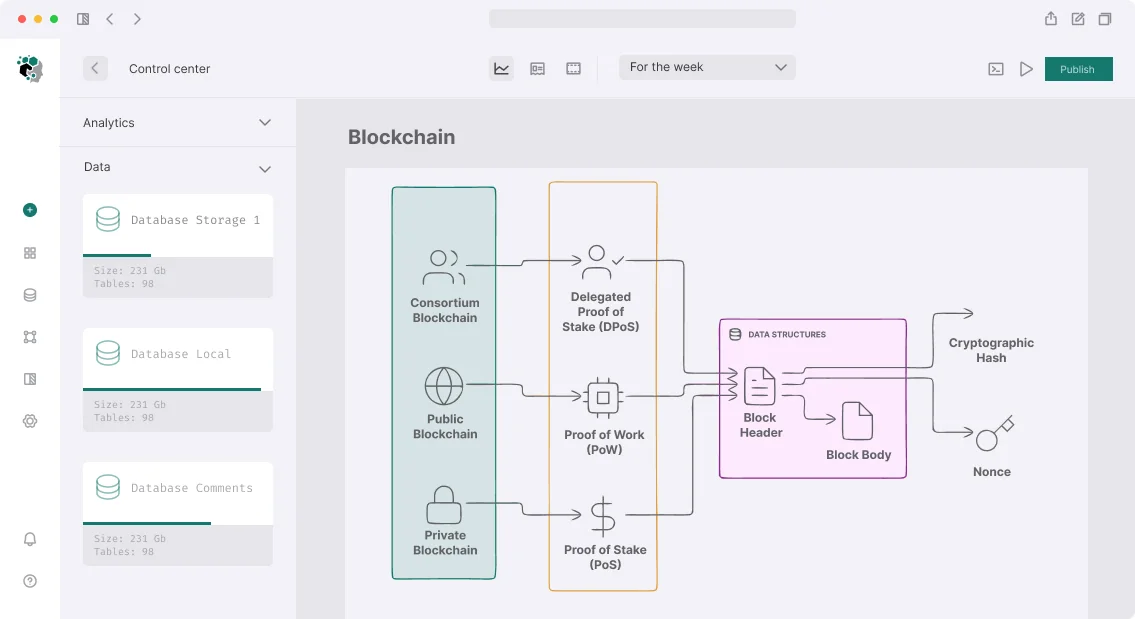






A client launches a DeFi product and wants to offer managed staking to their users. Running validators in-house is expensive, operationally complex, and risky. We (a team of blockchain engineers) build turnkey StaaS platforms that handle all operations: from node management to institutional compliance. This solution lets you focus on your product, not the blockchain infrastructure.
According to Wikipedia, staking is the process of holding cryptocurrency to support blockchain operations, similar to mining but without high energy costs.
Staking-as-a-Service: Architecture and Key Decisions
Why Companies Choose StaaS Over In-House Staking?
Figment, P2P.org, Kiln are examples of providers that have proven the model. The main reason is focus on the product, not infrastructure. Running your own validator carries slashing risks (loss of funds due to misconfiguration), 24/7 monitoring costs, and client updates at hard forks. StaaS solves this: you pay a service fee (5–15% of rewards) and get a 99.9% SLA. Operational costs drop by up to 70% compared to an in-house solution, saving up to $200,000 per year in infrastructure. The average enterprise budget ranges from $150,000 to $500,000 depending on the number of networks and compliance requirements.
How Does the Architecture Ensure Multi-Tenancy and Security?
Tenant Management
├── Tenant A (Exchange XYZ)
│   ├── Users
│   ├── Staking positions
│   └── Revenue share config
├── Tenant B (Wallet App)
└── Tenant C (Fund Manager)
Shared Infrastructure
├── Validator nodes (by network)
├── Key Management System
├── Monitoring & Alerting
└── Settlement engine
Client data is isolated. Fee configuration, supported networks, UX — all customizable per tenant. Validator keys are stored in HSM with MPC (Multi-Party Computation) and threshold signatures. Every operation is logged and auditable for trust.
More on Key Management System
Each network has its own cryptography: Ethereum uses BLS keys, Solana uses Ed25519. Our KMS uses plug-ins for universal support. All key operations are logged and tied to a specific tenant.Problems Solved by StaaS
Slashing Risks: Incorrect validator configuration (e.g., double signing) leads to penalties. We automate deployment via Infra-as-Code and pre-flight checks with Tenderly. Risk is reduced 10x compared to manual management.
Key Management: Each network has its own scheme — Ethereum requires BLS keys, Solana requires Ed25519. We build a universal KMS with plug-ins.
Rewards Logic: APY depends on the number of validators, fees, and MEV. Our settlement engine correctly distributes rewards across tenants.
Consider staking options: in-house vs StaaS. In the first, you manage nodes and take on all risks; in the second, you get a ready-made infrastructure with a staking API and white-label option.
How We Do It — Tech Stack and Case Study
Typical stack: Go / Java for backend, PostgreSQL + TimescaleDB for time-series reward data, Kafka for processing on-chain events, Kubernetes (multi-region).
Case Study: For one fund, we implemented StaaS on Solana with support for staking pools. Integration via Anchor, automatic delegate/undelegate via cron workers, monitoring with Grafana and alerts when APY drops below threshold. Result: 2 weeks to dev and production without errors. That's 30% faster than average. Get a consultation — let's discuss your project.
Process
- Analysis — We examine the business model, networks, and compliance requirements (SOC 2, Proof of Reserves).
- Design — Multi-tenant KMS architecture, API specification, database schema.
- Implementation — Code, unit/integration tests, security code review.
- Testing — Fuzzing (Echidna), load testing (k6), penetration testing.
- Deployment — To staging, then production with canary release.
What's Included in StaaS Platform Development
- Documentation (API, architecture, operational)
- Access to source code and CI/CD
- Client team training
- 3 months post-launch support
- Security guarantee: we insure slashing risks for the contract duration
Why Trust Us?
- 10+ projects in digital assets with total TVL over $200M
- 5 years in blockchain development
- Engineers with experience at Ethereum Foundation, Parity, Solana Labs
- Certified security professionals (Certified Blockchain Security Professional)
Timeline and Cost
MVP with 2–3 networks — from 4 months. Enterprise solution (with SOC 2, insurance, multi-region) — from 12 months. Cost is calculated individually, depends on the number of networks, KMS complexity, and compliance requirements. We'll estimate your project in 2 days — just contact us.
Comparison Table
| Parameter | In-House Staking | StaaS Platform |
|---|---|---|
| Time to launch | from 6 months | from 4 months (MVP) |
| Slashing risk | high | low (automation, insurance) |
| Operational costs | 3+ DevOps/safety engineers | 1 manager |
| APY | 4–6% | 4–6% minus fee |
| Scaling to new networks | 2–3 weeks per network | 1–2 days via API |
Supported Networks
| Network | Mechanism | Unbonding |
|---|---|---|
| Ethereum | ETH PoS | 1–5 days |
| Solana | SOL delegation | Instant + cool-down |
| Cosmos | ATOM delegation | 21 days |
| Polygon | MATIC staking | 3–4 days |
| Avalanche | AVAX validation | Configurable |
| Near | NEAR delegation | 2–3 days |
| Polkadot | DOT nomination | 28 days |
Order a StaaS platform development — get a ready-made solution for managed staking under your brand. Leave a request, and we'll prepare a commercial proposal.
Additional resources: Staking on Wikipedia.