

Employees Don’t Complete Training in Totara? We Fix That
Training breaks down when it becomes a mandatory chore: a course is opened, but only a few reach the final screen. Totara’s reports fill with records of started and abandoned modules, while a manager sees only launch statistics — not the actual level of knowledge. Investments in development grow, but employee behavior doesn’t change.
The reason isn’t “lazy people” but a passive format. Long lectures and text materials can’t hold the attention of an adult who is already overloaded with tasks.
Even if a course is formally completed, the knowledge stays abstract: the employee hasn’t tested themselves, hasn’t applied the material, and forgets it within a week. Totara, meanwhile, doesn’t show depth of learning — only the fact that a page was opened.
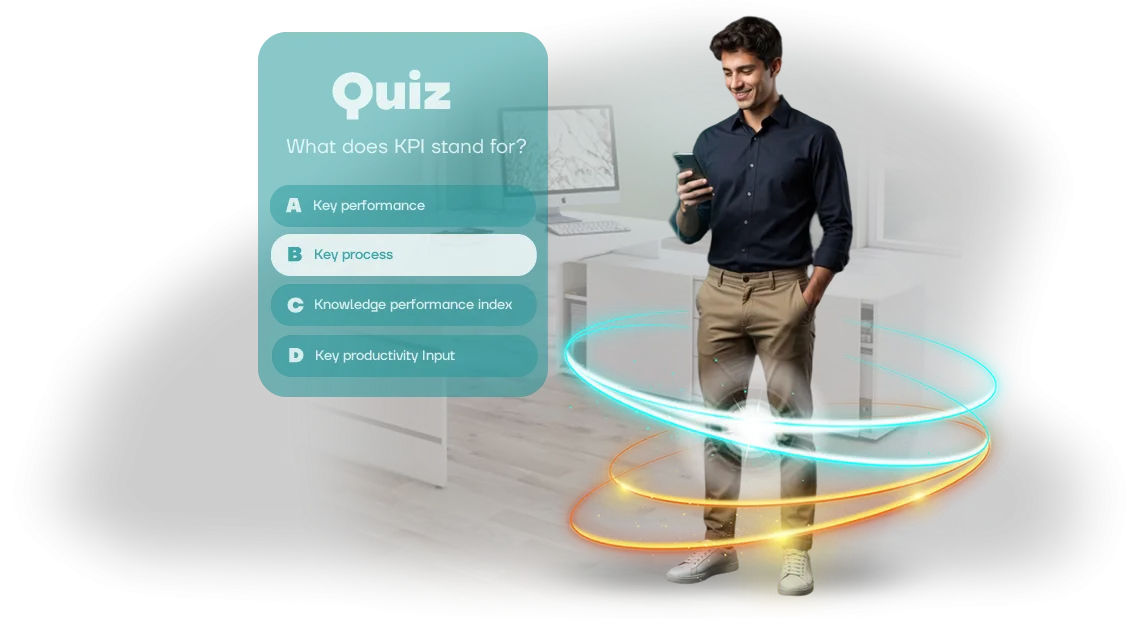
We fix this: we turn boring courses into short gamified quizzes embedded directly in Totara. Instead of hours of slides — 5–7 minutes of active engagement: a question, an answer choice, instant feedback. The brain remembers through action, not reading, so learning happens faster and more naturally.
A quiz adds what corporate training lacks — competitiveness. Scores, response speed, and a progress table among colleagues trigger healthy motivation. The manager doesn’t have to force anyone: employees return on their own to improve their results and prove their competence. Totara records every attempt, building a clear picture for reports.
For you, this means transparency: you see not “module opened” but “the material was actually absorbed.” Reports highlight the topics where the team stumbles, so you can adjust the program in time instead of discovering the problem at the end of the quarter. Employees remain in the familiar Totara interface — no duplicate data, no switching tools.
If the number of abandoned courses in your reports is growing, the issue isn’t team motivation but the delivery format. Tell us where engagement is lost — we’ll build a quiz for your learning goals and launch it in Totara so training stops being a tick-box exercise.
What Quizzes Bring to Corporate Training and HR
After a regular course, part of the material is forgotten within a week, and a manager doesn’t know who really understood it and who just checked the box. A learning quiz solves both problems: it applies knowledge immediately rather than passively flipping through slides. This format noticeably improves retention — reinforcement happens through questions and feedback.
A quiz drives engagement: a little competition, scoring, and instant results turn training from an obligation into a challenge. More employees reach the end of the course — a key indicator of corporate training effectiveness. Completion growth appears in the system immediately: HR gets full data for each launch.
For HR, this is a knowledge-control tool. Results show which topics are mastered and which are difficult for entire departments. You can adjust the program in time and repeat challenging blocks without waiting for formal certification.
Fast reporting and learning analytics become automatic: a SCORM-compatible quiz sends data to Totara — who passed, how many correct answers, how many attempts. HR doesn’t collect results by hand; reports are generated automatically the moment the test is completed.
The result is saved time, a transparent competence picture, and training as a measurable business process. We develop such quizzes for Totara so that HR gets metrics and analytics for management decisions.
Quiz Formats and Totara Integration: An Overview
Each employee training task requires its own format. A newcomer needs fast immersion into processes, an existing team needs confirmation of competence, and a sales department needs confident product knowledge.
When the mechanics are chosen correctly, a quiz motivates instead of feeling like an unnecessary check.
We design quizzes for a specific scenario — onboarding, certification, or product knowledge. The finished solution is packaged into a standard SCORM package that opens in Totara and other popular LMS platforms without modification.
The client doesn’t have to worry about the technical side: they receive a tool that immediately works in their training system.
Quiz Variants and LMS Compatibility
| Format | For whom | What it gives the client | Integration with Totara and other LMS platforms |
|---|---|---|---|
| Onboarding quiz | New employees | Fast integration into work, fewer questions for mentors | Loads as a SCORM package, progress is visible in the profile |
| Staff certification | Current employees | Objective knowledge check, clear statistics by department | Results are automatically sent to the LMS |
| Product quiz | Sales and support teams | Confident answers to clients, fewer errors in work | Can be relaunched multiple times and track dynamics |
Each table row is ready-to-use mechanics, not an abstract idea. The client receives a quiz that is easy to launch and, if needed, easy to update with new questions without another development cycle.
LMS integration is simplified to uploading a package onto the platform. We set up the quiz so employees see it in their personal workspace, and managers see results and progress.
This turns training into a controlled process: you know what has already been learned and what needs to be repeated.
How We Build a Quiz: From Brief to Launch
We designed the process so that at every stage you understand what is happening and can influence the outcome.
We analyze the task from the business side, not only from the learning side — so the quiz solves a measurable problem: increases engagement, checks knowledge, and collects statistics.
The final result works correctly in corporate learning management systems, including Totara, without any “surprises” during launch.
- Development brief. We interview you, study the audience, course goals, and existing materials. The output is a clear technical specification: deadlines, format, question types, acceptance criteria.
- Concept and approval. We create a quiz scenario: structure, question types, design, scoring logic, and feedback logic. We show a prototype and refine it until full approval — so there’s no need to redo everything after launch.
- Course development. We assemble interactive scenes, fill them with questions, and set up rewards and response comments. We use professional equipment and proven tools — this ensures a stable result without technical failures.
- SCORM compatibility testing. We check how the course transfers results, scores, and completion status to your LMS. We eliminate incompatibilities before employees see the quiz — you receive a completely ready-to-use product.
- Course launch. We help upload the quiz into your training system, set up access, verify result recording, and make final adjustments if necessary.
- Post-launch support. We stay in touch: answer user questions, quickly fix issues, add new questions, or change settings. You can develop the course further without searching for a new contractor and without losing accumulated data.
What’s Included in the Delivery: A Complete Training Package
You get not just a game but a complete, ready-to-work package. Everything is packaged, documented, and handed over to you permanently — you are not dependent on us for day-to-day tasks and can update the materials yourself.
Here’s what’s included in the delivery:
- Design mockup and quiz scenario — a detailed description of all questions, answers, and scoring logic. You approve it during the development stage, then use it as the foundation for new versions.
- Unity project source files — the entire project with comments. This means you aren’t tied to a specific contractor: any developer can understand the structure and make edits without starting from scratch.
- Ready SCORM package — a file that simply uploads to your learning system (for example, Totara). Employees take the quiz right in the interface, and all results automatically go into reports.
- Administrator guide — a step-by-step instruction for uploading, setting up access, and updating the quiz. Suitable for a specialist without a technical background: screenshots and clear wording.
- Employee instruction — a short text explaining how to log in, complete the quiz, and see results. Ready to send to a chat or publish on the corporate portal.
- Post-launch support — for one month we stay available: answer questions, help with uploads, and fix any issues that come up.
We especially highlight the Unity source files as the main asset. This is your intellectual property: if necessary, you can expand the quiz with new modules or adapt it for other training scenarios.
And thanks to the SCORM package, you won’t need to buy additional software — everything works in your standard system.
In summary: you get a full cycle — from idea to a finished training tool that you can manage independently. No hidden dependencies, no “black box.”
Case Study: Growing Training Engagement with Quizzes
Quiz for a Retail Chain
A chain of 120 supermarkets, Vkusny Den, approached us with a problem: mandatory training for sales staff and cashiers was being completed “just for show.” Only a third of employees reached the final test, and the average score didn’t meet the minimum threshold.
The marketing director wanted not just knowledge control but a format employees would actually want to complete.
We proposed replacing the dull test with a gamified competitive quiz: questions on service standards, conflict situations, and product categories, with instant results and a ranking among colleagues at the end.
The quiz was uploaded into the corporate training system so every employee could take it from any device.
Results after two months: the share of employees who completed the course grew from 34% to 91%. The average score increased by 26 points, and the number of repeated attempts quadrupled.
The ranking created healthy competition between stores: managers themselves asked to open the next quiz round.
The chain’s HR director shared their feedback: “For the first time, we saw employees reminding each other to update their knowledge. The quiz became part of onboarding and helped us cut introductory training time in half.”
Six months later, the client ordered a new round — for a course on handling objections. The company now uses the quiz as a regular knowledge-check tool, not a one-time campaign.
Frequently Asked Questions About Quiz Development and Implementation
Before ordering a quiz, typical questions come up: timelines, cost, edits, and post-launch support. Here are our short, direct answers.
How long does quiz development take?
A simple quiz with test questions and standard design is ready in 5–7 business days. If you need a non-standard scenario, interactive elements, and branded graphics, allow 3–4 weeks.
We provide the exact timeline after the brief and immediately fix it in the contract — you’ll know the launch date from the very beginning.
How is the cost calculated?
The cost depends on content volume, quiz format, mechanics complexity, and design. Before we start, we put together a transparent estimate so you can see what each part of the budget covers and adjust the options if needed. No hidden additional fees after launch.
Can changes be made after launch?
We include an approval stage, and after launch we accept revision requests: add new questions, adapt the scenario, or change the design. Edits usually take a few days, and the terms are covered by a separate agreement.
How will the quiz work in our system?
The quiz is packaged in SCORM format, so it works smoothly in Totara and other learning management systems — without additional configuration. After launch, we stay in touch: help with content updates, fix issues, and answer questions from your technical support team.
What do we need to provide to get started?
To start, all we need is a brief: the goal, a list of topics, questions, and examples of your corporate style. If you don’t have any materials, we’ll help you build the scenario from scratch. We handle all the technical work of development and integration ourselves.
How to Choose the Right Quiz Format for Your Task
Choosing a quiz format isn’t about “what’s more trendy” but “what will actually work for your employees.” There’s no universal answer: the same game will perform differently in a sales department and in accounting, among newcomers and experienced specialists.
The right approach is to start from the training goal and the audience, and then choose the mechanics to match.
If the task is to introduce employees to a new procedure or product, a light multiple-choice quiz is enough. It’s quick to complete, doesn’t cause strain, and gives a general picture: who has absorbed the material and who hasn’t.
When you need to practice complex skills or test the ability to act in unusual situations, case-based scenarios are a better fit — where there isn’t one correct answer, but several behavioral options with different levels of effectiveness.
The audience matters just as much. Younger employees respond well to competitive mechanics, timers, and rankings — for them, it’s a challenge. Experienced specialists, on the other hand, often value meaningful cases and error analysis more than racing for points.
If your company employs people of different ages and skill levels, it’s worth choosing a universal format with adjustable difficulty — so everyone can complete the quiz at their own pace.
A common client mistake is overpaying for complex mechanics that aren’t needed. Remember: a quiz is a knowledge-check tool, not an end in itself. A simple format with the right questions often delivers more than an expensive game with graphics but weak content.
Our job is to offer the type of quiz that solves your task with a minimal budget, while results are correctly recorded in Totara.
So at the start, we always ask three questions: who are we teaching, what are we teaching, and how will we know the goal has been reached. The answers determine the task format, quiz length, and difficulty level.
In the end, you get not “a quiz for the sake of a quiz” but a clear knowledge-control tool that fits your training system and requires no unnecessary investment. Describe your task in the brief — and we’ll recommend the optimal format.
Start Your Employee Quiz Project Today
Launching a corporate quiz doesn’t require a long preparation phase. Just submit a request — then we’ll consistently take the project to the final result. You’ll receive a ready SCORM package that uploads to Totara and starts working immediately.
Here’s what happens after you contact us:
- Development request. You describe the task in two sentences, and we get back to you within one business day.
- Quiz consultation. We clarify the learning goals, audience, scenario, and mechanics — so the quiz solves exactly your business task.
- Project estimate. We give you timelines and budget with no hidden conditions. You understand the scope of work before the start.
- Brief and plan. We fix the questions, design, and reward logic. All details are approved before development begins.
- Development and testing. We show intermediate versions, you make edits and see how the quiz works from the inside.
- Ready SCORM package and Totara integration. We assemble the course, upload it to your system, and verify that results are stored correctly.
- Staff training. We conduct a short webinar for administrators: how to launch the quiz, track completions, and analyze results.
You get not just “development” but a ready-made training tool that already works in your LMS. All that’s left is to invite employees — and the quiz will start paying off.
Submit your development request today — we’ll discuss your task, calculate the project, and offer a solution that fits your timeline.