

Why leadership and management team training stalls
Companies invest in leadership training, but the return falls short of expectations. Managers take courses, pass tests—and a month later they work using the old patterns. Knowledge doesn't turn into skills because the format doesn't force applying it in practice.
Classic lectures and presentations produce only a temporary effect. The participant listens, agrees, but in a real situation—under deadline pressure, in conflict, or when talking to a difficult employee—returns to familiar reactions. The program is completed, the checkbox is ticked, yet the management culture doesn't change.
Hence the stagnation: managers don't grow, don't learn to make complex decisions, don't develop their teams. A weak manager avoids giving feedback, dodges difficult conversations, overloads strong employees, and loses weak ones.
Motivation drops, staff turnover rises—and HR and business owners launch yet another training program, hoping for a miracle.
Business metrics don't move because training isn't connected to real management tasks. Instead of measurable changes—reports on the number of people trained.
Instead of growth in team engagement—formal ratings of “everything was great.” The company keeps operating as before, while competitors who solve these problems systematically move ahead.
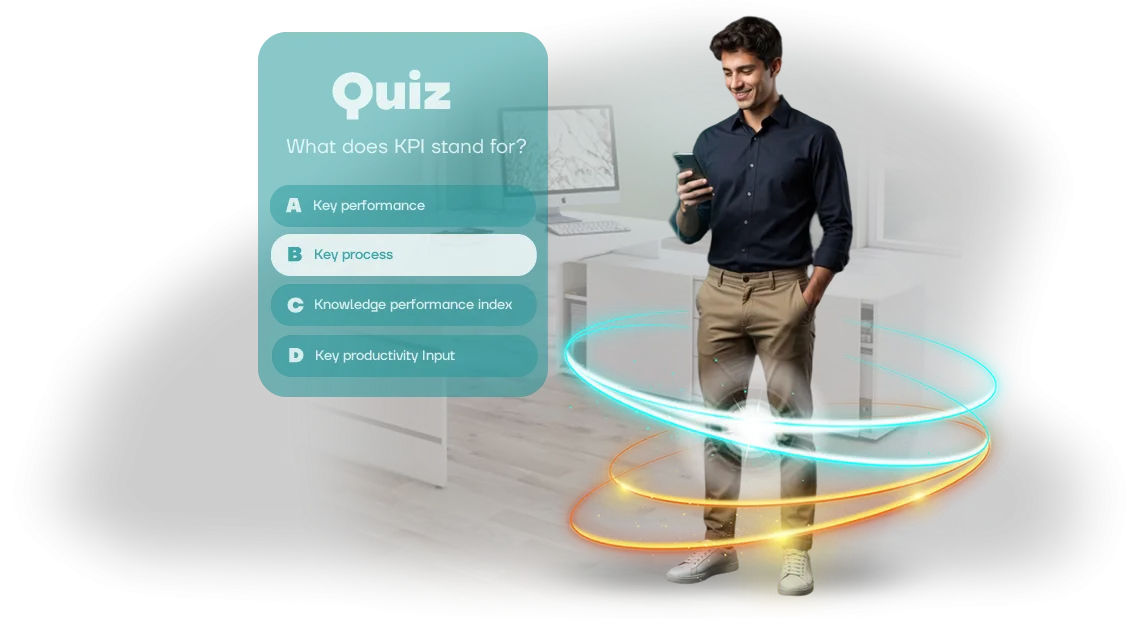
Wedecided to close this gap. We develop learning quizzes and game formats that force managers to make decisions in a safe environment, receive instant feedback, and cement new behavior patterns. Learning becomes practice, not a lecture.
Key benefits of the game-based approach for developing managers
Traditional management training formats often fail to deliver: participants passively absorb information and quickly forget it.
The game-based approach flips the process: the manager becomes an active participant who solves problems, gets instant feedback, and reinforces skills through practice. That's why we at our team develop quizzes that turn learning into an engaging and valuable experience.
Here's what you get by implementing game-based learning for your managers:
- Company KPI growth. The quiz practices specific management scenarios: from task setting to team motivation. Managers apply the skills immediately after training, which directly affects department metrics.
- Employee engagement. The competitive element and rewards keep interest throughout the course. Participants go through the training with enthusiasm, not “for show,” and willingly return to the materials for review.
- HR brand recognition. A modern training format shows that the company invests in people development. This increases loyalty among current employees and attracts strong candidates who value career and growth.
- Improved management skills. The quiz tests not knowledge of theory but the ability to act in difficult situations: conflicts, delegation, feedback. Leadership qualities are built through mistakes and their analysis in a safe environment.
- Fast manager onboarding. New managers grasp corporate standards and behavior patterns more quickly. They don't need to “earn their scars” on real projects—the quiz provides ready-made algorithms and confidence.
The main advantage of the game-based approach is measurability. Unlike trainings where results are hard to assess, the quiz gives you analytics for every participant: which material is absorbed, where difficulties arise, who is ready for promotion.
You get a transparent picture of your management team's development and can fine-tune training precisely.
Gamification formats for your business challenges
Not all training tasks are solved the same way: a short quiz works for getting familiar with regulations, while a full simulation is needed for practicing management skills.
We choose the format to match a specific business challenge so you don't overpay for unnecessary complexity and get a measurable result: greater engagement, faster learning, and better knowledge retention.
The table below shows how different formats map to typical manager challenges.
| Format | For which task | What the client gets |
|---|---|---|
| Quiz | Quick knowledge check after a course or regulation | Instant feedback across the whole team, gaps identified in one day |
| Quest | Team building and practicing algorithms in a game form | The team remembers the process through action, not through reading instructions |
| Simulation | Practicing complex decisions without business risk | Managers try different strategies and see the consequences in a safe environment |
| Interactive scenario | Training for dialogues, negotiations, employee feedback | The skill is honed to automaticity in several short sessions |
| Meta-game | Long-term leadership development program | Systematic learning with progress, ratings, and lasting behavior change |
A meta-game isn't a one-off activity but a whole learning universe. Employees go from novice to leader: they solve tasks, accumulate points, compete across departments.
That's how gamification turns from “an after-lunch game” into a regular tool for developing the management team.
Choosing a format with us means you get not just a game, but a solution tied to a specific metric: shorter time to proficiency, a higher engagement index, or lower turnover among managers. And if the challenge is complex, we combine formats within one platform.
How the project goes: from brief to launch
We've built the process so you feel in control at every stage and can influence the result. No “black box”: you see interim versions, give feedback, and get a quiz that genuinely develops management skills in your managers.
-
Brief and immersion in the task. We discuss your team, training goals, and current challenges. We define which management competencies need to be strengthened first.
-
Scenario approval. We create the quiz structure: questions, answer options, learning explanations, and the scoring mechanics. You approve the scenario before technical implementation starts.
-
Plan and prototype. We show how the quiz will look and work: the passing logic, interface, and reward system. At this stage, changes are easy to make without extra costs.
-
Technical implementation. We build the quiz on a professional engine and ensure stable operation on any device. We test every scenario—from the first log-in to repeated attempts.
-
LMS integration. We connect the quiz to your learning management system so results automatically flow into the overall reporting. No manual data collection—everything is visible in one place.
-
Launch and support. We launch the quiz for employees, monitor performance, and collect feedback. After the start, we support the project: we make adjustments, update questions, and help evolve the training program.
What's included in the delivery package
After the project is completed, you receive not just a game but a fully ready training tool. The package includes everything needed for launch, monitoring, and program development—from the game solution itself to materials for methodologists and managers.
- Game solution on a professional engine — a full-featured quiz with a storyline, levels, and competitive elements that runs on employees' computers and tablets. You get a stable, polished program, not an experimental prototype.
- Administration panel — a clear interface for managing courses, participant groups, and schedules. Setting up scenarios and adding new questions takes minutes, no programmer needed.
- Methodological materials for managers — implementation recommendations, session scripts, and cheat sheets. Your managers will understand how to use the quiz to develop leadership qualities, even without prior gamification experience.
- Employee progress reports — clear data on each participant: results, dynamics, typical mistakes. This lets you see the real level of material mastery and make HR decisions based on facts.
- Access to updates — we support the product after launch, so new question formats, fixes, and improvements arrive automatically. Your game doesn't become outdated over time.
- Technical documentation and administrator training — a short manual and 1–2 sessions with a specialist responsible for setup. Your staff will quickly learn to manage the system without our help.
- Launch support — at the start, we help with installation, equipment checks, and the first run so everything goes smoothly. You get peace of mind and confidence on launch day.
All documentation and the interface are in Russian and adapted to your company's business processes. We, our team, tailor the solution to your corporate culture and specific challenges, so the package isn't “off-the-shelf” but exactly matches your request.
Case study: how a game helped grow managers
A large manufacturing holding faced a typical problem: experienced foremen and shop managers knew the machinery perfectly but struggled when they had to lead people.
Orders were growing, but team management remained at the level of intuition—hence drawn-out shifts, conflicts within crews, and the outflow of talented specialists.
We decided to test whether we could grow managers not through boring lectures but directly in a working game environment.
Together with the client, we developed a series of learning quizzes: managers went through scenarios of typical workplace situations, made decisions, and immediately saw the consequences for their teams.
The format turned out to be so engaging that shop managers asked for additional levels themselves—leadership training became a game they looked forward to and returned to between tasks.
Project results
Three months after launch, productivity at the pilot sites grew by 18%, and turnover among new shift supervisors dropped by half.
Six months later, we measured effectiveness: the company's ROI for the program was 1 to 4—counting reduced defects and faster shifts, the program paid for itself in the first quarter.
The HR director of “PromTech” summed it up: “Before, leadership training took a month, and the result faded within two weeks.
Here, employees come back to the game again and again, and new skills show up in their work.” Within six months, the client returned with a request to scale the quiz across all sites and extend the contract—the repeat order was the best confirmation of the value of this format.
How to choose a game format for your challenge?
Choosing a format isn't a question of “what's trendier” but of “what solves the task and fits your constraints.” Before looking at games, you should clearly define what should change after the training: practice persuasion skills, teach how to give feedback, or test understanding of strategy. The format should match these goals, not the other way around.
Budget and timelines determine how deep the mechanics can go. If you need to launch training in two weeks, quizzes and simple dialogue simulations will do; if you have 2–3 months, you can build multi-step scenarios with branching and decision evaluation. We help you choose a level of complexity that fits your planning horizon exactly.
The second criterion is content requirements. A leadership quiz can work on your cases or on typical situations; what matters is how complex the content is that you're ready to put into the game.
Good mechanics won't replace meaningful content, so we discuss in advance which scenarios will be covered and who approves them.
Finally, technical compatibility: where will training take place—in a browser, on a corporate portal, or via mobile devices? This affects the choice of interface and logic, but not the quality of the result.
Our job is to make sure the game starts without a hitch for your employees, and you don't have to think about the technical side.
If you're unsure, start with a short diagnostic: we'll analyze your task, audience, and constraints, then propose 2–3 formats with an expected impact forecast. That way you get not “just a game” but a tool that truly fits your budget and timeline.
Answers to common client concerns
Any non-standard training format raises questions: how will managers react, will the launch fail, how reliable is it? Over years of work, we've gathered the main client concerns and are ready to address them point by point—honestly and without technical jargon.
Leadership and management team training is too important to risk. That's why the quiz is built on clear scenarios, and the technical side stays behind the scenes: you get a working tool, not a set of “raw” prototypes.
Will managers see the game as unserious and refuse to participate?
The quiz is built around real management situations: task allocation, difficult conversations, team motivation.
Participants work through cases from their own practice rather than “guessing answers.” Short 5–7 minute rounds fit into the workday, and after every round there's clear feedback—what exactly to improve and how.
What if the system freezes or breaks down in the middle of training?
We use fault-tolerant server architecture: load is distributed automatically, and before launch the quiz is tested with a group of employees. On launch day, a dedicated specialist monitors the platform and responds to any issues immediately. The launch won't be ruined—even if something goes wrong, we take over within minutes.
How safe are the training results and manager data?
The quiz runs on a closed loop: all data is stored inside your infrastructure or in a protected environment with role-based access. We don't request unnecessary information and don't transfer results to third parties. If needed, we coordinate the solution with your company's information security department.
Who supports the quiz after launch?
After project delivery, you get a dedicated manager, a clear procedure for handling requests, and the ability to update questions without involving developers. If your leadership development strategy changes or new cases appear, the content adapts to the company's current needs. This isn't a one-off story—it's a long-term working tool.
Order gamification development for your request
Want leadership training that actually changes how your managers lead their teams? Ordinary lectures and tests are quickly forgotten, but gamification holds attention and reinforces skills in practice.
To get a working format tailored to your request, just leave an inquiry—we'll guide you through a simple, clear process.
By leaving an inquiry, you get:
- Consultation on your task. We'll discuss which leadership competencies need to be developed in your managers and advise how gamification fits into your current training system.
- Project cost estimation. A transparent estimate scaled to your needs: number of participants, scenario complexity, implementation timeline. No hidden work or unexpected extras.
- Demo of a learning quiz. We'll show a live example of what gamification for managers looks like—you'll see the mechanics, the presentation, and understand whether it suits your team.
- Pilot project. We'll launch a mini-version with a group of managers so you can assess engagement and results before full deployment. Based on the pilot, we'll adjust the scenario to your needs.
- Full development plan. After the pilot, you'll get a clear plan with stages, deadlines, and assigned owners. All that's left is to approve it—and we start building the full gamification.
Every item on this checklist is a step toward making leadership and management team training genuinely work. You know what you're paying for, see results at every stage, and can influence the final product.
Leave an inquiry for a project estimate and pilot launch—we'll get in touch shortly, answer your questions, and prepare a custom proposal. Start with a consultation, then go step by step, without unnecessary bureaucracy.