

Developing Employee Soft Skills: Why Trainings Don't Work
Employees sit in a conference room, listen to theory, and do exercises — yet a month later they fall back into old habits. A classic soft skills training is a one-off event: the information fades and motivation fizzles out. Managers see the budget invested, but they don't see changes in team behavior.
The reason is simple: soft skills are skills, not knowledge. You can't "learn" them in two days. Lasting behavior change requires regular practice in a safe environment, repetition, and instant feedback. A training session provides theory but doesn't build a habit.
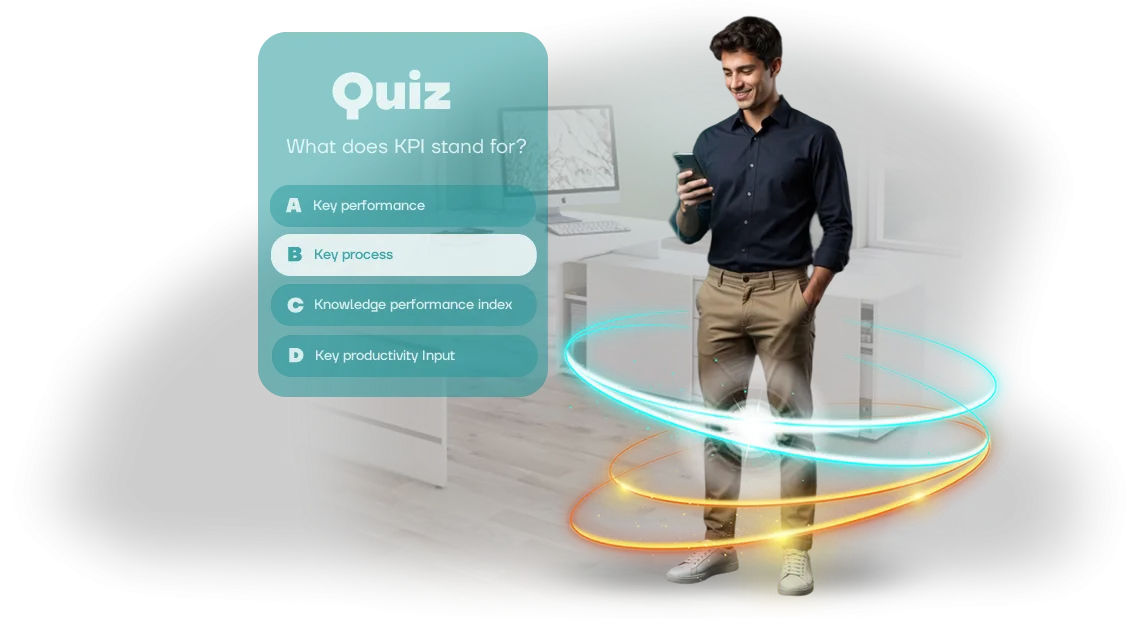
Gamified learning solves this problem. Short online quizzes with scenarios, a storyline, and a competitive element pull employees into the game — they make decisions, make mistakes, and try again.
This turns soft skills training from a chore into an engaging process that continues between sessions and doesn't take people away from work. Each round takes a few minutes, and the result is immediately visible.
For business, this means measurable growth: employees communicate with clients more confidently, resolve conflicts faster, and take responsibility. Corporate learning stops being a formality and starts affecting KPIs.
This is exactly the kind of staff development system we build — tailored to the company's goals and the team's specific needs.
We handle everything: from scenarios to launch. All that's left is to see your employees practice soft skills every day without being forced.
How Quizzes Develop Employees Better than Lectures
Lectures and presentations provide information but don't guarantee that employees will use it. After a week, only a tenth of what was heard remains, and management can't measure the actual level of knowledge.
Quizzes solve this differently: they turn learning from passive listening into active practice, where everyone sees their result immediately.
The interactive format taps into the competitive instinct and the appeal of play. Employees aren't hiding in their phones; they're engaged in the process: answering questions, receiving feedback, and remembering correct decisions through emotion. This approach accelerates comprehension and builds skills that are actually used on the job.
What a quiz system gives your business:
- Employee engagement in learning without coercion — participation becomes voluntary and exciting.
- Material retention several times higher than reading instructions or listening to lectures.
- Transparent staff assessment: you see who has mastered the topic and who needs additional work.
- Time savings for managers: automatic knowledge checks instead of manual testing and interviews.
We build quizzes on a professional game platform, so they work reliably on any employee device — from an office PC to a tablet on a business trip. You don't need to deal with the technical side: we handle development, question content, and launch.
In the end, you get a ready-made tool that measures team progress and shows how competence levels are growing.
Quiz Formats for Every Task: From Onboarding to Certification
Different tasks require different formats: one thing is quickly introducing a newcomer to the product, another is checking an entire department's knowledge before certification.
There is no universal quiz, so we design a format for a specific goal: an express quiz for onboarding, a corporate case game for soft skills development, an assessment test for certification.
| Format | For whom | What it gives the client |
|---|---|---|
| Express quiz | New employees in their first weeks | Fast immersion in company standards, stress-free knowledge check |
| Corporate case game | Existing teams, soft skills development | Practice with real situations, team building, and clear skill dynamics |
| Assessment test | All employees before certification | Transparent view of readiness levels, clear criteria for HR decisions |
The express quiz covers the onboarding needs of new employees: short rounds with questions about policies and the product help a newcomer get up to speed faster, while the manager sees which topics cause difficulties. The format doesn't require stepping away from tasks — each round takes a few minutes.
When it's time to develop soft skills, we use a corporate case game: teams solve typical work conflicts, communicate, and look for solutions. This format is more memorable than lectures, and the manager gets a live look at employee behavior in realistic conditions.
For personnel certification, we use an assessment test with varying difficulty levels and scenarios. Results are compiled into a clear summary — easy to see who is ready for promotion and who needs additional training.
We choose the format based on your request, and if your goals change, we combine quiz elements into a single system. This gives you flexibility: from one-off activities to a regular cycle of employee evaluation and development.
How a Project Works: From Brief to Quiz Launch
A transparent development process is what removes the main questions at the start: you always know what stage the project is at, what's being approved, and when the result will be ready.
We've structured the workflow so you can see checkpoints and manage deadlines without stalling your team.
Project Stages
-
Brief and onboarding into the task. We meet with you and department managers: we find out which skills need to be developed, what audience the quiz is for, and how it will fit into your current training. We record goals and success criteria.
-
Quiz scenario. We write the storyline, questions, and answer options based on your business processes and cases. We approve the scenario with you before development starts — edits at this stage don't require rework and don't delay launch.
-
Design and interface. We create visual design in your brand style: screens, animations, employee feedback. We approve the layouts so the quiz looks like part of your corporate culture.
-
Integration with your learning management system (LMS). We connect the quiz to your platform, set up automatic result export, and let employees access it through their regular account. No extra steps for users.
-
Testing and launch. We run the quiz on a test group, collect feedback, make final edits, and launch it for all employees. You receive a short readiness report and an administrator guide.
-
Support and evolution. After launch, we track completion statistics, help update questions, and add new scenarios. The quiz keeps working as a learning tool — not a one-off project.
The result is a working soft skills development tool with a clear implementation process and no surprises at any stage.
What You Get with the Quiz
With the quiz you're not just getting a game, but a ready-made tool for developing employees' soft skills — with configuration, instructions, and support.
Your team doesn't get distracted by technical details: everything needed for launch is already prepared; all that's left is to pick a date and invite participants.
What's included:
- Ready-made quiz with game mechanics — fully customized to your learning goals, storyline, and company style.
- Admin panel — manage questions, scenarios, and employee access without involving developers.
- Learning reports — clear data: who completed the quiz, which topics were learned, and where the team needs additional support.
- Instructions for administrators and participants — short guides so the team can get started in one day.
- Technical documentation — service description, update rules, and procedures for unexpected situations.
- Team training — a short session after which employees can manage the system independently.
- Launch support — we're available on the first day: we help if questions come up.
The complete package covers the entire cycle — from initial launch to result analysis. You get a transparent learning system that's convenient to use every day, and regular repetition of the material helps reinforce skills in daily work practice.
Case Study: How Quizzes Accelerated Staff Onboarding
A retail chain with several thousand employees faced a typical pain point: new sales associates and cashiers took weeks to get up to speed. Paper manuals and long presentations didn't hold attention, and staff turnover forced them to run training almost every month.
The issue wasn't the amount of material, but how quickly an employee can start working and delivering results.
We proposed replacing part of the onboarding training with short quizzes in Unity — the same scenarios that happen in real work. Instead of reading a lecture, the employee solves a problem: how to respond to a customer, what to do with a return, how to handle an objection.
Correct answers earn points; a mistake brings a hint. This turned training into an understandable game rather than a tedious obligation.
We measured results after two months: completion of mandatory courses rose by 40%, and the average time for a newcomer to start working independently was cut in half.
Feedback from the head of training at the "Vektor" retail chain: “We used to spend two weeks on an introductory course and still got questions like ‘what do I do now?’ Now newcomers go through the scenarios themselves and come to their shift with a ready action plan — it shows in service quality and the number of mistakes.”
The case confirms: quizzes work not as entertainment but as a results-management tool. The company gets more predictable onboarding, less load on mentors, and a faster return on training investment.
Gamification doesn't replace hands-on practice, but it accelerates the start — and this is a case where the numbers speak for themselves.
What to Choose: Test, Quiz, or Business Game?
The choice of format depends not on trends but on the learning goal and the audience. If you need to quickly check knowledge after an instruction session, a test is enough. When engaging the team and reducing tension matters more, a quiz works well.
And when it comes to developing soft skills that require dialogue, decisions, and feedback, a business game delivers many times more value than simple testing.
A test answers the question "knows or doesn't know." It's good for checking facts, policies, and standards, but it hardly changes employee behavior. A quiz adds competition and emotion — it's easy to energize the team and reinforce material in a light format.
However, deep development of communication, leadership, or stress-resistance skills requires modeling real situations, and that's where a business game takes center stage.
In practice, the best results often come from combining formats. We choose the method for a specific task: we assess what employees already know, what level of engagement is needed, and which skills need to be strengthened.
For soft skills development, we typically build a scenario where participants act in job-related situations, receive feedback, and immediately see the consequences of their decisions.
We also take constraints into account: time, number of participants, technical capabilities. If the team is distributed, we focus on interactive online formats. If training is held in person, we can use live game mechanics. Our goal is for employees not just to check a box, but to actually apply new skills at work.
In the end, the right format is the one that leads to measurable changes: higher conversation conversion, fewer conflicts, more confident negotiations.
We help you navigate all the options, prepare a recommendation, and deliver a turnkey solution — so that training is useful, interesting, and doesn't waste your team's time.
FAQ and Concerns About Rolling Out Quizzes
Any new solution raises questions — especially when it comes to employee development. We've gathered the most common concerns that come up before a quiz launch and answer them directly: no overpromises, but with clear terms and support at every stage.
What if the system fails in the middle of a training session?
Technical issues can happen, but we do everything to keep them from affecting your process. The quiz runs on a proven server architecture, and we conduct a test session with your team before launch.
You also get a support channel: we respond to requests during the business day and handle critical problems on a priority basis.
How long does implementation take?
A typical project takes two to four weeks from brief to launch. We set the timeline in the contract; you see the schedule and know who's responsible for what.
If you need it faster, we find a way: for example, we launch the first module within a week and add the full program gradually.
How secure is employee data?
Data stays inside your infrastructure or in a secure cloud with access controls. Only you can see the results; we never share personal data with third parties and don't use it for other purposes. After the project is completed, you can export all statistics and delete the data.
What if we need changes after launch?
You're never left alone with the product. In the first weeks, we support the launch, gather feedback, and make edits — to question content, level logic, or design. After that, you can expand the program with new topics or scale it to other departments.
If your question wasn't covered, just write to us. We'll discuss your task, show examples, and suggest a format that fits your team.Order a Quiz for Your Team — and Get Results
Ordering a quiz for your team isn't a "boxed product" purchase; it's a collaboration. You get a consultation, a project estimate, and a demo version before you make your decision.
This way you see how the format fits your task: onboarding new employees, building management skills, or strengthening team spirit.
We start with a short call or meeting. We discuss goals, target audience, and expectations. Based on this, we prepare a project estimate: timelines, stages, content volume, and cost.
We show examples of our quizzes and, for your scenario, a demo version fragment so you can evaluate the mechanics and presentation before full development begins.
What you get after submitting your request:
- A consultation with format selection based on your tasks and budget.
- A project estimate: timelines, stages, and team structure.
- A demo version of the quiz with your content or based on a sample case.
- A proposal for a motivation system and results evaluation.
- A clear implementation plan with support at every stage.
- A final quiz ready to launch for employees.
No "technical details we'll sort out later" — you understand from the very start what you're getting and how it will work. If the game needs to be adapted to your internal policies, we account for that in the project from the beginning.
To order a quiz or contact us, simply submit a request on the page. We'll respond within a business day, clarify the details, and suggest the nearest time for a consultation.
The decision to start is yours, but we'll prepare all the materials for it right after the first conversation.