

Developing Digital Literacy: How to Avoid Costly Mistakes
Employees are a business's most valuable asset, but they are also the ones who most often become the source of costly mistakes.
Lost passwords, clicking on phishing links, careless handling of documents, violations of data handling rules — these are all "silent" problems that lead to downtime, information leaks, and lost clients.
Digital literacy is not about whether an employee knows how to use a computer. It is about the ability to make the right decisions in a digital environment — from secure communication to correctly working with corporate services.
When these skills are not honed, every day turns into a game of Russian roulette: one mistake and the company loses money or reputation.
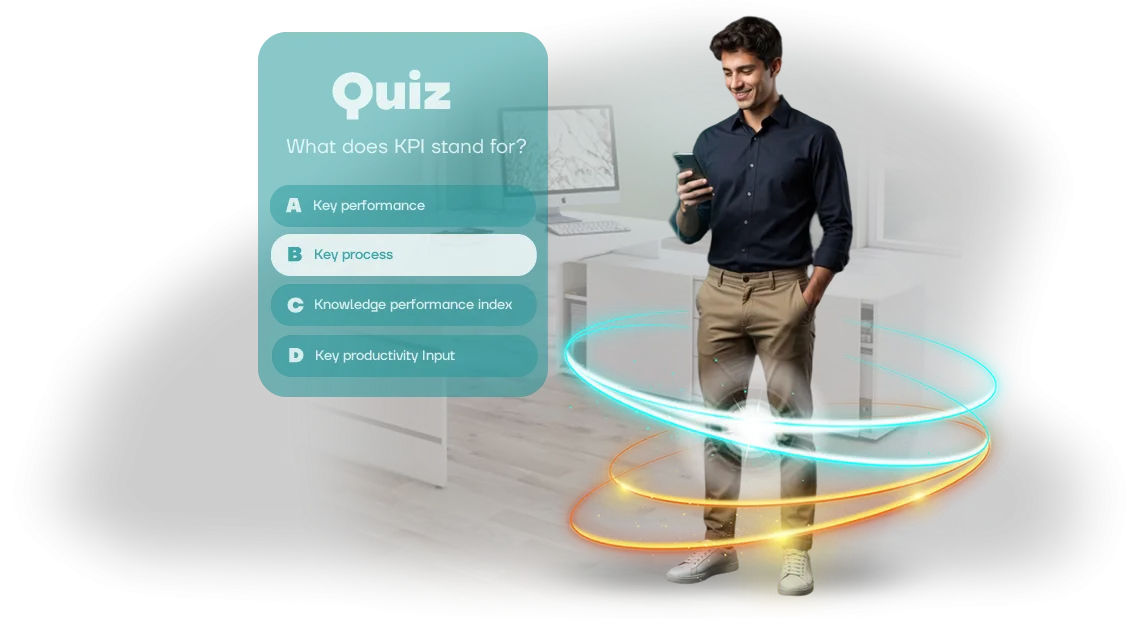
Classic courses and briefings do not work: employees skim through them and forget everything within a week. Quizzes for employees are a different approach. Short interactive scenarios in a game format reinforce correct habits rather than just delivering theory.
They make people think, show the consequences of decisions, and build safe behavior into daily practice.
Training staff through quizzes solves three tasks at once: it identifies knowledge gaps before they lead to an incident, reduces the number of errors related to human factors, and measurably raises the team's level of digital literacy.
You are not just "conducting training" — you are managing risks and protecting business results.
We help companies build such programs — taking into account industry risks, the specifics of your processes, and the real scenarios your people face. Instead of abstract theory — practice that reduces the likelihood of costly mistakes within the first few weeks.
What Quiz-Based Training Delivers: 5 Key Benefits
Quizzes are not just a knowledge check but a tool that turns learning into an engaging game. Employees do not sit through it "just for the record" — they get involved, compete, and remember the material 2-3 times better than when reading instructions.
Here are 5 key benefits you get:
- Higher staff engagement. The game format reduces stress and increases interest: employees complete quizzes voluntarily and even ask for new rounds to be added.
- Faster onboarding for newcomers. Short rounds allow you to quickly introduce an employee to the product and regulations, and mistakes immediately highlight where additional training is needed.
- Fewer risks and errors. When rules are learned through practice, employees violate processes less often — which means fewer disruptions and losses.
- Measurable learning outcomes. You see the percentage of correct answers by topic and by department, so you understand what has already been learned and what needs to be reviewed.
- Digital skills and feedback. The quiz itself provides answer breakdowns and hints — the employee gets immediate feedback, and the manager gets progress analytics.
This format is already helping our clients. The head of the training department at one company notes: "Previously we had to remind people about courses; now employees themselves ask when the next round is. And we can see the results growing."
Quiz Formats: From a Simple Test to a Meta-Game on Unity
Each quiz format solves its own business problem: one checks knowledge, another builds a skill, a third changes attitudes toward learning.
We offer a range of formats — from quick tests to a meta-game developed on Unity — so that developing employees' digital literacy does not become a formality but delivers a measurable result.
The table below shows typical scenarios: choose the one closest to your task, or combine several.
| Format | Who it is for | What it gives the business |
|---|---|---|
| Classic test | Quick knowledge check after a briefing | Fast knowledge snapshot, automatic report by department |
| Decision-choice scenario | New employees who have not faced real situations | The ability to see the consequences of decisions without risk to the business |
| Competitive quiz | Teams that need to build cohesion | Higher engagement, healthy excitement, repeated attempts |
| Training game | Employees who need to practice a specific skill | Hands-on practice in a safe environment, fewer errors on the job |
| Meta-game | Companies ready to embed learning into the corporate culture | A memorable event and lasting digital hygiene habits |
If the goal is not just to "pass a test" but to systematically raise the level of digital literacy, we choose a meta-game: multiple levels, a live storyline, and team mechanics.
Employees experience training as an adventure, and the business gets clear progress statistics for each department.
We do not sell a format for format's sake: we calculate timelines, implementation complexity, and the impact on workflows so that you get a tool with a measurable result.
How Quiz Development Works: 7 Turnkey Steps
We have structured the process so that you do not have to dig into the technical details or monitor every step. Instead, you get clear stages, agreed decisions, and a finished result — a quiz that launches and delivers value from day one.
-
Brief and immersion. You tell us which digital literacy skills need to be developed, who your audience is, and which formats they are comfortable with.
We ask clarifying questions and define the goals so that all further decisions are based on your task rather than abstract assumptions.
-
Scenario and quiz plan. We propose a structure: number of questions, topics, difficulty levels, game mechanics, and a reward system. You see what the training will look like and can make edits before the main development begins.
-
Design and content. We develop a visual style for your brand, write questions with explanations, and make sure the material is clear and useful for employees. You approve the texts and layout — we take every comment into account.
-
Assembly and configuration. We build the quiz and connect the required launch scenarios: for the office, remote teams, or through a corporate portal. We adapt it for different devices so people can complete the training from anywhere.
-
Testing and revisions. We test it on a small group of employees: correctness of scenarios, clarity of questions, and stability of operation. We collect feedback and make final revisions — you get a polished product with no "surprises" at launch.
-
Launch and training. We help you launch the quiz, prepare instructions for administrators, and show you how to track progress. You see for yourself who has completed the training, which topics are harder, and where employees lose interest.
-
Support and development. After launch, we stay in touch: we update questions, add new mechanics, and help you use the quiz for future training cycles. You can change the program without stopping the process.
In the end, you get a turnkey project: from idea to a working system that develops employees' digital literacy and gives you a measurable result. No technical routine — just clear stages, transparent approvals, and support at every step.
What Is Included in the Deliverable: A Complete Quiz Launch Package
The project's result is not just "delivered and forgotten" but a working training tool. You get everything needed to launch the quiz the first time and to develop the program further: from scenario to analytics.
The package includes:
- A question scenario for developing digital literacy — topics tailored to your goals: from basic security to working with services. The flow is structured so employees absorb the material gradually.
- A bank of ready-made questions with answers and explanations — you do not need to come up with them from scratch; each answer explains why the option is correct, which reinforces learning.
- Custom quiz design — adapted to your brand so participants immediately recognize the company.
- Administrator guide — a clear sequence of actions: how to schedule a launch, grant access, and monitor completion.
- A business report on training results — data on each employee and team, progress, and growth areas. You see which topic was the most difficult and where an additional session is needed.
- A participant guide — a short instruction for employees so they can complete the quiz without unnecessary questions in the chat.
- Support during the first launch — we are available when you launch the training to make sure everything runs without technical hiccups.
This is a complete training launch package, not a set of scattered files. You hand it to your team on Monday — and by Tuesday you already see the first results.
Case Study: How Quizzes Improve Digital Literacy
For the retail chain "Progress", staff digital literacy was a headache: sales associates got confused with cash register operations, managers wasted time on reports, and every update to internal software caused a wave of support requests. We saw that employees were not learning — they were simply afraid of making mistakes.
Instead of boring instructions, we developed training quizzes built into the regular workday. Short game rounds of 5-7 minutes — at the start of a shift or before a break. Employees competed, earned points, and immediately saw their mistakes.
Thanks to the familiar "question-answer" format, the material was absorbed faster than when reading regulations.
Over three months, more than 1,200 people completed the training. The number of errors when working with internal systems dropped by 40%, and request processing time was cut in half.
The conversion rate was especially pleasing: previously only about half of the trainees finished a course; with quizzes, it was nearly 90%.
The HR director noted: "For the first time, I see employees asking for access to the trainers on their own.
Even those who used to avoid computers have become more confident." After the pilot launch, the client expanded the program to all departments and ordered a new course for line managers.
The case confirms: quizzes are not entertainment but a working tool that pays off through speed, accuracy, and employee engagement. We did not just make a game — we solved a real business problem.
How to Choose a Quiz Format for Your Company's Task?
Choosing a quiz format depends on what you want to achieve: check the current level of digital skills, teach new security rules, or get the team involved in ongoing development.
So first define the goal and the audience — the number of employees, their distribution across departments, and their willingness to participate in competitive mechanics.
If the task is to diagnose gaps on a large scale and quickly, individual completion through the internal portal is a good fit. When it is important to develop team interaction and build a learning habit, group games with a shared leaderboard work better.
And for long-term training programs, a meta-game is effective: an employee completes a series of short quizzes and sees their progress over several weeks.
Below is a summary table — it helps you choose a format for a specific situation. Use it as a cheat sheet when preparing your brief.
| Quiz format | For what task | What it gives the company |
|---|---|---|
| Short quiz at the start of a meeting | Quickly engage the team, refresh knowledge | Warm-up, tension relief, 5-7 minutes per topic |
| Individual completion on the portal | Check each employee's knowledge | Objective statistics across the company, identifying weak spots |
| Team quiz with a leaderboard | Build competitiveness and cohesion | Higher engagement, informal communication between departments |
| Meta-game with a series of stages | Build a habit of regular learning | Long-term digital literacy development, visible progress over 4-6 weeks |
The main criterion is how the result will be used. If you only need a one-time check, there is no need to build a long meta-game. If you want lasting changes in employee behavior, choose a format that can be easily extended and embedded into regular communications.
Pay attention to implementation speed: simple quizzes can be launched within a few days, while a full-fledged learning meta-game requires more time for design and integration.
But it is the meta-game that allows you to develop digital literacy systematically — with a clear trajectory, rewards, and a connection between learning and real work that every employee understands.
We will help you choose the right format for your task: during a brief we will analyze the goal, audience, and constraints, and then propose the optimal option with an implementation plan and expected results.
Common Doubts About Quizzes: Our Honest Answers
It is understandable that questions come up before launching a quiz: how reliable is it, will development drag on, how will it fit into current processes. We answer honestly — no technical jargon, with transparent pricing and clear terms.
How quickly will the quiz start working for our employees?
A standard project takes 2-4 weeks from the moment the scenario is approved. If the quiz is needed by a specific date — for example, for annual training or the launch of a new program — we agree on a plan in advance and meet the deadline.
How secure is employee data?
Data is stored on a protected server, and access to results is available only to responsible employees. We do not share information with third parties and are ready to sign a confidentiality agreement.
Is it difficult to integrate the quiz into our learning system?
We build the quiz as a standalone web application that opens via a link from a computer or phone. So it is easy to add it to any learning platform or simply send employees the link — no complex setup required.
What happens if something goes wrong?
After launch, we stay in touch and resolve any issues quickly. We take responsibility for errors during the development stage: we fix everything before the first employee sees the quiz.
Doubts about quizzes usually disappear after the first call — we explain how we work, show examples, and give timelines. If you still have questions, ask them directly: we will discuss your scenario and propose the optimal format.Ready to Implement Quizzes? Order Development Today
Quizzes for developing digital literacy are not entertainment but a working tool that helps employees absorb new rules faster and apply them in everyday tasks.
We have been implementing such formats for companies across various industries — from retail to manufacturing — for over 10 years. If you have read this far, the need is clear, and only one step remains.
Leave a request for quiz development — and within one business day you will receive:
- a consultation on formats that suit your specific task and audience;
- a development brief: we will define the goals, topics, and expected result before work begins;
- an estimate of cost and timelines with no hidden conditions or additional "surprises";
- examples of our projects in learning gamification (no fluff, just cases);
- a launch plan: from testing to integrating the quiz into your current learning system;
- a dedicated project manager who will be available at every stage — from idea to final report.
"We do not make 'just games.' First we analyze the business goals and the team's skill level, and then we build a quiz that solves a specific task: improves digital literacy, reduces staff errors, or accelerates onboarding.
The client always sees a measurable result — and that is exactly why they come back for more formats."
We start with a short consultation and discuss your situation without template presentations. Fill out the form on the page or contact us any way you like — we will help turn employee training into a clear and manageable process that delivers visible value to the business.