

Boring Training Doesn't Work — Why HTC Vive Brings Training to Life
Most employees perceive training as mandatory routine: presentations, tests, instructions. Information is often delivered monotonously, attention drifts, and most of the material is forgotten within a few days. Business spends time and money organizing trainings, while the measurable value remains unclear.
Virtual training shifts the process into a format the brain perceives as real experience. An employee enters an environment where they need to act, make decisions, and make mistakes without consequences.
This approach is exactly what drives high employee engagement: instead of passive listening — active interaction with the material. Through emotion and immersion, information is absorbed more deeply, and the training itself becomes an event rather than a formality.
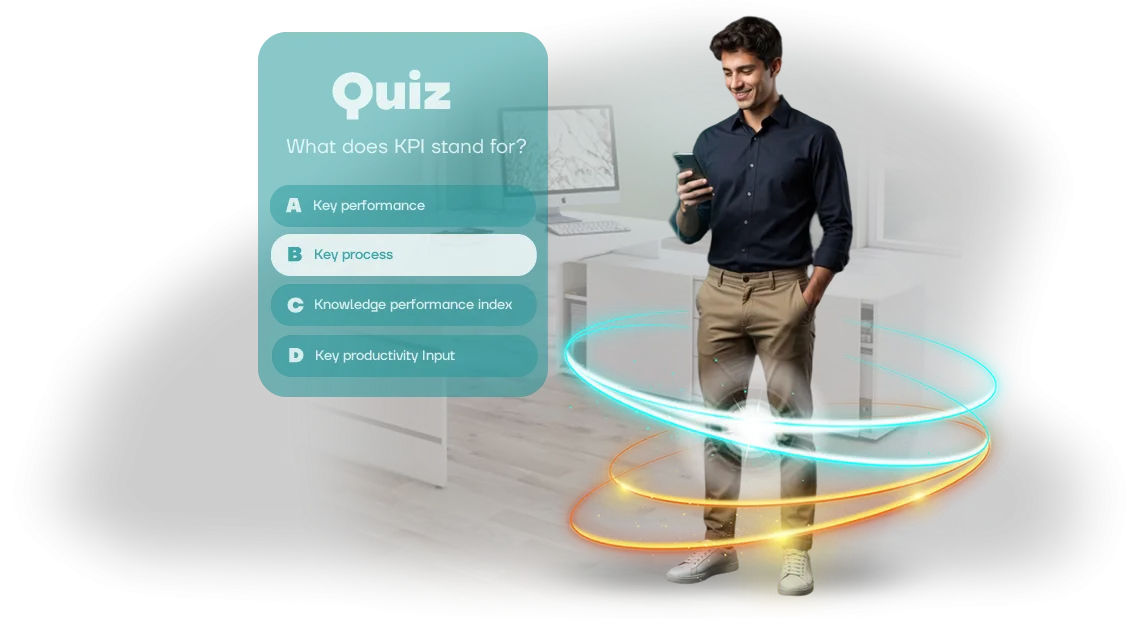
VR training on HTC Vive is an interactive quiz where employees compete, explore the space, and answer questions by controlling the interface with their movements. Employee engagement grows because the process feels like a game, not an exam.
Game mechanics let them quickly run through a scenario and then repeat it to reinforce the material.
For business, this means shorter onboarding, stronger corporate memory, and the ability to model complex situations without risk to equipment or people.
Virtual training scales easily — one scenario can be rolled out to any branch, and each participant's results are recorded automatically. You get transparent statistics for every employee and for the whole team.
We help companies implement such solutions — from idea to launch, with guaranteed results. This solves the problem of holding attention and makes training genuinely effective.
What a Company Gets from Implementing VR Quizzes
Implementing VR quizzes is not about replacing a textbook with a headset — it's a shift to a different format of absorbing material. The company gets a tool that simultaneously boosts engagement, tests knowledge, and maintains it at the required level.
Growth in Employee Engagement
Boring slides and tests lose attention within the first few minutes. A virtual reality quiz is competition, excitement, and immersion in a scenario. Employees complete training with interest, which means they remember the material instead of just clocking hours.
Objective Knowledge Assessment
Instead of a "completion checkbox" — a real picture: number of correct answers, time spent on questions, topics that cause difficulty. A manager sees who has absorbed the material and who needs extra help. This allows the training program to be adjusted precisely, not blindly.
Knowledge Retention After the Main Course
After training, knowledge fades quickly. This quiz can be relaunched after a month or a quarter for reinforcement and control. This way, the company maintains employee skills without a lecturer and without pulling people away from work for long courses.
Saving Time and Budget on Training
One quiz scenario in the HTC Vive headset replaces several in-person sessions. Results are checked automatically, and employees train in a compact way and on schedule. Development investments pay off through reduced spending on repeated trainings and increased staff efficiency.
Quiz Formats on HTC Vive for Different Tasks
When choosing training formats on HTC Vive, it's important to start from the specific task: onboarding a newcomer is one thing, testing staff knowledge before certification is another.
A universal scenario doesn't work here — each case needs its own mechanics, question depth, and session length.
We design the quiz interface and logic around your goal. On professional HTC Vive VR equipment, the employee is immersed in a story rather than just selecting answers — this boosts engagement and material retention.
| Format | For Whom | What It Delivers to the Client |
|---|---|---|
| Onboarding quiz | New employees, interns | Fast immersion in company values and standards, shorter onboarding time |
| Training quiz | Line staff, sales teams | Practicing knowledge without boredom, higher engagement and material retention |
| Certification quiz | HR departments, managers | Objective knowledge checks, recorded results, time saved on manual grading |
| Team quiz | Teams, departments | Stronger team spirit, collaborative problem-solving, informal interaction |
Any of these formats can be combined: for example, start with a training quiz, then run a certification on the same materials a month later. This way you get measurable results and understand where the team's knowledge needs support.
How the Work on Your Training Quiz Is Organized
Transparency is the most important thing in any project. That's why the entire process, from brief to launch, is broken into clear stages, each delivering a concrete result and a decision point. Here's how we work to make sure the quiz solves your tasks and is ready on time.
-
Quiz brief. We conduct interviews with you and your experts to understand what employees need to learn, their current level, and the right style for presenting material. You receive a document with goals, target audience, and format — it becomes the foundation for all decisions.
-
Concept and plan. We propose a scenario: question types, difficulty levels, scoring mechanics, and feedback after answers. We set timelines for each stage and the team that will work on the project.
-
Approving mockups. We design the interface: screens, buttons, fonts, animations, color palette. You see what the quiz will look like and can make edits before the final design — the first two iterations are included in the price.
-
Build and integration. We implement the quiz on a professional engine, adding sounds, visual effects, and answer-processing logic. We configure the system for your equipment, including VR, so everything runs smoothly.
-
Testing and launch. We test scenarios on real devices, fix any issues, and train your administrators. Then we launch the quiz and provide the first completion statistics.
-
Support and development. We stay in touch after launch: help with questions, update content, add new blocks or change questions as needed.
This approach lets you control the process rather than rely on chance. You know exactly what you're getting and can influence the result at every stage.
What's Included in the Deliverables and Final Materials
You don't just get "source files" — you get a ready-to-use package, from the game interface to an HR handbook. All materials are collected in one place and delivered with the final quiz build, so your team can start using the product right after implementation.
Here's what's included:
- Quiz interface design — adapted to your corporate style, with an emphasis on large controls and easy navigation in VR space. Employees aren't distracted by small details but quickly get into the game.
- Quiz scenario — a structured document describing question logic, difficulty levels, and storyline. You see exactly how the training is built and can approve the mechanics before development begins.
- Methodological materials — instructions for your team: how to launch the quiz, how to run a group session, and how to review results with employees. Your L&D manager or HR specialist will be able to organize training on their own without a contractor.
- Administrator's guide — a cheat sheet for managing sessions: launching the game, pause, completion. Suitable for non-technical staff — the whole process is described step by step, without complicated jargon.
- Integration materials — a ready content structure so you can expand the question database with your own data. This lets you update the quiz for new business tasks without rewriting the game from scratch.
- Equipment setup instructions — clear steps for preparing HTC Vive VR headsets and workstations before training. Prevents sessions from failing due to incorrect calibration.
- Presentation for managers — a brief overview of the product and its metrics, so you can quickly get sign-off from a director or show results to an internal team.
All documentation is written in business language and doesn't require your employees to have any development knowledge. With this package, you're not just getting a game — you're getting a repeatable training process that can be run regularly and scaled to new departments.
Case Study: How We Increased Training Engagement by 40%
A large retail chain came to us with a typical pain point: employees went through training formally, but within a week they forgot the procedures and were losing customers at key stages.
Text-based tests and presentations didn't create the emotional engagement needed — people just "sat through it" and waited for it to end. They needed a format that would make staff think, compete, and remember.
We proposed a virtual reality training quiz on professional HTC Vive equipment. Instead of boring questions — a game arena with a timer, points, and live reactions to every answer.
The employee gets dropped into a simulated situation: a customer objection, a conflict at the checkout, a dispute over product quality. A mistake shows the consequences immediately, while a correct answer boosts their virtual reputation.
Project Results
- Training engagement grew by 40% — employees started asking for additional games on their own.
- The share of employees who passed the quiz on the first attempt rose to 95%, with average scores up by a third.
- A follow-up request from the client came within a month: the quiz was adapted for a new product line.
Client Testimonial
"Training used to be a formality for us. Now it's a tool that genuinely improves the quality of work. Employees remember the procedures and apply them in real life. Our team proposed a non-standard solution and delivered everything on time."
How to Choose the Quiz Format That's Right for You?
There's no single "right" quiz format — the choice depends on the goals you set for training and on your team's habits.
For some, a quick knowledge check "on the fly" is enough; for others, it needs to be a live competition people will remember and talk about for a month.
So first, it's worth answering three questions: what employees should take away from the game, how many people will take the quiz at the same time, and whether you have distributed teams.
If the main goal is to remind people of rules or standards on a large scale and quickly, light formats work well: short surveys, multiple-choice quizzes that take 10–15 minutes.
They don't require special equipment, run easily on work computers, and provide clear statistics for each employee. This format is convenient for regular repetition and knowledge checks without pulling people away from work.
It's a different story when you need to create emotional engagement, unite the team, or practice complex scenarios in action. Here, interactive formats win: team quizzes with a live host, augmented reality quizzes, or VR competitions on virtual reality headsets.
For example, a quiz on HTC Vive turns training into a game where employees don't just pick answers — they physically interact with the material. Research shows such experiences are remembered far better than reading instructions and spark genuine excitement even among skeptics.
It's critically important that the format matches the scale of the event. If you need to run a quiz for a hundred employees across different cities, an online format with individual completion is better.
If you're bringing a team together for an offline meeting or a corporate event, go bold with immersive solutions — they pay off with atmosphere and great photos.
We'll help you choose a format based on your budget, number of participants, and venue technical capabilities — not the other way around.
Ultimately, choosing a format isn't about finding the "most modern" tool — it's about finding a solution for your specific task.
Come to us with a description of your goal, and we'll figure out what will deliver results faster: a standard test, a live quiz, or a VR adventure.
Frequently Asked Questions and Concerns Before Starting a Project
Before a project kicks off, clients usually have the same questions — about guarantees, timelines, and how everything will work after launch. Here are answers to the main ones, so you understand the process and can make a confident decision.
What if the result isn't satisfactory or the quiz doesn't work?
We start with a brief and record the goals, audience, and scenario list in it — this becomes the basis of the contract. The project runs in iterations: you see intermediate versions of the interface and logic and make edits before everything moves to the final stage.
Before launch, we run testing on your side and with real employees. If something isn't working, we refine it. The risk of getting "the wrong thing" is eliminated at the prototype stage, not after delivery.
Is it hard to integrate the quiz into the workflow?
Integration doesn't require any special knowledge from your team. We handle HTC Vive equipment setup, installation, and scenario verification. For employees, it's simply launching a program in the training area — no extra preparation needed.
If the quiz needs to be embedded into an existing training system or corporate portal, we plan for that at the design stage. On launch day, a specialist supports the process and trains administrators, so you can manage content on your own going forward.
What technical support is provided after launch?
After project delivery, you get a warranty period during which we fix errors and assist with setup free of charge. Technical support includes consultations on updating questions, adding new modules, and resolving any issues related to the quiz.
All communication channels are documented in the contract, and the typical response time is one business day.
In the end, you're never left alone with the product: even after the project wraps up, we stay in touch to make sure the quiz runs smoothly at your events and training sessions.
How do we know employees will actually find it interesting?
We design the interface around engagement: clear hints, dynamic question pacing, competition elements, and feedback after every answer. The quiz feels like a game rather than a test — that's confirmed by our experience in business games and educational projects.
After the first few runs, you'll get analytics: how many employees completed it, which questions caused difficulties, how long it took. This data helps improve the scenario and increase engagement without additional investment.
Start Your Quiz Development Project Today
Employee training stops being a boring obligation when it turns into a game. A virtual reality quiz on HTC Vive headsets engages the team from the first minute: people compete, remember the material, and ask for "one more round" instead of scrolling through slides.
You get a tool that genuinely improves knowledge retention and doesn't require pulling people away from their work.
To get started, you don't need to prepare a technical specification or dive into details. Leave a request — we'll suggest the format, calculate the cost, and prepare a work plan for your task.
What you get when you order quiz development from us:
- Consultation: we'll analyze your task and recommend an engagement scenario that fits your team.
- Transparent cost calculation: an estimate before the start, with no hidden charges along the way.
- Turnkey project: from the question scenario to headset setup and host training.
- Adaptation to your materials: we'll load in your procedures, standards, and topics — the quiz will be about your business.
- Launch support: we'll help you run the first game to make sure everything goes smoothly.
- Replication capability: the finished quiz can be reused for different teams, branches, and cities.
Usually, it takes two to three weeks from the first call to the first game. We handle the entire technical side — from scenario assembly to virtual reality setup. All you have to do is gather your employees and watch the results.
We've been working on such projects for more than 10 years and take responsibility for results at every stage.
Order your quiz development today: write to us or leave a request — we'll get back to you within one business day, provide a consultation, and calculate the cost to fit your budget.