

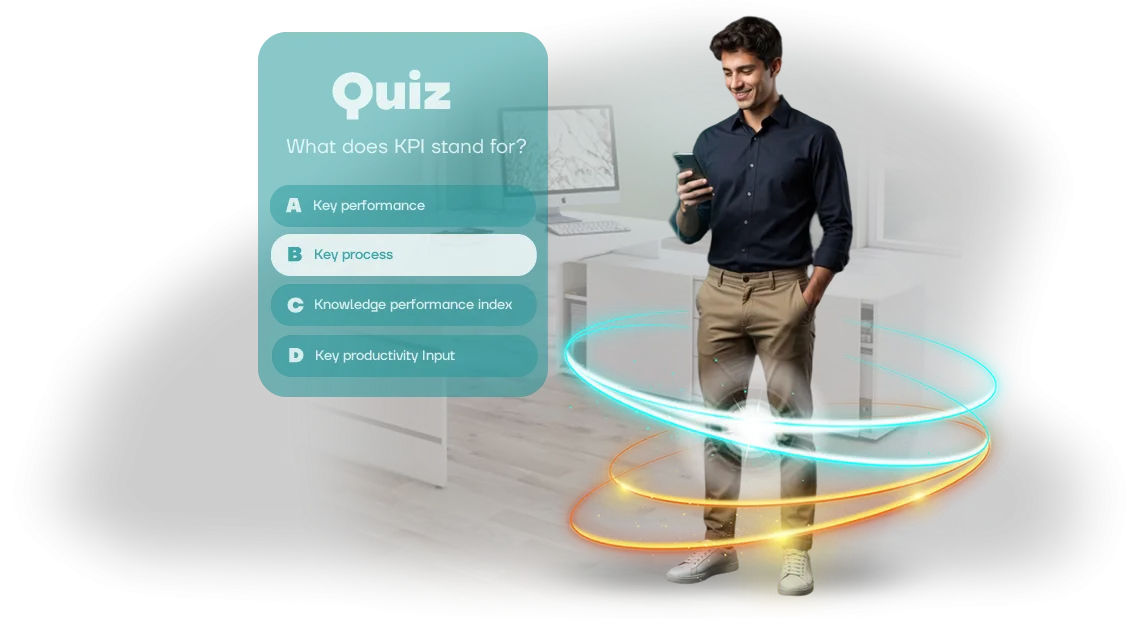
Employees forget their training? Microsoft HoloLens brings engagement back
Employees complete training, nod through tests — and two weeks later forget the key points. Any manager will recognize this situation: money has been spent on programs, yet in practice the same mistakes, slow decisions, and wasted time keep recurring.
The problem is not discipline — it is the delivery format: passive reading or listening does not create a personal connection with the material.
Interactive quizzes in mixed reality change that. Training becomes a live activity: the employee sees 3D objects, answers questions with hand movements, and the system immediately explains where the mistake is. This activates visual and muscle memory — so the material stays with the person for a long time.
Microsoft HoloLens is a professional tool that makes training visual and engaging. Instead of a dull on-screen test, the employee sees 3D objects and works through real situations. The quiz becomes not an exam but a game you want to win.
It has a competitive element — employees strive to complete the task on the first try, and they remember the steps better.
For business, the result is measurable: higher engagement in training, fewer repeated instructions. You can see which topics remain difficult and adjust the program quickly. Employees stop treating training as a formality — and use the knowledge in real work.
We will build mixed-reality training quizzes for you — tailored to your procedures and equipment. A ready-made scenario and launch support — you get a modern training system that pays off through increased team qualifications.
What you get from game-based training
Classic lectures and dry presentations deliver low engagement: employees sit through the hours and forget most of the material within a week. Game mechanics in augmented reality flip the process — people absorb information through emotion, movement, and active participation. Here is how that benefits business.
Knowledge retention grows without lengthening the course
When an employee answers quiz questions directly in their own workspace instead of flipping through slides in a classroom, the brain processes information more actively.
The immersive format captures attention and makes people seek solutions, so knowledge is anchored in long-term memory and the employee applies it on the job faster.
Employees want to learn on their own
Competitive elements — points, ratings, virtual rewards — spark healthy excitement and turn training into a pastime. People return to the quiz voluntarily, discuss results with colleagues, and the manager does not need to spend time on supervision and reminders.
Turnover drops, loyalty rises
Investment in development is a clear signal that the company values its employees. When people see the employer putting resources into their growth, brand loyalty forms, and the desire to leave due to lack of prospects disappears. This reduces the costs of recruiting and onboarding new hires.
An HR brand people talk about
A modern training format with augmented reality elements is a reason to talk about the company on social media and in the press. A high-tech quiz sets the employer apart from competitors, attracts talented specialists, and strengthens the reputation of an innovative business.
Quiz formats for different business needs
One and the same quiz cannot equally well assess a newcomer's knowledge, unite a team, and confirm occupational safety skills. Each task needs its own format and interaction scenario.
We develop quizzes for Microsoft HoloLens where the employee sees questions directly in the workspace and answers with actions — so the result is closer to real work.
Below are three basic quiz formats that we adapt to your task: from onboarding to annual safety knowledge checks.
Basic formats
| Format | For whom | What the client gets |
|---|---|---|
| Individual test | New employees, trainees, post-training checks | Objective assessment without group pressure. The employee quickly sees their growth areas, and you see readiness for work |
| Team quiz | Departments, adjacent units, corporate events | Engagement and lively discussion. Material is remembered through competition, not rote learning |
| Exam simulation | Skilled trades, occupational safety, permits | Verifying actions in a safe environment. You get confirmation of real skills, not memorized answers |
Each format is customizable: we change the scenario, number of questions, and difficulty level to fit your specifics.
In the end, you get measurable indicators — time to full productivity, the percentage of employees who pass the exam on the first attempt, and team engagement at internal events.
How we develop a quiz: from brief to launch
We have broken the work into clear stages — from the initial brief to the launch of a ready-made training. At each step you receive a concrete result: scenario, interface mockups, prototype, and after launch — support and refinements based on the pilot.
-
Brief and task immersion. We study how training currently works, what knowledge needs to be tested, and who the target audience is. We define goals: measurable result, timeline, success criteria.
-
Quiz scenario. We develop the structure: set of topics, number of questions, difficulty levels, answer options, and explanations. We align the scenario with you so that it accurately matches internal procedures.
-
Augmented reality interface design. We create the visual style and element layout in Microsoft HoloLens. The interface does not overload perception, hints appear at the right moment, and the employee is not distracted from the work process.
-
Development and prototype assembly. We program the logic and "stitch" the scenario together with the design. You receive a working prototype — you can launch it and assess how the quiz will look live.
-
Testing with real users. We check for usability, speed of understanding instructions, and correctness of results. We fix identified issues to avoid problems in the full-scale launch.
-
Training launch and support. We deploy the quiz on your device fleet and train administrators. In the first days, we staff a hotline and promptly make edits based on pilot results.
What is included in the delivery: a complete kit for results
When clients order a quiz, they often think the result is "a working program." In practice, a project leaves behind a set of artifacts, and that determines whether you can use the solution without constantly depending on developers.
We have included everything needed for independent work in the delivery: from content to training for your administrators.
- Quiz scenarios — ready-made question sets with answer options and scoring logic. You get content you can launch immediately and, if needed, easily change for new tasks.
- Interface design mockups — every screen from the start page to the final results, assembled in a consistent brand style. We align them with you before development so the final look is no surprise.
- Game interface for Microsoft HoloLens — gesture and voice control adapted for employees. Participants do not need to understand the technology — they focus on the content of the game.
- Methodological materials — instructions for the host, rules for participants, and recommendations for running the session. Everything you need to organize the quiz without additional preparation.
- Administrator training — a short workshop for your staff: how to launch the quiz, manage the flow of the game, collect results, and resolve issues quickly.
- Technical documentation and access — a clear description of the project structure and all necessary data. You remain the owner of the solution and can develop it with any contractor if needed.
- Post-launch support — during the warranty period, we stay in touch so any questions are resolved promptly and do not interrupt your training process.
This kit covers the full cycle: you receive not just files but a ready-made tool for launching the quiz and reusing it. Everything is aligned at the start and supported after launch — so the end result truly works for your goal.
Case study: how a network of event organizers raised exam pass rates to 98%
The event organizer network "Vector" had a pain familiar to every HR professional: employees completed mandatory training just to check a box. Lectures and PDF instructions bored everyone, and at certification almost half the team could not answer simple questions. Every hire and development initiative became an expensive and ineffective process.
We proposed not just another program but a complete change of format. Instead of presentations — an interactive quiz in mixed reality: the employee sees 3D objects through Microsoft HoloLens, answers with voice and gestures, and the scenario adapts to their responses. The brain remembers a game better than text, so the material is absorbed more deeply.
Results
The numbers speak for themselves. Exam pass rates rose from 47% to 98% after just the first quarter of use. Training time dropped by 30%, and inquiries to HR about program content fell threefold.
Managers received detailed analytics: which topics cause difficulties for each employee. The improvement in performance also directly affected client work: staff errors became rarer, and repeat inquiries declined.
This result turned a one-off development into a systemic tool. "Vector" ordered additional modules for newcomer onboarding and ran the same quiz across all branches.
For us, this is the key indicator: the client returned not because they "had to," but because the training was genuinely delivering value and paying off. We took this case into our portfolio as an example of improving performance.
How to choose a quiz for Microsoft HoloLens for your task?
Choosing a quiz starts not with mechanics but with the task you are solving: bringing a new employee up to speed, checking knowledge of procedures, or practicing actions in an emergency situation.
Each goal needs its own scenario, and it is important to define the expected outcome before development begins.
If you need to quickly introduce staff to a product or service standards, short rounds with instant feedback are optimal: the employee immediately sees where they went wrong and remembers the correct answer.
For complex processes, it is better to build the quiz as a sequence of steps where each answer affects the next part of the scenario — so the participant does not just pick an option but lives through a real situation.
The audience's skill level also matters. Beginners suit a simple scenario with hints and explanations; experienced employees suit a competitive format with time limits and result ratings.
We often see companies overpaying for a "flashy" interface when the key question is whether it will engage their specific people and deliver a measurable rise in competencies.
We help you choose a quiz for your specific task: at the start, we define the learning goal, participant profile, and desired outcome, and then we propose a format — from simple tests to multi-step scenarios.
After that, we build a prototype on Microsoft HoloLens and align it before full development, so you understand how the training will look and work before committing budget.
A properly chosen quiz saves employees' time and accelerates knowledge adoption.
So start not with the question "which engine or technology" but with the answer to "what do we want to teach and how will we know they learned it." We will turn the rest into a clear and engaging scenario for your goal.
We answer questions about reliability and safety
Any project with new equipment is a step into the unknown. Questions about whether the system will work on day one, how quickly implementation will go, and whether corporate data will be safe are a normal reaction from a responsible manager.
That is why during the discussion stage we openly address these concerns and show how risk is reduced to zero.
What happens if equipment fails during training?
We test every scenario on professional Microsoft HoloLens equipment before launch, and on the day of the event our engineer is available on a hotline. If hardware fails, we quickly sync progress from a backup device or provide an alternative exercise scenario. You lose neither the group's time nor the session results.
How long does preparation and approval take?
The standard cycle from brief to a working scenario takes 2–3 weeks including revisions. We show the first demonstration within a few days of starting — so you can see the direction and make corrections before the final version.
How secure is employee data?
The quiz runs in the closed loop of your network. We do not store personal data on third-party servers, and after the project is completed, we hand over all anonymized results to you.
The scenario and materials never leave your company — they are accessible only to authorized personnel.
The bottom line is simple: you get a working tool with predictable timelines, technical support, and clear accountability on our side. If you still have doubts after seeing the system, we will suggest a path that minimizes risk — and you can make a decision without pressure.Order a quiz development for your team
We are ready to take on your task — from idea to launch. We develop training quizzes for employees on Microsoft HoloLens: turning dull instructions and procedures into an interactive quest that is memorable and genuinely raises team engagement.
The simplest thing now is to leave a request for a consultation. We will review your case, propose a scenario, and calculate the cost and timeline for your training format.
If you need it fast, we will send a demo scenario of the quiz so you can see how the technology works in your context.
What you get after contacting us:
- Cost and timeline estimate for your task — no hidden fees or "we'll find out later."
- A consultation with a learning gamification expert — we will advise which format will work for your employees.
- A demo quiz scenario on HoloLens before development starts — you know what you are buying.
- Content adapted to your brand, standards, and corporate style.
- Support at every stage: brief, mockup approval, test launch, administrator training.
- A guarantee of results: a trial run with a focus group of employees and refinements based on feedback before release.
All you will need to do is watch your team confidently master new knowledge. Leave a request for a consultation — we will discuss your goals, guide you on budget, and show you how the quiz can fit into your training program within a few weeks.