

Learning Without Results: How Steam Quizzes Engage Employees
Corporate training and courses often turn into a formality: employees sit through the hours, but a week later they forget 80% of the material. The reason is monotonous delivery and a lack of emotional engagement.
When learning doesn’t resonate, it doesn’t change behavior, which means the company’s money isn’t working. Familiar lectures, tests, and presentations are perceived as an obligation, not as a chance to become better at one’s craft.
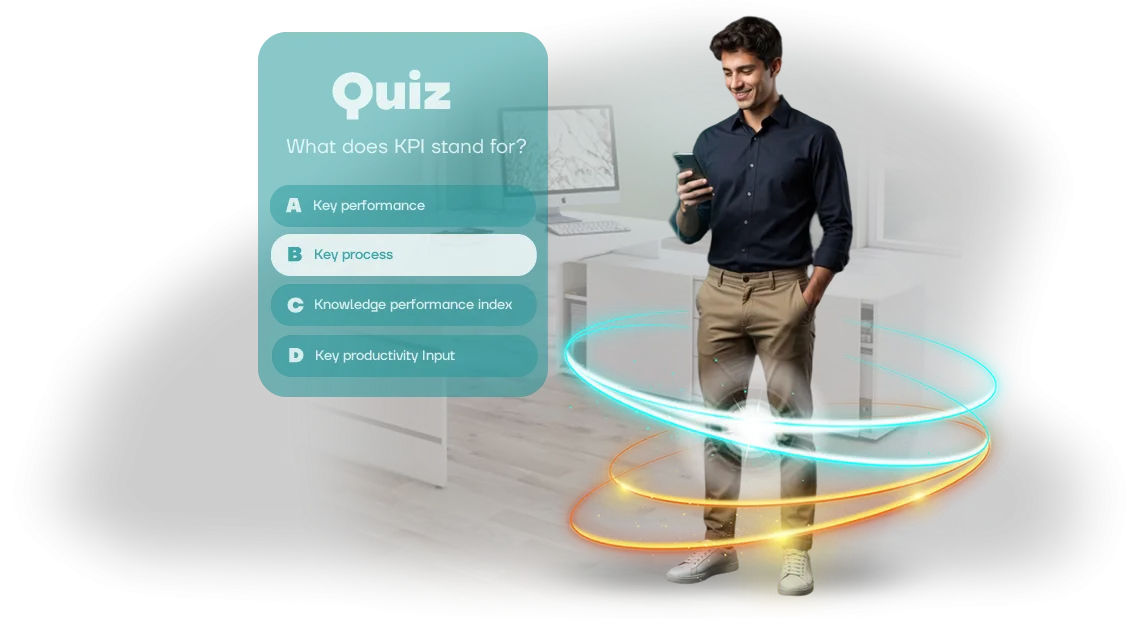
This is where gamification comes in. A Steam quiz is an educational game in which employees answer questions, complete levels, and compete with one another.
The game format turns a boring knowledge check into an exciting activity: the brain remembers information better when it is delivered through emotions and active participation.
Every correct answer gives a sense of progress, and a mistake becomes a reason to reflect and understand the topic.
The key advantage of Steam quizzes is high employee engagement. Employees complete the training because it’s interesting, not because they “have to.” Managers see real results: completion statistics, percentage of correct answers, and speed of material absorption.
This turns training into a growth tool rather than a mandatory chore. The quiz can be used for onboarding new hires, checking knowledge after courses, or regular professional development.
We develop corporate quizzes on the Steam platform that solve the problem of knowledge retention and increase team engagement. We rely on proven game mechanics and a thoughtful interface — the client receives a ready-made product that employees will enjoy completing.
Gamification here is not an end in itself, but a way to achieve a measurable business result: fewer mistakes at work, faster adaptation for new employees, higher productivity.
What a Game Quiz Gives Your Business: Key Benefits
Ordinary courses are presentations and tests “for show.” After a week, less than a third of the information remains. A game quiz turns learning into a competitive format: employees return to the material on their own, memorize rules faster, and apply them at work.
For business, this is a measurable result: higher engagement, fewer mistakes, and a unified knowledge standard. And the employee gets a game, not another mandatory task.
Engagement Without Coercion
When learning feels like a game, the team joins willingly. Short rounds, points, leaderboards, and instant feedback create excitement. “Forgot to complete it” disappears — time spent on the course grows, while turnover decreases.
Mistakes as Stepping Stones
The quiz reveals knowledge gaps immediately. Employees see the correct answer and an explanation, so a mistake turns into knowledge. Managers receive a report showing which topics were poorly understood — and can strengthen training specifically where it’s needed.
The Effect Is Visible in Numbers
Game-based learning provides transparent metrics: who completed the quiz, which questions caused difficulty, and how the percentage of correct answers has grown. This is directly connected to business: fewer errors in processes, faster task completion, lower costs for retraining.
To make it easy for employees to take the quiz where convenient, we design the interface for a corporate portal or a separate application in Steam. The result is training that employees don’t abandon, while the company sees real growth in competencies.
Quiz Formats for Steam: From Simple Quiz to Simulation
Training formats in Steam are a scale from short quizzes to detailed simulations. We create both in Unity and publish them in Steam: for you, this means predictable launch and automatic updates — no “installing from a flash drive” or manual settings.
A quick quiz is an option for regular knowledge checks. An employee answers in 5–7 minutes, immediately sees the correct answers, and remembers their mistakes. It suits onboarding new hires and periodic knowledge testing across the whole team.
A scenario quiz builds questions around real work situations. The participant chooses how to act in a dialogue with a client or colleague and receives feedback on the consequences. This trains decision-making, not just memorizing theory.
A simulation is a full-fledged trainer for a work process: several stages, changing conditions, and accumulative results. The employee “experiences” a day or shift from the inside and sees where their choices lead. This is the format for complex scenarios where every mistake matters.
| Format | Suitable for | What the Client Gets |
|---|---|---|
| Quick quiz | Onboarding new hires, knowledge checks on regulations, monthly testing | Team involvement, a summary of mistakes and knowledge gaps |
| Scenario quiz | Practicing client conversations, handling objections, typical requests | Confident employee actions, fewer mistakes in real work |
| Simulation | Training for complex processes, evaluating management decisions, emergency situations | Deep immersion, clear statistics on choices and actions |
We select the format for a specific task: if a 15-minute quiz is enough, we build it; if you need a full-fledged trainer, we design a simulation. In any case, you get a game that employees complete with interest, and you see the results in numbers.
How a Quiz Is Created: Stages and Timelines
Creating a quiz for employees is a transparent process where you see intermediate results at every stage and can make changes.
We’ve broken the work into development stages so you control the schedule and budget rather than receiving a finished product “on the last day.” Below is a typical process for a quiz prepared for Steam.
-
Brief and objectives. We document the learning goals, audience, and success metrics. We determine how the quiz will fit into the current onboarding or professional development program.
-
Concept and script. We design the mechanics: how to keep an employee’s attention, how long completion takes, and in what form to present the questions. The script is approved before design starts — this saves time.
-
Interface design. We develop the visual style, screens, animation, and clear navigation. If you plan to publish the quiz on Steam, we immediately account for storefront requirements and PC gameplay specifics.
-
Build and content. We program the logic, upload questions, configure score calculation, and set up reports for HR. You get a working version that can be demonstrated to management.
-
Testing. We verify scenario completion, correct point calculation, and display at different screen resolutions. You test it yourself and make changes before launch.
-
Approval and launch. We approve the final version and prepare instructions for employees and administrators. If necessary, we set up access via Steam or the corporate portal.
-
Post-launch support. We update questions, add new blocks, and monitor correct operation. Training doesn’t stop after the first completion — the quiz lives and evolves.
Each stage ends with approval: you understand what you’re getting and control the process. This eliminates surprises and guarantees that the result matches expectations.
What a Quiz Project Includes: Delivery Package
A quiz is not just an entertainment module, but a measurable result: employees absorb material faster, and you see who has understood the topic and who needs additional explanation. We don’t hand over a “black box” — you get a complete package for independent work. Here’s what’s included in the project:
- A ready-made quiz based on your training materials. It runs on a corporate portal or in a browser — employees don’t need to install anything; they just open a link and complete the test.
- Source project files. You are not tied to us as a contractor: the project stays with you and can be handed to any IT team or refined later.
- Administrator instructions. A clear guide on how to add questions, change session duration, adapt the design to your company’s brand style, and update answer options.
- Administrator training. We hold an online meeting, show you real examples of how to manage the quiz, and walk through typical scenarios. After that, your employee works independently.
- Launch support. On launch day, we’re available: we check the settings, help with the first run, and resolve any difficulties so training starts without delays.
- Room to grow. You can order new mechanics, expanded statistics, or additional modules — the quiz scales with your goals.
In the end, you get a tool that integrates into your learning system and works for years. Employees complete it again and again — during hiring, certification, or initial onboarding — and you always see the dynamics and understand which topics need reinforcement.
Case Study: How a Quiz Improved Team Performance
When standard training becomes a box-ticking exercise, the results of the entire team suffer. That was the case for a large retailer, Name: course materials were studied, but forgotten within a week.
Our task was to make employees genuinely engage with the process and start applying knowledge in practice.
We proposed an educational quiz format. We designed the game interface so it required no learning curve: employees launched the quiz through Steam like an ordinary game and immediately found themselves in a familiar environment. No instructions, no extra windows — just a question, an answer, and the system’s instant reaction.
The result exceeded expectations. Within a month, 87% of the team completed the quiz — by comparison, only half had finished the previous courses.
The average test score grew by a third, and the time spent on preparing one employee halved: instead of multi-hour lectures, short game sessions.
Engagement even increased among those who had previously ignored training: 9 out of 10 participants reached the final and asked on their own when the next round would be.
The repeat order is telling. Two months later, the client returned and asked for a quiz for three new departments, adapting the questions to their tasks.
Training thus shifted from a mandatory procedure to a tool the team looks forward to, while the business gets measurable performance growth.
Frequently Asked Questions About Implementing Quizzes
Introducing an educational quiz often raises questions: will it disrupt workflows, how much time will preparation take, and what technical requirements are needed? Let’s address the main concerns — briefly and to the point.
We’ve already completed such projects for companies in various industries, so most doubts are resolved during the brief stage. We handle all the technical work, from launch setup to post-release support.
Is it difficult to integrate a quiz into existing processes?
No. Employees don’t need to install additional software or go through training — they just open a link or launch the game through the corporate portal. We integrate the quiz with your system so it works inside a familiar environment: in a browser, or through Steam if needed.
How long does development take?
A typical project takes from two to six weeks, depending on the number of questions, scenarios, and design. We set clear deadlines before the start, and we share intermediate versions at every stage so you can see progress and make changes without delays.
What are the technical requirements?
The quiz works on ordinary office computers and laptops. The browser version requires a modern browser and a stable internet connection; the Steam version uses the platform’s standard parameters.
We check compatibility with your device pool in advance, so there won’t be any surprises on launch day.
What about post-launch support?
We don’t abandon the project after release. For three months, we fix bugs free of charge, help update questions, change design, and refine scenarios for new tasks. Support works remotely, so response time is within one business day.
This block addresses the main fears about implementation. If you still have questions — just write to us, and we’ll suggest the optimal solution for your task.Get Your Own Employee Quiz
Leave a request, and we’ll contact you within one business day for a consultation. You tell us about your goals — we’ll propose a quiz format that fits naturally into your employee training system and calculate the project immediately in terms of timeline and budget.
For most companies, this is the first step toward turning routine training into a lively game format. We handle everything from the script to the Steam release: you get a finished product, not just a set of screens and a specification.
How your quiz project will work:
- Request — you leave your contacts, we call you back, and we record the main requirements.
- Consultation — we break down the goals: what knowledge needs to be tested, how to evaluate results, and how to motivate the team.
- Project estimate — we prepare a detailed cost estimate with the stages and timelines for each one.
- Script approval — we create questions, hints, and a scoring system tailored to your business specifics.
- Interface development — we design UI/UX that is intuitive even for inexperienced users.
- Launch — we publish the quiz on Steam, set up employee access, and train administrators.
- Support — after release, we make adjustments based on metrics and add new question blocks as needed.
In the end, you get an educational quiz for employees that isn’t left on the shelf but is used regularly and updated easily. Leave a request — the consultation and project estimate come with no obligations.
How to Choose the Right Quiz Format for Your Task?
Choosing a quiz format starts with the question: what problem does it solve? If you need to quickly check knowledge of instructions or newly introduced regulations, a short test with answer options and instant results is enough.
If the goal is deeper — teaching a new product, reinforcing skills, or building a habit — a narrative quiz with levels, hints, and rewards works better. The larger the task, the more mechanics you can build in, but the budget also grows.
The second criterion is the audience. Younger employees are more willing to complete competitive formats with leaderboards and time limits; for an experienced team, clear navigation and the absence of excessive animation matter more.
So first determine who will take the quiz, on what device, and in what setting — in the office, remotely, or after a shift. This determines how much time a person is willing to spend and how complex the mechanics should be.
The third step is the launch channel. If the quiz is integrated into a corporate portal, lightweight web formats are a good choice.
If you want to boost engagement and turn learning into familiar entertainment, a full-fledged game interface — for example, on the Steam platform — is ideal.
Employees get a familiar environment, progress is saved, and gamification elements strengthen their desire to reach the end.
How to choose a quiz in practice? During the brief, we record the goal, the team composition, and the expected result: knowledge testing, onboarding, or motivation to learn.
Then we select the format for the budget and timeline: from simple tests to large-scale games with multiple scenarios.
The main thing is not to chase complexity for its own sake, but to choose a solution that measurably increases engagement and provides clear statistics for HR and managers. That is the true criterion for the right choice.