

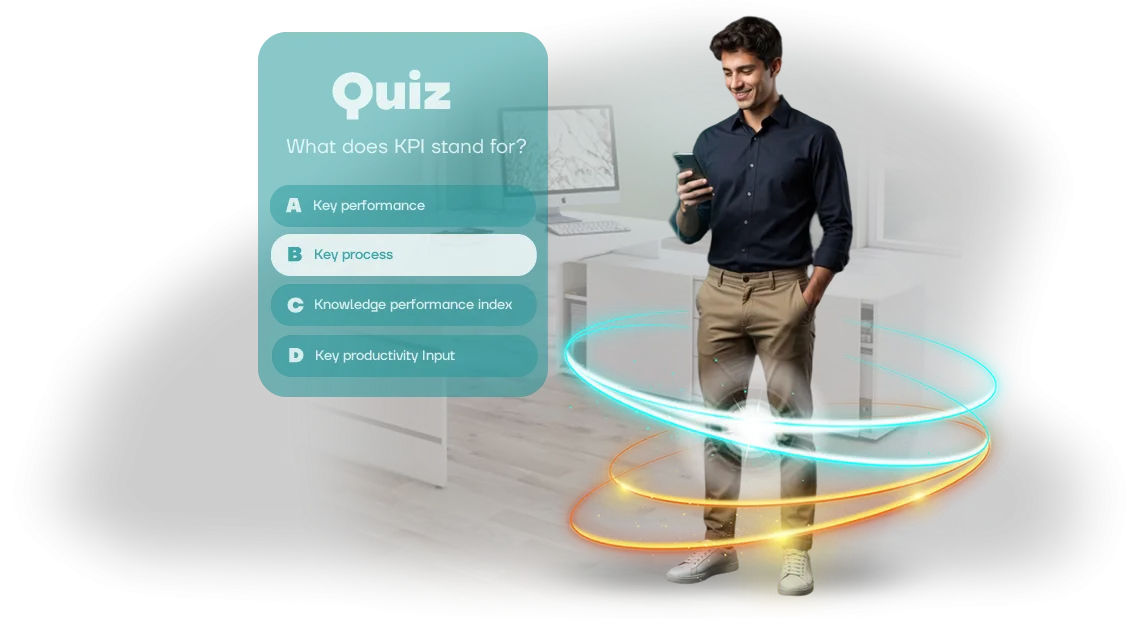
Employees Yawning at Trainings? Anime and Manga Quizzes Change That
Employees yawn through trainings, scroll their phone feeds, and remember only a couple of slides from the presentation. Familiar picture?
It’s not about staff laziness — it’s about the format: adults don’t want to listen to lectures; they want to participate, compete, and get an emotional response.
When employee training becomes routine, its effectiveness drops — and so does the value of the budget and time invested in development.
Anime and manga aren’t just entertainment — they’re a powerful tool for holding attention. Stylized characters, vivid stories, and familiar visual imagery resonate even with those who don’t consider themselves fans of the genre.
Anime quizzes switch the brain from passive mode to active: instead of a dull test, the employee goes through a quest, receives feedback, and sees progress. Gamification of learning works exactly this way — through interest, not coercion.
Employee engagement grows when training answers the question “what’s in it for me?” An anime-style quiz does this: it turns knowledge assessment into an engaging scenario where every correct answer brings you closer to the goal.
Employees compete with each other, discuss results, and return to the material to get a better score. This improves retention by 40–60% compared with classic testing.
We specialize in creating such training quizzes — from scenario to a complete product that’s easy to integrate into your learning system. You don’t need to be an anime expert: we adapt the style to your corporate culture and your company’s specifics.
You get a tool employees complete with pleasure, while managers get clear analytics on knowledge retention. Boring trainings become a thing of the past, and learning turns into an event people look forward to.
Why Game-Based Quizzes Are More Effective Than Classic Courses
An employee goes through a course, clicks “Next,” and two weeks later remembers only a tenth of the material. That’s not a problem with people’s memory — it’s how the format works: passive reading and viewing don’t hold attention.
Classic information delivery loses where the goal isn’t just “to get familiar with” but to truly absorb knowledge and apply it on the job.
A game-based quiz turns training from an obligation into a competition. When an employee answers questions, earns points, and sees progress, natural engagement kicks in.
They want to finish the course and do better than others — and that means information is remembered through action, not passive perception.
Research confirms what any manager feels: game formats increase material retention many times over. Instead of “read and forgotten,” a person goes through a scenario where knowledge has to be applied in context — this creates lasting neural connections. The business result is fewer mistakes at work and less time spent re-explaining tasks.
A special value of gamification is lower turnover. When company processes are designed to be interesting, employees get a sense of drive and progress. Quiz-based training with anime aesthetics is perceived not as routine but as part of a great corporate culture. People talk about such training on social media and stay with the company longer.
We use modern game engines so that every project isn’t a “course for show” but a product employees enjoy completing.
The quiz also remains a practical tool: it integrates with your motivation system and gives transparent data on what has been learned in every department.
Quiz Formats: From Anime Quest to Manga Comic
The choice of quiz format directly affects how easily employees get drawn into training and retain material. This is especially clear in an anime setting: characters, story, and visual style enhance immersion, but the scenario itself must match the learning goal exactly.
If the format is wrong, even vivid artwork won’t save it — employees will go through the test “for show” and won’t transfer the knowledge to work.
We compare formats using three criteria: preparation complexity, audience engagement, and depth of knowledge assessment. Below are the typical options we use in training projects. This will help you choose a suitable scenario or combine several formats for your material.
| Format | Target audience | What the client gets |
|---|---|---|
| Anime quest | New employees who need to quickly get up to speed | Instead of a boring test — moving through anime locations with questions and answers. Material is absorbed through play, the entry barrier is lowered, and engagement grows. |
| Manga comic | Safety rules, regulations, service standards | A decision-making scenario in comic form. The employee sees the consequences of mistakes without real risks, and key rules are remembered visually. |
| Quick quiz | Regular review and knowledge control | Short rounds of 5–10 minutes in an anime wrapper. The competitive element boosts activity, and training coverage is easy to track by completion results. |
| Investigation quest | Complex topics — from basics to expertise | A step-by-step “investigation” with questions of different difficulty levels. It shows each employee’s level of preparation and helps fine-tune training. |
If you need to quickly introduce the team to new regulations, a manga comic is enough. For reinforcing knowledge, an anime quest or a short quiz works better. An investigation quest suits final certification or complex product scenarios.
Together with you, we’ll choose a format for a specific topic and audience. We’ll design the plot, draw characters and locations in anime style, and after launch show how completion results change — without extra technical details, only clear analytics for the business.
How We Create a Quiz: 7 Steps
A transparent quiz development process is what lets you control timelines and budget at every stage. We don’t turn the project into a “black box”: you see intermediate results and understand exactly what you get at each step. Below are the 7 stages we use to create learning games for employees.
- Brief and goals. We dive into your task: what knowledge needs to be reinforced, which employees will play, and what result counts as success. We fix project metrics and timelines.
- Scenario and learning content. Together with your experts, we develop questions, scenarios, and the storyline. The quiz shouldn’t just entertain — it should teach, so every question is based on real work situations.
- Prototype and mechanics. We build an interactive scheme: progression logic, points, difficulty levels, feedback. We agree it with you before moving to full-fledged development.
- Design and animation in anime style. We create a visual style, characters, and locations that your team likes. A recognizable style increases engagement and helps hold employees’ attention.
- Programming and game assembly. We turn the approved scenario into a working game: interface, sound, scoring, and adaptation to employees’ devices. We use the professional Unity environment — this ensures stability on any device.
- Testing and revisions. We test the game on real scenarios and collect feedback from a focus group. We make changes before the quiz reaches all employees.
- Launch and support. We deploy the game, train administrators, and share instructions. After launch, we stay in touch: we update questions, add levels, and help with technical support.
What's Included in a Ready-Made Quiz: The Complete Package
A ready-made quiz is a fully packaged product, not just a set of questions in a document. You get everything you need to launch employee training without developers or designers. Below is the package we hand over to the client.
-
Quiz scenario tailored to your tasks. A well-structured design, transition logic between topics, and answer options with correct explanations. The scenario is adapted to your company’s specifics — from knowledge checks to practicing work standards.
-
Anime graphics and 3D locations. A unique visual style: characters, environment, interface — all in a consistent key. This design holds attention and boosts engagement, while also strengthening brand recognition.
-
Learning content with feedback. Built-in hints, error analysis, and explanations after every question. The employee immediately sees where they went wrong and how to do it right, so training goes faster and without mentors.
-
Statistics panel for result control. You see who completed the quiz, the percentage of correct answers, completion time, and problem topics. This data helps adjust the training program and close knowledge gaps in the team.
-
Unrestricted usage rights. A full set of rights to content, graphics, and design. You can run the quiz unlimited times, adapt it for new groups of employees, and make changes as your business evolves.
-
Launch instructions and technical support. We provide a simple instruction, ensure access to the quiz, and help with integration into your learning system. If questions arise, support is on call.
This is a turnkey package: from scenario to analytics. All you have to do is send employees the link and monitor progress.
Case Study: How a 3D Quiz on Unity Raised Course Completion to 91%
How It Started
Employees of a retail chain were taking mandatory training on service standards — and quitting the course halfway through. Regular tests didn’t hold attention: completion stayed at 40%, and new employees often came onto the floor without key knowledge.
We offered not a test but an adventure. Instead of boring questions — a 3D anime-style quiz with characters, dialogues, and office locations. Training became a game: the employee goes through a story, with questions built directly into the scenario.
Numbers After Launch
The project’s results exceeded expectations: course completion grew to 91%. Employees began reaching the final and replaying the quiz to unlock secret endings. The average test score rose by 20%, and the number of support requests on typical issues dropped in half.
Most importantly, training was no longer seen as an obligation. The head of learning at Atlant noted: “For the first time, employees themselves asked for access to the course and recommended it to colleagues.”
Why It Worked
The anime format provides emotional engagement, and 3D visualization creates a sense of presence. Instead of abstract slides — a familiar space where decisions need to be made. This is how training turns from a formality into a tool that genuinely changes employee behavior.
This development case shows training effectiveness measured not by checkmarks but by real completion and business results.
How to Choose a Quiz Format for Your Team’s Specifics?
Choosing a quiz format isn't a matter of taste — it’s a way to achieve a concrete result: employees not only pass the test but also absorb the material and apply it at work. There’s no universal solution: what works perfectly for a sales department may fail in a technical team. Understanding these differences is the first step toward effective training.
Start with the content. If you need to check knowledge of regulations, product details, or safety procedures, a classic multiple-choice survey works — it’s fast and gives a clear picture.
For developing communication skills, handling objections, or managing conflict situations, choose a format with practical scenarios: the employee gets a realistic situation and chooses how to act. This evaluates behavior rather than memory, which is much more important for actual work.
Consider how the team’s work is organized. If employees are in the office, synchronous quizzes on a shared screen are convenient — they create a competitive spirit and bring the team together.
For remote work and frequent travel, a format completed at a convenient time from any device is better suited. In large teams, you can combine both: a team game for warm-up and an individual test for reinforcement.
Motivation level also matters. If the team is tired of dry instructions, add game elements: a story, characters, anime-style atmosphere. This format is perceived as a break rather than routine, and employees go through it with interest, not under compulsion. The effect is especially strong for young teams and creative departments.
We help you choose a format for your tasks: we analyze your team’s specifics, suggest suitable options, and deliver them on the professional Unity engine.
As a result, you get a quiz that engages employees and gives a measurable outcome — without lengthy approvals or extra costs.
Frequently Asked Questions About Developing Quizzes for Employees
Before starting, clients ask the same things: about timelines, integration with the corporate learning system, game complexity, and post-launch support. We’ve gathered answers to these questions — no technical jargon, just the essentials.
How long does quiz development take?
The timeline depends on the format. A simple quiz with questions and anime illustrations will be ready in 2–3 weeks. If you need 3D locations and a story, allow up to 1.5–2 months. We fix exact dates in the contract.
Will the quiz work in our LMS?
Yes, we integrate it. We connect launch and result reporting to your learning system or corporate portal. The employee completes the game in a browser, and you see statistics in your familiar interface without manual exports.
How complex will the game be?
We adjust the complexity to your task: from a calm quiz with anime characters to a full-fledged quest across 3D locations. We work on Unity, so graphics and animations run reliably in the browser. The learning part remains the priority, and game elements help employees remember the material.
How does implementation work and what about support?
Implementation is phased: we collect questions from your experts, prepare design in corporate or anime style, and test with you. After launch, we update questions, add scenes, and fix errors. We’re available during business hours, with a response within a day.
Order a Quiz and Get a Team That Learns on Its Own
Order a quiz — and training will stop being an obligation employees put off. Instead of boring tests, you’ll get an anime adventure with 3D locations where every person must answer questions to move forward.
This format engages by itself: employees return to training because they’re interested, not because they “have to.”
We have already created dozens of learning games on Unity — professional equipment and proven tools allow us to build quizzes quickly and reliably. You don’t need to understand the technical side: we handle development, content, and launch. You get a ready-made system that teaches your team without constant supervision from you.
After the engagement is complete, you receive bonuses:
- quiz setup according to corporate standards and style;
- a discount on new topics and improvements;
- methodological recommendations for embedding the quiz into the training program;
- an analytics report: which employees completed the course and which questions caused difficulties;
- priority support for a month after launch;
- the ability to update questions with your own specialists without contacting us.
These bonuses make ordering a quiz not a one-time purchase but a long-term investment in training. You spend less time on control and get a team that knows the product more deeply.
Leave a request on the website — we’ll prepare a proposal for your task and show examples of our anime quizzes. Start with one test, and you’ll see employees ask for more themselves.