

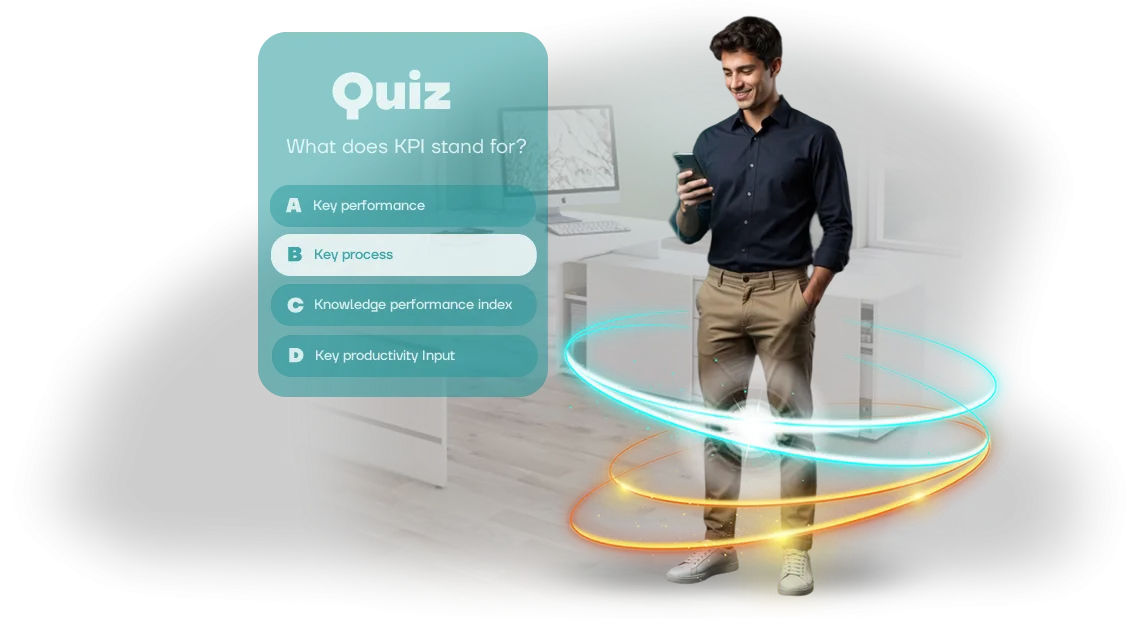
Boring tests don't teach: use AR-optimized quizzes
No one likes boring tests. Employees take them just to check a box, reluctantly, and a week later they forget half the material. Classic multiple-choice tests don't create emotions—and without emotions, knowledge doesn't stick.
You spend time and budget on training, but the result is invisible: mistakes repeat, and skills never transfer into daily work.
AR-optimized quiz changes the approach: the employee doesn't choose an answer from a list, but interacts with digital objects in the real environment. They need to find, assemble, check—so the brain actively works, information is experienced, not just read.
The key difference from ordinary e-learning courses is active action instead of passive clicking. Engagement grows, knowledge sticks for a long time.
For business, this means: faster onboarding, fewer process errors, faster reaction to changes. Training stops being an obligation—employees themselves get involved in the game, and the competitive element boosts motivation.
At the same time, you see the real picture of material comprehension: who is ready to work and who needs additional support. This format works on smartphones and tablets that the team already uses every day—no need to buy special equipment or rebuild infrastructure.
We develop AR-optimized quizzes tailored to your business challenges: new-hire adaptation, safety, product handling, customer service.
We adapt the presentation format, scenario, and difficulty to your team—so training integrates into current processes without unnecessary bureaucracy. The result is training that works: employees remember it for a long time and apply it in practice.
What interactive learning gives you: 5 business results
Interactive learning is not just a modern format, but a way to get measurable business results. A well-designed course changes employee behavior and directly affects work quality, process speed, and attitude toward tasks.
The first effect is engagement. Instead of passively viewing slides, an employee goes through scenarios, answers questions, and gets instant feedback. Material is absorbed through the process itself; training doesn't turn into a formality, and employees finish the program.
Learning speed also increases. Knowledge is immediately applied in practice, so the path from theory to skill shortens. The employee reaches target KPIs faster, and the business saves time on onboarding new people and launching new processes.
Reduction of errors is achieved by practicing actions in safe scenarios. The employee tries different options, sees the consequences of decisions, and reinforces the correct algorithm.
Such experience is more reliable than studying instructions—which means fewer failures, disputes, and customer complaints.
Staff motivation is strengthened by game mechanics and a competitive spirit. Training becomes an interesting event; employees engage themselves, share successes, and support each other. This increases loyalty, reduces turnover, and creates a positive atmosphere in the team.
Finally, the manager gets transparent analytics: it's clear who completed the course, how long it took, and where difficulties arise.
Based on this data, you can easily adjust the training program and influence business metrics—from application processing speed to service quality. The interactive format becomes a performance management tool, not just a waste of time.
AR-optimized quiz formats for business challenges
Each training quiz solves its own problem: one employee needs to be quickly introduced to the product, another—taught to act in production, a third—tested on the go. Therefore, we choose the format not "just to check a box", but based on a specific business task.
AR-optimized quizzes are especially useful where it's important to connect answers with the real work environment: the employee sees not abstract pictures, but objects they work with every day.
We develop quizzes in several basic formats. They can be combined—one scenario can be adapted for office, production, and field teams with shared statistics for the manager.
| Format | For whom | What it gives the client |
|---|---|---|
| Mobile AR quest | Field teams, sales managers, couriers | Training on the go, without interrupting the work schedule. The employee chooses the time themselves, and answers are tied to real locations. |
| Stationary simulator | Production floors, warehouses, technical staff | Practicing actions on real equipment. The employee trains without risk to themselves or equipment; mistakes are analyzed instantly. |
| Office quiz | Managers, marketing, administration | Quick knowledge checks during breaks, team engagement, saving time on organizing training. |
| Mixed format | Companies with distributed teams | A unified training system for office, points of sale, and field specialists. Results are visible in a single report. |
We select the format for your task: if you need to train mobile employees—we use a mobile quest; if hands-on skill practice is important—a stationary simulator.
We'll show how one scenario can fit your specifics and prepare a demo version you can show management before the full launch.
How the project goes: from brief to launch and support
The project is structured so you see results at every stage and can influence the process without extra approvals. We don't just write code—we accompany the task from the first idea to the moment the quiz starts working for your team.
All stages are fixed in a clear plan with dates. You always know what's happening with the project, what the deadlines are, and exactly when you'll get the finished result.
-
Brief and task immersion. We start with a short interview: we study your business goals, specifics of employee work, and existing training materials. The result is a technical specification that captures the quiz goals, its style, and success criteria.
-
Content and scenario approval. Together with you or your L&D manager, we refine questions, wording, and branching logic. At this stage, you approve the scenario—what exactly and how employees will go through, so that training meets real tasks.
-
Mechanics and design concept development. We show how the quiz will look and interact with the user: interface, presentation, difficulty levels, and gamification elements. You see the picture before development starts and can make changes before the main budget is invested.
-
Training environment assembly. We build the quiz itself on a professional game engine adapted for AR devices. You get a working prototype with a basic set of questions—you can test it on real employees and understand how convenient and interesting the training is.
-
Launch and trial period. We deploy the quiz on your devices, help with installation, and conduct technical testing with a pilot group. Based on the results, we collect feedback, make final adjustments, and only then announce the full launch.
-
Support and development. After release, we stay in touch: we fix inaccuracies, add new questions as materials appear, and update content. You can order a separate maintenance package to keep the quiz relevant without involving your IT department.
This order helps avoid the main problem—when the result doesn't match expectations. At each stage, you accept the work and see how you're moving toward the goal. The average project timeline is from three weeks, depending on the amount of content and depth of development.
What's included in the delivery: a complete launch kit
After the project is completed, you get not just a training game, but a fully launch-ready kit. Everything is packaged so your employees can start training without delays, and you don't have to bring in developers for setup.
The delivery kit includes both technical components and practical materials for work:
- Ready-made 3D models and locations in AR-optimized style—they look modern and work correctly on the mobile devices your employees use.
- Training quizzes with questions adapted to your company's specifics. Content can be changed independently via a simple admin panel.
- Launch instructions: a step-by-step guide on how to install the game, configure access, and conduct the first launch without involving technical specialists.
- Materials for the administrator: how to track employee progress, view completion statistics, and promptly identify topics that cause difficulties.
- Short training for your team—we'll give a demonstration, show how to use the tools, and answer questions.
- Source materials and usage rights—you remain the owner of the project and can develop it further.
We don't abandon you after project delivery: we provide technical support for the entire period of active use. If questions arise or fine-tuning is needed, we'll help promptly.
With such a kit, launching a training quiz takes one day, and your employees get a modern training format that is easy to remember and doesn't require complex instructions. You simply open the game—and the process begins.
Case study: how a game quest increased staff engagement
One of our clients faced a typical pain: staff training was formal. Employees clicked through courses just to check a box, and a month later forgot key algorithms. Engagement was falling, workplace mistakes repeated, and managers spent time on repeated explanations.
We proposed not a lecture, but a game. Our team developed a training quest in a quiz format with AR-optimized 3D locations. Employees went through scenarios on their phones, received instant feedback, and saw their progress. This turned routine into a competition.
Implementation results
After launch, the share of successful completions grew by 40%. The average time to master the material decreased, and the number of repeated questions from newbies dropped.
Managers stopped being distracted by training during work hours—people simply played when it was convenient.
The secret of the project's success is not mechanics for the sake of mechanics, but the right presentation. A game quest creates emotional engagement: the employee doesn't cram instructions, but solves tasks in familiar situations. This format is remembered better and forms a habit of acting safely.
Today, this case study is one of the most cited in our practice. We use it as an example of how game mechanics change staff attitudes toward training and give businesses a measurable result.
How to choose the right training format for your task?
Choosing a training format always rests on three questions: what task we're solving, who the employees are, and what conditions they work in.
For salespeople, objection handling is important; for production staff—safety and sequence of actions; for managers—decision-making in non-standard situations.
Therefore, there is no ideal quiz "for everyone", there is a properly selected format for a specific business process.
Start with criteria: what the employee should do after training and how you will measure the result. If you need to check knowledge of regulations—a classic test with cases will work.
If the speed of reaction in a stressful situation is important—a scenario with choice of actions is better. And when training should happen right at the workplace, it's worth considering a format with augmented reality.
It is for such non-standard tasks that we develop AR-optimized quizzes—this is a familiar survey, but with elements of digital objects that the employee sees through a smartphone or tablet screen.
This approach allows training with equipment, warehouse navigation, or customer interaction without risk to real processes.
If standard formats don't fit, we help you navigate: we analyze your business specifics, employee work conditions, and training goals. Then we offer the optimal option—from short quizzes in messengers to scenarios with 3D locations adapted for mobile devices.
As a result, you get a format that solves exactly your task, not an abstract "conduct training".
Answering frequent questions about quiz development
We understand that before launching a training quiz, you have questions: how much time it will take, how difficult the implementation is, and what equipment employees will need.
We answer the main ones—so you can see how the work is structured and what will be required from your team.
How long does quiz development take?
A typical project takes from two to four weeks. The time depends on the number of questions, scenarios, and the level of interactivity. We fix deadlines in the contract and deliver work in stages—you always see progress and can influence the result.
How difficult is it to implement the quiz, and do I need my own programmer?
You won't need to hire a technical specialist. We handle development, setup, and testing: you provide materials for questions and approve the concept. After launch, we conduct a short training for the administrator—usually no more than a couple of hours.
What equipment do employees need to take the quiz?
Ordinary smartphones or tablets on popular mobile platforms are enough. Special AR glasses and expensive devices are not required: the quiz is created in AR-optimized format and works correctly on mid-range hardware. This removes barriers to participation and saves budget.
We use the professional engine Unity to create quizzes—this guarantees smooth operation on different devices and quick edits. If you still have questions, write to us: we'll advise which format is best for your task and calculate the timeline within a day.Ready to make training effective? Write to us
We've already helped dozens of companies turn boring lectures into interactive quizzes that employees complete with interest. We know how to make training clear and engaging even for complex topics—you get a turnkey product, not technical details.
Leave a request—we'll discuss your task on the next business day. We'll tell you what your interactive quiz will look like and which question formats suit your employees.
We'll offer implementation options—from simple surveys to AR-optimized scenarios with 3D elements—and calculate the development cost. You'll learn real timelines and get a step-by-step launch plan.
What you'll get after contacting us:
- A consultation on the quiz scenario and mechanics—tailored to your audience.
- Calculation of cost and timeline on a turnkey basis—without hidden fees.
- A demonstration of similar projects from our practice.
- A technical specification that will become the basis of the contract.
- Support at all stages—from brief to launch and maintenance.
You can order development right now: write to us in a messenger or leave your contacts—we'll come back with first questions within a few minutes. Then we'll prepare a proposal, you'll approve the details, and the team will start work.
If you want to save time, just request a cost estimate—we'll send a commercial proposal within a business day. Start with a short message—and make training effective.