

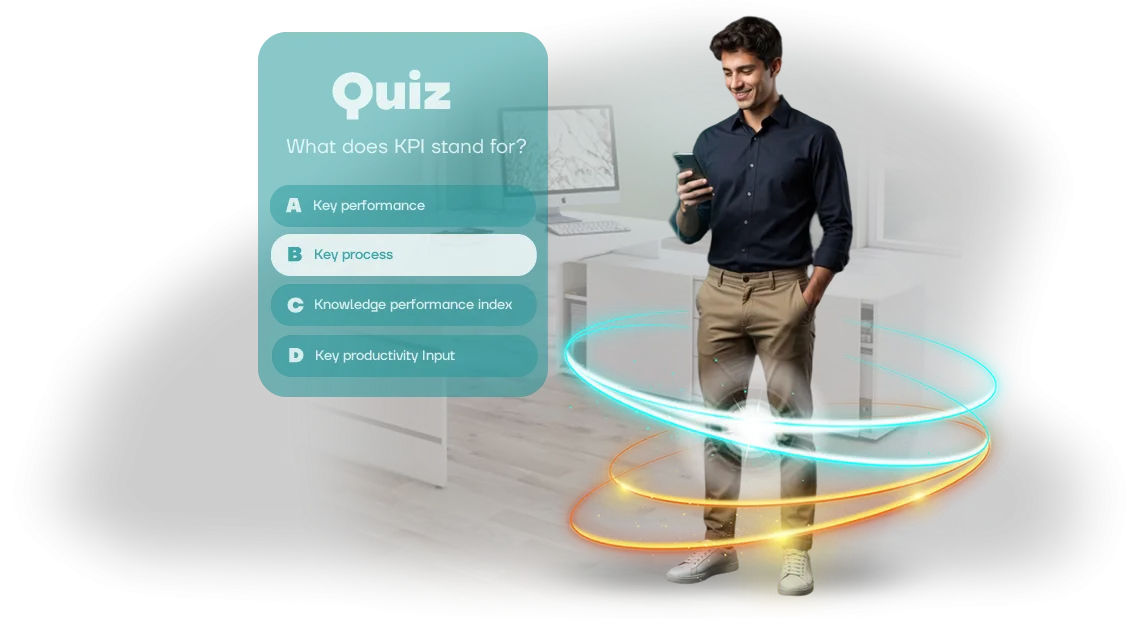
Why employees abandon tests and how a Blocky quiz engages them
Standard tests are perceived by employees as just another mandatory procedure: questions with a single correct answer, a progress bar, and boring wording.
Attention wavers within 5–10 minutes, motivation drops, and learning outcomes remain a formality—the material is not retained or applied at work. Corporate training becomes a box-ticking exercise rather than a team development tool.
A Blocky-style educational quiz solves this problem differently. Instead of a flat questionnaire, the employee enters a three-dimensional world where they need to move around, interact with objects, and find answers through exploration.
The game mechanic naturally holds attention: people are interested in completing a level, seeing the result of their actions, and comparing it with others. Blocks, bright locations, and adventure elements turn knowledge testing into a mini-game you want to finish.
This format is especially effective for engaging people in learning: the employee stops being a passive receiver of information and becomes an active participant.
Every correct answer is reinforced by visual feedback, and a mistake is not perceived as failure—it is part of the gameplay. As a result, material is absorbed through action rather than rote memorization, and knowledge stays in memory longer.
A Blocky quiz also helps relieve tension before a knowledge check. Employees treat it as an interesting challenge rather than an exam, so they show their real level of preparation.
For business, this means a more accurate assessment of competencies and a quick launch of training without resistance from the team. We take on the development of the scenario, mechanics, and locations for your topic so that the quiz solves exactly your training objectives.
What you get from the quiz: improved metrics and motivation
Ordinary training feels like a chore: employees listen to a lecture or take a test just to tick a box, and within a week they forget most of the material. A gamified quiz shifts their focus: people solve tasks, compete, and receive instant feedback.
This format keeps interest high and makes the brain work actively rather than passively absorbing information.
The first benefit is increased engagement. Employees return to the training material on their own to improve their results. This is especially important for complex regulations or new products: instead of forcing people to learn, you give them a reason to do it with enthusiasm.
As a result, completing the course stops being a formality and becomes part of the work routine they look forward to.
The second benefit is deep retention of the material. Game mechanics with levels, points, and rewards engage emotional memory, so knowledge sticks better than when simply reading instructions.
The employee does not just learn the correct answer but practices applying it in simulated situations. This reduces the number of errors at work and speeds up onboarding for new hires.
The third benefit is lower costs for retraining. When material is absorbed from the first attempt, there is no need for additional seminars and reminders. You save mentors' time and team working hours while achieving a higher level of preparedness.
And motivated employees who have completed training in a game format stay with the company longer and perform better.
Blocky quiz formats: choosing the right one for your task
When a company needs to train employees, it is easy to take the standard route—create one quiz for everyone.
But in practice this does not work: newcomers need careful onboarding, experienced employees need fair assessment, and the whole team needs regular knowledge checks without disrupting work. A universal format is either too simple or too difficult, so the results suffer.
We develop Blocky quizzes in three formats, each covering a specific task. The recognizable "cubic" style helps reduce the stress of evaluation: the employee perceives the check as a game, while the manager gets objective data. Below is a table to help you choose the right format for your situation.
| Quiz format | For whom | What it gives the client |
|---|---|---|
| Employee onboarding | New employees on probation | Shorter time to proficiency, reduced anxiety, clear visibility of early mistakes |
| Employee assessment | Teams after a training cycle or project completion | Objective assessment of knowledge level, automated protocols and reports, fair HR decisions |
| Regular knowledge checks | Current employees, including remote teams | Maintaining quality standards, quick rule reminders, identifying weak topics |
You don't have to choose just one format—we combine them into a single system. For example, onboarding for newcomers, assessment at the end of the probation period, and regular checks for the whole team.
This gives you an end-to-end learning process where each employee sees their own progress and the manager gets a full picture of the department.
Development stages: from brief to quiz launch
Quiz development is a project with clear stages, and at each stage you see the result and can influence the work.
We have completed dozens of implementations, so the process is designed to require minimal coordination time from you while delivering a ready-to-use employee training tool.
- Brief and task immersion. We collect requirements: who is learning, which topics to reinforce, and on which devices it will run. The result is a document with goals and expected outcomes for your approval.
- Prototype and plan. We align question scenarios, quiz style, and scoring logic. You receive a plan with deadlines and checkpoints.
- Creating the Blocky 3D game. We design locations and characters in the brand style and fill the mechanics with questions. During interim demos you see how the game looks and works.
- Testing and refinement. We test scenarios on different devices, fix issues, and make adjustments. By launch, the quiz works reliably.
- Launch of training. We set up employee access and show administrators how to track progress. If needed, we train your team.
- Post-launch support. We maintain the quiz: help update questions, add employees, and analyze results. Always available for improvements.
What's included: a complete package for launching training
After project delivery, you get not just a game but a complete package for launching training. Everything you need to start is in one bundle—from scenarios to training materials for administrators. We hand over work that can be used immediately and stay in touch until your team gets comfortable.
- Quiz scenarios — ready-made questions and answer options on your topic, edited to match the corporate style. You can change the content without involving developers.
- Blocky-style 3D models and locations — all objects, characters, and environments created specifically for your training program. They are already embedded in the game and ready to use.
- Administrator instructions — step-by-step guidance on configuring the quiz, adding employees, and tracking results. Even someone who has never worked with such systems can handle it.
- Demo access to the training game — you and your colleagues can test all the mechanics before the official launch to make sure everything works as intended.
- Administrator training — a short webinar or recording where we show how to use the system, answer questions, and provide recommendations for engaging employees.
- Technical support at launch — in the first days after launch, we are available to quickly resolve any installation or configuration issues.
This package saves your time and effort: you don't need to figure anything out or look for contractors for individual tasks. You get a working solution and clear documentation—all that's left is to invite employees and start training.
Case study: Blocky quiz for a retail chain — 80% completion rate
When a retail chain saw that employees were completing mandatory training just "for the sake of it," the completion rate stood at 30%. Text-based instructions and tests could not hold attention: the rules got lost among excess information.
We proposed turning the training into a Blocky quiz. The employee, playing as a character, moves through a virtual store and answers questions along the way. A correct answer opens the next zone; a mistake points them to where they can read the relevant section. This turns training into a short adventure instead of a boring lecture.
Results for the chain
After the quiz launch, 80% of employees now complete it. Completion time has nearly halved, and the share of mistakes on the first attempts has dropped by a third. Store managers see that new hires get up to speed faster and ask mentors fewer repeat questions.
For the business, this means uniform work standards from the checkout to the sales floor, fewer errors, and fewer disputes with customers. Training takes less time, and the result is immediately visible.
Why it worked
The Blocky mechanic gives employees the chance to apply a rule in a game situation—this is exactly how material is remembered best. Moreover, the quiz runs on an ordinary computer or tablet without complex setup.
The project is built on Unity, a professional platform that ensures the game runs reliably on any device. The chain received not a prototype but a reliable tool that can be easily expanded to new departments and regions.
After the pilot, the client deployed the quiz across all stores and ordered scenarios for logistics staff and administrators—coming back to us again.
How to choose a Blocky format based on your company's specifics?
Before choosing a format, answer two questions: who is your audience and what should an employee be able to do after the quiz.
Your answers will determine the style of the Blocky scenario: from a light "walk" through locations to a multi-step quest simulating real work situations.
If the goal is fast onboarding for newcomers, choose short linear scenarios with hints: the employee plays a 5–7 minute game, absorbs the basic rules, and immediately starts working.
For upskilling experienced specialists, branched scenarios with mistakes and consequences are better suited: the player makes decisions themselves, sees the result, and remembers the correct algorithm through action.
Consider the team's technical proficiency. Younger audiences easily take to dynamic 3D scenes with humor, while older employees value a calmer pace, larger hints, and clear navigation.
If part of the staff works on the shop floor and part in the office, it makes sense to create an adaptive version: the same mechanics but different visuals and difficulty.
You don't have to choose one format for the entire company. The flexible structure of blocks allows combining: a basic module for everyone and additional levels for specific departments.
This way you cover common training goals and department-specific tasks without overpaying for a new project.
The main criterion is that the game solves your business problem, not just entertains. If you're unsure what to choose, send us a description of your team and training goal, and we will propose a Blocky scenario that suits you.
Frequently asked questions about developing educational quizzes
The most common client concern is that the quiz will become dead weight: employees won't complete it, implementation will drag on, and the result won't pay off. These are understandable worries—let's address them point by point. Below we answer the most frequent questions.
Employees don't like taking training, so this won't work?
The quiz looks like a game, not a boring test: the Blocky style, storyline, and scoring engage even those who usually put off training. We add competition between departments—interest stays until the end, and repeated playthroughs reinforce the material.
How long does development take?
A standard project takes 2–4 weeks: brief, scenario, location design, assembly, and testing. If you need an urgent version, we compress the timeline by using standard mechanics—we give an accurate estimate after the first call.
How do we integrate the quiz into current training?
The quiz works as a standalone trainer: you give employees a link, and they complete it at their convenience. Results are collected in the administrator dashboard—you see who completed it, who made mistakes, and which topics need review.
Employees won't understand it and will keep asking questions?
The interface is intuitive, and the rules are explained in the first scene. For larger teams, we add a short cheat sheet and mini-instruction—an employee spends less than a minute getting started.
What happens after launch?
We stay in touch: fix bugs, add questions, and help with content updates. If needed, we make changes to the scenario or introduce new levels—without reworking the entire game.
Let's discuss your task: submit a request for a quiz
Submit a request for a quiz, and we will analyze your task from all angles within one business day.
You will receive concrete options rather than general words: which format suits your team, where the quiz will deliver quick results, and how to integrate it into current training without overburdening employees.
We want you to make a decision with numbers in hand. That's why we'll prepare a brief, a project cost estimate, and realistic launch timelines—before you commit.
You'll see what drives the cost, which stages affect the schedule, and when the quiz will start contributing to your business metrics.
What you get when you reach out:
- Task audit — we review your current training program and identify points where the quiz will have the greatest impact.
- Brief — we structure the requirements: topics, difficulty, audience, and what knowledge needs to be reinforced.
- Project cost estimate — a transparent calculation of the cost without hidden fees or vague line items.
- Launch timeline — we give realistic dates from day one and commit to them in the contract.
- Work examples — we show what a finished Blocky-style quiz looks like so you can evaluate the style and mechanics before starting.
No obligations at this stage—only benefit and clarity. Tell us about your task, and we will propose a solution that pays off through increased employee engagement and faster material retention.
Fill out the request form—we'll respond within one business day, clarify a couple of questions, and prepare a brief with a cost estimate and timeline. This way you'll quickly understand whether this format suits you and can make an informed decision.