

Training Yields No Results: Employees Are Not Engaged
Employees are not engaged in training — and that's a direct loss of money. The organizer sends people to courses, prepares regulations, conducts mandatory trainings, and a week later only 10–15 percent of the material remains in memory.
In effect, the company pays just to tick the box: employees sit through the hours, knowledge isn't consolidated, mistakes repeat, and service quality doesn't improve.
The reason is simple: traditional formats — presentations, instructions, tests in distance learning systems — are perceived as routine. The brain quickly switches to energy-saving mode. Formally, the person "completed the training," but in practice nothing has changed. The business spends its budget but gets neither growth in competencies nor a measurable effect.
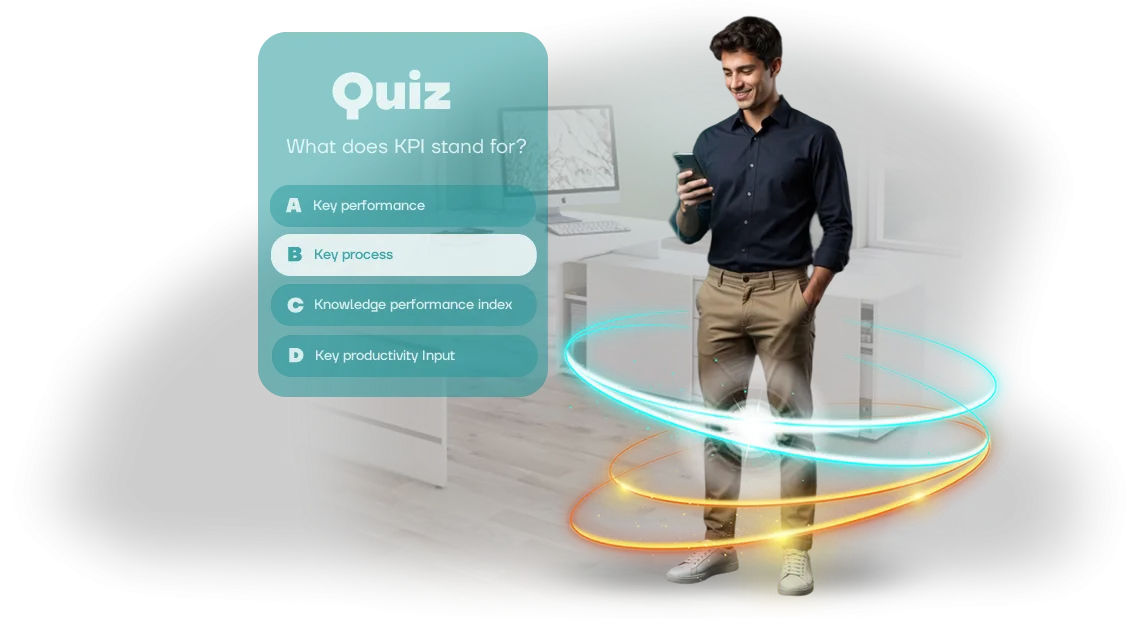
We solve this with training quizzes for employees that look and feel like a game, not a chore. The Cel Shading visual style makes the image lively and attractive — you want to stay in it rather than rush through it.
Game mechanics hold attention, make people think deeply, test themselves, and return to the material. This is how knowledge becomes skills, and the learning process starts working for the business.
Moreover, we don't need offices or meetings: we work remotely, you receive a ready-made turnkey product, and your employees get training they actually want to complete.
Benefits of Cel Shading for Training Quizzes
Employees remember not lists of rules but vivid images and emotions. Cel Shading is a graphics style that makes a training quiz look like a quality animated film: dimensional characters, expressive locations, rich colors.
Such imagery stands out from standard slides at first glance and holds attention even during mandatory courses.
The first benefit — increased engagement. People are more willing to open an interactive that looks like a game rather than a document with tests.
Instead of clicking mechanically, employees actually delve into the scenarios: they analyze cases, look for correct answers, and react to what's happening on screen. As a result, courses are completed to the end rather than abandoned halfway.
The second — material memorability. The brain retains information better when it's delivered through visual stories.
Cel Shading lets you turn every question into a mini-scene: a hero illustrates the situation, a location hints at the context, and a vivid image cements the association with the correct action. A month later, employees will recall key rules because they're linked to visuals.
The third — reducing boredom and training fatigue. Corporate courses often suffer from monotony: text, lists, standard diagrams. Cel Shading graphics add lightness and humor, easing the tension.
This is especially important for mass training, where employees are required to go through the same material.
The fourth — branded training. The style easily adapts to a company's corporate identity: corporate colors are used, characters reflect the internal culture, and locations reflect real work scenarios (warehouse, office, point of sale).
This way, the quiz is perceived not as an external trainer but as a native company tool, which further builds trust and loyalty.
In short: Cel Shading solves the main problem of corporate training — employee indifference. We apply it in quizzes so the content is absorbed and the process evokes positive emotions.
The client gets a course that genuinely works for knowledge retention and doesn't require "please complete your training" reminders.
Quiz Formats with Cel Shading: From Test to Quest
The same material can be presented in different ways — as a strict test, an engaging quest, or a team competition. The format directly determines how much employees engage with the training and what they take away from it.
The Cel Shading style adds lightness and recognizability: even complex regulations turn into a game with bright 3D locations rather than yet another presentation.
| Format | For whom | What the client gets |
|---|---|---|
| Test | Quick knowledge check after a briefing or course | Clear assessment of each employee, automatic result tracking, minimal completion time |
| Quest | New employees who need to master processes in a tight timeframe | Experiencing work scenarios in game form, better retention, gentle adaptation without stress |
| Team game | Departments that need to improve collaboration | Whole-team engagement, competitive spirit, team bonding through shared problem-solving |
| Exam | Staff certification, knowledge control before granting work access | Objective knowledge snapshot, no cheating, clear employee readiness statistics |
The table is easy to adapt to your tasks: combine formats, add branding to 3D locations, adjust scenario difficulty. A short brief is enough to choose the optimal option — we'll take care of the rest.
How Quiz Development Works: From Brief to Launch
We structure the work so you can see the project status at any moment and understand what's happening. All stages are set in a plan with dates — you know when you'll get the result and what happens at each step. Below is the typical journey of a quiz from the first meeting to launch and support.
- Brief and goals. On a call, we discuss which knowledge needs to be tested, how many employees will take the quiz, and which style suits them best. You receive a format description and cost estimate within a couple of days.
- Concept. We propose the storyline, style, and mechanics. For training games, we often use 3D models and Cel Shading locations — this makes complex topics clearer and easier to remember.
- Approval. We show samples, you make edits. Texts, visuals, and question logic are approved at this stage — we sign the approval protocol and the work goes into production.
- Development and testing. We assemble the full quiz version, check answer correctness and loading speed. You receive a test link and can run the scenario on a pilot group.
- Launch. We publish the quiz for all employees, configure access, and set up integration with your internal system if needed. We provide a short administrator briefing.
- Support. After launch, we stay in touch: answer questions, refine texts, add new questions, or adjust difficulty without missing deadlines.
"Usually we just received a file with a list of questions, but here everything looked like a game — employees themselves asked to add more questions.
The process was transparent, we saw every stage and never worried about the result," — head of training department, corporate quiz client.
This process spares you from chaos: roles, deadlines, and the result are fixed from the start, and at launch you receive not an abstract "development" but a ready-made training tool with clear support.
What's Included in the Training Quiz Delivery Package
When you order a training quiz, you get not just a game but a launch-ready package: it fits straight into your employee training process and requires no developers, designers, or lengthy approvals from you.
Inside is everything needed to run training in a 3D quest format and get a clear result: engagement, knowledge assessment, and a report for the manager.
- Quiz scenario. Step-by-step game structure: opening, plot tasks, finale. You see in advance what an employee learns at each stage and can approve the logic before launch.
- 3D locations and characters in Cel Shading style. Bright, recognizable graphics that turn a dull test into a game. Employees complete the whole level instead of closing the window after the first question.
- Question bank with answers and explanations. Questions are tailored to your business processes and refined during approval. Each item includes the correct answer and a short explanation for self-study.
- Methodological materials for the manager. Recommendations for integrating the quiz into the training plan: how much time to allocate per session, how to run an error review, and which topics to bring into offline discussions.
- Launch instructions. A clear checklist for launching on laptops and tablets. No technical team needed — one administrator is enough.
- Team training and source material handover. You receive the project files and a short guide on how to change questions and scenes. An internal specialist will be able to update the game on their own — no need to contact us.
Every item in the package solves a specific task: clears up questions about training logistics, helps measure results, and makes the game reinforce brand recognition. All control stays with you, and we remain on call if you need to refine the scenario or add new levels.
Case Study: How a Quiz in an Unusual Style Boosted Engagement
Training courses in large companies often become a formality: employees complete tests "for show" and forget key rules a week later.
That was the case for a retailer with 400 warehouse and retail staff — standard presentations produced low scores and almost zero interest in revisiting the material.
Our team proposed an unusual format: a training quiz in Cel Shading style. Bright, comic-like graphics instantly read as a game — employees engage more readily.
The visual style brought dull regulations to life and helped hold attention through to the end of the scenario.
What Changed
A month after launch, we measured the effect. The average test score rose from 53% to 87%, and the share of employees who voluntarily returned to the quiz doubled.
Managers noted that safety-related questions came up more often — the material had truly stuck, not just been "completed" for the record.
The key factor behind the result was the choice of engine — Unity. It made it possible to build the game mechanics and fine-tune the quiz across devices: employees completed it on both desktop computers and tablets on the sales floor.
Corporate training doesn't have to be boring — this case confirms that the right visual style and gamification deliver measurable engagement growth.
Case Numbers
- Average score: from 53% to 87%
- Share of repeat completions: doubled
- Employees covered: 400 people
- Development timeline: 5 weeks
How to Choose a Quiz Format for Your Company's Needs?
Choosing a quiz format is about matching your company's objectives. There's no one-size-fits-all solution: something that works perfectly for a team of ten loses its effect in a company with hundreds of employees. So first, define who you want to train and what outcome you expect.
The first benchmark — headcount. For a small team, a short game with questions and explanations that can be completed in 15–20 minutes is enough.
For a branch network or distributed departments, a more sophisticated format is needed: with 3D scenes, a storyline, and a progress system to hold attention and motivate people to finish.
The second factor — goals. When employees need to be introduced to a new regulation, a light reaction-speed quiz works well. When it's about building skills or handling a complex product line, immersive learning is better: game locations and choice scenarios.
This way, the employee isn't memorizing answers but learning to make decisions in settings close to real work situations.
The third factor — budget and timelines. The more participants and the deeper the engagement, the more resources development requires.
But that doesn't mean mid-sized businesses are left without options: for many tasks, a modular quiz that can be expanded with new blocks and difficulty levels is enough.
To choose wisely, start with a short brief: describe the number of employees, the knowledge to be tested, and the desired reach. We'll propose a format that solves your task without overpaying for unnecessary options and with clear launch timelines.
Frequently Asked Questions About Training Quiz Development
Clients usually ask the same questions — about reliability, timelines, and flexibility. Here are the key answers so you can decide with confidence. our team works flexibly: we test first, then launch, and always adapt to your needs. If you don't see your question — just write to us.
What if employees don't like the quiz?
We test it on a small group first and adjust the scenario. You receive a pilot version at the start — if anything's off, we rework it before launch. Engagement is typically above 80%: employees see it as a game, not a chore.
What if the quiz breaks during operation?
We run on reliable server infrastructure and monitor metrics. If anything goes wrong, we handle it ourselves. In years of work, we've never had a failed launch.
How quickly can you change content?
Most edits take 1–3 days. You send new questions or a scenario, and we update the quiz and rebuild it. Questions, answers, design, and logic can all be changed.
Is the quiz compatible with our learning system?
Yes, we adapt it to your platform: it works with most corporate systems that accept a ready-made module. If needed, we'll configure result export and synchronization with your database.
What are the development timelines?
A typical project takes from two weeks to a month. We give an accurate estimate after the brief: you get a calendar plan with stages and clear deadlines.
What if we want something refined later?
You see intermediate results and can influence the development process. Changes at early stages have minimal impact on timelines and budget.
Shall We Discuss Your Training Quiz? Leave a Request
Employees remember material faster when training feels like an engaging game rather than a dull lecture. We build interactive quizzes with 3D locations in cel shading style: bright characters and cartoon-style graphics hold attention and make people want to complete the training.
Shall we discuss your task? Leave a request — and we'll propose a solution that fits your business. After ordering, you receive:
- a tailored project: scenario, questions, and design aligned with your tasks and corporate style;
- a lively training format: employees complete the quiz like a game and gladly come back for more;
- clear statistics: you see who completed the material and which topics are challenging for the team;
- transparent stages and timelines: you always know what's happening at each step and when the result will be ready;
- post-launch support: we'll help with updating questions and adding new modules;
- adaptation to different formats: the quiz will work on both computers and tablets.
We've already delivered such projects for companies across industries — from small teams to large chains. Tell us about your goals, and we'll show you how a training quiz can help achieve them. Leave a request — we'll start with a short conversation and discuss your project details.