

Employees Are Bored in Training — Bring Your Course to Life in Industrial Style
Classic lectures and dry presentations lose employees' attention within the first few minutes. Even the most important material goes unnoticed: adults get distracted, think about work tasks, and after the training cannot recall the key points. As a result, time is wasted, and the expected growth in competencies doesn't happen.
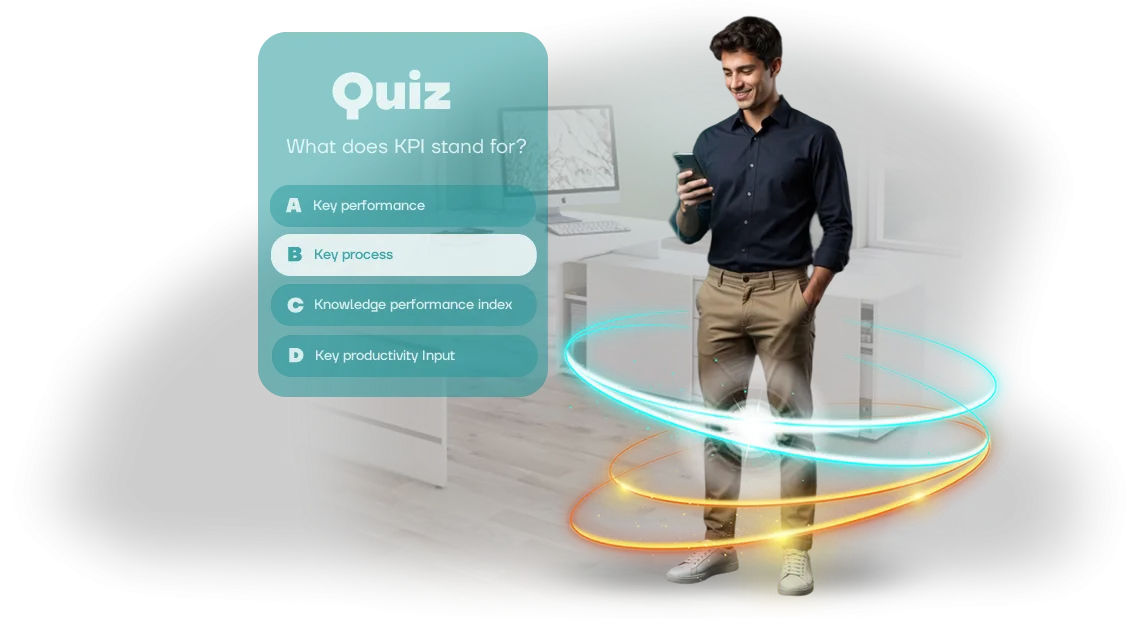
An Industrial-style 3D quiz turns training into a game format where the employee is not a passive listener but an active participant.
Immersed in industrial aesthetics — workshops, machinery, technological processes — they solve tasks, search for answers, and receive instant feedback. This approach holds attention and sparks natural curiosity, rather than forcing memorization.
For business, this means higher staff engagement and real absorption of the material. Game mechanics turn training into a challenge: employees take the quiz not "just to check the box" but to test themselves.
Companies get a measurable result — test outcomes show which topics were mastered and which require additional review.
The Industrial style was not chosen by chance: it is close to manufacturing, construction, energy, and logistics, where clarity, reliability, and technological sophistication matter.
Harsh textures, blueprint-like graphics, and clear visual imagery create a working atmosphere and emphasize the connection between training and real tasks. At the same time, the quiz remains lively and engaging, breaking the stereotype of boring courses.
We develop 3D quizzes for corporate training — from industrial safety to onboarding new hires. Professional development tools guarantee stable operation on any device — from laptops to tablets on the shop floor. You get a ready-made tool that employees will complete with interest, and business — with benefit.
What Results a Training Quiz Delivers to Business
A training quiz turns one-time training into a system with a measurable effect. Unlike standard lectures and presentations, it gives businesses concrete learning outcomes: employees actually absorb the material rather than simply showing up to the session.
Every scenario, every knowledge check is tied to work tasks, so staff efficiency grows not "in general" but in specific operational indicators.
The key metric — higher course completion rates. An interactive format with competitive elements motivates employees to finish: the average completion rate of such programs is several times higher than with ordinary slides.
People get involved in the process instead of sitting it out — and this directly improves the quality of team preparation.
For new employees, the quiz noticeably accelerates onboarding. Instead of spending a long time studying regulations, new hires quickly immerse themselves in company standards through game situations.
They don't need to reread documents ten times — just running through a short scenario is enough to understand how to act in typical cases. The time to reach full productivity shrinks, and mistakes in the first months happen less often.
Material retention is another direct benefit. Two weeks after an ordinary training, people remember only a small portion of the information, while game mechanics reinforce knowledge through emotions and repetition.
The quiz helps keep key rules and algorithms in memory that employees apply every day — and this shows up in fewer repeat requests to mentors.
The comprehensive effect — lower turnover. When training is interesting and clear, employees feel that the company invests in their development. This boosts loyalty and reduces the desire to look for another job.
The result — a stable team, lower recruitment and hiring costs, and greater predictability of business processes. These are exactly the kinds of measurable changes we build into every training quiz.
Formats for Industrial-Style Training Quizzes
Standard tests with questions and answers do not prepare an employee for real work in production. They test memory, but not reaction or understanding of risks.
That is why we develop training quizzes in formats that simulate work situations and help staff act correctly without unnecessary stress.
These formats solve specific production tasks: reduce the time of introductory briefings, increase employee engagement, and allow objective knowledge assessment before granting access to work.
You can choose one scenario or combine several, and we will adapt the quizzes to your specifics — shop floors, regulations, and typical risks.
| Format | For Whom | What It Gives the Client |
|---|---|---|
| Production Quiz Tour | New employees, interns | Quick introduction to shop floors and safety rules without taking time away from work |
| Instruction Check | Workers on all shifts | Updates knowledge of regulations, identifies gaps before audits |
| Hazardous Situation Simulation | All staff categories | Practices emergency response with no risk, reduces injuries |
To make the quizzes look realistic, we create 3D models and locations in Unity. This allows scenes to run smoothly on ordinary office and production equipment — the employee goes through training with a sense of presence, not just clicking through cards. As a result, you get training that is memorable and truly affects safety culture.
How We Build a Quiz for Your Task
Every project starts with understanding how the quiz will fit into your current training and achieve your business goals.
We have structured the process so you always know what stage the development is at and what changes in the final product — from the first brief to post-launch support.
- Brief and task. We discuss which employees will take the quiz, what knowledge needs to be tested, and how the results will affect the company's operations. You get a project plan with timelines and stages, not a vague promise to "make a quiz."
- Training scenario. Together with you, we write the questions, answer options, and explanations — so the training flows naturally rather than like an exam. You see the quiz text before development starts and can make edits before launch.
- 3D prototype and locations. For Industrial-style games — steel structures, pipes, factory premises — we create a working model. You evaluate the visual part at an early stage and get a style that matches your brand and immerses participants in the subject.
- Project approval. We show intermediate results, gather your feedback, and make adjustments. You are not waiting for a finished product "blind" — every stage is approved and clear.
- Integration into the learning management system. We place the quiz in your platform, connect results tracking, and set up access for the right groups. Employees launch the game without additional instructions, and you see completion statistics.
- Launch and support. After the start, we stay in touch: monitor performance, explain to your team how to use the results, and quickly update content if training requirements change.
This approach helps avoid drowning in details and get a working training tool. You make all key decisions based on what you see with your own eyes — from the scenario to the finished 3D scene — and our responsibility does not end at launch.
What's Included in a Training Project Delivery
You receive a complete delivery package — a ready-made tool, not scattered files and rough drafts. Everything needed to launch the training quiz is already assembled, tested, and packed into a clear structure.
The package includes:
-
A ready-made Industrial-style 3D location. A detailed scene with a realistic environment that the participant moves through while answering. It instantly immerses them in a working atmosphere and makes the training visual.
-
A quiz scenario with questions and transition logic. This is not just a list of tests — you get a well-thought-out sequence of tasks, scoring mechanics, and action scenarios for different answers. The scenario can be easily adapted to your rules and regulations.
-
An administrator guide. A clear manual: how to launch the quiz, add employees, assign completion, and view results. Written in plain language — any employee can figure it out without special training.
-
Training materials for the team. A participant memo: how the quiz works, how to enter the platform, how long it will take. This answers most questions before the start.
-
Project source files. Editable versions of scenarios, settings, and logic. If you later need to change questions, add a new location, or expand functionality — you can do it without redoing everything from scratch.
This package covers all stages: from the first launch to results analysis and further development. You get not a "semi-finished product" but a working tool that can be implemented immediately and gradually improved to fit your business needs.
Case Study: Staff Training Became Clearer and Faster
Employees at industrial enterprises go through dozens of briefings a year — and most of the information is forgotten within a few days.
Text memos and lectures do not hold attention, and knowledge checks turn into a formality: workers mechanically tick answers without grasping the meaning.
We solved this problem for an industrial company that needed to train staff on safety rules and equipment operation.
Instead of a standard briefing, we developed a training quiz in the format of an Industrial-style 3D quest — familiar production premises, realistic scenarios, and clear questions.
our team designed the game so that the employee did not just choose an answer but saw the consequences of their decision: what would happen on the production floor if a regulation was violated.
How It Works
The employee enters a virtual workshop and goes through scenarios: starting equipment, working with tools, acting in an emergency. Each correct answer brings them closer to completing the level; a mistake shows what the violation leads to and offers a chance to repeat the step.
What Changed
Training time was cut in half — instead of long lectures, employees complete the quiz in 20-30 minutes. At the same time, material retention improved: the game format engages visual memory and holds attention to the end.
Employees replay scenarios on their own to improve their results — repeated engagement with the material reinforces knowledge.
The workshop manager sees statistics for each participant: who completed the quiz, with what result, and which topics cause difficulty. This allows targeted improvements to the training and quickly identifies gaps in staff knowledge.
The quiz itself can be reused — when regulations change, edits are made without a full course rework.
How to Choose a Quiz Format That Matches Your Corporate Style?
Corporate style is not just a logo and brand colors — it is also how you present information and communicate with employees. The quiz format should follow the same logic so the training does not feel like a foreign element.
If your company is used to strict regulations and a clear hierarchy — a structured test with a points system works well. If your culture values competition and drive — a format with a timer, ratings, and gamification elements is a better fit.
The key parameter — the number of employees. For teams of up to 30 people, short interactive formats work best: each participant sees progress in real time, which creates healthy excitement.
For teams of a hundred or more, it is better to split the audience by department or difficulty level so the quiz can be taken simultaneously without losing performance and with individual settings.
The third factor — material complexity. Simple regulations and briefings can be packed into a "true or false" format with an explanation after each answer.
Complex product knowledge requires a modular system: short blocks of 5-7 questions with reinforcement and repetition between levels.
This is not a technical limitation but a pedagogical one: employees absorb information gradually rather than trying to hold everything at once — so engagement stays high and results improve.
Budget also affects the format. A simple quiz with automatic checking covers basic tasks in a few days.
A deeper experience — with adaptive scenarios, non-standard mechanics, and an industrial-style 3D environment — takes more time but delivers a fundamentally different level of immersion and retention.
At the same time, we always match the solution to your task, not to a "shelf in a catalog": if you need a compact tool for mass use, nobody will push you into overpaying for a massive scene.
The key is not to guess. We help you choose the format at the start: we ask a few clarifying questions about team size, budget, and material complexity, and give you a scheme that fits your specific business.
In the end, you get not a pretty toy but a tool that covers your learning and business goals with a predictable result. We can run that short survey right now — and within a day you will understand which scenario to take into production.
Answering Common Client Concerns
Before launching a quiz, clients most often ask about scene reliability, office PC performance, and the ability to change questions. We answer without technical details — only what affects your results and peace of mind.
Below are common concerns and how we address them.
Can an average office computer handle the quiz?
Yes. We configure the graphics in advance to match your fleet of machines and run tests on different configurations. As a result, the game runs smoothly without lag or crashes — employees complete the training without stress.
Can the 3D scene break during the game?
The scene loads locally on each PC, so a failure on one device does not affect the rest. Intermediate results are saved automatically: even after a restart, participants continue from where they left off without losing anything.
Can questions be changed after launch?
Yes, through a simple admin panel — without help from a programmer. Update wording, answer options, and hints in a couple of clicks. More significant changes to the 3D location are handled through our technical support.
How quickly do you respond to requests after project delivery?
We stay in touch. Under the standard maintenance plan, we respond within one business day, and urgent launch-related questions are handled faster. The support terms are written into the contract so you know your timelines.
Launch Your Training Quiz This Month
Corporate training is usually planned months in advance, and game launches get dragged out by approvals and revisions. We have structured the process so you get a working quiz this very month — without sacrificing quality or getting bogged down in technical details.
It all starts with a request. We send you a development brief with key questions about the topic, audience, and style. You will quickly lock in the requirements, and we will prepare a cost estimate and realistic launch timelines.
After you reach out, you will receive:
- a development brief — the quiz structure and clarifying questions;
- a launch timeline estimate with dates for each stage;
- a cost estimate with a transparent breakdown by work item;
- examples of industrial-style 3D scenes to evaluate the graphics;
- a plan for integrating the quiz into your learning management system;
- a dedicated project manager who oversees the project from brief to launch.
This package lets you make a decision without lengthy approvals. You immediately see what the game will look like, when it will work, and what it will cost.
The project is handled by a team with experience creating 3D models and locations in industrial style. We use the professional Unity engine, which delivers a stable picture and fast editing — so the result is predictable in terms of timelines and quality.
To order a quiz, leave a request on the website — within a day you will have a launch plan, a clear budget, and graphics examples. Then it is just a matter of approving the details and accepting the finished game.