

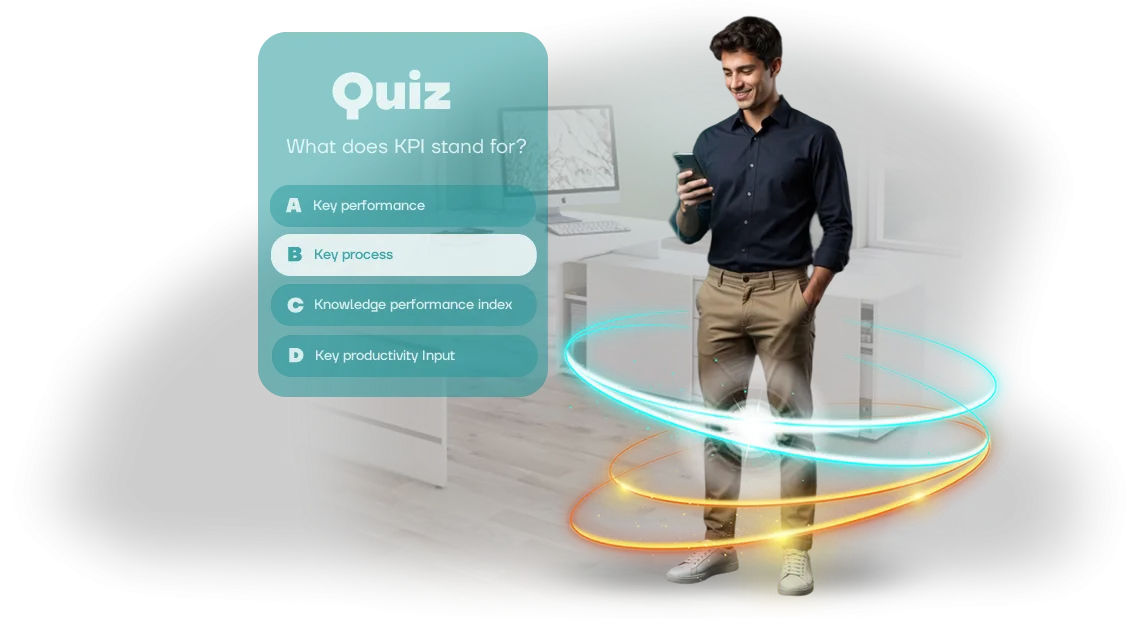
Why Training Without an Engineering Schematic Delivers No Results
Short “training clips” and multiple-choice tests stopped working long ago. An employee formally watches the material, as if serving out an obligation: the eyes see, but the memory does not engage.
Interest fades by the third screen, and along with it, confidence in one’s own actions drops. As a result, training consumes time and budget but has no effect on qualifications—neither in numbers nor in the employees’ real mistakes.
Without an engineering schematic of the process, knowledge remains fragmented. A person may know individual instructions but does not see how they fit together: what affects what, where the critical point is, what happens in a failure.
Such “broken” perception leads to slow reactions and typical mistakes in stressful situations. That is why training without an Engineering Schematic does not build skill—it builds an illusion of competence.
The consequences are immediately visible: the support department takes a long time to solve one task, managers get confused about regulations, and clients receive contradictory information. This is not only a loss of reputation but also direct financial losses.
The company spends effort on finding and hiring new people, when it would have been enough to properly structure the training of current staff.
To close this need, we develop training quizzes built as an engineering schematic of your department’s work.
Instead of dry slides, there is a clear sequence of actions in which the employee independently walks through the key branches of the process and sees the consequences of each decision.
Game mechanics hold attention, and the graphical schematic helps the brain build a complete picture.
As a result, training becomes fast and practical: staff remember algorithms, easily navigate non-standard cases, and make fewer mistakes. For business, this means higher qualifications without increasing headcount and better service quality with the same resources.
What Benefits Do Businesses Get from Engineering Quizzes
Engineering quizzes are not just a knowledge check but a tool that directly affects business metrics. Instead of passively watching presentations, employees engage in an active game process, which means they absorb the material better and apply it faster at work.
The first benefit is increased engagement. The competitive element and visible progress turn mandatory training into a challenge: employees return to the material on their own, discuss questions in the team, and ask for additional rounds. This reduces staff turnover and lowers retraining costs.
The second is knowledge systematization. Engineering schematics in a quiz help break complex processes down into clear pieces and build a unified action logic for all departments.
As a result, beginners reach the required level faster, and experienced employees fill gaps they may not have even known existed.
The third is fewer mistakes and higher sales. When every specialist acts according to a clear algorithm, the number of defects, returns, and conflict situations with clients decreases.
This directly affects the company’s reputation and repeat orders: a satisfied client returns and brings new ones.
Finally, the quiz gives the manager transparent analytics: you see which topics are well mastered and which need additional work. This allows you to target weak points without spending budget on general training.
The result is controlled competence growth that converts into measurable business results within a few weeks after launch.
Training Formats with Engineering Schematic for Business Tasks
Each stage of working with an employee solves its own task: one needs to be quickly onboarded, another checked before they are allowed to work, and a third developed into an expert.
Ordinary picture-based tests do not work here: engineering schematics require live understanding, not rote memorization. An employee who has been “crammed” with questions still gets lost during a real breakdown or non-standard situation.
We build quizzes based on engineering schematics—detailed 3D models of equipment and technological processes. The employee does not choose a text option but interacts with the schematic: finds a unit, identifies a malfunction, assembles the sequence. It is one and the same construction kit that unfolds to fit different business tasks.
| Format | For whom | What it gives the client |
|---|---|---|
| Onboarding | New employees | Fast entry into the role: less time from a mentor, fewer mistakes in the first weeks |
| Certification | Current personnel | Objective knowledge check without cheating: it shows who really understands the schematic and who is “swimming” |
| Development | Promising specialists | Growth of competencies and preparation of a talent pool without interrupting production |
We select the format to fit your task: number of questions, difficulty levels, and completion scenarios. The same set of schematics can be used both for training and for control—you only need to change the rules of the game.
You get not just a quiz but an assessment and development tool that is easy to update along with your equipment.
How We Create a Quiz: A Step-by-Step Process
Every quiz starts not with code but with understanding the tasks of your employees. We analyze what knowledge needs to be reinforced, in what format people learn comfortably, and how to measure the result. After that, we build a turnkey project—from scenario to launch.
- Brief and audit. We define goals, audience, and current materials. We understand how the quiz will fit into your training program.
- Scenario and mechanics. We choose question types, difficulty levels, and branching logic. We design a narrative that leads the employee through a virtual space styled as an engineering schematic.
- Content and 3D locations. We develop questions and hints. We create recognizable models and locations in Unity so the training looks modern, not like a boring test.
- Assembly and testing. We build the quiz, test it on different devices, and fix any flaws. You receive a stable version with no surprises.
- Launch and integration. We connect your learning management system or provide a link for employees. We set up access and, if necessary, run a pilot on one group.
- Analytics and support. We show results: who completed the quiz and where they make mistakes. We help update questions and adapt the mechanics to new regulations.
In the end, you get ready-made training that employees complete with interest, and you get clear numbers on material retention. The process is transparent: an intermediate result is visible at every stage. Your team does not need technical knowledge—all development and support are on our side.
What Is Included in the Deliverable: A Complete Training Package
When ordering the development of a training quiz, it is important to understand in advance exactly what the service includes. We assemble a full delivery package—from question content to technical support after launch.
You receive a ready-made training tool, not just a “toy” that your employees have to refine themselves.
The delivery package includes:
- A ready-made library of questions on your topic—engineering schematics, regulations, quality standards. The quiz content adapts to your tasks and business specifics.
- A completion scenario with clear navigation and feedback: the employee sees where they made a mistake and gets explanations. This speeds up material retention.
- Location design in an engineering schematic style—a visually familiar and memorable interface. Employees do not waste time learning an “unclear game” but immediately immerse themselves in training.
- The ability to independently update questions and add new blocks through a simple admin panel. You do not need to involve developers for every change.
- Technical support after launch: we are responsible for stable operation, update the system to fit your tasks, and help with setup.
- Training for your administrator: we hold a short session so the responsible employee can manage the quiz, view results, and make edits.
- Reporting for each participant: you see who passed the test, how much time they spent, and which topics caused difficulties. This allows you to fine-tune the training.
Thus, you get not just a quiz but a ready-made solution for employee training. Everything needed for launch is already included in the delivery package: content, design, setup, and support. All that remains is to invite employees to take the test and evaluate the result.
Case Study: How an Engineering Quiz Increased Engagement by 40%
The company InzhStroy—a manufacturer of metal structures—came to us with a typical pain point: training employees to read engineering schematics was conducted formally.
Lectures and paper tests gave engagement of about 20%, and a month later employees still confused symbols on drawings. The head of training wanted the material to really stick, not just be ticked off in a logbook.
We designed a training quiz in the style of an engineering schematic: using 3D models and spatial locations in Unity, the employee literally gets inside the structure. They have to find components, match them to standard symbols, and answer questions.
Errors are highlighted immediately, and correct answers unlock hints for the next level—this reinforces knowledge through action, not rote memorization.
What the Client Received
In two months, employees completed 1,200 training sessions. Engagement grew by 40%: instead of “sat through it and forgot”, managers saw active participation, debates about correct answers, and voluntary repeat attempts—their share reached 60%.
Time spent on initial training dropped by almost a third, and accuracy on the control test rose from 55% to 88%.
These results held even after implementation. Three months later, the client returned for a second module—for new departments and updated regulations. The quiz can be easily extended with new levels, so it works as a permanent tool rather than a one-time campaign.
Employees themselves ask for new rounds, and training is no longer a mandatory chore—it has become part of their work.
How to Choose the Right Quiz Format for Your Task?
The right quiz format is determined not by fashionable trends but by the specific task and the characteristics of the team. If you need to quickly check knowledge after initial training, a classic multiple-choice test is enough.
For practicing complex scenarios or sequences of actions, an interactive game in the form of an engineering schematic is better suited.
We help you choose a format based on your goals and team specifics. We take into account the composition of employees, the complexity of the material, and the expected result.
For a large team with different roles, a single format often does not work, so we combine quick surveys and deep game modules. This allows you to cover everyone and get a reliable picture of the skill level.
Our experience shows that the best effect comes from a format that mirrors the logic of how your team works. If engineers think in schematics, a three-dimensional world in the style of an engineering schematic feels natural.
The system is revealed through connections between elements, and the employee sees not abstract questions but their own work context. This approach is especially effective for training people in complex processes.
In this presentation, the quiz turns from a control tool into a learning tool. The employee does not just guess answers but starts to see dependencies within processes.
This increases engagement, reduces time spent on repeated explanations, and makes training part of everyday work.
We recommend starting with a short description of your task. We will identify the key scenarios, the employees’ current skill level, and the desired pace. Based on that, we will propose a suitable format and adapt it to your corporate style.
As a result, you will get measurable indicators of material retention and a quiz that employees complete with interest.
Frequently Asked Questions and Concerns: Honest Answers
Before launching a training quiz, the client always has doubts: will employees like it, will it break, how to integrate it into current processes. These are normal concerns—which is why we have collected honest answers to the most common questions. Below, straight to the point, without advertising promises.
What if employees don’t like it?
We run testing on your own employees, collect feedback, and refine the mechanics. As a result, you get a quiz that engages rather than collects dust on the portal. If something still does not work for you after that, we find a solution together.
What if something breaks?
We provide a guarantee on the solution. In the event of a failure, we quickly fix the problem: support and maintenance are included after launch. The response time is stated in the contract. You are never left alone with the issue.
How do we integrate it with training?
The quiz can be run in an LMS, on a portal, or during a class—all you need is the internet. We help with setup and provide instructions for administrators. We fit into your processes without unnecessary approvals.
We specify risks in the contract: deadlines, stages, responsibilities. You pay for a result that can be verified. If you still have doubts, ask us a question before launch.Ready to Improve Your Team’s Skills? Order a Quiz
Quizzes turn training from an obligation into a game—but only if the scenario is written for your team. We first identify which skills need to be developed and what result you want to achieve. That is why every project starts with a questionnaire, not a ready-made template.
Leave a request and get a questionnaire and a preliminary cost calculation. It does not obligate you to anything: filling it out takes 10 minutes. In the questionnaire, we ask you to clarify several points:
- what topic or product needs to be reinforced in knowledge;
- how many employees will take the training;
- whether ready-made materials exist—regulations, instructions, presentations;
- what result should count as success: a test, a certificate, fewer errors;
- whether you need a competitive mode, a team game, or individual completion;
- whether integration with your learning system is required.
Based on the answers, we will prepare a cost estimate and offer scenario options—from a compact quiz to a training game with a 3D location styled after your engineering schematic.
You will see what is included in each option and choose the best one in terms of budget and timeline.
Filling out the questionnaire saves weeks of negotiations: you immediately receive a transparent calculation, and we get a precise understanding of the task. This is the first step toward training that delivers measurable results.
Leave a request right now—by tomorrow, you will know the cost and timeline of your quiz.