

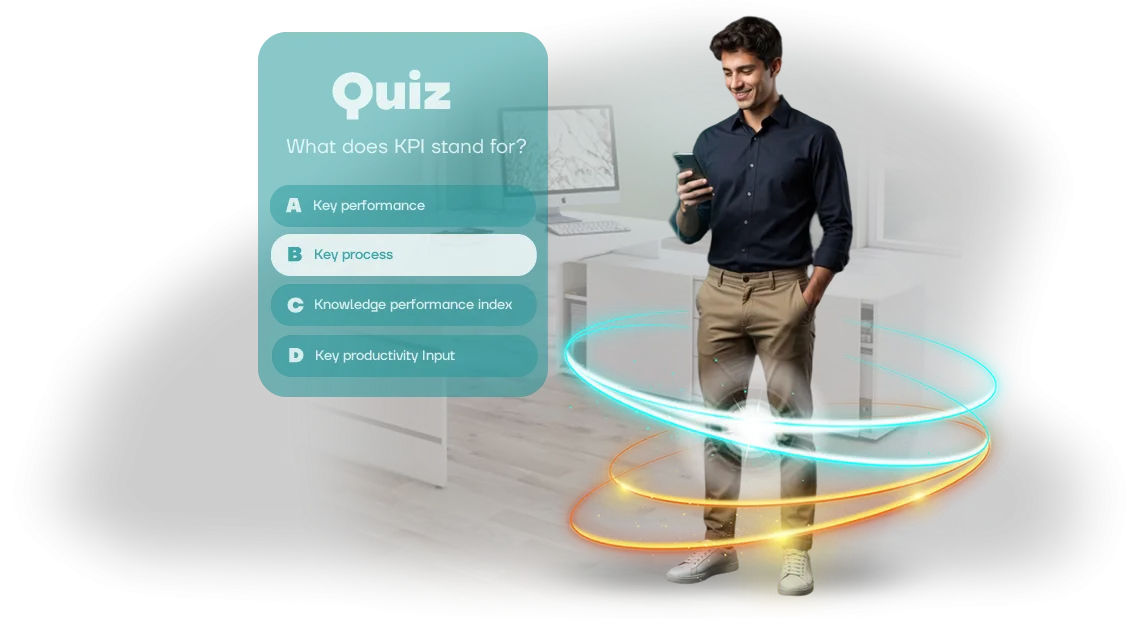
Low-Poly Quizzes: How to Make Employee Training Engaging?
Classic employee training often turns into a formality: video lectures play in the background, tests are clicked through randomly, and by the end of the quarter the manager sees depressing statistics — the material hasn't been mastered, mistakes keep repeating.
It's not about people being lazy. The brain only remembers what triggered an emotion, and a standard presentation or a dry document doesn't provide that.
Educational quizzes work differently. Short questions, instant feedback on answers, the spirit of competition — employees themselves strive to complete the course, see their results, and compare them with colleagues.
Gamification turns a mandatory procedure into a game, and a game holds attention far better than any slideshow. Another plus: a quiz can be completed in 10–15 minutes between tasks without disrupting the work rhythm.
The Low-Poly style amplifies this effect. Neat stylized worlds and characters look friendly, don't overload perception, and don't require powerful hardware — the quiz runs even on a regular office laptop.
Instead of visual noise, employees get a clean narrative: they're going through a quest, not a boring knowledge check. This style easily fits into the company's corporate identity and looks equally good on any screen.
At our team we've been creating educational Low-Poly quizzes on Unity for over 10 years and we know how to turn educational material into an engaging scenario.
We start with a short brief, propose a course structure and visual concept, and after launch we show measurable results: completion rate, engagement time, and growth in material retention.
What Benefits Does a Company Get from Educational Quizzes?
Higher Course Completion Rates
Employees are more willing to finish their training when it feels like an engaging game rather than a mandatory lecture. Quizzes with points, levels, and rewards turn the course into a competition, so the share of completed programs grows noticeably.
For the business, this means the money invested in training doesn't go to waste: more people gain the knowledge they need and apply it on the job. The company reaches its goals faster — whether in sales, service quality, or compliance with procedures.
Material Retention
The interactive format forces employees to actively recall and test themselves rather than just flip through slides.
Immediately after answering, the participant sees feedback and reinforces the correct option — this way, information is absorbed more deeply and stays in memory longer.
In real work situations, this is noticeable right away: fewer repeated questions, fewer mistakes, faster adherence to standards. For the company, this means lower operational costs and consistently high quality of work.
Employer Brand Recognition
Modern training is part of a company's image. A vibrant low-poly quiz shows that the employer keeps up with trends and invests in team development. These details strengthen the loyalty of current employees and spark interest among candidates.
The unusual format often gets discussed on social media — the company gains additional reach and a positive reputation in the job market. This contributes to the long-term attractiveness of the brand and helps bring strong specialists onto the team.
Low-Poly Quiz Formats for Different Goals
The quiz format determines how employees perceive the training and how quickly they apply new knowledge on the job. Some teams just need a quick check before a shift; others need a storyline that holds attention for 20–30 minutes. A properly chosen format increases engagement and material retention.
We create low-poly educational quizzes tailored to a specific task.
The graphics are optimized, so the game loads quickly on laptops, tablets, and phones — the client gets a finished scenario with 3D locations, characters, and a results scoring system without diving into technical details.
| Format | Who It's For | What It Gives the Client |
|---|---|---|
| Blitz quiz: 10–15 questions | New employees, regular knowledge checks | Quick assessment of material retention without taking time away from work |
| Location-based quest | Teams learning procedures and standards | Hands-on practice of work situations and action algorithms |
| Story-driven game with 3D characters | Onboarding new hires and professional development | Emotional engagement and high course completion rates |
Any format can be adapted to your industry and training scenario. Before work begins, we show you a demo fragment so you can evaluate the low-poly style and quiz mechanics on your own materials — this removes risks and speeds up approval.
How the Development of an Educational Quiz for Your Team Works
We've structured the process so you always know where the project stands and what's happening at each stage. No "black boxes" and no sudden surprises — just clear steps, regular review checkpoints, and a predictable result.
Typically, the path from brief to launch takes 3–6 weeks depending on the scope of the quiz. At every stage, you receive intermediate results and can make changes — this eliminates the "you built the wrong thing" situation after final delivery.
-
Brief and immersion in the task. You tell us about the training goals, audience, challenging topics, and desired format. We ask clarifying questions to understand which scenarios your employees actually need.
-
Concept and plan. We propose the quiz structure: number of questions, difficulty levels, game mechanics, and style. We align on the scenario and timeline — you see what the training will look like before development even starts.
-
Content and question creation. Our methodologists and editors prepare questions, answer options, and explanations. You review the wording to make sure it matches your internal procedures and corporate language.
-
Development of 3D locations and models. Artists create environments and characters in the Low-Poly style: neat, lightweight, and visually pleasing scenes. They don't distract from learning — they create the right atmosphere and hold attention.
-
Assembly and setup in Unity. Programmers put the quiz together: answer logic, score calculation, level transitions, progress screens. You get a working demo version you can open on a computer or tablet.
-
Testing and refinement. We test the quiz in real scenarios: we play through it multiple times, looking for bugs, awkward moments, and weak spots. We make fixes until the product is stable. You also get access to the test version and provide feedback.
-
Launch and support. We deliver the final version in a convenient format and help install it for your employees. After launch, we stay in touch: answering questions, fixing issues, and adding new questions or updating content when needed.
What's Included in the Educational Quiz Package for Employees
We deliver every project as a finished product, not as an "archive of files." You get a fully assembled Low-Poly educational quiz plus all the materials you need to launch it, run a session, and measure results. Here's what's specifically included in the delivery package.
-
Game levels and locations in the Low-Poly style: atmospheric scenes that immerse employees in work situations instead of boring slides. This boosts engagement and material retention.
-
Characters and animated episodes: realistic scenario playthroughs — from customer interactions to handling emergency situations. Employees see concrete examples, not abstract rules.
-
A clear quiz interface: question screens, a progress bar, a timer, and a final results slide. No additional training needed — employees simply open it and play.
-
Admin instructions: a short guide on how to launch the quiz, run a team session, and collect results. Even someone who has never worked with games can handle it.
-
Quiz result reports: we set up an export showing each employee's and each team's scores. You immediately see which topics have been mastered and which need additional review.
-
Source project files: the entire Unity project with a clean structure. If you'd like, your team can make edits — we also provide training and ongoing support.
-
Customization for your scenario: we adapt the questions, design, and visuals to your brand and business specifics, so the quiz feels like your own product, not a third-party template.
In the end, the package covers the entire cycle: from launch to evaluating employee training. You don't need to refine anything — the content and the tools for tracking results are all included.
Case Study: How an Educational Quiz Increased Team Engagement
When the company Sirius Logistik came to us, training 300 warehouse employees took two weeks and required three instructors. People sat through hours of lectures but forgot half the material within a month.
The task was simple: make training faster and significantly more engaging so it wouldn't have to be repeated.
We proposed an educational quiz in a Low-Poly game world built on Unity. Instead of slides and tests, employees go through short scenarios: receiving goods, sorting them into zones, responding to an emergency situation.
Questions appear right in the flow of the game — employees learn by making mistakes and immediately seeing the correct answer.
We measured the results after a month. Course completion reached 96% — previously, only 70% of employees attended lectures. Training time dropped from ten days to three, and the number of errors during goods receiving fell by 22%.
We also received a repeat order for training new employees — this is now the company's onboarding standard.
The manager noted that engagement grew beyond training itself: employees discussed the game among themselves, and photos and videos of playthroughs appeared on the company's social media.
For the business, this means free internal marketing and lower turnover during the probation period.
This case study is an example of how game mechanics with Low-Poly graphics turn mandatory training into an event the team actually looks forward to. The metrics prove it: employees don't just complete the course — they genuinely absorb the material and apply it on the job.
How to Choose the Right Format for an Employee Training Game?
Choosing the format of a training game is the first decision that affects both employee engagement and the project budget. There's no one-size-fits-all option: something that works great for a short safety quiz will fail for practicing complex negotiation skills. So the key is to match the format to the task, not to a trendy technology.
Start with the goal and the audience. How much material needs to be covered? How critical is an employee's mistake? If it's a quick knowledge check or instructions, a lightweight quiz with questions and feedback is enough.
If you need to teach people how to act in emergency situations, a scenario with environmental immersion — where the employee makes decisions and sees the consequences — is the better choice.
A common mistake is overpaying for expensive 3D graphics where simple mechanics would deliver the result. But skimping on visuals is also risky: a flat test doesn't create the right context, and knowledge doesn't stick.
The low-poly style offers the compromise: it looks modern, creates a lively atmosphere, and costs significantly less than photorealistic graphics. That's why we often recommend it for corporate training: it solves the problem without inflating the budget.
Choosing the right format means analyzing three factors: material complexity, the training scenario, and the expected outcome.
We conduct this analysis at the start of the project, propose 2–3 options, and honestly explain which one will get the job done and which would be overpaying.
In the end, you get a game employees enjoy completing, and the business gets measurable knowledge growth without unnecessary expenses.
Frequently Asked Questions About Educational Quiz Development
Before launching an educational quiz, almost every client asks the same questions: will the game break, is it hard to update, what if employees don't like it. Here we address the main concerns — and explain how quiz maintenance works after launch.
What if the quiz suddenly stops working?
No game is completely immune to issues, which is why we provide a warranty on the product after launch: during the warranty period, we fix any problems for free. Support doesn't end on the delivery day — you can always reach out to us if something goes wrong.
Is it difficult to change questions and tasks?
No — and that's the main convenience for you. We make the admin interface straightforward: adding a new question or adjusting a scenario doesn't require a programmer.
Your training manager can update content on their own in a few minutes, and we stay available for consultation if needed.
What if employees don't like the quiz?
Before the full launch, we run a test session with a small group and gather feedback. This helps us refine the presentation, question difficulty, or design before the quiz rolls out to the whole team. If something doesn't work, we improve it based on your feedback.
How long does development take?
A typical project takes about a month: from brief to a finished game. If you need it faster, we can discuss that separately. In that time, you get a low-poly quiz that works equally well on employees' computers, tablets, and phones.
Order an Educational Quiz for Your Team
An educational quiz is a way to turn a boring mandatory program into a game your employees will genuinely thank you for.
Instead of presentations and PDFs — competition, points, and excitement, with knowledge absorbed through practice rather than "just going through the motions." We handle the entire development cycle: from scenario to launch, so you don't have to piece the project together from different contractors.
The Low-Poly style keeps the game easy to process and quick to launch even on office computers. Employees complete the quiz without installing complex software, and you get clear statistics: who has mastered the topic and who needs additional training.
What you get after reaching out:
- A finished quiz based on your materials — no rewriting content from scratch.
- A scenario and questions adapted to your company's specifics and job roles.
- A training game in the recognizable Low-Poly style that colleagues will remember and talk about.
- A simple launch process: no dedicated IT department needed, an administrator can figure it out in an evening.
- The ability to update questions and add new rounds after launch.
- Support at every stage: from the test version to the first corporate record.
Starting the project is simple: leave a request on the website or message us in a convenient messenger. A manager will clarify your goals, show you quiz examples, and propose a timeline within one business day.
Then comes the brief, the plan, and immersion into your topic — so the result won't need to be redone.
Don't put it off until next quarter — your competitor is already investing in team training, and your employees are still memorizing material from paper handouts.
Order a quiz development today, and in a couple of weeks you'll have a tool that works for engagement and business results.