

Why do employees forget training? The solution is Material Design
Employees complete mandatory training, but after a couple of weeks they forget more than half of the material. Managers see the same thing: money spent on courses, regulations not followed, and mistakes repeated.
The cause is not staff laziness — the brain is wired to retain only vivid and emotionally charged experiences, while standard lectures and presentations are read as "noise" that gets erased without a trace.
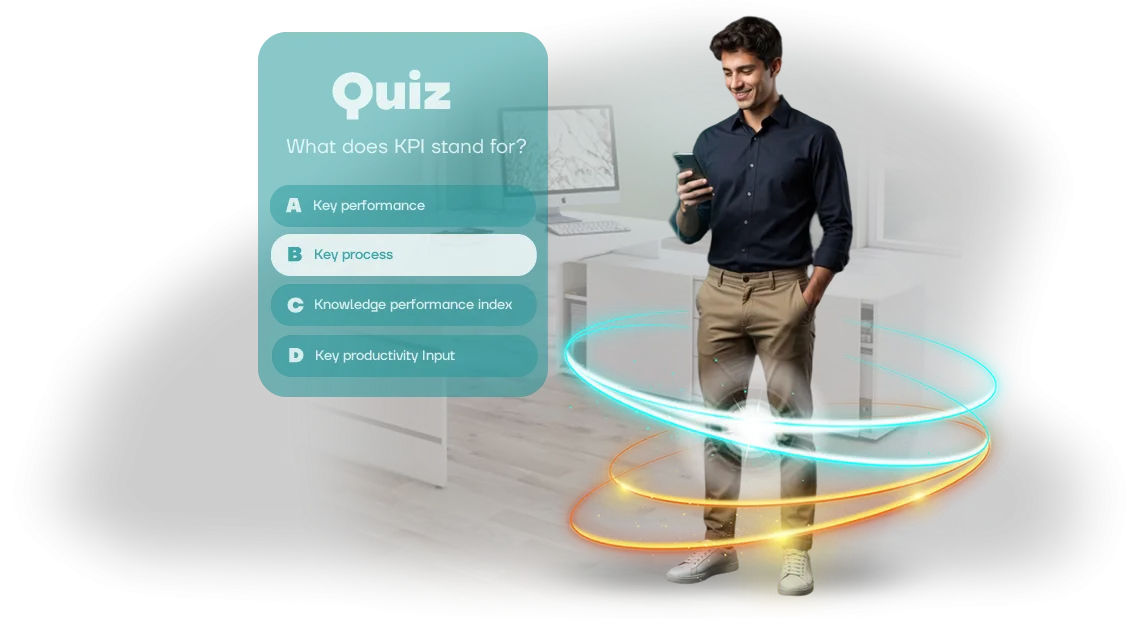
Corporate training needs a format that makes people think and remember, not passively listen. That is exactly what a 3D quiz in Material Design provides: clean interfaces, familiar navigation principles, and elements people are already used to in apps on their smartphones.
This style does not distract from the content; on the contrary, it helps the employee focus on the questions rather than figuring out the controls.
Game-based delivery turns boring instructions into scenarios where you have to choose what to do in real work situations. The employee goes through a scenario, immediately sees the result of their choice, and receives feedback — this activates the brain's natural reward system.
As a result, the right action is repeated, rules are remembered without rote memorization, and engagement in training noticeably grows.
Material in this format serves two goals at once: it keeps attention within the company, creating a reason for lively discussion, and gives managers clear numbers — who has mastered the material, where gaps are, which topics need more attention.
Training stops being an unclear obligation and becomes a tool that genuinely affects the quality of work.
For a company, this is also a foundation for the future: a quiz created once easily scales to new regulations and product changes, and employees themselves ask for "one more round" instead of postponing the course.
Training effectiveness stops depending on the lecturer's charisma — the result comes from a well-calibrated mechanic that our experience allows us to tailor to your business goals.
What benefits a corporate quiz brings
A corporate quiz turns learning from a mandatory chore into an exciting competition. Employees engage with enthusiasm, test themselves and each other — this naturally increases employee engagement.
Information presented in a game format is remembered better, and the scenarios completed remain in memory for a long time.
For new employees, this is a way to significantly shorten onboarding. Instead of reading long regulations, a newcomer gets to know the company through short questions, storylines, and visual scenes.
If the interface is made in the modern Material Design style, it is intuitive and from the first minute creates the right impression of the employer.
Gamification also helps with retention. When a person sees their progress, receives points and recognition from colleagues, work stops being a routine. Turnover decreases, team spirit strengthens, and managers can more easily track employees' actual knowledge.
A separate benefit is HR brand development. A bright quiz in brand style shows that the company uses modern tools and cares about team development. Candidates notice such details, and the employer image becomes more attractive.
In the end, the quiz pays off in several areas at once: increased engagement, rapid onboarding, lower turnover, and stronger reputation. One tool covers tasks that previously required separate programs and additional budgets.
Material Design quiz formats: from test to 3D quest
Employees are used to Material Design-style interfaces — familiar cards, large buttons, clear navigation. When a corporate quiz looks like familiar services, it does not feel off-putting and is easier to perceive.
We use this style so that an employee thinks about the questions rather than figuring out the interface.
One task can be handled in three different formats — the choice depends on your goal. Do you need to check knowledge after a course, engage newcomers, or hold a bright team event? We select the suitable option or combine mechanics so that the quiz delivers a measurable result.
| Format | For whom | What it gives the client |
|---|---|---|
| Test quiz | For quick knowledge checks after training | A clear picture: who has mastered the material, which topics need to be reviewed. Minimal time for preparation and launch |
| 3D quest | For onboarding, team building, corporate events | Emotions and memorization through immersion. Participants experience the scenario and connect the material with a vivid experience |
| Hybrid | For programs that need both control and engagement | First the game, then the test: employees go through the scenario and answer questions. You get both engagement and data on knowledge retention |
This flexibility allows you to cover different tasks without unnecessary costs. If you need to quickly measure knowledge — we take the test; if atmosphere matters — we add a 3D quest; if you want to combine benefit and celebration — we assemble a hybrid.
In any case, you receive a report on the results and an understanding of what to focus on next time.
How quiz creation works: from technical specification to launch
Creating a quiz for employees is not a mysterious process on the developer's side, but a clear sequence of steps where you control the result at each stage.
We work turnkey: from brief to training launch, we take on all tasks, and you receive a ready-made tool that immediately integrates into the team's workflow.
How we structure the work
- Brief and immersion. You describe the training goals, audience, and expectations. We clarify details so the quiz solves your specific task rather than being an abstract game.
- Plan and scenario. We agree on the question structure, completion logic, and timeline. You see how the training will look for an employee before development begins.
- Design approval. We select a style, including Material Design, so the quiz matches your brand and is convenient on any device. You approve the mockups before work starts.
- 3D content development and quiz assembly. We create game locations and training elements. At this stage, the quiz becomes a cohesive product, and you receive interim versions for review.
- Testing and refinement. We test the quiz across different scenarios: question accuracy, loading speed, and ease of completion. We fix everything before employees see it.
- Training launch. We place the quiz in your system, share links, or configure access. Employees complete training at a convenient time, and you see statistics.
- Support and development. We stay in touch after launch: we help, update questions when needed, and refine the quiz for new tasks.
This approach delivers predictable results and reduces risks. You always know what stage quiz creation is at and can influence key decisions without delving into technical details.
What is included in the quiz delivery package
When you order a quiz for employees, it is important to understand what exactly you will receive as a result. We hand over not a set of files, but a ready-to-use working product: you open it, connect it to your system, and launch training. The delivery package includes everything necessary — from the idea to technical support at launch.
- Quiz scenario. A fully developed structure: questions, answer options, scoring logic, and difficulty levels. The scenario is adapted to your specifics — you can include topics that are relevant specifically to your team.
- 3D models and locations. All visual elements are made in a unified Material Design style: clear shapes, neat graphics, modern color schemes. Thanks to this, employees immerse themselves in learning instead of being distracted by a "raw" picture.
- Sound accompaniment. Background melodies, question voice-over, and sound cues for correct and incorrect answers. Sound makes the quiz lively and helps maintain attention throughout the entire session.
- LMS integration. Each participant's results automatically go into your learning system. You see employee progress, the number of completions, and typical mistakes — without manual data collection.
- Instructions and guidelines. Short memos for the administrator and participants: how to launch the quiz, how to understand the interface, what to do if something goes wrong. Everything is written in simple language, without technical complexity.
- Implementation support. In the first days after handover, we stay in touch: we help launch it, answer questions, and if necessary promptly fine-tune the scenario or individual elements.
Such a package allows you to focus on the main thing — employee training and development, not technical details. You get a ready-made solution that quickly pays for itself through increased engagement and clear analytics.
Case study: how a quiz reduced onboarding time for newcomers by 30%
A newcomer in retail faces dozens of instructions: cash register, shelving, service standards. The training day turns into reading regulations, while mentors explain the same thing ten times over.
In the chain of construction hypermarkets «МастерСити», they realized: this way onboarding stretches to 3–4 weeks, and some employees leave before reaching live work.
We proposed replacing boring testing with a 3D quiz on Unity. Instead of abstract questions — game scenarios inside a location replicating a real store. The newcomer "goes through" a workday: accepts a delivery, helps a customer, checks stock.
The interface is made in Material Design style — familiar cards and buttons, so employees don't waste time learning the program itself.
The quiz result — onboarding 30% faster. The average time to enter the position decreased from 21 days to 15. 96% of newcomers reach the finale and pass the final scenario on the first try.
The number of questions to mentors fell by almost half: the employee masters the basics on their own. Two months later, the chain ordered a second version for training managers — with additional conflict situation scenarios.
Project metrics
- Onboarding time — 30% less;
- Course completion — 96%;
- Mentor workload — reduced by approximately half;
- Repeat order — training for managers.
We work on professional equipment and well-tuned tools, so the quiz works reliably even on weak computers in stores. And most importantly — the result is easy to measure: you see who passed, where they made a mistake, and which topic requires additional review.
Answering questions about quiz development
The question we hear most often: "What if the quiz fails at the most crucial moment?" For the client, it is important that the training goes smoothly: employees stay focused, and the result is right in front of them.
We address this issue already at the design stage — we build a Material Design-style interface that feels familiar and requires no training, and we test every scenario before launch.
To give you peace of mind, we answer the key questions about guarantees and support.
What guarantees are there that the quiz won't break?
Before launch, we run full testing on computers, tablets, and across different browsers. We check all scenarios: transitions between questions, score calculation, and display of results.
If a failure occurs after launch, technical support is available during business hours and resolves the issue quickly.
What should we do if employees have questions while taking the quiz? We set up built-in hints and reference blocks directly in the interface. An employee can resolve the question independently without interrupting the training.
And you retain a direct contact with the project manager — they help with any organizational matters.
How often can questions and tasks be updated? Content should evolve together with your company. We provide you with a simple control panel: you can change questions, add blocks, or edit answer options yourself — without a programmer. If needed, we take on ongoing support and update materials according to your scenario.
The main thing is that you are not left alone with the program. We support the quiz after launch, help with content and technical questions until the training starts delivering consistent results.
Order the development of a quiz for your employees
Submitting a request and getting a quote is simple: write to us via the form, and within 2 days you will have a ready-made commercial proposal. You will receive not an abstract "project estimate", but a document with a specific cost, timeline and work stages.
We adapt to your tasks: onboarding of newcomers, upskilling or certification. That is why we do not make "off-the-shelf boxes" — we tailor the format, volume and difficulty of the questions to your employees.
We also put all agreements in writing in the proposal, so there are no hidden extra charges or unexpected "surprises" along the way.
What you will get after contacting us:
- A transparent estimate — you know what you are paying for and can compare it with other contractors.
- Exact start dates and stage deadlines — you plan the preparation and launch of the training in advance.
- Format recommendations: from quick surveys to 3D locations in the Material Design style for maximum engagement.
- The quiz structure: breakdown by topics, number of questions and completion mechanics.
- A personal manager who will stay in touch at every stage — no "lost" emails and no long waits.
Leave a request in the form below — in the comments, specify the number of employees and the training topic. The next day we will start preparing your proposal. If you are unsure which format suits you, just write to us and we will advise you.
What if I have specific requirements for the quiz?
Every company is unique in its own way: its own regulations, standards, and specifics of work. That is why the question of whether a quiz can be adapted to your requirements is entirely fair.
We do not work from a template — every project begins with studying your processes, and it is they that become the foundation of the future training.
First, we immerse ourselves in your specifics: we study work instructions, talk with experts, identify key points that are truly important for knowledge assessment.
On this basis, we build scenarios and questions — not abstract ones, but those reflecting real situations from your employees' practice. This approach helps the quiz become part of the training rather than a formal test.
Quiz adaptation also concerns format, complexity, and even visuals. You can choose question types — from simple tests to multi-step cases — and set the required difficulty level for different groups of staff.
If the design style matters to you, for example Material Design, we integrate it into the learning game so that employees enjoy not only the content but also the appearance.
Specific requirements are not a problem for us, but a task that is interesting to solve. Need to test knowledge of internal instructions, highly specialized regulations, or even non-standard actions in emergency situations? All of this can be built into the quiz scenarios.
We take into account any unique processes and turn them into tasks understandable for employees, so that the learning result is measurable and useful.
Many clients doubt that their specifics can be correctly reflected in a game format. But it is customization to real tasks that helps increase engagement and material retention.
As a result, you get a quiz that speaks the language of your company, and employees see practical benefit and remember what matters better. Tell us about your requirements — we will propose a solution that fits your processes.