

How to Improve Industrial Safety When Employees Ignore Training
Formal instruction stopped working long ago: an employee signs the logbook, but a week later doesn't remember where the emergency exit is or how to act during a leak. Training turns into routine, and industrial safety becomes a formality — until an incident happens.
The consequences of this approach aren't measured in test scores but in real risks: injuries, production downtime, regulatory fines, and reputational damage. Management learns about the problem after the fact, when fixing it costs more than preventing it.
Personnel who haven't learned the rules are a ticking time bomb planted in the operational processes.
The problem is that you can't force people to memorize instructions. An adult learns only when they're interested and see personal meaning.
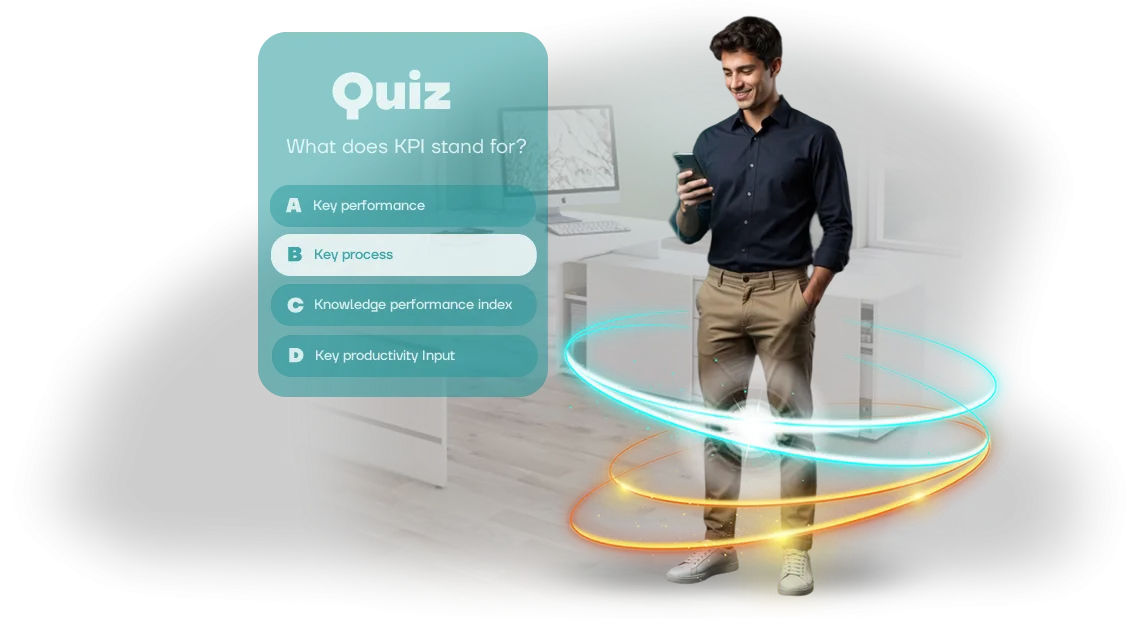
That's exactly why staff training in the format of quizzes and game scenarios delivers lasting results: the employee experiences the situation themselves, makes a decision, and sees the consequences — in a safe environment, before the mistake happens at a real facility.
We close the gap between formal instruction and real employee readiness to act. Instead of reading regulations — an engaging scenario that tests not memory but understanding.
This approach reduces risks, shortens the time needed for staff preparation, and gives management a transparent picture: who actually absorbed the material and who isn't ready yet to work under difficult conditions.
Industrial safety doesn't start with paperwork but with the behavior of a specific person in a specific situation. And if employees ignore training, that means it wasn't designed for them. We make it impossible to ignore.
5 Advantages of 3D Quizzes Over Traditional Tests
Traditional tests measure memory, not understanding. An employee formally answers questions and forgets the material within a week — and more importantly, doesn't change their behavior on the production floor.
A 3D quiz turns training into hands-on experience: the worker enters a virtual situation, makes decisions, and immediately sees the consequences.
The first advantage is engagement. Instead of boring questions, the employee goes through a scenario that resembles a real shift.
They actively look for the right solution because it's interesting, not because they "have to." Almost everyone completes this type of training — game mechanics hold attention and prevent distraction.
Second — memorability. Emotionally charged actions are remembered many times better than reading an instruction. A mistake that led to an accident, even a virtual one, stays in memory. The employee doesn't just know the rule; they remember what happens if they break it. This reduces repeat violations and makes training truly effective.
Third — risk reduction. In a 3D quiz, you can safely simulate the most dangerous scenarios: fire, leaks, working at height. A person practices their actions in a stressful environment without any threat to their health.
When such a situation occurs in reality, they'll already have a ready algorithm — and that directly affects injury rates.
Fourth — the ability to play out rare and complex cases. In real life, not every employee has encountered an emergency. A virtual environment lets you show such scenarios to everyone.
Plus, we adapt the game to your production processes and typical violations — this makes training targeted rather than abstract.
Fifth — transparent results for management. The system shows who completed the training, which mistakes keep recurring, and which topics the team keeps failing. You see not just scores but real risk areas.
With this data, it's easy to refine the program and strengthen weak points before they lead to an incident.
Bottom line: a 3D quiz increases engagement, memorability, and safety all at once. Training stops being a formality and becomes a tool for reducing production risks.
Quiz Formats for Industrial Safety: From Test to 3D Simulator
Safety training often becomes a formality: employees check the boxes but don't remember the rules. Most briefings don't change behavior — in a critical situation, people act on guesswork. To make training work, you need a quiz that engages and makes people think. This approach reduces the risk of accidents and the losses associated with them.
The quiz format depends on your goals: verify knowledge, practice an action sequence, or create full immersion in a dangerous situation.
We select the right option for your budget and team size — from a simple test to a realistic 3D simulator that reproduces production conditions. You get a tool that employees perceive not as a boring obligation but as an interesting challenge.
Format Options
| Format | Who It's For | What It Gives the Client |
|---|---|---|
| Basic Test | For checking the knowledge of the whole team after a briefing | Quick results in 15 minutes and an automatic report per employee |
| Scenario-Based Quiz | For practicing actions in emergency situations | Employees learn to make decisions with no production risk |
| 3D Simulator | For immersion in a realistic hazardous-area environment | Deep memorization of algorithms through emotional engagement |
| Combined Format | For distributed teams and different skill levels | Flexible training for any budget and result tracking in a single system |
How We Create a Quiz: From Brief to Launch in 4 Weeks
Developing a quiz for employees is not a set of questions but a complete learning product. We've structured the process so you can see how a scenario turns into 3D models and then into an interactive industrial safety simulator. All work takes four weeks — from brief to launch in your training program.
Development Stages
- Analysis of tasks and audience. We identify typical violations and determine which regulations employees need to practice.
- Quiz scenario. We develop the plot, situations, and hints so employees think and remember the correct actions rather than guessing answers.
- Development of 3D models and locations. We create recognizable areas: workshops, machinery, safety zones. This enhances immersion and helps transfer skills to real work.
- Interactive game assembly. We combine the scenario and 3D models. The employee sees the consequences of their decisions — this is more effective than reading instructions.
- Testing and refinement. We show the prototype to employees and managers and make revisions based on feedback.
- Launch and integration. We deploy the quiz in your training system and set up access and statistics.
- Post-launch support. We track results and update content if regulations change.
Bottom line: within a month, you get a ready-to-use industrial safety simulator that engages the team and reduces the risk of violations. All quiz development stages are transparent — you always see what's done and what's left.
What's Included in the Delivery: A Complete Training Package
You're getting not just a game but a ready-made training tool that can be launched immediately after implementation. We handle everything: from the script to technical support, so you don't have to assemble the solution piece by piece or coordinate with different contractors.
- **Script and training scenarios.** We write realistic situations in industrial safety — from emergency response to choosing the right equipment. Employees go through them in a game format and remember the correct procedure.- **3D locations and characters.** We create a recognizable environment: workshop, warehouse, construction site, office. Realistic graphics help employees immerse themselves in the context and perceive the quiz not as an abstract test but as training for real skills.- **Scoring logic and feedback.** Every answer includes an explanation: why it's correct and why it isn't. This way, employees don't just earn points — they understand their mistakes and act more consciously next time.- **Admin panel for management.** You configure questions, update materials, view results by department, and generate reports yourself. No programmers needed — the interface is as clear as a spreadsheet.- **Launch and training guide.** Ready-made checklists for administrators and employees: how to start, where to find results, what to do if there are questions. Implementation takes one business day.- **Support and warranty.** We help with installation and provide consultations on the system. If you need additional configuration or a new module, we'll build it as part of our ongoing collaboration.Bottom line: you get a complete package that covers all your needs, and your employees get a clear, engaging knowledge-check format. All that's left is to distribute access and track progress.Case Study: How a Unity Quiz Reduced Plant Injuries by 40% Industrial injuries aren't just missed deadlines — they mean reputational risks, fines, and the loss of skilled workers.Paper briefings and tests are quickly forgotten: within a month, an employee remembers less than half the material. That's why many plants are switching to gamified training, where knowledge is practiced in conditions close to real life.In this case study, our team created a training quiz in Unity for an industrial enterprise with 1,200 employees.
We developed 3D models of production locations — a workshop, a warehouse, an equipment area — and loaded them with scenarios: leaks, fires, and work at height.
The employee goes through the scenario and answers questions; for each mistake, the system shows the correct actions and explains the consequences.
Results over one year: workplace injuries at the plant dropped by 40%, and the share of employees who passed the training successfully on the first attempt grew to 96%.
Staff turnover didn't affect training levels: new hires get up to speed faster because the quiz works on any computer and doesn't require an instructor to be present. After the pilot launch, the plant ordered additional modules for other workshops.
The head of the occupational safety department assessed the project this way: "For the first time, we see training that people don't just sit through — they actually complete it with interest.
Employees are asking when the next session will be." Employees stopped treating the briefing as a formality — and that produced the main business impact.
Why Unity? Because this platform makes it possible to quickly build realistic 3D scenes and quiz logic, while the client gets an intuitive interface and the ability to change questions without involving developers.
For an enterprise, this means the system evolves alongside changes in regulations instead of becoming outdated after launch.
How to Choose the Right Format for Employee Training?
Choosing a training format starts not with technical details but with answers to three questions: how many people need to be trained, what budget is allocated, and which specific skills or rules you want to reinforce.
There's no one-size-fits-all solution — some businesses only need a light quiz, while others require a full-fledged learning game with 3D models of production areas.
If the goal is to quickly verify knowledge of industrial safety instructions among a large number of employees, a multiple-choice quiz is the optimal choice. It doesn't require much time, is clear to everyone, and immediately reveals the team's weak spots.
This format suits regular checks and helps maintain knowledge levels without taking people away from work for long.
When the priority isn't just checking knowledge but practicing actions in an emergency, an interactive learning game in a 3D location takes center stage.
The employee finds themselves in a familiar environment and makes decisions in conditions close to real ones — this multiplies engagement and material retention. For companies with 50+ employees and goals of reducing injuries, this format delivers tangible results.
The key is matching the quiz to the specific task. We help you decide after a short brief and combine formats when needed: quick tests for mass checks and deeper scenarios for key specialists.
That way, your budget works toward achieving the learning goal rather than a generic set of features.
Frequently Asked Questions About Developing Training Quizzes
Implementing a training quiz is a clear step, but it always raises client questions: will it disrupt the process, will the system be supported, who will help after launch. We answer the most common concerns so you can make your decision with confidence.
Is it difficult to implement a quiz into the current training process?
No, there's no need to prepare special infrastructure. The quiz works in the browser and connects to your learning management system. We'll set everything up and test it during the launch stage; your employees will start taking tests without a long adaptation period.
Is the quiz compatible with our LMS?
Yes, we use standard data exchange formats, so it integrates with most LMS platforms. During implementation, we run a compatibility check and adapt it to your system if needed. Results are automatically included in the overall reporting.
What happens after launch?
We don't disappear: we provide technical support, help update questions, and analyze results. If regulations or internal standards change, you can update the content quickly. The quiz keeps working reliably without constant oversight from your side.
Order a Quiz Development and Get Engaged Employees
Employee training pays off when it's actually completed, not just purchased. Regular tests and presentations are boring, so knowledge doesn't stick. A quiz with 3D locations turns a knowledge check into a game: employees engage on their own, compete, and remember safe-work rules.
We develop the quiz turnkey — from script and questions to deployment on your corporate portal. You don't need to understand game mechanics or administration: we handle every stage and deliver a finished product.
Leave a request — and we'll calculate the development cost based on your scenario, headcount, and timelines. It's free and doesn't obligate you to anything. You'll get a clear commercial estimate with no hidden work or technical fine print.
What's included in turnkey development:
- Analysis of your instructions and regulations, turning them into game questions and situations from real work.
- Creation of 3D enterprise locations and characters that model work processes.
- A system of rewards, ratings, and feedback — employees see progress and compete to reach the top.
- Adaptation to your corporate portal so employees take the quiz without installing any apps.
- Administrator training: how to change questions, add participants, and view statistics.
- Post-launch support: we respond quickly to questions, make edits, and refine scenarios.
Ordering a quiz means getting a tool that works for safety and engagement every day. Leave your contacts — we'll get in touch, answer your questions, and prepare a cost and timeline estimate for your company within one business day.