

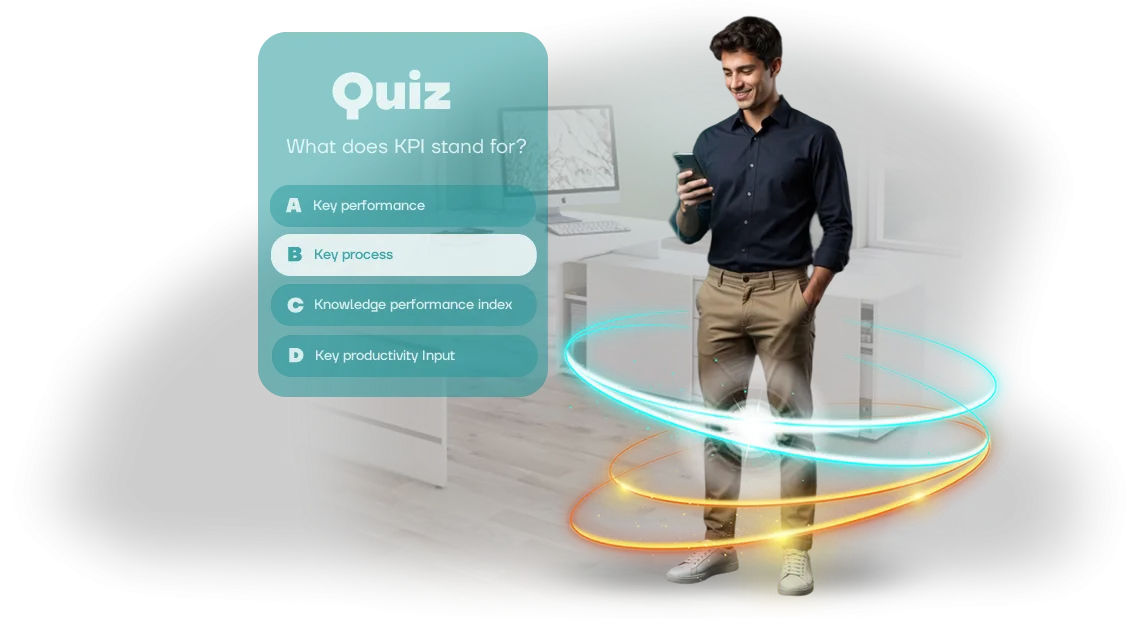
Employees Don't Apply Knowledge: Why a Realistic Approach to Training Is Needed
Every manager has faced the same situation: employees complete training and pass tests successfully, but a week later they're working the same way as before. The knowledge is there, but the results don't change.
This is the main problem with corporate training — it remains theory that never translates into real action.
The reason is that classic formats deliver information, not experience. Employees memorize the rules but never encounter situations where they need to apply them. The Realistic approach solves this problem: training is built around believable scenarios from everyday work.
Instead of abstract questions — concrete challenges where decisions have to be made and consequences are visible, just like in real work.
This format reinforces skills naturally. When a person operates in an environment close to reality, the brain connects knowledge to actions. A mistake in training doesn't cause losses but provides valuable experience.
As a result, employees leave the quiz with practiced behavioral patterns, not just a collection of facts.
That's why we use the Realistic approach for employee training: we create quizzes where every question is a work situation and every answer is a step toward the right skill. The employee doesn't passively consume information but actively practices the required actions.
This turns training from a formality into a tool that changes work habits, increases team efficiency, and delivers measurable results for the business.
What a Quiz Delivers: Higher Engagement and Verifiable Results
Employees passively go through traditional courses: information is poorly absorbed, and after a week only vague impressions remain. An educational quiz turns the process into a game where each participant is engaged in action rather than just flipping through slides. This is a fundamentally different level of material retention.
Engagement grows through the competitive element and realistic 3D scenes that create a sense of presence. Employees don't just read theory — they apply knowledge in simulated situations close to real work tasks.
This approach holds attention and motivates the team to complete training, not just go through the motions.
For business, the main thing is verifiable results. The quiz provides transparent statistics: who has absorbed the material, which topics are difficult, and where additional training is needed.
Managers see an objective picture of their team's preparedness and can respond in a timely manner rather than relying on subjective assessments.
A well-designed quiz scenario works to boost motivation: employees see it as a challenge and an opportunity to prove themselves, not as a boring obligation.
Realistic graphics and thought-out scenarios on a professional engine create a full-immersion effect — this keeps interest high and builds a habit of regular learning.
In short, a quiz solves three tasks at once: it increases engagement, gives measurable learning outcomes, and strengthens team motivation. That's exactly what we build into every project — from idea to finished product.
Realistic Quiz Formats: Which Scenario Each One Fits
Realistic quizzes are not just tests with multiple-choice answers. They let employees experience a situation as close to real work as possible: from a conversation with a client to acting in an emergency.
But for a format to solve a specific problem, it needs to be matched to the training stage and the staff's level.
Newcomers and experienced employees have different needs: the former need to be safely introduced to processes, the latter need to be quickly checked for gaps. Compare the basic Realistic quiz formats we integrate into training programs.
| Format | Who it's for | What it gives the client |
|---|---|---|
| Scenario simulation | Newcomers, employees on probation | Safe practice of real situations: mistakes don't hurt the business but build experience |
| Knowledge check in a Realistic format | Employees after theory, regular certification | Quick gap diagnosis, clear team statistics, shows who needs to be trained and on what |
| Quiz quest | Team during onboarding, cross-functional training | Engagement with standards and regulations through play, competitive spirit, high material retention |
The choice of format depends on the goal. Need to quickly bring a newcomer up to speed — use scenario simulation. Need to objectively assess knowledge — a Realistic check works. Want easy training with emotions and team spirit — use the quest.
In any case, you get a tool that integrates into the learning process and delivers measurable results: reduced time to onboarding, higher quality of work, and clear statistics for managers.
How Development Works: From Brief to Launching the Training Game
We've structured development as a clear seven-stage roadmap: you always know what's happening, who's responsible for what, and when you'll get the finished game. All communication is in plain language — no technical detail, but clear deadlines and approval points.
- Quiz brief. You tell us about your employees, training goals, and the tricky parts of the material. We ask clarifying questions and record expectations and deadlines.
- Content approval. Together we define questions, answer options, and the game's storyline. You approve the texts and logic — changes are made before development starts, so nothing has to be redone later.
- Visual concept. We show you an example of a location and characters in a realistic style on Unity. You see what the future game will look like and adjust it to your corporate style.
- Creating 3D models and locations. We build the environment, interiors, and objects employees interact with. In parallel, we assemble the quiz's game mechanics.
- Demo version and testing. You receive an intermediate build and check it on your own devices. We fix errors and take your feedback into account before launch.
- Training launch. We deploy the game for all employees, configure access, and give administrators a short briefing. At this point, you already see the first results from those completing it.
- Support and development. After launch, we stay in touch: we help with questions, collect completion statistics, and add new levels or questions if needed.
This sequence removes the biggest risk — the "we're doing something, but no idea what the result will be" situation. At each stage you approve the work, and only then do we move forward, so the project never drifts off course.
What's Included in the Delivery: A Complete Set for Launching Your Quiz
After the project is complete, you receive a full delivery package — everything you need to launch the training quiz without involving developers.
No "open questions": every element is ready to work, and the support team stays available to help adapt the solution to your scenarios.
The package includes:
- A ready-made Realistic-style training quiz: a fully configured application with realistic 3D models and locations that can be immediately shared with employees.
- Admin panel: a convenient interface for managing questions, answers, and scenarios — you update content without a programmer.
- Launch materials: installation instructions for work computers and the internal portal, a first-run checklist, and answers to common user questions.
- Training materials for the team: short video instructions for administrators and a guide for employees, so the start goes smoothly with no unnecessary support requests.
- Operations documentation: a detailed guide to updating assignments, backup, and technical support — all the necessary information in one place.
- Source files and settings: structured project data, so you remain the owner of the solution and can continue developing the quiz.
- Warranty support: a free support period during which we quickly fix issues and help with the launch.
This is not just a "handover of files" but a complete delivery package. You get both a finished product and the knowledge and support — everything needed for the quiz to run reliably and deliver business value from day one.
Case Study: How a Training Quiz Increased Engagement by 40%
At the federal coffee chain "Berg", employees went through standard training: presentations, tests, instructions. Managers complained that newcomers remembered little and started making mistakes in service standards after a month of work.
Engagement in training was falling — staff took the tests "just for show," and results didn't affect their work.
We suggested replacing the boring test with a realistic scenario. Using Unity, we built a virtual coffee shop with an exact copy of the equipment layout, the cash register, the pickup area, and typical guests.
Employees found themselves inside a familiar environment and made decisions: how to greet a guest, which drink to suggest, what to do in a conflict. A wrong answer immediately showed consequences on screen, and hints were built right into the scene.
The result of the quiz exceeded expectations. Staff engagement rose by 40%, the number of employees who completed the training reached almost 90%, and the average score on the final test jumped from 71% to 93%.
Newcomer onboarding time dropped by a third: they stopped being afraid of real situations because they had already "lived" them in the game. Two months later, the chain ordered an expanded version for store managers — with dialogues and conflict situations.
The chain's training manager noted: "The best corporate case I've seen: people redo the scenario themselves to get the maximum score." A second run confirmed steady demand — the quiz became part of onboarding and annual certification.
How to Choose a Format for Your Task If You Have Specific Requirements?
Specific requirements are not a limitation but a reason to build the quiz exactly to your task.
We don't force training into a ready-made template; we adapt the format to the scenario: the specifics of the profession, the employees' skill level, the technical conditions of the platform, and even time constraints.
For example, if the company has remote warehouses or scattered offices, we make a quiz that works equally reliably on any device — from a desktop computer to a tablet.
If you need to test not knowledge but an action algorithm in an emergency, we package the material into a simulation with branching scenarios. Built-in statistics show managers which topics are poorly understood and where additional review is needed.
It's also important that adaptation doesn't inflate the timeline. We collect the brief in advance, record hard requirements, and propose a solution that fits your schedule.
In 10 years of practice, we've accumulated ready-made mechanics for non-standard cases: quick surveys before meetings, long courses with intermediate checks, quiz quests for large events.
As a result, you don't get "a quiz in general" but a tool that solves a specific business problem. This format is easier to implement; employees see it as part of the work process, not some abstract test.
We take care of the details so all you have to do is evaluate the result: higher engagement and real numbers on material retention.
FAQ: Training, Timelines, and Technical Support
Before ordering a training quiz, you probably have questions about timelines, technical support, and updates. That's natural — we've prepared answers to the most common ones so you can make a decision with full clarity.
How long does quiz development take?
It depends on scope. A standard course with about twenty questions and a realistic 3D location in the Realistic style takes two to three weeks.
If you need more scenarios, additional characters, or integration with your learning system, we'll create a custom plan and lock the timeline into the contract.
Who handles technical support after launch?
We support the game after launch too: we monitor stability, quickly fix errors, and help your team learn the interface. During the warranty period, support is included in the project; after that, it's optionally available on transparent terms.
Can we update the quiz without developers?
Yes. We design the quiz so your employees can independently change questions, add new answer options, or adjust the difficulty. Learning how to manage it takes less than an hour. If needed, we'll connect your corporate system so results automatically appear in reports.
What quality and timeline guarantees do you provide?
We work under a contract that specifies timelines, scope of work, and warranty obligations. Before launch, we test the game on different devices so it runs smoothly both on office computers and on employees' laptops. You get a working product that won't require endless refinements.
Launch Training Your Employees Will Actually Complete
You already know that ordinary courses don't work: employees close the tab, and test results don't reflect real knowledge. A training game for employees in the Realistic style captures attention and turns the test into an exciting quest.
All that's left is to take the next step — submit a request for a quiz, and we'll build training around your task.
Here's what you get immediately after contacting us:
- We'll show you a demo of the training game on your scenario — no abstract presentations.
- We'll agree on a training launch plan: the set of quizzes, deadlines, and format.
- We'll adapt the mechanics to your employees' level — from beginners to experienced specialists.
- We'll integrate the quiz into your corporate learning management system or launch it as a separate workspace.
- After launch, you'll see completions and results in real time — for each employee and team.
- We stay in touch: support, refine questions, and add new scenarios.
Submitting a request for a quiz takes less than a minute. After that, we'll set up a call, clarify goals, and show you how the training game will fit into your process. The launch is on us: you get a tool that employees complete to the end rather than abandon halfway through.