

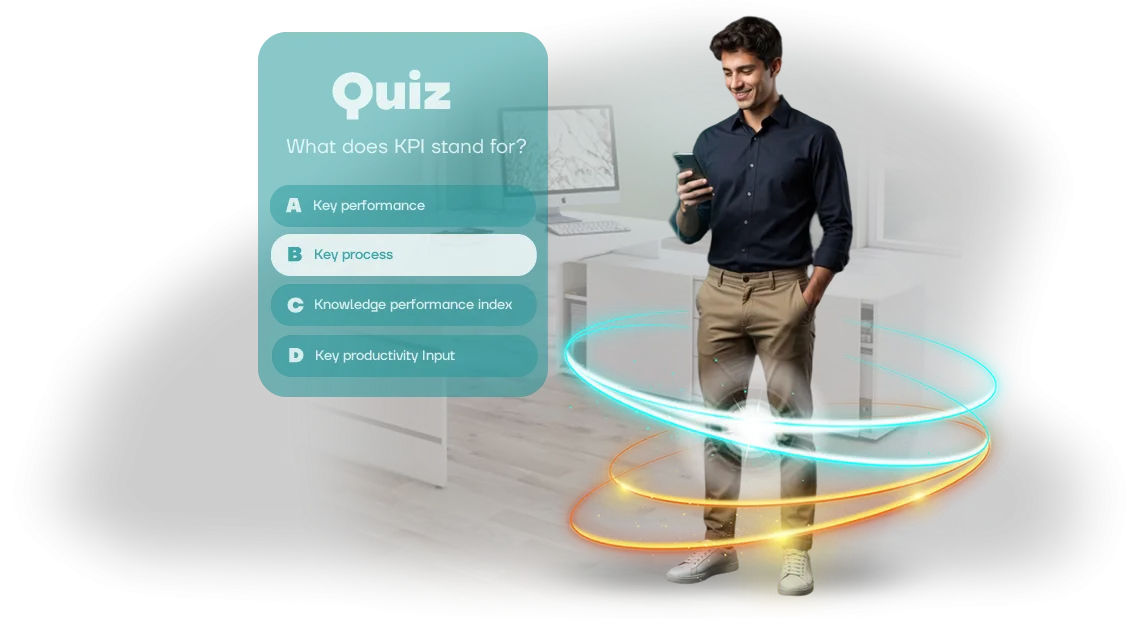
Why do quizzes for the public sector teach better than lectures?
Lectures and manuals in the public sector rarely change employee behavior. A person listens to the material, but a week later forgets the details of the regulations, and a month later acts according to the old pattern again — with the same mistakes and penalty risks.
The problem is not laziness but the format: passive perception does not create the necessary neural connections.
Training quizzes solve precisely this problem. The employee does not listen but actively answers questions, receives instant feedback, and remembers the correct algorithm through their own mistakes.
Gamification for employees adds a competitive element: colleagues take the quiz, compare results, and discuss difficult questions. As a result, training effectiveness grows — the material stays in memory for months, not until the end of the workday.
This is especially important in government institutions: there is high staff turnover, a large number of regulations, and responsibility for every action.
When knowledge is reinforced through real-life scenarios, employees make fewer mistakes in documents, adapt faster to new rules, and interact with citizens more confidently.
The manager sees a measurable result: fewer repeated questions, higher application processing speed, and fewer violations.
We design quizzes tailored to your organization’s specifics: we immerse employees in the context of their job responsibilities and make training short, clear, and engaging.
No boring tests — only live scenarios after which employees say, “now it’s clear how to do it right.”
What business tasks does game-based learning solve inside a company?
Employee training is often seen as a formality: lectures, presentations, checkbox tests. As a result, knowledge is not retained, and mistakes are repeated — especially in the public sector, where regulations and procedures change regularly.
The game format solves this problem: it engages employees in the process rather than forcing them to mechanically memorize instructions.
Game-based learning increases employee engagement. When instead of a boring document employees need to complete a quiz with points, levels, and feedback, natural competition kicks in.
People complete the training not because they were “ordered to” but because it is interesting — and as a result, they actually absorb the material.
A quiz works as a knowledge assessment tool. The manager sees who has mastered the topic and who made mistakes — and exactly where. This allows for targeted improvements to the training program and help for those lagging behind, without meetings or manual checking.
Training happens without disrupting work. Short 5-7 minute rounds easily fit into the workday: employees answer questions between tasks instead of sitting through a mandatory two-hour course.
This is especially important for organizations with large headcounts or distributed branches — no schedules are shifted, and everyone learns at their own pace.
The game standardizes knowledge within the company. All employees go through the same scenario, answer the same questions, and follow the same current regulations.
This creates a uniform standard for performing tasks and reduces errors caused by “different interpretations” of procedures. In government structures, where the cost of an error is high, such control is especially valuable.
We have been creating training quizzes for over ten years that solve exactly these tasks: they engage, assess, and align the team’s knowledge level. Below is how this works in practice.
2D quiz formats for public sector tasks
In government structures, training and knowledge assessment are not a one-time event but an ongoing process. An employee moves from learning regulations to annual qualification confirmation.
Each stage requires its own format: one helps quickly onboard newcomers, another objectively evaluates staff.
A 2D quiz covers both tasks. It scales easily to different scenarios: short onboarding tests, full certification quizzes, and intermediate knowledge checks. Below is how this looks in practice.
| Format | For whom | What it gives the client |
|---|---|---|
| Onboarding quiz | New employees | Reduces time to full productivity, lowers the burden on mentors |
| Certification quiz | Employees before being allowed to work | Objective knowledge assessment, transparent certification procedure |
| Annual staff evaluation | All employees | Identifies gaps, provides a basis for the training plan |
| Practice quiz | Current employees | Keeps knowledge up to date without interrupting work |
This approach builds a continuous line: adaptation → regular practice → certification. Each format is tailored to your internal regulations and your agency’s specific needs.
We use the Unity game engine — this ensures stable rendering and fast quiz loading even on weaker work computers.
As a result, you get not just tests but a tool for managing staff knowledge: you understand who has learned what, and where additional training is needed.
The formats combine easily — for example, after onboarding, an employee is automatically allowed to take the certification quiz. This saves time and eliminates manual checking errors.
How we develop a quiz: step-by-step process
For the public sector, transparency and control at every stage matter. That is why we have structured the quiz development process so that you see intermediate results and can make changes before production starts.
Quiz development stages
-
Brief and goals. We define who is being trained, which regulations and topics need to be covered, and how the result will be measured. We agree on evaluation criteria.
-
Scenario design. We create the quiz structure: questions, answer options, explanations. We send you the text for quiz approval — you adjust the wording and approve the content.
-
Design and prototype. We show screens in your corporate style. You confirm the visual appearance before full development.
-
Game development. We build the quiz on a professional engine with a secure server side: results are saved and ready for reports.
-
Testing. We run a pilot with a small group of employees, collect feedback, and fix any rough edges.
-
Training launch. We place the quiz on your platform or open access, train administrators, and hand over instructions.
-
Support. We monitor completion statistics, help update questions, and adapt the quiz to new documents.
Thanks to this process, approval proceeds without delays: you control every stage, and the training launch happens exactly on time.
What’s included in the delivery: a kit for launching the quiz
You receive a ready-to-launch quiz kit — nothing needs to be developed, assembled, or figured out by your own staff. Everything, from question logic to the final results report, is already packaged into a clear system that can be launched at any time.
Here is what the delivery includes:
- Question scenarios tailored to your specifics. Ready-made blocks of 10–30 questions: regulation checks, knowledge of internal procedures, and industry-specific standards. Scenarios can be adapted for different employee categories and skill levels.
- Quiz design in your corporate style. Branded styling: colors, logo, fonts. Employees see familiar identity — the quiz feels like an internal project, not a third-party tool.
- Integration with your systems. We connect the quiz to your corporate portal, HR platform, or learning environment. Employees take the test in a familiar interface, without installing additional software or following external links.
- Administrator guide. Step-by-step instructions: how to launch the quiz, add new participants, view results, and export reports. An employee without technical training can handle it — everything is explained in plain language.
- Results management dashboard. You see in real time who passed, who made mistakes on which questions, and which topics need review. This is ready-made analytics for the training and HR departments.
- Training for your team. We give a short walkthrough for administrators: how to use the system, how to read reports, and how to update questions. It takes one working hour and resolves all operational questions.
- Technical support after launch. You are not left alone with the system: we help with updates, answer employee questions, and quickly resolve any issues with the quiz.
This kit covers the full cycle: from idea and scenarios to launch and support. All you need to do is set a date and invite employees — everything else is ready.
Case study: how a quiz reduced the number of errors among employees
Managers of government institutions often face the same problem: new regulations and instructions exist, but employees keep making mistakes. Regular lectures and memos do not work — information is forgotten within a week, and control measurements show only slight improvement.
We encountered this request when implementing a training quiz for a government institution.
Instead of another instruction session, we proposed a game format: employees went through short scenarios with questions on key regulations and immediately saw correct answers with explanations.
This approach turned boring documentation study into a competition and allowed the material to be reinforced in practice.
The results exceeded expectations: the number of employees who completed the training to the end increased by 40%, and the number of errors in work operations decreased by 30%.
Managers noted that staff became faster at navigating changes and asked fewer clarifying questions — the quiz closed exactly the gaps that had previously caused the most problems.
The secret behind this effect is that the quiz does not just test knowledge but builds the correct action algorithms. Employees absorb the material through practical situations rather than rote memorization, so they make fewer mistakes in real work.
The institution now plans to expand the quiz to new departments and use it for regular rule refreshers.
How to choose the right quiz format for your task?
Choosing a quiz starts not with the question “which engine to use” but with the training goal. In the public sector, this is usually regulation knowledge checks, professional development, or introductory briefings for new employees.
Therefore, the key selection criteria are audience coverage, frequency, and the result the manager needs: just a completion mark or actual material retention.
If the task is to quickly check the knowledge of a large number of employees and get an objective picture, a classic format with questions and answer options works well. It scales easily, is understandable for participants, and requires no special preparation.
This option is convenient for scheduled certifications and mandatory training when it is important to record completion.
When it is more important to engage employees and turn training from a checkbox into a memorable process, it is worth choosing a game-based quiz with a narrative, levels, and feedback.
It works no worse than a regular test, but employees go through it with interest, and the material is absorbed more deeply. This format works well for team competitions, newcomer onboarding, and reviewing complex practical cases.
Pay attention to two more points — frequency and reporting. If the quiz is needed once for a special event, a simple solution may be enough.
If it will become a regular knowledge control tool, plan for the ability to update questions and automatic statistics for each employee and department.
We help you choose the right quiz for your specific task and your organization’s regulations. We discuss goals, audience, and format — and only then prepare a solution that fits into your workflows and delivers measurable results. You do not need to understand technical details; just describe the task — we will handle the rest.
Addressing common concerns: security and reliability
Managers’ concerns are usually not about the quiz itself but about its security and reliability. This matters especially in the public sector, where data protection and operational stability requirements are higher than in commercial projects. We answer three key questions — without technical details but with clear guarantees.
How is employee data protected?
Quiz results are stored on a secure server infrastructure, and only authorized persons have access. During transmission, data is encrypted and access rights are separated — this meets basic information security requirements in the public sector.
We do not share materials with third parties and do not use them for advertising or any unrelated purposes.
What if employees don’t like the format?
The quiz is designed for your audience: short rounds, clear questions, elements of competition and humor — it feels like a learning game, not a strict examination. Before launch, we run a test pass with a small group to adjust difficulty and presentation.
Based on our project experience, employees themselves ask for more and look forward to the next round.
What happens during outages or technical issues?
We build in a safety margin: the server architecture handles all employees working simultaneously, even at peak launch times. If a temporary failure still occurs, results are saved automatically, and the participant continues from the same point.
Technical support is provided during the quiz: a specialist is on call and quickly resolves any issues.
These measures eliminate the main risks and allow you to launch the quiz without stress for the manager and with comfort for employees. Still have doubts? Contact us — we’ll briefly discuss your case and show how we handle security in similar projects.Contact us to launch a quiz for your employees
Leave a consultation request — we’ll analyze your task and propose a quiz format that fits your team. We’ll prepare a commercial proposal with clear timelines and cost calculated after audit, as well as provide demo access so you can evaluate the interface.
We work with the public sector, so we account for reporting and security requirements — and we also help you formulate a technical specification if you don’t have one yet.
What you get after contacting us:
- A personal consultation on the quiz scenario and mechanics for your employees.
- Demo access to a sample quiz — see what game-based training looks like.
- A commercial proposal with fixed timelines and work stages.
- Cost calculated after audit based on your budget and number of users, with no hidden fees.
- Support at all stages: from development to launch and results analysis.
- The ability to integrate with your corporate training system or government employee portal.
We work on the professional Unity engine, so the quiz runs smoothly on employees’ computers and tablets without delays. This is especially important for the public sector: training proceeds without failures even during large-scale launches.
Ordering a quiz is simple — send a request, and today we will discuss the details and schedule a demo time. We will respond within one business day.