

Why Clients Leave: Why Cosmetology Needs Educational Quizzes
Clients don't leave because a procedure has stopped being in demand. More often than not, the reason is the specialist's lack of confidence: couldn't answer a question about ingredients, didn't select home care, showed hesitation in the algorithm.
The guest remembers not the service itself, but the feeling of staff professionalism — and when it's missing, they look for another salon.
Staff training in cosmetology often comes down to one-off lectures that are quickly forgotten. Yet it's precisely the specialist's qualification that directly affects repeat visits and the average ticket.
Regular upskilling of specialists gives the salon predictable service quality, and clients confidence that they're in safe hands.
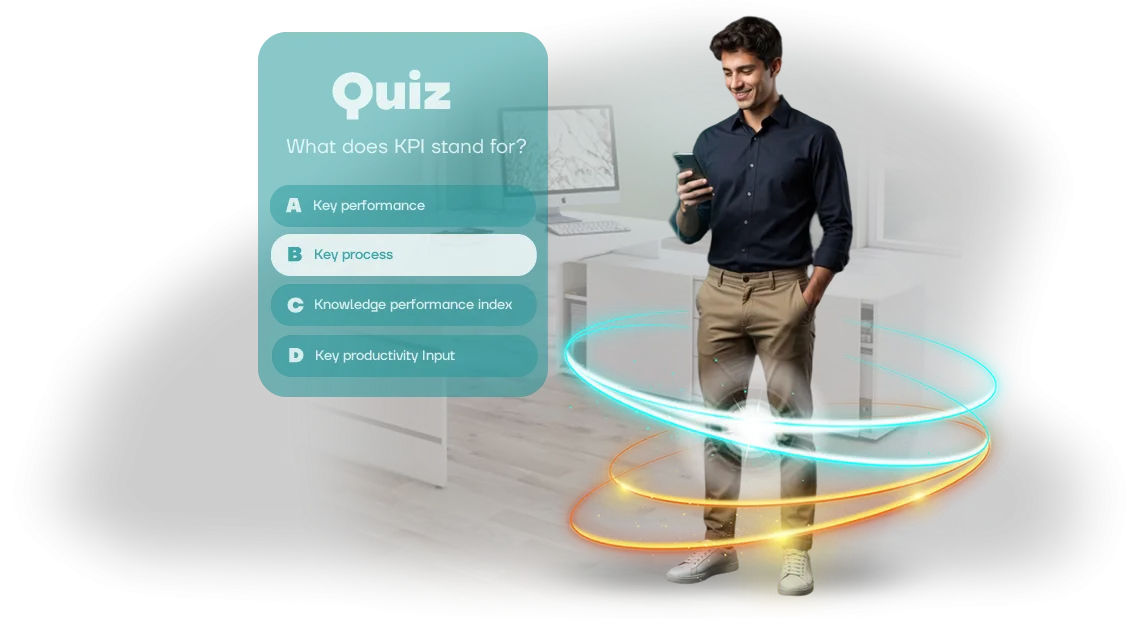
An educational quiz solves this problem using game-based learning methods. Employees don't read boring instructions — they go through short game rounds with questions about product ingredients, contraindications, and service standards.
Engagement is higher, knowledge sticks naturally, and the result is easy to verify: who has grasped the topic and who needs extra support.
This format improves qualifications without disrupting work — specialists complete the quiz from their phones in a few minutes. The manager sees each employee's progress and can adjust training in time.
As a result, not only the team's competence grows, but also client retention: guests return to specialists they trust.
We develop educational quizzes tailored to the needs of cosmetology clinics: clear scenarios, questions about your procedures and products, adapted to each specialist's level.
This closes the gap between "we need to train" and "we trained, but nothing changed" — and turns the team's knowledge into a steady stream of regular clients.
5 Benefits a Salon Gets from Implementing Quizzes in Cosmetology
Quizzes in cosmetology aren't just a knowledge check — they're a tool that directly affects the salon's profit. We develop educational quizzes on a professional game platform — this delivers consistent results and clear value for business.
Fast Specialist Onboarding
New employees don't need to study instructions for weeks. Short quizzes help them master procedure standards and protocols in a matter of days. The manager immediately sees from the results who's ready to work with clients and can relieve experienced mentors of extra load.
Improved Service Quality
When a specialist regularly takes quizzes, they make fewer protocol mistakes and navigate products better. This directly affects the client's impression and their desire to return. Service quality stops depending on an employee's mood — it becomes systematic.
Higher Average Ticket
Trained employees confidently offer additional procedures and care products. Quizzes practice sales skills in a safe environment, without the fear of harming the client. As a result, specialists gently increase the ticket, and the salon earns more from every visit.
Fewer Errors
Mistakes in cosmetology cost a lot: wasted materials, unhappy clients, reputation risks. Quizzes reveal weak spots before they become problems. Employees train on simulated situations, so in real work they act precisely and confidently.
Higher Employee Loyalty
Game-based training is perceived as care for development, not as control. Specialists see that the company invests in their growth and change jobs less often.
Turnover decreases, the team becomes more cohesive, and the manager gets engaged professionals who want to stay at the salon long-term.
Quiz Formats for Staff Training: From Test to Full Game
Staff training at a cosmetology salon can't be reduced to handing out manuals — knowledge must translate into skills and affect service quality. The quiz format determines how quickly staff will absorb new material and how often they'll return to it. We create different quiz formats so businesses can choose the optimal solution for their task.
Quiz Formats and What They Give Business
| Format | For whom | What it gives business |
|---|---|---|
| Short test with 5–7 questions | New employees, post-instruction check | Quick knowledge assessment, clear criteria, easy integration into onboarding |
| Extended quiz with 10–15 questions | Staff when new products or standards are introduced | Deep material absorption, gap identification, statistics by position |
| Level-based quiz game | Ongoing training, higher engagement | Emotional involvement, natural knowledge repetition, growing interest in learning |
| Competitive mode with leaderboard | Whole team, motivation boost | Excitement and healthy competition, higher activity, knowledge reinforcement through regular challenges |
How to choose? If you need to quickly check new employees' knowledge — a short test is enough. When you need to train the team on a new cosmetic line or procedures — an extended quiz will give the full picture.
To maintain ongoing interest in learning, we use a level-based quiz game, and for motivating the whole salon — a competitive format. We work on a professional platform, so the quiz runs equally stably on computers and tablets, with no additional setup required.
Quiz Development Stages: From Brief to Launch
Developing an educational quiz isn't just a set of questions on a screen. Whether employees remember the standards and can apply them in daily work depends on how well the mechanics and content are crafted.
That's why we've built a process where every stage is coordinated with you, and the result is measured not in "completed tests," but in real growth of cosmetologists' qualifications and fewer errors in procedures.
- Brief and immersion in the task. We collect your goals: which knowledge to reinforce, which mistakes to fix, what coverage and timelines are needed. We set success criteria — for example, the share of correct answers or the time it takes to complete the quiz.
- Concept and mechanics. We propose a scenario: individual or team format, difficulty levels, error explanations. We align the mechanics before development starts, so the final product fully matches expectations and your team's characteristics.
- Content and expertise. Together with you and relevant specialists, we compile questions based on real cases, protocols, and cosmetology standards. We check formulations for accuracy and ambiguity — training must be safe and unambiguous.
- Design and interface. We style the quiz in your brand's look: clear screens, neat typography, comfortable use on computers and tablets. The interface doesn't distract — only the question, answer options, and clear feedback.
- Testing and pilot launch. We run through all scenarios, find weak points, and have a small group of employees take the quiz. Based on their feedback, we polish the product before it rolls out across the entire network.
- Launch and implementation. We host the quiz on your platform or our cloud, set up access and result tracking. We provide a short guide for the administrator — you'll be able to monitor training progress yourself.
- Support and development. After launch, we track statistics, help update questions, and add new topics. The quiz lives with your business instead of becoming a static file.
This approach makes it possible to launch the quiz on time with a predictable result — without lengthy approvals or surprises.
We've been through this process dozens of times and are ready to guide you from idea to a working training tool that employees actually use.
What's Included in the Educational Quiz Delivery Package
The delivery package includes everything needed to launch training without hiring external developers. You get a ready-made product that can be used immediately after handover — from scenario to analytics reports.
- Quiz scenario — a logical question structure divided into blocks: theory, client interaction, standards, and typical mistakes. The scenario adapts to your clinic's or salon's needs.
- Test questions — a bank of 20–40 questions with answer options and explanations. The questions cover real situations: how to greet a client, which procedure to offer, how to handle objections.
- Branding and design — the quiz is styled to match your brand: your logo, colors, and fonts. Employees see their own brand, not an abstract "foreign game."
- Employee access — a simple link or entry code. Works on computers, tablets, and phones, so training can be done on the floor and between procedures.
- Administrator guide — a clear reference: how to launch the quiz, view results, restart the test for a new employee. Everything takes a couple of clicks.
- Content updates — after launch, we make edits: change questions, add blocks for new services, or refine formulations. The quiz stays relevant.
- Training analytics — a personal dashboard with results: who completed the quiz, which questions caused difficulty, where mistakes are most common. You see the team's actual skill level, not just "everyone answered."
This package covers the full cycle: employees master the material, you monitor results, and training becomes a clear working tool rather than a one-off "mandatory test." All that's left is to distribute access and start using it.
Case Study Results: How a Quiz Increased Sales at a Beauty Salon
Typical cosmetologist training means lectures and tests where answers can be copied. Knowledge doesn't stick, and within a week employees slip back into old habits: they don't offer procedures, miss client indications, and lose out on upsells.
That's what happened with the Lamel chain of cosmetology clinics: the owner noticed the price list had expanded, but the average ticket stayed flat.
We developed an educational quiz on Unity — with real scenarios from a cosmetologist's practice: how to choose care, when to suggest injections, how to respond to the objection "it's expensive." The quiz became part of onboarding and scheduled training.
Within two months, procedure sales grew by 35%, and the share of repeat visits increased by a quarter. Cosmetologists stopped avoiding conversations about price and began properly justifying the cost — clients perceive recommendations as care, not pushiness.
What matters most to the owner is that the result is measurable. The quiz doesn't just entertain: it turns knowledge into a skill that generates revenue. This case can be easily scaled to all branches of the network, with questions updated for new services.
Which Quiz Format Should You Choose for a Specific Task?
Choosing a quiz format isn't a matter of preference but of goal. Before developing a game, it's worth determining what it should give the business: faster onboarding, higher qualification, or an objective knowledge assessment. The mechanics, difficulty level, and how results are used all depend on this.
For onboarding newcomers, an educational format with hints and instant feedback works best. The employee isn't afraid to make a mistake, and the screen explains why an answer is right or wrong.
This scenario reduces stress in the first working weeks and helps memorize work standards faster — meaning new people start adding value sooner.
If the goal is to upskill current specialists, a quiz with real cases and error analysis is more effective. Instead of dry theory, the employee is placed in a situation close to real work and must make a decision.
Such practice reinforces new knowledge and teaches applying it in non-standard cases — which directly affects the quality of service for your clients.
When knowledge control is needed, choose an exam format with a time limit and detailed statistics per participant. You get an objective picture: who has mastered the material and where the gaps are.
This is convenient for scheduled checks after training or for certification — and lets you send employees for targeted retraining.
In practice, formats can be combined: first an educational quiz for newcomers, then an assessment to consolidate, and after an upskilling course — another check.
We'll help you choose a structure for your task and account for cosmetology specifics — such as client service standards and procedure knowledge. The key is that the game solves a business task, not just entertains.
Frequently Asked Questions About Quiz Development and Implementation
When it comes to staff training, managers doubt the same things: how fast a quiz can be made, whether new equipment will be needed, and whether the team will accept it.
These questions are natural — the answers determine whether you'll greenlight the project and when you'll get your first trained employees.
We make educational quizzes for cosmetologists, administrators, and salon managers, so we hear these concerns regularly. Below are answers to the main ones, which usually relieve all fears before the start.
Is it difficult to integrate a quiz into current processes?
No, the quiz doesn't disrupt the usual schedule. It can be launched after a team meeting, during a break, or at any convenient time — employees complete training from any device, and results automatically go into the report. Only the knowledge-check format changes, not the workflow.
How long does it take to develop a quiz?
On average, two to four weeks — depending on the number of questions, levels, and design preferences. First, we do the brief and training structure, align it with you, then build the quiz. You get a finished product by the agreed deadline, not a promise of "someday."
Is special equipment needed?
No, regular computers, tablets, and smartphones work fine. For a cosmetology salon, this is convenient: training happens on a device that's already at the workplace. No additional rooms, monitors, or servers need to be purchased.
What if employees don't like it?
We design the quiz as a game: points, progress, the ability to see your result and compare it with colleagues. This turns training into a competition, not control.
If you see engagement dropping, we change the questions or the presentation format — you're not tied to a static template.
How will the quiz affect work quality?
The quiz reveals knowledge gaps: it's immediately clear who has absorbed the standards and who needs to review the material. This simplifies onboarding for new employees and levels out service quality across all locations.
A manager doesn't need to check each employee manually — the system shows results for the whole team.
Order a Quiz for Your Salon
To get a working training tool, you don't need to understand gamification — just submit a request. We'll handle everything: from idea and scenario to launching the quiz at your salon.
After you reach out, you'll get a concrete action plan and a clear cost estimate — without unnecessary calls or "technical fog."
- Staff training consultation — we'll review what knowledge needs to be checked and how a quiz can help reduce mistakes in client interactions.
- Turnkey quiz development cost estimate — we'll lock in the scope of work, timeline, and budget so you know the final figure before the start.
- Quiz prototype before development begins — you'll see what the game will look like and can adjust questions at an early stage.
- Scenario and questions tailored to your cosmetology practice — we'll adapt content to your procedures, service standards, and common client objections.
- Implementation and staff training plan — we'll advise on how to launch the quiz so staff perceives it positively and results show up in sales right away.
- Post-launch support — we'll help update questions when new services appear or work protocols change.
Ordering a quiz takes one step — submit a request, and we'll contact you on the next business day. Then everything follows the agreed schedule: you control the process, and we're responsible for the result.