

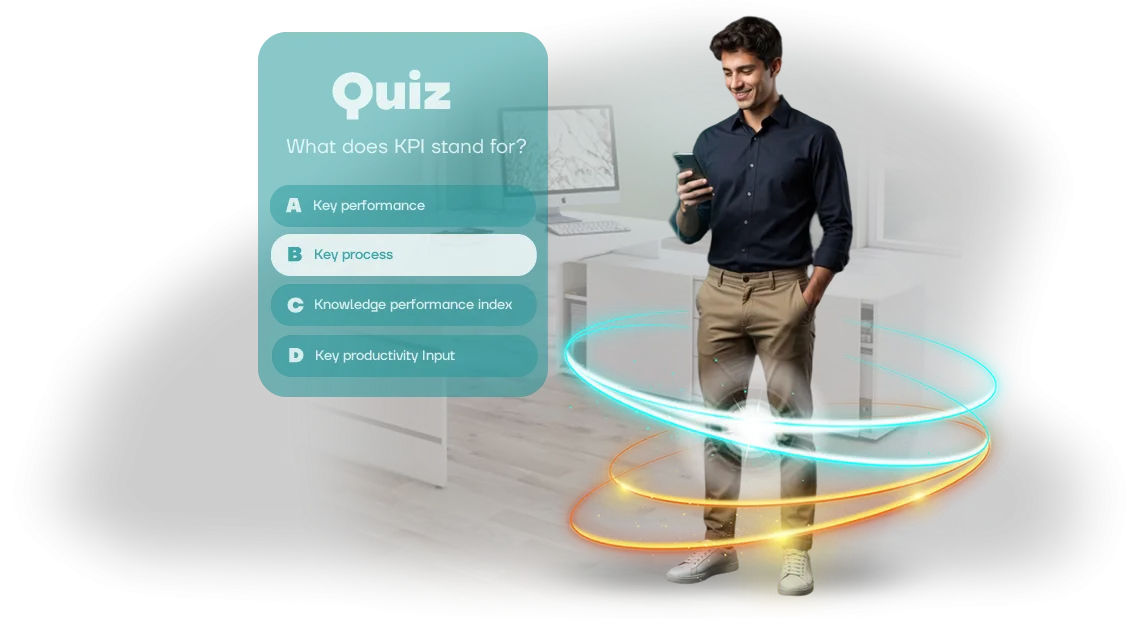
Employees complete training formally — and forget everything within a week
Employees go through mandatory training "for the checkmark": scrolled through the module, passed the test, got back to work. A week later, almost nothing remains in memory — and the mistakes the course was supposed to prevent happen again.
The manager spends time and resources on the program but gets neither growth in competencies nor a reduction in the number of errors.
The reason is not employee laziness, but the format. Linear slides and single-correct-answer tests create neither engagement in learning nor a desire to figure things out.
A person mechanically picks an option rather than applying knowledge — which is why checking employee knowledge turns into a ritual that shows nothing about the team's real readiness.
A learning quiz breaks this scenario. It's not an exam, but a game format: short rounds, live feedback, points and a leaderboard, repetition of difficult topics until they become automatic.
The employee doesn't sit through the course but returns to the material again and again — and remembers it because they themselves want to advance further and outpace their colleagues.
For the manager, this solves the main task — forgetting the material stops being the norm. You see who is making mistakes and where, which topics the whole team is failing, and you close gaps in a targeted way instead of re-running the entire course. Mistakes at work go away because employees practice the right actions in a safe game environment.
We build such quizzes for your product, regulations, and real work situations — with adaptation for smartphones and tablets, so learning happens during a break, not only at the workplace. Let's discuss the task — we'll come back with an estimate and a plan.
What changes when learning is built on a game
Game-based learning changes the mechanics themselves: an employee doesn't "take a course" but solves a task and immediately sees where they went wrong.
Material that in a regular format is skimmed through in an evening comes back into the workflow here — because a correct answer makes you want to move on, not just check a box.
The main effect is knowledge retention. When a person answers questions on their own topic, they recall what they've already heard and reinforce it through practice. Mistakes are addressed right away rather than surfacing a month later with a real client.
Staff engagement grows without pressure from above: employees return to the material on their own to improve their results, not because they "have to complete the module."
For a manager, learning becomes transparent. A quiz result isn't a "passed" mark but a picture of the actual knowledge level across departments, topics, and people. It's clear where the team has a solid grasp of the material and where additional work is needed. Learning decisions are made on facts, not on gut feelings.
A learning quiz also works as an onboarding tool: a newcomer gets up to speed faster, while an experienced employee refreshes what they've forgotten.
We build such quizzes around your product, regulations, and service standards — we design the scenarios, questions, and progression logic so that learning brings value instead of turning into a formality.
Training quiz formats for your task
The same material can be delivered in different ways: sometimes a short knowledge check is enough, sometimes you need the excitement of a team tournament, and sometimes you need a regular series that gradually reinforces skills.
We choose the format to fit the task, not the other way around: first we look at whom we're teaching, how much time people have, and how you'll know the result has been achieved.
Below are typical scenarios that clients come to us with. Any of them can be adapted to your content, branding, and internal communication rules.
| Format | For whom | What it gives the client |
|---|---|---|
| Single check | New employee, certification, one-time knowledge snapshot | A quick answer to who has mastered the material and who needs help |
| Team tournament | Departments, branches, shifts | Engagement and healthy competition, overall results by unit |
| Regular series | Ongoing training, product updates | Knowledge isn't forgotten, progress is visible over time rather than from a single snapshot |
| Mobile quiz | Employees in the field, on shift, without a computer | They take it at a convenient moment, coverage is higher, and the excuse "no time" stops working |
| Adaptation to the task | Non-standard topics and audiences | A scenario tailored to your process: your own questions, logic, and feedback |
How to choose a format
Start from the goal: if you need to confirm knowledge one time, a single check is enough; if it's important to hold the attention of a large audience, a team tournament works.
When training is ongoing, a regular series wins: short sessions of a few minutes each deliver more than one big snapshot once a year.
We help you decide at the stage of discussing the task: we examine who your employees are, how they work, and what result you want to see. Then we propose a format and show how it will look with your material.
How the project works: from brief to launch
We structure the project so that at every stage you understand what is happening and what you will get as a result. No "months of silence": you see progress, make edits, and accept the work in parts.
How the project journey is structured
- Brief and goals. We discuss the task: who we are training, which topics and skills are important to reinforce, and how you will know the quiz worked. We define success criteria in metrics that are clear to you — completion rate, average score, returns to the material.
- Project plan. We prepare a plan with stages, timelines, and checkpoints. You see in advance what and when you will approve, and you can plan your team's workload.
- Content approval. We assemble questions and scenarios together with your experts, verifying wording and logic. The output is an approved structure that remains to be implemented.
- Implementation. We build the quiz, fill it with questions, and set up difficulty levels and feedback for employees. We show intermediate versions — edits are made along the way, not at the end.
- Testing. We run through the completion scenarios, check the accuracy of score calculation, and verify convenience for employees on different devices.
- Quiz launch. We place it on your platform, connect it to the accounting system, help with the first wave of employees, and review the first results.
- Post-launch support. We monitor stability, update questions for new topics, and add levels and formats as the training program grows.
Checkpoints
At every stage you receive a result you can look at and evaluate — not a report on work performed. This way risks are visible in advance, and the launch does not turn into a surprise for the team.
What is included in the delivery
The client receives not a "game file," but a ready-to-use tool that the team can operate without us. Everything needed for launch and independent work is handed over as a single package — with a clear structure and usage rights.
- Question bank. Ready-made questions on your topics — from basic regulations to complex work situations. We compile them together with your experts so that training reflects real practice, not abstract theory.
- Quiz scenarios. Several formats for different tasks: a quick warm-up before a shift, a knowledge check after training, team tournaments between departments. Change the scenario — and engagement changes too.
- Branding for your brand. Brand colors, logo, mascot, tone of voice in the texts — the employee sees a continuation of your corporate culture, not someone else's product.
- Administrator's guide. A step-by-step manual: how to add a question, fix the wording, set up a new tournament, export results. Without a programmer and without contacting us.
- Training for your team. We conduct knowledge transfer for those who will run the quiz: we go over typical situations and show how to maintain interest over the long haul.
- Results dashboard. You see who passed, where mistakes are most common, which topics are failing — and you adjust the training program based on facts, not feelings.
- Project handover and rights. We hand over the source files and access, and secure the usage rights. You are not tied to us: the tool remains yours and works for as long as you need it.
After launch, we stay in touch: we help with updates and answer questions about operation. But the goal of the delivery is for you to manage on your own.
Case study: how a quiz transformed training at a telecom company
A telecom operator approached us: employees needed to quickly learn new tariffs and typical scenarios for communicating with subscribers, without interrupting their work.
Conventional instructions and mailings did not work — people read them "just to tick a box," and repeated the same mistakes on the line. We proposed a training quiz format with game mechanics and built it around the client's needs.
What we did
We broke the material into short rounds based on real situations: a client asks about changing a tariff, complains about a charge, compares conditions. The employee goes through the quiz like a game — with levels, hints, and error review.
The department head got a clear picture: who is making mistakes and where, which topics are "failing" across the whole team.
Results
In the first training cycle, the share of correct answers rose from 54% to 87%. Repeated mistakes on key topics dropped by nearly threefold — employees returned to weak spots until they closed them. A separate effect: training became voluntary.
People logged into the quiz during breaks on their own to improve their score in the overall ranking.
Telecom operator extended its work with us: first for a second cohort of employees, then for new product lines. Based on knowledge dynamics, the client saw what neither instructions nor in-person trainings had delivered — measurable growth and a reduction in repeated mistakes.
How to choose the right format for the task?
Choosing a format starts not with the question "what game should we make," but with the question "what result does the business need." If the task is to quickly communicate changes in a regulation to a hundred employees, a short regular quiz with questions on the key points will work.
If the goal is to reduce the number of errors in working with clients, the format is built around real work situations, where the employee chooses a solution and immediately sees the consequences. That is why we first analyze the learning goals, and only then propose the mechanics.
The employee audience sets the tone and complexity. For frontline staff, simple, clear questions and instant feedback are important so they do not lose motivation. For managers and experienced specialists, more complex scenarios are needed, with analysis of non-obvious cases.
The same learning quiz rarely works for everyone — more often we create several levels within a single product so that each person goes at their own pace.
The frequency of assessments determines how deep it is worth going. A one-time launch before a product rollout is a compact quiz with an emphasis on memorization.
Regular assessments once a month or quarter require a question bank that is updated and does not repeat, otherwise employees start answering from memory rather than from knowledge.
We build in this capability from the start so that the product lasts a long time and does not become outdated.
The client's technical conditions also influence the choice. For some, it is important that the quiz opens on work computers without installation; for others, on employees' personal phones.
We clarify this at the start and select the format so that employees do not have to figure out access, and the manager does not have to collect results manually. Describe the task and the audience — we will come back with a format recommendation and a plan.
Common doubts before ordering
Before launching a training quiz, a manager usually has three fears: "it will break — and no one will fix it," "the questions will become outdated in a month," "employees won't figure it out, and we can't afford our own server." Let's break down each one — without promising "everything will be perfect," but with how it actually works in practice.
What happens if the quiz breaks in the middle of training?
We stay in touch even after launch: we monitor stability, respond to failures, and keep backups so we can restore operation without losing employee results.
You have a point of contact on the team — no need to search for "the person who built it" and figure out someone else's project all over again.
Who will update the questions when processes or products change?
Content is your domain, but you can change it yourself through a clear panel: add a question, fix the wording, replace something outdated. If there are many edits or you need new logic — we step in and make changes as part of support, without rebuilding the quiz from scratch.
Do we need our own server and a dedicated IT specialist?
No. We handle hosting and the technical side, and you get a ready-made quiz via a link. Your employees don't need accounts in complex systems — access opens from a work computer or phone, and results are collected in one place for reports.
How quickly will employees figure it out, and will we have to train them?
We design the interface for people, not developers: clear buttons, hints, start in one click. Usually employees take their first quiz without any briefing, and you can see progress for each person — who passed, who fell behind, where the topic is harder.
What if in six months we need more features?
The quiz doesn't "freeze": we add new task formats, levels, team modes, integration with your learning system. We'll discuss the task — we'll come back with an estimate and a plan, so development follows your priorities, not our convenience.
Let's discuss your task and come back with a plan
Describe the task in your own words: how many employees need training, what topics and rules, and how you will know the training worked.
We will review the request and come back with a project plan, an estimate, and format recommendations — no generic words or templated presentations.
To make the conversation specific, it helps to know in advance:
- How many people and departments are involved — this determines the quiz structure and the launch workload.
- Which topics and regulations need to be reinforced: safety, products, customer interactions, internal processes.
- How you measure the result — the share of correct answers, how quickly a newcomer reaches the norm, a reduction in work errors.
- Timeline constraints — by what date the finished product is needed and whether it is tied to training or certification.
- How you distribute it — internal portal, email, employees' mobile devices, a shared screen in the office.
- Who is responsible for the content on your side and how quickly edits are approved.
After you reach out, you receive a breakdown of the task: what actually affects the result and what can be left out.
Then — a stage-by-stage project plan with clear timelines, an estimate, and format recommendations: where a short quiz is enough and where a game mechanic with levels and a rating is needed.
The next step is a short, focused conversation. Describe the task in whatever way is convenient, and we will come back with a plan, an estimate, and a format proposal.