

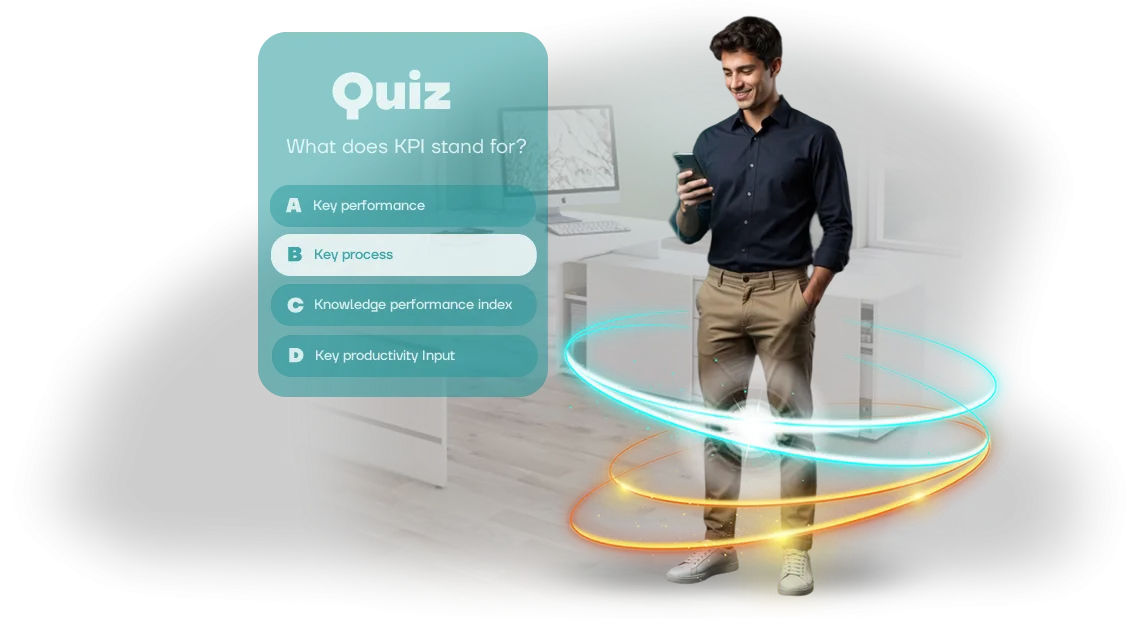
Transport Employees Lose Interest in Training — Knowledge Fades Away
Every manager of a transport company knows: formal training doesn't work. Employees complete briefings "for show," forget key rules within a week, and the cost of a mistake is passenger safety, cargo integrity, reputation, and fines.
Meanwhile, training investments grow, but the number of violations doesn't decrease — knowledge simply doesn't stick.
The reason is that standard lectures and tests don't create engagement. Adults only remember what interests them and carries emotional significance, while monotonous slides cause boredom and rejection.
As a result, staff motivation drops, and transport safety remains at risk — even experienced drivers and dispatchers act out of habit rather than according to current regulations.
The solution is to turn training into a dynamic quiz game. Wedevelop educational quizzes for transport companies that capture attention from the very first minute: competitive format, clear scenarios, and instant response to answers.
Employees themselves strive to complete the training, and knowledge is reinforced through practice and repetition.
As a result, you get not just "completed hours" but a real reduction in errors and incidents. Employees remember the rules, apply them on the job, and feel engaged in the process.
Developing quizzes tailored to your regulations is an investment in safety that pays off through fewer incidents and greater team discipline.
Quizzes for Transport Employees: Engagement and Safety
For transport companies, employee training is not a formality but a matter of safety and service quality. Standard lectures and briefings don't hold attention, and knowledge quickly evaporates.
Corporate quizzes built on Unity turn training into a game: employees compete, retain the material, and apply it on the job.
Knowledge Growth and Engagement
Game formats make the brain work more actively. Instead of passive listening — solving tasks, choosing answers, and getting instant feedback. This boosts staff engagement: employees complete the quiz with interest, not under pressure. The result is a higher level of knowledge without extra training hours.
Fewer Errors and Better Safety
When an employee learns rules through a game, they violate them less often in real work. For drivers and dispatchers, this means fewer accidents, missed trips, and fines. A manager can see which topics are poorly understood and close the gaps in time. Transport safety starts with a clear knowledge of instructions.
Convenience and Time Savings
The quiz works on any device — from a tablet in the dispatch office to a smartphone on the road. An employee can complete it at a convenient moment without disrupting the schedule.
Managers don't need to gather groups: results are collected automatically, and reports show dynamics for any period. This is corporate training that doesn't interfere with work but supports it.
Quiz Formats: Choose What Works for Your Team
Every transport company faces different training challenges: a newcomer needs to be brought up to speed quickly, an experienced driver needs a refresher on regulations, and the entire team needs to be united around a common goal.
No single universal quiz format handles all scenarios equally well. That's why we select a format based on your task, audience, and operational specifics — and only then implement it as an engaging 2D game.
| Format | Target Audience | What the Client Gets |
|---|---|---|
| Test | New employees, trainees | Quick knowledge check without unnecessary stress, clear reports for HR and mentors |
| Quiz | Current employees | Reinforcement of rules and standards in a light format, higher engagement in training |
| Competition | Drivers, dispatchers, teams | Excitement and healthy competition — material is remembered better, motivation increases |
| Quest | The entire team | Team interaction, practice for emergency situations, emotional connection with the brand |
The choice of format depends on the goal: if you need to quickly check knowledge after a briefing — a test works; if you want to regularly keep staff sharp — a quiz; if engagement is the priority — a competition; and for team building, a quest works best.
At the briefing stage, we'll help you decide and propose the optimal solution — without unnecessary development costs. You get not just a game but a working training tool measured in correct-answer percentages and employee progress.
How We Create a Quiz: Five Steps from Brief to Launch
To ensure you get a working training tool rather than just a game, we've structured the quiz development process as a clear sequence of stages.
We start with a quiz brief and finish with launching the training and providing ongoing support — at every step, you see intermediate results and can make changes.
-
Quiz brief. We dive into your objectives: what knowledge needs to be tested, who the target audience is — drivers, dispatchers, or line staff. We account for transport specifics: shift schedules, distributed employees, and limited training time. We lock in topics, difficulty, and success criteria.
-
Scenario and methodology. We turn technical material into an engaging scenario: questions, explanations, and game mechanics. We adapt the delivery for short sessions — an employee can complete the quiz in 10–15 minutes during a break or before a shift.
-
Design and interface. We create a visual style matching your brand and easy-to-understand navigation. On any device — tablet or smartphone — an employee understands what to do without prompts and isn't distracted by technical issues.
-
Development and build. We program the quiz logic, scoring, result display, and, if needed, integration with your learning management system. We use proven professional tools that guarantee stable operation even when a large number of employees take the test simultaneously.
-
Testing and debugging. We check scenarios on real devices and fix bugs and rough edges. We involve a focus group of your employees to make sure the questions are clear, the interface is convenient, and the process is hassle-free.
-
Launch and support. We help deploy the quiz in your system, train administrators, and hand over instructions. After launch, we stay with you: we review completion statistics, update questions, and refine mechanics as new requirements emerge.
What's Included: Tasks, Scenario, and Training Reports
In the end, you receive a complete quiz package ready to launch in your transport company. There's no need to write a scenario, come up with tasks, or figure out game mechanics separately — everything is bundled in one set. Inside: a ready-made scenario, a question bank, and clear reports for training oversight.
The package includes:
- Quiz scenario based on your employees' real tasks: transportation rules, safety, and passenger handling. Round logic progresses from simple to complex to keep attention.
- Task bank with answer options and explanations. Each question is reviewed in a session or report so employees understand which topic needs improvement.
- Game mechanics adapted for transport-sector training: points, hints, and time limits. This sustains engagement and turns knowledge checks into a competition.
- Instructions for hosts and participants — how to run the quiz offline or online, how much time to allocate, and what to do in an unexpected situation.
- Methodological materials for training managers: recommendations for integrating the quiz into onboarding, analysis of common mistakes, and evaluation criteria.
- Reports for staff and managers: each participant sees their own result, while you see a summary by group and topic. This data makes it easy to adjust the training program.
Once the package is delivered, you can launch the training within weeks — no lengthy development or extra approvals.
Case Study: How We Raised Employee Knowledge and Saved Time
This quiz development case for a transport company is a story of how we replaced dull briefings with a game.
TransLine, a cargo carrier with 1,200 drivers and logistics staff, came to us with a problem: employees completed training formally, and knowledge checks took safety engineers several days.
We developed a mobile quiz with questions on regulations, typical road situations, and dispatcher communication. Instead of paper tests — short 5–7 minute rounds right on the phone.
Implementation took two weeks: we loaded the questions, set up access, and ran a pilot with one team.
Results after the first month:
| Metric | Before Quiz | After Quiz |
|---|---|---|
| Training completion | 61% | 96% |
| Average test score | 68% | 87% |
| Time to complete course for a new hire | 3 hours | 1.5 hours |
| Number of retakes | 40% | 12% |
The efficiency metrics speak for themselves: completion rates nearly doubled, and training time was cut in half. Employees stopped putting off the course until the last day — reminders and the game format motivate them to complete the material right away.
Safety engineers saved 14 working hours per month by no longer needing to manually check and collect signatures.
Two months later, the department head ordered a second quiz — for new drivers, with an expanded cargo-safety section. That's the best sign of satisfaction: the client came back for more rather than for fixes.
How to Choose a Quiz When Employees Don't Like Gadgets?
Transport employees often don't consider themselves "advanced users" — and that's normal.
A driver or dispatcher who has worked with paper instructions for 30 years is wary of yet another "program." That's why a proper quiz for such an audience must be as simple as possible: no harder than answering a question in conversation.
Choose a quiz where the screen always shows one question, with large answer buttons and nothing extra. The employee doesn't need to install an app, register, or dig through settings — open a link, answer, see the result.
Ideally, training takes no more than five minutes: show a colleague, and they immediately understand how to respond.
Adaptation to the audience matters too. Phrase questions in your employees' language: about routes, safety procedures, and regulations — using familiar words, no bureaucratic jargon.
Keep the quiz within 10–15 minutes so it can be completed during a break between trips, not at the end of a shift when someone is tired and wants to go home.
Pay attention to how the launch materials look. When we create quizzes for transport companies, we always prepare a paper cheat sheet "how to complete it in a minute" and instructions for those who'll help colleagues. Employees shouldn't fear asking a silly question — support at the start removes that tension.
And the final criterion: test the quiz with a pilot group — at least five people of different ages. If most completed it without prompts and didn't quit halfway, it fits your employees.
It's simplicity and respect for their habits that deliver results, not the number of interface bells and whistles.
Frequently Asked Questions: Fear of Breakdowns and Other Concerns
Any project is first and foremost about people, and we understand a client's doubts: what if the equipment fails at a critical moment, employees don't like the game, and preparation takes too much time. We answer these questions honestly.
What if the equipment breaks down during the event?
We work with professional equipment that undergoes checks before every event. A technical specialist is present at the event, and all quiz elements are backed up. If a failure occurs, we resolve it within a couple of minutes without stopping the program.
Will employees actually enjoy taking the quiz?
The quiz is built on game mechanics: excitement, competition, instant response to answers, and visible progress. It's a completely different experience compared to a regular test.
As practice shows, most participants get drawn into this space, and afterwards they discuss the game with colleagues on their own.
Will preparation take up too much of our team's time?
Your team doesn't need to handle the organization. We take care of the brief, adapt the questions to your corporate materials, and plan the launch.
Typically, it takes 5–7 days from approval to a finished quiz, and on the day of the event we arrive early and set everything up ourselves.
Who handles support after launch?
We stay in touch after project delivery. During the quiz's operation, you get online monitoring and direct specialist support. Long-term programs include a reliability guarantee: if any failure occurs, we restore service within an hour.
We take on technical risks so you can focus on your business objectives.Order a Quiz — Get a Ready-Made Training Tool
To turn employee training into a clear and measurable process, you don't need to understand technology — just submit a request for development. We handle everything: from idea to a finished quiz that works on any device and doesn't require you to hire a programmer.
You get more than a test — you get a tool employees complete with interest while managers track results through clear statistics. Before we start, we'll show you a quiz demo and discuss your goals — you'll see how the mechanics work with your own examples.
What You Get After Reaching Out
- Consultation on format and content — we'll help determine what knowledge needs to be tested and how to package it into an engaging quiz.
- Quiz demo — an interactive prototype with your subject matter so you can evaluate the logic and design before full development.
- Transparent development cost — we lock in the estimate after the brief, with no hidden charges or "surprises" along the way.
- Adaptation to the transport industry — we cover your organization's specifics: routes, safety procedures, and service standards.
- Built-in analytics system — see who completed the quiz, which questions caused difficulty, and where additional training is needed.
- Post-launch support — we help implement the quiz, update questions, and keep everything running smoothly.
Submit your request — we'll call back within one business day and answer your questions about timeline and cost. The first step is a short consultation, after which you'll understand how a quiz fits into your training program.