

Why doesn’t employee training in legal services work?
Training in legal firms often becomes a formality: employees skim through presentations, nod, and forget key procedures within a week.
Yet mistakes in this work are costly — an incorrectly drafted document, a missed deadline, or inaccurate consultation impacts both reputation and budget.
The problem is not laziness on the part of the staff, but the format. Lectures and text instructions don’t hold attention, and “tick-the-box” knowledge checks don’t reveal the real level of preparation.
An employee can formally complete a course and still keep making mistakes — no one notices the problem until it becomes critical.
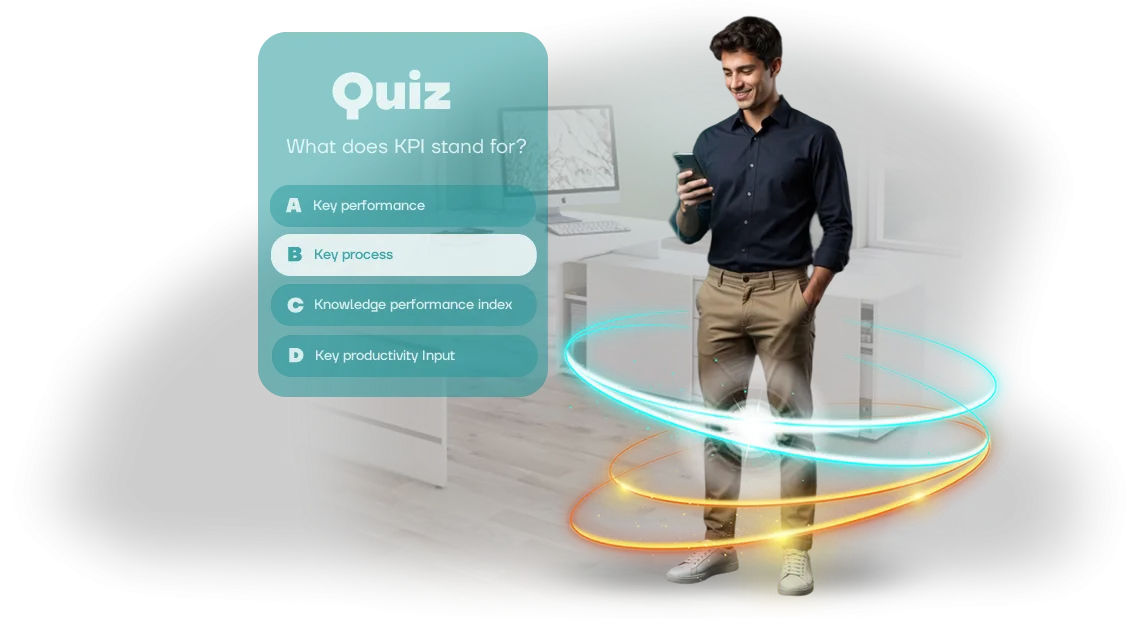
A staff quiz changes the approach. Short rounds, questions based on real cases from your practice, and instant feedback trigger healthy competitive excitement — employees engage in the process instead of sitting through it.
Game mechanics make them recall, analyze, and apply knowledge immediately, rather than “someday after the course.” The manager gets an objective picture: which topics have been absorbed and which need targeted rework — without retraining the whole department.
We create corporate training that works for results: employees remember regulations and procedures, and legal services are delivered faster and with fewer errors. Instead of boring instructions — an engaging game where every participant is motivated to show the best result.
Why is a game-based quiz more effective than boring lectures?
Legal industry employees face a large amount of information every day: new codes, regulatory acts, court clarifications. It’s hard to keep it all in mind, and boring lectures don’t help — after an hour, attention is almost gone, and after training, knowledge quickly fades.
Mistakes in legal practice are expensive for both clients and the reputation of the firm. That is why many managers are switching to game-based learning: it solves the problem of passive perception.
A game-based quiz is an engaging format in which the employee becomes an active participant. Gamification adds competitiveness: colleagues see each other’s results, strive to earn more points, and advance level by level. This engagement means training isn’t postponed — it becomes interesting.
Knowledge gained in a game is retained more firmly. Instead of memorizing wording, the employee applies it to situational questions: analyzes a client request, chooses the correct norm, and sees the consequences of their decision. This trains exactly the skills used in real work.
As a result, the legal firm gets a team with up-to-date knowledge and spends less time fixing errors.
The game format saves time and resources. Short 10–15 minute rounds are convenient to complete without leaving work — no need to gather everyone in a conference room.
Training goes remote and asynchronous, and the manager receives clear statistics: who has completed the material, where difficulties arose, and which topics should be reviewed. This makes it easy to close knowledge gaps.
We build such quizzes on the professional game platform Unity. The choice of technology directly affects the outcome: employees can complete training on computers, tablets, and smartphones without glitches.
Our team has been developing game solutions for business for over a decade, so you get a tool that genuinely improves learning efficiency and pays off.
Quiz formats for legal services: from test to tournament
In training employees at a legal company, not only the material matters, but also the format of delivery. The same quiz can be a quick knowledge check, a team competition, or a long educational program — the main thing is that the format matches the business objective.
We develop quizzes for legal services in three formats: test, tournament, and marathon. Each one solves business tasks in its own way — from rapid assessment to systematic professional development.
| Quiz format | Who it’s for | What it gives the client |
|---|---|---|
| Employee test | For regular knowledge checks and for recruitment | Objective assessment of each lawyer, fast results, clear department statistics |
| Tournament | For team competitions, corporate events, and non-financial motivation | Team engagement, healthy excitement, stronger team spirit |
| Marathon | For long-term training, onboarding new hires, and professional development | Gradual material absorption, regular practice, expertise growth without taking time away from work |
How to choose a format
If you need to quickly identify knowledge gaps, choose a test. If you want to make training a vivid event and boost engagement, choose a tournament. If the goal is to improve the team’s qualifications over several weeks, choose a marathon.
The formats are easy to combine: a test gives a starting snapshot, a tournament reinforces the material in a game format, and a marathon turns learning into a habit.
How the quiz development process works: from brief to launch
Corporate training in the legal field often comes down to lectures and tests that employees complete “just to tick the box.” A quiz works differently: it engages, creates healthy competition, and shows the real level of knowledge.
To ensure you get exactly that result, we have built a process of five transparent stages — from diving into the task to launching the solution in your environment.
-
Brief and needs analysis — we identify which norms, procedures, and typical mistakes employees must know. The result is a document with quiz objectives, target audience, and success criteria.
-
Scenario and mechanics set — we develop the storyline and question types: legal cases, choosing the right action, matching norms with situations. You receive a 20–40 question structure adapted to your specific context.
-
Design and prototype — we create an interface in your corporate colors, responsive for computers and tablets. We show you a prototype so you can see what the quiz will look like before development begins.
-
Development and content — we build the quiz on a professional engine — this guarantees stable operation on any device.
Together with your lawyers, we fill it with questions, and each answer is accompanied by an explanation so the employee immediately understands why that answer is correct.
-
Testing and launch — we run a pilot with a group of employees, collect feedback, and make adjustments. Then we place the quiz on your internal portal or learning management system and provide access.
-
Support and analytics — after launch, you receive reports: completion rates, typical mistakes, and performance trends. This gives you a ready basis for the next training round.
What you get as a result of the project
When you order a training quiz for a legal company, you care about the result, not the technical implementation. Therefore, we deliver the project as a complete package: scenario, questions, design, reports, and documentation — everything in one package that is easy to work with.
The project delivery package includes:
-
Quiz scenario — a ready-made story flow and question sequence adapted to your objectives: from initial orientation on regulations to knowledge checks on complex cases.
-
Quiz questions — a bank of specialized questions with answer options and explanations, so employees don’t just guess but actually remember the correct solutions.
-
Design and styling — visual screens in your corporate identity, so the tool looks professional and aligns with your brand standards.
-
Results report — data for each employee and the whole team: who completed the quiz, which answers were correct, and which topics need further review.
-
Administrator documentation — a short guide on how to launch the quiz, change questions, and add new participants without developer assistance.
-
Ready-to-deploy package — a file or link for placement on your internal training portal or learning management system.
After delivering the package, we hold a short session for the administrator, answer questions, and support the launch. You get a working training tool that is easy to update and scale to new employee groups. This saves your time and lets you focus on legal practice rather than technical details.
Case study: how we increased training engagement
The head of a legal company faced a typical problem: employees were completing internal training formally. They opened lecture materials and immediately closed them, and passed final tests only on the fifth attempt. Engagement metrics were near zero — the process needed to change urgently.
We proposed turning the boring course into a game. Our team developed a training quiz in a 2D quiz format: instead of abstract slides — real situations from legal services practice, points awarded for correct answers, and new levels unlocked.
The employee instantly sees their result and progress — this creates healthy excitement and a desire to understand the material.
The training results exceeded the customer’s expectations. Full course completion grew by 64%, and the average score on the final test increased by a third. The number of repeated quiz launches tripled — employees return to it voluntarily, not on a schedule. That’s how the team’s engagement changed.
For the business, this means faster employee onboarding, fewer errors in documents, and more confident client interactions. The customer was so pleased with the result that they ordered the next series of quizzes for the entire department.
This implementation case shows that training delivers value when it becomes part of the team’s habits, not a formal obligation.
How do you choose the right quiz format?
Choosing a quiz format starts not with the screen design, but with answering two questions: what employees need to learn and in what mode they find it comfortable to learn.
There is no universal solution here — what motivates sales managers is unlikely to suit lawyers who value precise wording.
Therefore, we first study the company’s specifics: what knowledge needs to be reinforced, how often the database is updated, and whether there are remote employees or branch offices.
Based on this information, we select the quiz type for specific goals. If you need to quickly refresh knowledge of legislation, we make short interactive polls with explanations of errors.
If the task is to teach how to apply norms in practical situations, we create a quiz with cases and choosing the right strategy. And when training stalls because of low motivation, we add competitive elements: points, rankings, team scores.
We pay special attention to the precision of wording — this is critical for the legal field. Questions and answers are checked for ambiguity to avoid disputes and misinterpretation.
We also take into account which devices employees will use to take the quiz: desktop computer, tablet, or phone. This is important for companies with a distributed structure and frequent business trips.
As a result, you get a format that is easy to integrate into your current training process, plus analytics: which questions caused difficulties, how long completion took, and how much the knowledge level increased. This data helps adjust the program and see the real progress of each employee.
Tell us about your objectives — we will propose a quiz format that suits your company and delivers measurable results.
Common questions and client concerns
Questions before placing an order are a normal part of the work. Most often, managers worry that employees won’t complete the quiz, that development will drag on, and that the content will become outdated after a couple of months. Below, we answer the main concerns the same way we answer clients on calls.
Employees don’t like training. How can you guarantee they will complete the quiz?
We design the quiz as a short quiz with clear mechanics and instant feedback. It takes 5–7 minutes to complete — simpler than opening a document or watching a webinar.
We also add a rating and a competitive element. People enjoy comparing results with colleagues — it creates healthy competition in chats. If needed, we can show department statistics so the manager sees real coverage.
How long does development take and who is responsible for the launch?
A standard project takes two to three weeks from the moment the brief is approved. We show the first version within a few days so you can evaluate the mechanics and style.
We assemble the questions into the system, upload the quiz, and test it on different devices. All you have to do is send the link to employees — the technical part is entirely on our side.
The content will become outdated. Can we update the quiz quickly?
Yes. We provide a simple admin panel so you can change questions and answers without involving developers. When an employee refreshes the page, they see the updated version.
If there is a lot to change, we step in ourselves: we will upload new questions within a couple of working days. The knowledge base stays up to date no matter how much time has passed since launch.
Keeping your training up to date is not a one-time task but an ongoing process. That’s why we make the quiz flexible: you decide when to update questions, add new topics, or launch a repeat run to reinforce the material.If you need a clear format without extra presentations and lengthy approvals — just write to us. In a half-hour call, we’ll show you what your quiz will look like and give you timelines for your task.
Order a quiz for your employees
Employee training in the legal field should not be limited to lectures and dry tests. A corporate quiz in a gamified format helps employees absorb the rules for working with documents, cases, and clients — and does so without boredom or long hours away from their tasks.
We will develop a quiz around your internal regulations, quality standards, and current legal norms — your employees will consolidate their knowledge, and you will get a clear training control tool.
To order a quiz, just five steps are enough:
- Leave a request on the website — tell us which topic needs to be covered and how many employees will participate.
- We will contact you to clarify the objectives and audience — the call will take no more than 20 minutes.
- We will propose a solution to fit your budget: number of questions, design, timelines, and implementation format.
- You approve the plan — we prepare the scenario, fill the quiz with content, and configure the game.
- We launch the quiz, run a test pass, hand over access, and remain on support.
Submitting a request is not an obligation — it is the first step toward a discussion. You don’t need to prepare a technical specification: an idea is enough, and we’ll work out the rest together.
We’ll show you examples of our training quizzes, explain how to embed the game into your current staff training, and tell you which results you can measure.
Leave a request now — we’ll discuss your task and offer a solution that fits your budget and timeline. Game mechanics, professional graphics, and clear statistics: you get training that employees actually complete to the end.