

Why does healthcare training require a game-based approach?
In healthcare, the cost of a mistake is especially high: patients' lives and health depend on following protocols and standards. At the same time, traditional staff training — lectures, presentations, tests — most often turns into routine.
Employees mechanically check off their attendance, and within a week they forget most of the material. That is why medicine requires a special approach to training, one that builds real skills and cements them for the long term.
For a clinic or medical center manager, this is also a question of budget efficiency. Time and money spent on training produce no results if employees are not engaged in the process.
And in pharmaceuticals and laboratory diagnostics, new drugs, equipment, and regulations constantly emerge — staff need to be trained quickly and systematically, without pulling them away from work for long seminars.
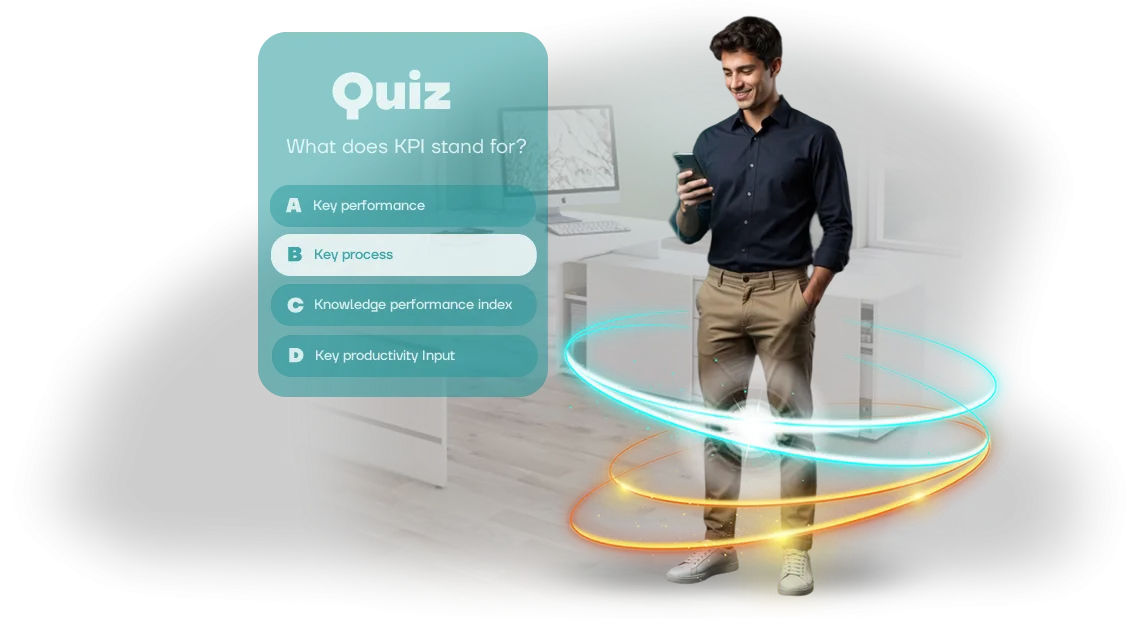
Gamification and educational quizzes change how staff approach training. Instead of passively listening to material, employees join a game, compete, receive instant feedback, and practice actions on situations that are relevant to healthcare.
This format multiplies engagement: doctors and nurses remember not dry wording, but the decisions they made themselves.
Developing 2D quizzes for the specific tasks of medical organizations is our core focus. For over 10 years we have been creating educational games and quizzes that help clinics, laboratories, and pharmaceutical companies raise their staff training standards.
The game-based approach delivers measurable results: higher course completion rates, better test scores, and, most importantly, confident employee performance in real work.
What results does an educational quiz bring to your team?
Ordinary briefings and presentations fail to hold attention: employees sit through training and forget a significant portion of the material within a week. For healthcare this is especially dangerous — staff errors directly affect patients and the clinic's reputation.
An educational quiz changes the approach: knowledge checks turn into a dynamic game with real work situations. Employees get caught up in the competition, receive instant feedback, and see for themselves which topics need work.
That is why these formats show high effectiveness: in our projects, staff engagement reaches 95%, and material retention grows 1.5–2 times.
For HR departments, a quiz means transparent knowledge monitoring without manual checks. The system itself collects results for each employee, shows the dynamics, and flags those who need retraining. A manager gets a ready-made competency snapshot without fire drills or paper reports.
In addition, a quiz sustains motivation over the long haul. Rankings, rewards, and scenarios that get harder round after round build a learning habit.
As a result, the number of recurring errors drops — in projects for medical clinics, we recorded a one-third reduction in incidents.
At our team we build such solutions on a professional game engine, so the game runs reliably on computers, tablets, and smartphones and slots easily into your training program.
We will show you how to adapt these mechanics to your team's needs — just reach out for a consultation.
Quiz formats for healthcare and business tasks
In healthcare, the cost of a mistake is especially high: patients' health and lives depend on staff qualifications. At the same time, standard lectures and tests do not give the full picture — employees formally complete training, but knowledge is not retained.
A quiz solves this problem: it engages, checks understanding, and reveals gaps in a convenient format.
The same quiz can be adapted to different goals — from initial training to regular skills assessment. Below are the formats we use in projects for medical centers, clinics, and pharmaceutical companies.
| Format | For whom | What it gives the client |
|---|---|---|
| Educational quiz for beginners | New employees, trainees, junior medical staff | Fast immersion in regulations and standards, fewer mistakes in the first months of work |
| Certification quiz | All staff categories during scheduled assessment | Objective knowledge evaluation, less time spent on checking, results protocol |
| Knowledge monitoring quiz | Current employees | Regular control without taking time away from work, early identification of gaps |
| Onboarding quiz | New hires during their entry into the role | Lower stress, reinforcement of corporate standards, feedback to the mentor |
This structure lets you cover different business goals: from training and onboarding to qualification confirmation and quality control. We design the quiz around your specifics — taking into account internal regulations, work scenarios, and staff competency levels.
How we develop a quiz: step-by-step process
Transparent project stages are the key to getting a tool that truly solves your training task. We work with healthcare in particular, where precision matters, so every step is agreed upon and you always know where things stand. No "black boxes": only clear steps, results, and deadline control.
Work stages
- Brief and immersion. We study your organization, work specifics, and staff audience. We define training goals and determine what knowledge needs to be assessed. You receive a quiz development plan and an understanding of how it will affect your team's qualifications.
- Scenario and question approval. We develop the structure, wording, and answer options. Together with you, we agree on the difficulty level and presentation style so the material is useful and engaging. This is your main quality-control point on content.
- Design and development. We create the visual style and an interface that is easy for employees to navigate. We show intermediate versions and make edits promptly. You see what the future quiz looks like even before launch.
- Testing and refinement. We check performance on different devices and typical scenarios. We fix any issues found so that everything runs stably on launch day and does not distract employees from learning.
- Training rollout and launch. We help integrate the quiz into your training system and set up reporting. We provide a short orientation for those who will track results. You launch training quickly and without extra hassle.
- Support and growth. We stay by your side after launch: we update questions, add new seasons, and expand scenarios. You get a long-term tool that grows with your tasks.
At each stage, we record agreements and deliver a clear result. This removes risk, and your team stays focused on what matters — improving employee knowledge and skills.
What's included in project delivery and support
The delivery includes not just a game, but a ready-made tool for staff training. You receive a complete package to run the quiz on your own — without bringing in developers or external methodologists. Here is exactly what you get.
- A ready-made quiz tailored to your tasks — an educational game adapted to healthcare specifics: medical terminology, care standards, action algorithms for non-standard situations. Questions can easily be replaced with your own if the training program changes.
- A teacher's guide — clear materials on how to build the quiz into your course: which scenarios to use, how to review errors with employees, and how to link the game to knowledge certification.
- Administrator training — in one or two sessions we show you how to change questions, add new topics, and launch sessions for different staff groups. Your employee can manage the system without developer involvement.
- Post-launch support and maintenance — we stay in touch: we help with technical issues, advise on increasing engagement, and update content for new regulations when needed.
- Stable performance guarantee — the solution is built on professional tooling and load-tested, so you never risk a session being derailed by glitches or freezes.
- Clear results reporting — you see which topics are not sufficiently mastered and can adjust the training program promptly. This saves time and increases the effectiveness of every training session.
In short, you get not just a game, but a working professional development tool. All you need to do is appoint a responsible administrator — we handle the rest, from delivery to ongoing support.
Case study: educational quiz for a healthcare clinic
At the Avicenna medical center, staff training was a formality: employees read long instructions, took routine tests, and quickly forgot important regulations. Managers spent hours checking results, and new nurses and administrators only got up to speed after several weeks.
This is a familiar situation for many clinics, where patient service quality depends on adaptation speed.
We proposed an educational quiz to the client instead of dull knowledge checks. The quiz is built on real situations from clinic life — from patient intake to emergency actions.
An employee goes through a scenario that feels like a game and immediately sees where they made a mistake, with an explanation right in the process.
This way the material is remembered naturally, without rote memorization, and experienced staff refresh their knowledge without leaving work.
What changed at the clinic after launch
- The share of correct answers grew by 40% in the first quarter alone — confirmed by internal checks and feedback from senior staff.
- New employee onboarding time dropped by a third: instead of four weeks of instruction, it now takes about ten days.
- Managers saved up to three hours a week — the quiz checks itself and produces clear statistics for each employee.
Importantly, we did not just deliver a turnkey game — we handed over an admin panel so the clinic team can update questions and add new topics on their own.
Six months later, the medical center expanded the quiz to all departments and ordered additional modules — staff training became a regular process.
This is a case where a healthcare quiz delivers measurable results: higher knowledge, faster adaptation, and saved managerial time — not just a formal checkbox.
Answers to common questions about quiz development
Before launching a quiz, clients often have similar doubts: will staff accept it, how quickly can questions be updated, will data security be affected.
In medicine these questions are especially important — staff are overloaded, and training material must align with internal regulations. We address them at the project stage, so by launch the team has only clear expectations.
What if employees don't want to take the quiz?
We design the quiz as a game, not an exam: short 10–15 minute sessions, clear rules, and instant feedback. This format fits easily into a workday and does not cause resistance even among those who dislike computer-based learning.
During the pilot stage, we collect feedback from the first users and adjust the difficulty and presentation so that from the very first full launch, the quiz is completed with genuine interest.
How quickly can questions and rules be updated?
Content lives separately from code: you send new questions, protocols, or instructions, and we add them without stopping the project. Standard edits take a couple of business days; urgent ones take a few hours. This keeps the quiz current when clinical recommendations and internal standards change.
How secure is employee data and results?
We work in line with medical data requirements: role-based access, encryption in transit and at rest, and clear separation of administrator and participant rights.
Results are visible only to those they are intended for — for example, the training manager — and employees can take the test anonymously if your policy allows. We use a proven server architecture, so leaks are ruled out.
Can we adapt the quiz to our own scenarios?
Yes, the quiz can be configured for any scenario: from post-lecture knowledge checks to mandatory annual testing. You can add timed scenarios, question branching based on answers, random task selection, and explanations after each question. The more you tell us about your training program, the more precisely we can tailor the logic.
If you have more questions of your own — ask us directly: we will answer, show examples from our healthcare projects, and help you determine whether the quiz format fits your team.Fast implementation and first results within a month
Typical training program development drags on for months: approvals, clarifications, long testing cycles. We compress that path to a month thanks to a streamlined process and ready-made quiz building blocks.
A fast start begins with a short questionnaire — you tell us about your team, and we show the first questions and a launch plan within the first week.
What you get right after submitting your request:
- A 15-minute questionnaire — we capture the topic, difficulty, and target audience of the quiz.
- A calendar plan with dates — you see when test questions will appear and when the launch will happen.
- Sample questions for your specific area — by the first week it is clear what the tasks will look like for employees.
- A trial version for internal testing — you can run through the game with a small group before the full launch.
- Administrator training — your specialist will be able to change questions and add new topics independently.
- On-time launch with a guarantee — we commit to a date and take responsibility for the result.
After launch, you see the first effects right away: the quiz takes 10-15 minutes, employees complete it at their convenience, and you get a clear report on which topics are well mastered and which need review.
Within the first month, you see higher training engagement and less time spent on knowledge checks — replacing manual tests and forgotten paper briefings.
For healthcare, this is especially valuable: quickly raising staff competency without interrupting work. You pay for results, not long development cycles — and within a month you already see the quiz working for your team and saving resources.
How to choose a quiz format for your healthcare tasks?
Choosing a quiz format for staff and doctors is not a matter of "which template to download," but of finding a tool that solves your healthcare challenge.
There is no universal option: training new clinic employees requires one approach, regular knowledge checks another, and motivating experienced staff toward new standards a third.
That is why at our teamwe start with a short consultation, not a generic product pitch.
We ask who will take the quiz, what the goal is — reducing documentation errors, practicing emergency care algorithms, or introducing medical staff to new equipment — and what scale of result is needed.
The format, difficulty, and duration all depend on this: it could be a compact 10-minute quiz for everyone in a department, or a deep scenario with clinical case reviews running 30-40 minutes.
An individual approach saves budget: you pay only for what will actually affect your metrics, not for the "flashiest" build with unnecessary options. A properly selected quiz provides clear diagnostics: management sees which topics are mastered and where staff stumble.
We help you precisely choose the format for your situation — from simple question-and-answer to game narratives with levels, points, and team scoring.
To understand which format suits you, send us a few words about your healthcare challenge on our website. We will propose 2-3 options, show examples from our practice, and honestly tell you where a ready-made solution is enough and where an individual approach is needed. The first consultation comes with no obligation.