

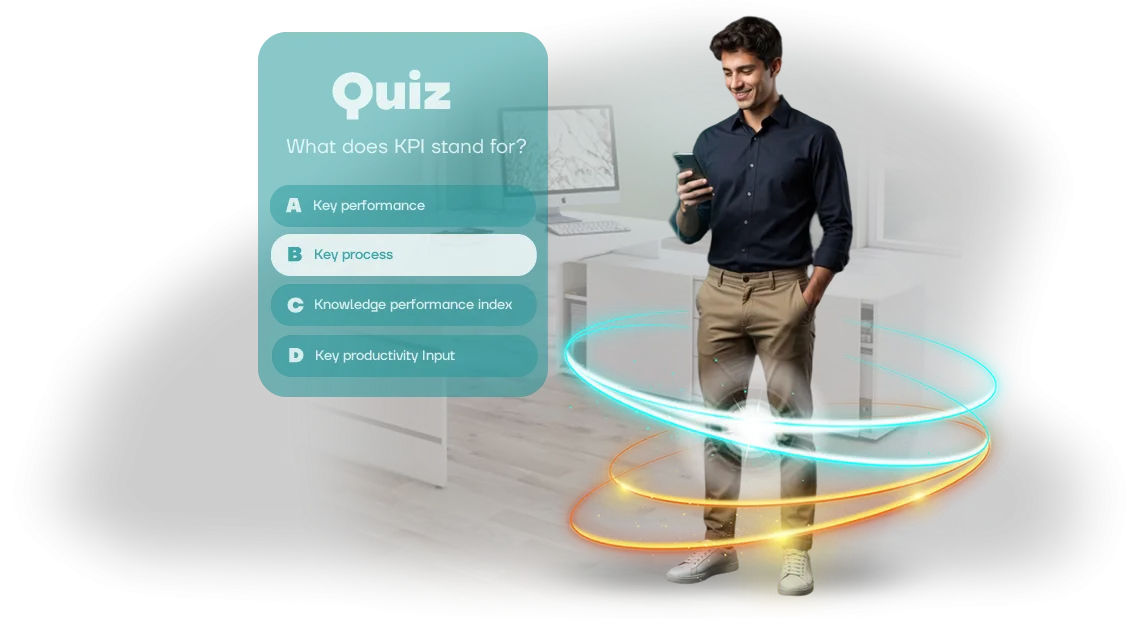
Why quizzes for healthcare professionals fail to deliver results?
Healthcare professionals are required to constantly learn: new protocols, medications, safety standards. But if training consists of scattered tests and PDF instructions, information quickly fades.
Employees take mandatory assessments “for the sake of a checkmark,” and a month later cannot apply their knowledge in practice.
This is exactly what damages the quality of patient care and the reputation of the clinic. Errors due to forgotten algorithms can cost dearly — both literally and figuratively.
Managers invest time in organizing training, but results are measured not by real skills but by the number of completed tests. Staff are not engaged, motivation drops, and metrics remain formal.
The problem is that classical testing does not create emotions and does not reinforce knowledge. Dry questions and correct answers do not make people think, do not provide feedback, and do not show exactly where an employee makes a mistake.
Even well-designed materials become outdated if their delivery remains boring. Gamification in medicine solves this task, but only when it is thoughtfully integrated into the learning process — with a storyline, scenarios, and practical cases.
We restructure medical training so that a quiz for doctors becomes a tool for real growth. Instead of unsystematic tests — structured scenarios that engage, immediately show mistakes, and help reinforce knowledge through work situations.
This format bridges the gap between “passed the test” and “acts confidently.” And this is exactly what we take on — we design training that delivers measurable results, not just a completion report.
What advantages does game-based learning offer for your staff?
Game-based learning is no longer just "entertainment" — for medical staff, it is a working tool that noticeably improves training effectiveness.
Instead of passively watching lectures, an employee goes through interactive scenarios where they immediately see the consequences of their decisions. This activates internal motivation: you want to complete the level, get a high score, and not let the team down.
The first advantage is engagement. Game mechanics with tasks, points, and feedback hold attention even with a busy shift schedule. Employees return to training on their own rather than waiting for reminders from their manager. The second is retention.
Knowledge gained through action is absorbed more firmly than text that has been read: a doctor or nurse remembers algorithms through practice rather than rote memorization.
The third is error reduction. The quiz simulates complex and rare cases: from recognizing symptoms to actions in emergency conditions. In a safe environment, staff practice the correct responses, and in real work such errors become fewer.
The fourth plus is motivation and healthy competition. Ratings and awards turn training into a team game, which is especially important for bringing a department together and enhancing the prestige of knowledge.
Technically, we implement such quizzes on a professional game engine — this provides stable operation on any devices, fast loading, and convenient statistics for the manager. You see who has completed the course, which topics are lagging, and where additional training is needed.
We have been creating educational products for more than 10 years and know how to combine game mechanics with medical precision. As a result, training stops being a formality and becomes part of your clinic's quality system.
3D quiz formats for healthcare professionals: choosing by task
Different tasks require different formats. Initial employee training, practicing action algorithms, knowledge assessment, or team building — the same quiz cannot cover everything at once.
That is why we develop 3D quizzes in three basic formats and, when needed, combine them for the specific goal of a clinic or training center.
Each format engages healthcare professionals in its own way. Some remember material better through competition, others need a detailed review of mistakes, and for the organization it is important that knowledge is reinforced across the entire team. Below is a comparison of formats so you can choose the optimal one for your task.
| Format | For whom | What it gives the client |
|---|---|---|
| Competitive quiz | For experienced staff and periodic knowledge checks | Identifies gaps without stress, creates healthy competition, and increases engagement in training |
| Learning mode with review | For new employees and complex topics | Each answer is accompanied by an explanation, so rules and protocols are memorized faster, and the number of errors decreases |
| Team quiz | For departments, shifts, and divisions | Analyzes real clinical cases in teamwork, improves interaction and experience sharing among colleagues |
When choosing a format, we take into account the number of employees, frequency of training, and specifics of departments. As a result, you get a tool that works toward a specific result: professional development, fewer errors, or rapid onboarding of newcomers.
How a 3D quiz is launched in your clinic
Launching a 3D quiz for training medical professionals is a clear process that we manage turnkey. You don’t need to understand the technology: all stages are agreed upon, controlled, and you always know what is happening.
We handle everything from the first meeting to regular updates, and your team gets a ready-made tool for assessing knowledge.
- Brief and training goals. We discuss which employees need training, which skills to assess, and which topics to reinforce. The output is a clear technical specification with understandable success criteria.
- Analysis of the clinic’s materials. We study your regulations, protocols, and real cases so that the questions match the daily work of medical staff and are not disconnected from practice.
- Development of the quiz scenario. Together with your experts, we assemble questions, answer options, and error explanations. The scenario makes training useful and takes into account the specifics of your department.
- Creation of the 3D quest. We turn the scenario into an interactive medical world: an office, patients, emergency situations. Employees train in a familiar environment, so knowledge is reinforced faster.
- Testing with a control group. We run the quiz with several clinic employees, collect feedback, and make revisions before the official launch.
- Launch and implementation. We connect the system to the necessary devices, help announce the training, and show how to use the quiz. Employees can take it at a convenient time.
- Support and updates. We provide support after launch, answer questions, and update the questions when protocols change or new standards appear.
Each stage takes exactly as much time as is needed for a quality result. Usually, the path from brief to a working quiz takes 2–4 weeks — you don’t notice most of the work; you see the finished 3D quiz and the progress of your employees.
What is included in the training game package
The training quiz for medical professionals is not just a game, but a full-fledged tool for knowledge assessment and professional development.
When ordering development, you receive a package that can be launched from day one: scenarios, visual materials, a methodological guide, and access to the admin panel. This is a ready-made solution that integrates into an existing training program without lengthy preparation.
Here is what is included in the package.
- Quiz scenarios. Ready-made questions on your topic — from basic medical concepts to clinical cases. Scenarios are divided into rounds of varying difficulty, suitable for team play or remote sessions. If needed, you can adjust them yourself to suit your objectives.
- 3D models and interactive characters. Recognizable images of doctors, patients, and locations help immerse participants in the storyline. Good visualization reduces fatigue and holds attention even during lengthy training — important for shift staff.
- Methodological materials. A guide for the instructor or HR: how to conduct the quiz, explain the rules, review mistakes, and interpret results. The guide is formatted in a simple format so the facilitator can prepare in 20 minutes.
- Admin panel access. An employee with administrator rights can change questions, add topics, configure completion time and participant groups. Changes are applied immediately — no need to wait for the developer.
- Employee training and technical support. We provide instructions and hold a short session for your team. After launch, you receive a communication channel for questions and quiz improvements.
All components of the package are delivered with documentation. You receive a working system that can be filled with new quizzes as training develops.
Case study: how we helped a clinic network improve testing results
Clinic managers often face a situation: employees seem to complete training, but test results remain low. In one of our projects, this led to recurring errors in documentation and lost time on corrections. The problem was not the staff, but the format — boring lectures and tests did not engage them.
Our team proposed the following quiz case: instead of regular questions — an interactive game built on real situations from the clinic's practice. Employees answered, immediately received an explanation of the correct answer, and saw a rating by department. This allowed them to learn from their mistakes in a safe environment.
What changed over three months
- Test completion increased by 40%.
- Errors when filling out documents became noticeably less frequent.
- Managers received clear statistics: who had mastered the topic, and who needed additional work.
- Employees returned to the quiz on their own to improve their result — learning became a habit.
Why is such an example effective for a clinic? The quiz is adapted to daily tasks, launches from any device, and takes only a few minutes. Instead of abstract theory, employees practice specific actions, and the result is visible in numbers — this is sustainable behavior change.
Would you like to replicate this scenario for your team? We will create a quiz tailored to your regulations, integrate it into your current training system, and help implement it without disrupting work.
How to choose a quiz format for training specialists?
The right quiz format is not entertainment, but a working tool. It must solve a specific task: test knowledge, train on new protocols, or prepare staff for certification.
For medical professionals, accuracy and the ability to act in a non-standard situation are especially important, so the choice of format determines how well the material is absorbed.
First, determine the goal. For a quick knowledge check of a large group, short quizzes with feedback will work. For practicing clinical scenarios — interactive formats where the specialist makes decisions step by step. And 3D visualization simulates real situations without risk to patients.
The second criterion is the specifics of the material. Medical information needs to be visualized: diagrams, anatomical models, sequences of actions. Text-based questions do not convey nuances, while interactive scenarios with images and simulation help remember details.
Also consider the number of employees and their technical proficiency — the quiz should work on any device without complex setup.
The third point is motivation. Medical staff are overloaded, so the quiz should be a quick and engaging way to test themselves.
Game elements with points and levels increase engagement, but for serious certification a strict mode is needed, and for regular training — a more relaxed format.
We help select a format for your tasks: we analyze the audience, goals, and volume of material, then propose a solution that fits into the workflow.
A correctly chosen quiz saves resources, makes training systematic, and delivers a measurable result — increased knowledge and greater confidence among staff.
Frequently asked questions before ordering a 3D quiz
Before ordering an educational 3D quiz, heads of medical institutions have the same questions: how long development will take, what budget to allocate, whether standard hardware can handle it, and how to embed the game into current training. We answer the main concerns so you can make a decision with a clear picture.
We have been developing educational interactive experiences for business for over 10 years and know how to make the process predictable. Below are answers to what is asked most often.
What are the timelines for developing a 3D quiz for medical professionals?
A standard project takes from 3 to 6 weeks — from brief to finished version. The timeline depends on the number of scenarios, the level of detail of 3D models, and whether integration with your learning system is needed. At the start, we fix the stages and dates so you understand when you will receive the result.
How is the budget formed and can it fit within constraints? The budget consists of the volume of content, complexity of mechanics, and number of users who will take the quiz simultaneously.
We offer 2-3 implementation options for different budgets — from a basic version to an extended one with custom scenarios. We provide an exact estimate after the brief, and it does not change during the process.
What technical requirements are needed to launch? The quiz runs on ordinary office computers and laptops, as well as tablets. No expensive equipment or graphics cards are required — average performance is enough, which is available in most medical organizations. If necessary, we will set up access via browser so employees can take training from any device.
Is the quiz compatible with our equipment and software? We conduct a preliminary audit of your hardware and, if necessary, adapt the game to a specific configuration. The product easily integrates with electronic learning and HR systems. You get a solution that fits into existing processes without replacing equipment.
If you still have questions, ask them directly, and we will prepare an individual answer for your situation. You can also request a demo version to evaluate how the quiz looks and works before development begins.
Commission the development of a training quiz for your team
Continuing education for medical professionals is a task that directly affects the quality of care and patient safety.
A training quiz turns mandatory instruction into a lively interactive experience: employees remember the rules faster, and managers see the real results of each participant.
Our quiz development is fully tailored to your internal regulations and clinical protocols, so training uses terminology and scenarios familiar to your specialists.
You don’t have to choose between work and study: the quiz is available on any device — a desktop computer, tablet, or smartphone. You can conduct training at a convenient time, without interrupting shifts and without unnecessary administration.
We handle the entire process: from briefing to launch and technical support, while you receive a ready-made tool with clear analytics.
Submit a request — within one business day we will hold a consultation, clarify the tasks, calculate the scope of work, and send a preliminary cost estimate.
This does not commit you to anything: you make the decision, and we will help you choose the optimal format for your budget.
After ordering quiz development, you will receive:
- a ready-made training quiz tailored to the medical field and your internal standards;
- question scenarios and answer options approved by your experts;
- the ability to embed the quiz into your distance learning system or corporate portal;
- clear statistics for each employee: result, completion time, repeat attempts;
- instructions for administrators and support during the first launch;
- technical support and the ability to promptly make changes to the question bank.
To order a quiz for your team, fill out the form below and provide your contact details. We will send a cost estimate and answer all questions — from the format of the questions to the implementation timeline. We will start as soon as you are ready and help you launch training within the coming weeks.