

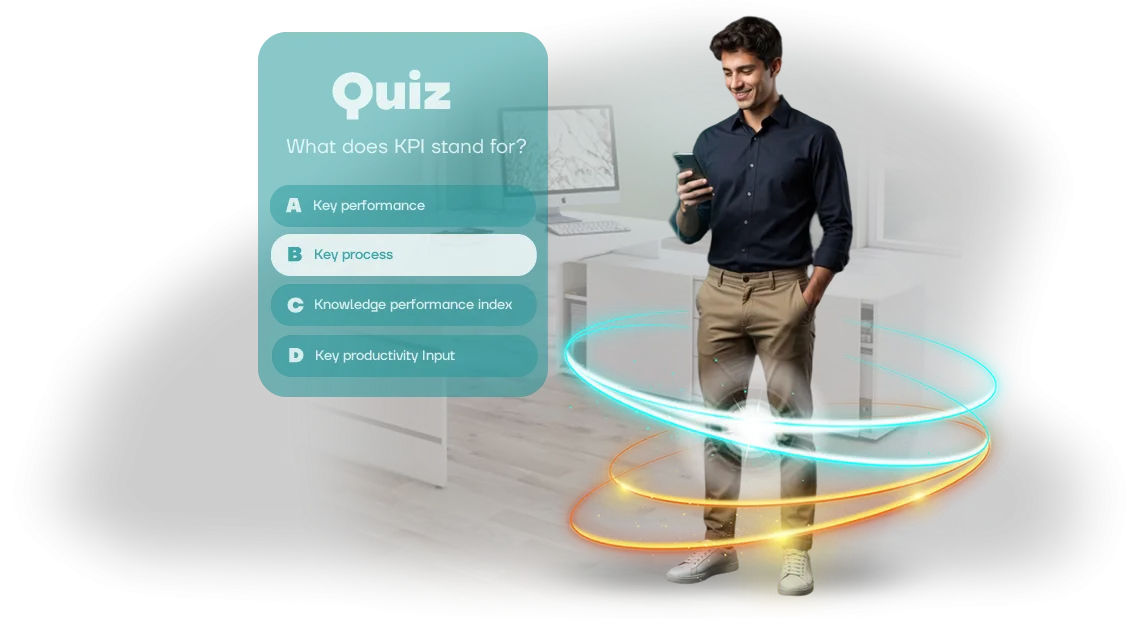
Employees are bored during training — how this affects the business
A manager invests time and people in staff training, and a month later employees can't answer basic questions about the product or regulations.
Mandatory trainings are done "for the checkmark": people sit with their laptops open, answer emails, and leave with a feeling of a wasted day.
Knowledge doesn't stick because passive listening leaves almost no trace — which means the hours invested don't turn into results.
Then a chain of costs kicks in that is rarely calculated directly. A newcomer takes longer to reach the required output, experienced colleagues spend time on repeated explanations, and the same mistakes surface again and again — in client work, in documents, in reporting.
When employee engagement drops, fatigue from "yet another mandatory course" grows too, and along with it — the risk of staff turnover: people leave not because of the tasks, but because of the feeling that their time is being wasted.
A learning quiz breaks this scenario because it shifts the employee from "listening" mode into "solving" mode.
Short game rounds with questions, points, and a leaderboard bring back the excitement: a person wants to go through the level again to improve their result, and unnoticed by themselves, they memorize the material.
A mistake stops being a reason for awkwardness — it becomes part of the game that you want to replay.
For the business, this changes in measurable ways. Material is absorbed faster and retained longer, newcomers reach working output in a shorter time, and repeated mistakes become fewer.
The manager gets a transparent picture: who has mastered which topics, where the team has gaps, who can be moved further. Training stops being a formality and becomes a management tool — and employees perceive it as part of the work, not as an obligation.
We handle this task turnkey: we design the quiz scenario around your regulations and products, assemble it, and hand the team a ready-made tool that can be reused for new topics and departments.
What the customer gets: engagement and results
Training that employees abandon halfway through benefits no one: neither the company nor the person themselves.
A quiz holds attention through game mechanics — the employee goes through the material to the end because they are interested, not because they "have to." As a result, the manager gets not the fact that an event took place, but knowledge that has actually been absorbed.
Knowledge retention is the key benefit. The questions within the quiz are structured so that the employee returns to important topics several times in different wordings. This is not rote memorization, but natural memorization through repetition. A week after launch, a person remembers more than after a regular slide review.
The burden on mentors decreases noticeably. Typical questions that previously had to be explained to each newcomer individually are now covered by the quiz itself. The mentor spends time on complex cases rather than repeating basic things. This frees up hours of their working time every week.
Measurable dynamics are what all of this is set up for. The manager sees how many employees completed the training, which topics cause difficulties, and how results change from attempt to attempt.
These training metrics show where the program works and where the content needs improvement. Decisions are made based on data, not gut feelings.
Engagement does not grow on its own — it is a consequence of training ceasing to be a chore. Employees share results, compete between departments, and return to the quiz again.
For the manager, this means that the effort invested in the program pays off: people actually learn rather than just putting in the required time.
Formats of an educational quiz tailored to a company's objective
The quiz format is chosen not by how attractive the interface looks, but by the objective: what exactly should change in employees' work after completing it.
Some need to quickly relieve tension before the start of a conference, some need to reinforce regulations for a new department, and some need to revive regular training that everyone has long been going through "on autopilot." Below are working scenarios that clients most often choose from.
| Format | For whom | What it gives the client |
|---|---|---|
| Short warm-up | Teams before a meeting, training session, or shift start | Quick immersion into the topic, a check of basic knowledge in 10-15 minutes |
| Team tournament | Departments, branches, mixed groups | Healthy competition, team cohesion, engagement of up to 90% of participants |
| Story-driven quest game | Onboarding of newcomers, complex products, lengthy regulations | Material is remembered through a story rather than rote memorization — higher knowledge retention |
| Regular challenges | Companies with distributed teams | Ongoing interest in learning, dynamics visible for each employee |
How to choose a format
Start from two questions: how much time employees are actually willing to dedicate and what result you want to see — a one-time surge of interest or a lasting skill.
For a quick effect, a warm-up or a tournament is enough; for systematic work on knowledge, a combination of "quest + regular challenges" is better suited.
What can be combined
Formats combine well: a tournament is launched as an event, while challenges maintain interest between events.
We help select a combination for your team and goals — at the stage of discussing the objective, we will propose 2-3 options with different workloads for employees and different launch timelines.
How a project works: from task to launch
We run the project transparently: you always know what stage the work is at and what you will get as a result. Below is the path our team's clients go through, from the first conversation to launching training in the company.
- Brief and goals. We discuss the task: who we are training, which topics and skills matter, and how you will know that the training worked. We define the success criteria — for example, the share of employees who completed the quiz and the growth in correct answers on key topics.
- Scenario and structure. Our instructional designers build the logic of the quiz: question blocks, difficulty levels, engagement mechanics, and how the material is presented. You get a clear scenario, not a set of disconnected tasks.
- Scenario approval. We show the structure and texts before assembly begins. You make edits to wording and emphasis — at this stage, changes are free and do not break the timeline.
- Assembly and content. Our engineers build the quiz on a professional game engine, filling it with questions, graphics, and the logic for scoring results. We work in iterations so you can see progress.
- Focus group test. We let a small group of your employees take the quiz. We look at where attention drops, which questions cause difficulties, and refine it before launch.
- Training launch. We deploy the quiz in your environment, connect results tracking, and hand the team a clear instruction on how to use it.
- Support. After launch, we stay in touch: we help with updating questions, adding new topics, and reviewing completion statistics.
This order removes the main risk — getting a finished product that does not solve the task. You influence the result at every step, not only at the end.
What is included in the delivery
You receive not a "game file," but a turnkey learning tool that your team can manage without us. Everything needed to get started and continue working independently is handed over as a single package — with documentation and training.
- Ready-made learning scenarios — quizzes tailored to your topics: onboarding for newcomers, product, regulations, security. The scenarios are designed so that an employee completes them in one sitting and returns to weak spots.
- Question bank — populated and structured by topic and difficulty level. You can add and change questions yourself, without a developer.
- Results system — clear reporting for the manager: who passed, what score they got, where mistakes happen most often. You see not an "average score," but specific gaps in the team's knowledge.
- Administrator instructions — a step-by-step guide: how to launch a quiz, assign a group, add questions, export a report. Written for a person with no technical background.
- Training for your team — we hold a session with those who will run the quizzes going forward, walk through typical situations, and answer questions.
- Support period — after launch, we stay in touch: we help with edits, advise on content, and make sure everything runs smoothly.
- Transfer of rights and access — all content and settings remain with you. No dependency on us: the tool is entirely yours.
What this gives the client
You don't need to keep a developer on staff to update questions or launch a new topic. The training and instructions are designed so that you work independently going forward, and we step in only where our help is needed.
A package like this pays for itself on the very first wave of training: new employees reach results faster, and the manager sees a real picture of knowledge rather than a formal checkbox confirming course completion.
Case study: how a quiz transformed training in a retail chain
A chain of stores came with a clear pain point: turnover in retail is high, newcomers start their shifts without properly understanding the product range and service rules, while classic on-floor training takes time away from experienced salespeople and is poorly retained.
The department head wanted not "another course" but a tool that would fit into the working rhythm of shifts and deliver a measurable result in onboarding newcomers.
What we did
We analyzed the real mistakes of the first weeks on the job and turned them into scenarios for a training quiz: product recognition, typical customer questions, handling objections, internal rules.
Employees went through short game rounds right from their smartphone — during a break or between shifts, without leaving the floor and without a dedicated trainer.
The format was deliberately made competitive: points, a leaderboard between stores, retries. This kept interest alive where a regular test gets abandoned halfway through.
Each newcomer's progress was visible both to themselves and to the manager — it became clear who was ready to work independently and who needed support.
Implementation results
The share of employees who fully completed the training grew from a fraction to nearly all newcomers in the cohort — people finish the quiz because it feels like a game, not a mandatory test.
Onboarding time for newcomers was cut by roughly a third: people began confidently working with customers faster.
The most noticeable change was at the start: mistakes in the first weeks dropped markedly, and mentors stopped spending shifts repeating basic things. The manager gained a transparent picture for each store and came back to us for an expansion — we added new topics and roles. A repeat order speaks better than any promises that the training case study worked.
How to choose the right format for the task?
Start with diagnosing the needs, not with choosing the technology. Gather at one table those who are responsible for the result: the head of the department, HR, and the person who will run the training.
Ask three questions: what skill or knowledge should "stick" with employees, how will you know the goal has been achieved, and how much time people are actually willing to devote to learning.
The answers almost always diverge from the initial formulation of the task — and that's normal; it's at this stage that it becomes clear whether you need a short 10-minute learning quiz or a full-fledged game with levels and a storyline.
Next, the format is selected to fit the goal, not the other way around. If you need to quickly test knowledge of regulations or products, a dynamic quiz with questions and instant feedback is enough.
If the task is for an employee to live through a situation and remember the sequence of actions, a narrative game with roles and consequences of decisions works. If team dynamics and engagement matter, a competition format between departments with an overall leaderboard.
We don't sell one universal template: for each task we build our own scenario, and a professional technical foundation is needed only so that the game runs reliably on any of your employees' devices.
The most reliable path is a pilot launch on one department. You get a working product on a limited group, see real engagement, and understand where the scenario sags.
Based on the pilot results, we refine the questions, pacing, and logic, and then scale it to the whole company without surprises. This approach removes the main risk: investing in a big project and discovering that employees are going through it just to tick a box.
Scaling after the pilot is faster and cheaper: the core has already been proven, and all that remains is to adapt the content for other roles and divisions. We support the launch, collect feedback, and update materials when processes change.
Describe your task — we'll come back with an estimate and a plan for which format is the logical one to start with in your case.
Common customer doubts before the start
Doubts are almost always the same, and that's normal — a manager is evaluating not a game, but a risk.
Let's break down the four main fears customers have: "employees won't play," "it will break and go down," "our case is too specific," "this will fall on the IT department." Below is how we address each of them before the start.
What if employees refuse to play?
Motivation is built into the scenario, not into persuasion.
Short sessions of 5–7 minutes, a leaderboard between departments, rewards for progress — the employee comes back on their own because it's interesting, not because they "have to." During the pilot, we look at how many people make it to the end and come back for a second round, and we refine the scenario before rolling it out to the whole company.
What happens if something breaks?
We hand over the solution with a margin of safety and instructions for your team, not a "black box." We provide support during the first period after launch: we monitor stability and promptly fix anything that behaves unexpectedly.
After that — support according to an agreed protocol, so that you have a clear channel of communication rather than a search for someone to blame.
We have specific requirements and a load on IT
Non-standard conditions are a normal part of the work: your own evaluation rules, integration with internal systems, access restrictions. On the IT department's side, a minimum is needed — approval and a point of contact; we take care of the rest.
We calculate the load on the infrastructure in advance so that a mass rollout doesn't turn into a scramble for your team.
What if the result doesn't meet expectations?
That's why we start with a pilot on one department: you see real engagement and retention of the material before scaling. If the hypothesis isn't confirmed — we adjust the scenario or honestly tell you so, rather than dragging out the project just to tick the delivery box.
Describe your task — we'll come back with an estimate, a plan, and how we'll mitigate the risks in your specific case.
Let's discuss your task and come back with a plan
Describe the task in your own words: how many employees you're training, which topics need to be covered, and by when you need results. No need to prepare a technical specification — just tell us what's happening now and what you want to achieve. We'll understand the context and come back with specifics, not generalities.
After you reach out, you'll receive:
- Task analysis — which topics and skills actually need to be tested, where employees most often fall short, and which quiz format will work for you specifically.
- Format recommendation — a single game, a team tournament, a series of short sessions, or a mechanic built into your training program. We'll explain why we recommend a particular option.
- Launch plan — stages from scenario approval to launch, with clear timelines at each step and areas of responsibility.
- Deliverables — what exactly you'll get: the quiz itself, access credentials, administrator instructions, and materials for employees.
- Timelines and stages — a realistic schedule with no surprises: when the scenario will be ready, when the prototype will be ready, and when you can launch the first group.
- Answers to support questions — how to update questions, add new employees, and view completion statistics on your own.
We don't send template commercial proposals. We review each inquiry individually: we look at your industry, team size, and how your training is currently structured. If the task can be solved more simply and at lower cost than you expected, we'll tell you directly.
Write to us in whatever way is convenient — email, messenger, or the form on the website. Describe the task in two or three paragraphs, and attach examples of topics or current materials if you have them. We'll come back with an estimate and a launch plan within one business day.