

Why Lectures Fail to Hold the Attention of Teachers and Trainers
Professional development problems for teachers often come down to the same scenario: educators gather in a classroom and spend hours listening to tedious lectures.
The theory is presented in an abstract way, with no connection to everyday tasks, so teachers' attention starts to drift after just 15-20 minutes. New methodologies stay in notebooks and rarely make it into real classroom practice.
These are the typical professional development problems: a monologue instead of a live dialogue, passive note-taking instead of active work with the material. The brain receives no feedback, and knowledge fades within the first few days after the course.
School and education center administrators spend budget and time but see no measurable growth in competencies — neither in mastery of methodologies nor in student outcomes.
This approach satisfies neither organizers nor the educators themselves. Modern teachers are used to interactive formats — they use games and apps with their own students, yet in their own training they encounter outdated passive methods. This creates a gap between the real needs of educators and the way the course is organized.
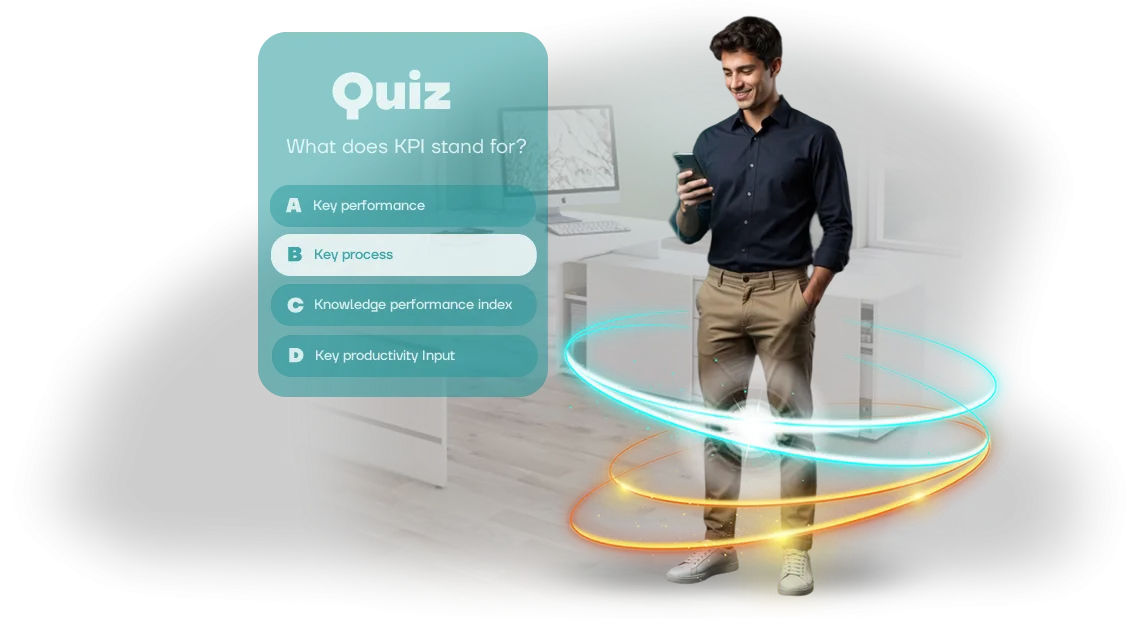
At our team we close this need differently. Training teachers through interactive quizzes turns the process into a game with instant reaction to every answer. Teachers don't listen — they act, make mistakes, correct themselves, and remember.
This format can be completed at a comfortable pace and remotely, while organizers get metrics: progress, mistakes made, level of engagement. Instead of a boring lecture — an engaging quiz that genuinely improves qualifications.
What a 3D Quiz for Teacher and Trainer Training Delivers
Traditional lectures at professional development courses rarely hold educators' attention. The material is delivered passively, and within a week a significant portion of the knowledge is lost.
Gamifying professional development with a 3D quiz solves this problem: the teacher enters an engaging space where they need to answer questions, compete with colleagues, and receive instant feedback.
The benefit of a 3D quiz for learning is directly tied to emotions. Competition and excitement make the brain work harder — the educator doesn't just listen, they think, choose, and try again.
This kind of training ensures high retention of learning material and enables practical application of knowledge.
Engaging educators is another important outcome. A dull mandatory event turns into a vibrant experience that people look forward to and discuss. The manager sees live statistics: who has mastered the topic and who needs a refresher.
This makes it possible to fine-tune the training program and raise the qualifications of the entire team.
We develop quizzes on the professional Unity engine, so the games run stably on any equipment and require no complicated setup. Each scenario is created for your organization's specific objectives, and the 3D environment enhances immersion. The result is a modern learning tool that delivers real results.
Quiz Formats for Your Team's Objectives
Every team of teachers learns differently. Some need an online quiz to bring together educators from different branches; others need an offline experience in a 3D space to create a sense of presence and genuine emotion.
We offer three formats that address specific objectives: from quick knowledge checks to full immersion in a topic.
| Format | Who It's For | What It Delivers to the Client |
|---|---|---|
| Online quiz for teachers | Educators working remotely or across different buildings | Quickly engages, requires no shared schedule, results are immediately visible in the report |
| Offline 3D quiz | In-person staff meeting, conference, methodology day | Turns training into an event; material is remembered through movement and interaction |
| Blended learning | Part of the team in the hall, part joining from home | A single game session for everyone, unified results without manually collecting answers |
The blended format is especially convenient for schools where not all teachers can be physically present. Those who came play in the 3D hall, while remote participants see the shared screen and answer from their own devices.
The organizer gets unified results for the whole team — no need to cross-check answers from different systems.
To make sure the format solves your specific task, we adapt the mechanics to the scenario: questions on new standards, compliance checks, or a warm-up before a seminar.
At the briefing stage you choose the right option, and we prepare the content, game management, and report — all you have to do is invite the teachers.
How an Educational Quiz Is Developed
We have completed dozens of corporate launches and have structured the quiz development process so that you control every stage and see the result in advance. No sudden surprises — just clear agreements, firm deadlines, and delivery of work that can be used immediately.
-
Brief — we dive into the task. We examine what knowledge is important to reinforce among teachers and which topics and formats suit your team. You receive a technical specification with goals and success criteria.
-
Scenario approval — we write out the questions, answer options, and explanations. We account for pedagogical techniques and the specifics of adult learning. You approve the scenario before development begins — we make revisions without wasting time.
-
Prototype — we show what the quiz will look like: interface, controls, design. You see in advance how teachers will experience the game and can adjust the details.
-
Development — we build the game itself: fill the quiz with the approved scenario, configure score calculation, and set up feedback for participants.
-
Testing — we test the quiz with a real group of teachers. We make sure everything is intuitive and iron out any rough edges before launch.
-
Launch — we host the game on your platform or provide a link for access. We help organize participation for all employees and collect statistics.
-
Support — we stay in touch after the start. We answer questions, quickly fix bugs, and update questions when training materials change.
This approach frees you from technical concerns. You get a working tool for training and professional development of teachers, as well as full transparency at every stage.
What's Included in the Deliverable Quiz Package
When you order quiz development, it's important to understand: you get not just a game file, but a complete kit for launching training. Everything is packaged so your team can run the quiz on their own — without developers or technical specialists.
The quiz delivery package includes:
- A game scenario tailored to your topic — the full structure of rounds, questions, and discussion breaks. You see how the training flows from both the host's and the participants' perspectives.
- Game mechanics and rules — clear descriptions of how the quiz works, how points are awarded, and how winners are determined. No "figure it out as you go."
- Quiz interface — screens, buttons, and animations are already assembled and tested. You don't need to design or configure anything; just put the image on screen.
- Host instructions — a step-by-step plan for running the session: introduction, timing, and answers to likely audience questions.
- Host training — a short session where your employee learns all the techniques for managing the game. Plus a checklist for emergency situations.
- Preparation materials — announcement templates, rules for participants, and a list of required equipment. With these, launch takes minimal time.
This way, you get a repeatable format. After the first launch, the quiz can be reused for new groups — with the same scenario or with updated questions. This makes employee training systematic rather than a one-off event.
Project Example: How a Quiz Helped Train 400 Educators
For schools, teacher training often becomes a formality: attendees sit through lectures and take tests "for show." The material doesn't stick, and within a month there's no trace of the new methodologies.
This is exactly the problem the school network «Erudit» brought to us — they needed to train 400 teachers to work with a new educational platform.
We developed a 3D quiz — an interactive competitive game in which educators mastered the material in a game format. Instead of boring slides — a virtual space with tasks and the opportunity to compete between branches. The training took place in several stages, and the competitive spirit fueled interest.
The results exceeded expectations:
- Participation in training grew from the usual 70% to 96% — experienced teachers who typically skipped courses were themselves waiting for the next round.
- The average final test score rose from 68% to 89%, and the number of retakes dropped threefold.
- Educators completed the quiz multiple times — not out of obligation, but out of a desire to improve their results.
The principal noted that after the training, teachers didn't just pass the test — they began applying the new tools in their work.
Engagement increased, and methodologists received detailed statistics on each employee: who grasped the material easily and who needs additional help.
The quiz solved a problem that ordinary webinars couldn't address. We continue working with the school, and this approach is now used in other educational projects.
How to Choose the Right Quiz Format for Your Task?
Choosing a quiz format should start with the question of where and how employees will learn. A quiz for an offline event is a team game on a big screen: participants argue, build on each other's answers, and respond in real time.
This format turns a seminar or conference into a vibrant event, raises audience energy, and helps people remember the material through emotion and competition.
For an in-person event, this is often even more important than a dry presentation of theory — people leave with an impression and are more willing to apply what they heard in their work.
If the goal is to organize training for remote employees, an individual quiz within a distance learning course becomes the appropriate training format.
Each person completes it at a convenient time from their own device, receives automatic answer checking, and a brief breakdown of mistakes.
This makes it possible to cover all branches without gathering everyone in one place, doesn't tie participants to a webinar schedule, and frees instructors from manual grading.
A quiz for a distance course easily integrates into a learning management system and gives employees the opportunity to return to the material if something remains unclear.
Often the optimal approach is to combine formats: a short quiz at an in-person launch sets the tone for the topic, while a remote round reinforces knowledge and gives the manager an objective picture — who has grasped the material and who needs additional support.
This way, choosing a quiz format becomes a tool that solves both the engagement challenge and the results tracking challenge. The key is to define the learning goal in advance: introduce a topic, check comprehension, or hold attention during a meeting. The mechanics, question difficulty, and quiz duration all depend on this.
We'll help you determine the right training format for your goal, prepare the questions, and run the quiz in whatever mode you need — whether at a live event or inside an online course.
This saves you from compromising and gives you confidence that the training will genuinely lead to a measurable result.
Common Concerns Before Launch
When a client prepares training for educators, the main question isn't about content — it's about whether the game will run without glitches and won't demand technical feats from the organizers.
The quiz should launch on the first try, questions should be easy to update, and the team should feel confidence rather than fear of "what if something breaks." That's why we address typical concerns in advance and build reliability into every project.
What if the quiz freezes during the session?
We use professional server equipment and test the scenario for your number of participants. We run a test session before the event, and during the game we keep a backup plan — even if the internet fails, the quiz won't stop; it will simply switch to a fallback mode.
Will it be difficult to change questions or add new rounds?
No. You get a simple control panel where questions are changed with a mouse click: fix a phrase, replace an image, add a new round — it takes minutes and requires no programmer. Updates save automatically, so the game will already reflect all edits at your next session.
What if we want to change the mechanics or add our own feature?
We design the quiz with future modifications in mind. Adding a timer, changing the scoring system, switching the quiz to team mode — all of this is implemented quickly because the base structure is already refined. You're not locked into a permanently approved scenario: the game grows together with your tasks.
Who provides support if something goes wrong on launch day?
During the event, you get a personal technologist who connects remotely and monitors stability. If the organizer or an instructor has a question — a response comes within a couple of minutes.
After the launch, we stay in touch and help with any edits for the entire duration of our collaboration.
This approach removes the main fears — our team takes responsibility for reliability, management, and technical support, while you focus on training rather than fixing equipment. If you still have doubts — ask us before the project starts, and we'll show you how your specific case can be solved.Order Development of an Educational 3D Quiz
Want to order development of an educational 3D quiz for teachers? Leave a request — we'll call you back within one business day, discuss the task, and propose a solution tailored to your budget.
No complicated technical details: you describe the goal, and we handle the entire process from idea to launch.
Starting a project is easier than it seems. After you reach out, you get a personal manager who guides you through every stage. Here's what happens right after your request:
- Request. You fill out a short form or call — we record your contact details and pass the task to a relevant specialist.
- Consultation. We discuss which topics need to be covered, how many teachers will participate, and which format best engages your audience.
- Cost calculation. Within two business days, we prepare a transparent estimate: no hidden fees and no fine print. You know the price before work begins.
- Brief and plan. We formalize the requirements, timeline, and stages. We approve the scenario, questions, and quiz mechanics — you make edits before development starts.
- Development and testing. We build the 3D quiz on a proven game engine, test it with a focus group of teachers, collect feedback, and polish the details.
- Launch and support. We hand over the finished product, help integrate it into the training program, and provide support after the release. If anything needs to be refined — we're here.
This way, you get not just a game, but a working tool that boosts teacher engagement and helps them retain material faster. Start your project right now — leave a request, and we'll take care of everything else.
Translate the above into English. Preserve structure exactly.