

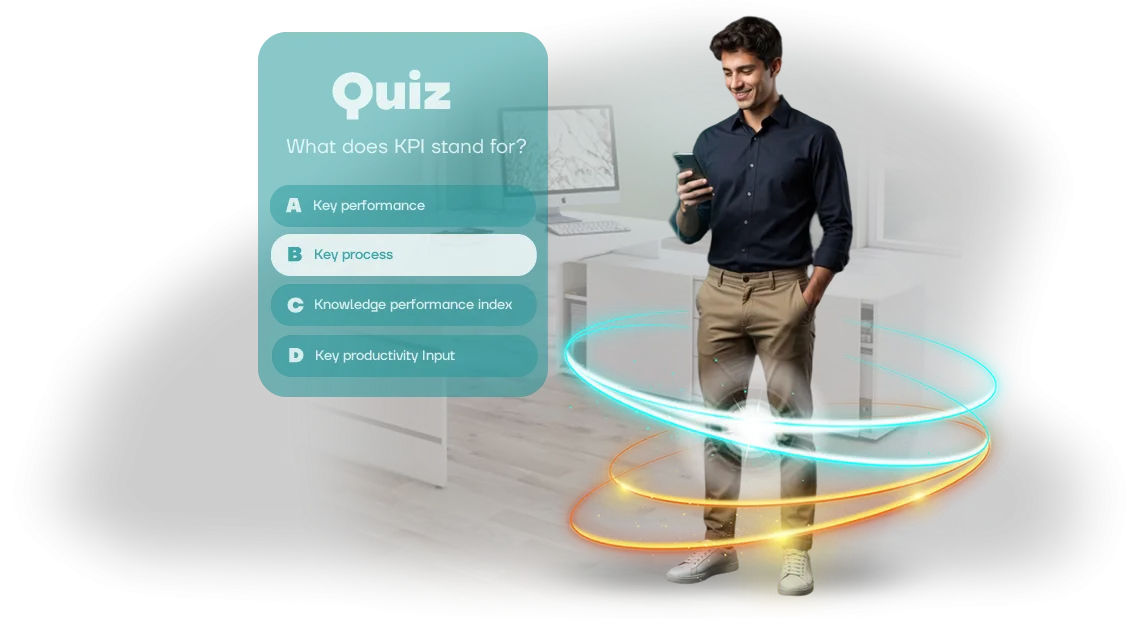
Why Aviation Safety Training Doesn't Reduce Risks
Aviation safety briefings most often become a formality: employees sit through the hours, listen to lectures, but at the right moment act out of habit rather than by the rules.
That's why personnel errors repeat themselves — the material isn't reinforced, and critical actions haven't been drilled to the point of becoming automatic.
Training problems are visible in incident statistics: most incidents happen not because of ignorance of the rules, but because of the inability to apply them in a stressful situation.
Traditional trainings provide theory but don't teach how to quickly assess the situation and make the right decision. When passenger safety is at stake, the price of such a shortcoming becomes too high.
Retaining material requires practice, not passive listening. An employee needs to go through the scenario themselves, see the consequences of an error, and understand how to act correctly. Only then does knowledge turn into a skill that lasts and works in real situations.
We solve this problem: we develop training quizzes and dialog simulators that turn aviation safety into engaging practice of real situations. Employees train to make decisions in a safe environment, and their level of preparation is tested by actions, not by a checkbox test.
5 Measurable Results from Implementing Quizzes in Training
Learning aviation safety rules is most often perceived as a mandatory formality. Employees go through materials "for show," and the briefing takes time from managers without guaranteeing that the knowledge is actually retained.
Quizzes turn this process into a measurable system: you see who absorbed the material and who just sat through it. Based on implementation results, clients get concrete business outcomes — from higher exam pass rates to fewer violations. Below are the five main effects.
Metrics HR Can See
Higher knowledge check pass rates. An interactive format holds attention better than a PDF instruction or video: employees complete the quiz to the end instead of closing the tab after a minute.
On average, the share of those passing the final test grows by 20–30% after just the first training cycle.
Objective knowledge assessment without arguments. The system calculates scores on its own, records errors, and shows which topics cause difficulty. HR sees not the instructor's subjective opinion, but numbers for each employee and department.
Engagement instead of coercion. Competitive elements and visible progress motivate employees to complete training without reminders. Managers stop spending time checking "did you even open the materials?"
What Managers Get
Fewer violations and errors. When rules are run through practical scenarios rather than just read, employees make fewer mistakes in real situations.
In projects for the aviation industry, the number of repeat violations drops by 15–40% — the exact number depends on the department's specifics.
Time saved on briefings. The quiz automatically checks knowledge and compiles reports, so the instructor doesn't need to check each person manually.
An hour of in-person testing is replaced by fifteen minutes of self-paced completion — that's hours of routine saved for the manager every month.
our team builds such training programs around your internal regulations rather than abstract textbooks. That's why efficiency numbers are visible after the first course, not "sometime later."
Quiz Formats That Close Gaps in Aviation Safety
Different employees face different risks in aviation safety, which is why a single training format works unevenly. Pilots need to practice actions in abnormal situations, ground personnel need to know the regulations, and management needs control over the entire system. We've developed three quiz formats, and each closes its own gap.
Dialog 3D Quiz Simulator for Pilots
This is immersion in a virtual cockpit or airport zone where decisions must be made in real time. A pilot can rehearse rare emergency scenarios without risk to people or equipment.
An emotionally charged experience is remembered better than dry theory, which means that in a critical situation, actions will be automatic.
Workstation Tests for Ground Personnel
A quick check of knowledge of aviation safety instructions and regulations. The employee sits at a computer, takes the quiz, the system automatically checks answers and saves the result.
Convenient for mass training: the manager immediately sees who has absorbed the material and who needs additional practice.
Mobile Quizzes for Management
Short checks that can be taken from any device at any time. Managers and executives receive summary statistics for the entire team and quickly identify knowledge gaps. This format supports a safety culture and keeps the topic in focus.
| Format | For Whom | What It Gives the Client |
|---|---|---|
| Dialog 3D simulator | Pilots, cabin crew | Practice of actions in emergency situations without risk, high engagement |
| Workstation tests | Ground personnel, technicians | Quick knowledge check, automatic result recording, convenient mass training |
| Mobile quizzes | Management, executives | Control over team knowledge level, statistics, flexibility of completion |
We'll help you choose the right format or a combination for your company's goals. Quizzes are developed on a professional platform, including Unity for 3D scenarios, and integrate easily into your existing training system.
Leave a request — we'll offer a solution that will close the aviation safety gaps specifically for your employees.
How Quiz Development Works: From Brief to Launch
Developing an aviation safety quiz isn't just assembling questions. It's a project where the scenario, presentation, and knowledge testing must work toward a specific result: that employees learn the rules and apply them on the job.
That's why we've structured the process so you understand what happens at each stage, who is responsible for what, and when you'll see the finished result.
Stages for a Typical Project
- Brief and immersion in the task. We meet with you, analyze what knowledge needs to be tested, who the audience is, what level of complexity, and which format is more convenient for taking the quiz — on a tablet, computer, or phone. We record the goals and success criteria.
- Plan and scenario structure. We determine the number of questions, topics, branching logic, and task types. You receive a document showing what blocks the quiz consists of and how they relate to safety regulations.
- Scenario approval. We prepare the text of questions and answer options, as well as explanations for employees on why a particular answer is correct. You make edits, refine the wording to match internal standards — and only after your "ok" does development begin.
- Quiz creation. We assemble the interactive shell, add visual materials, and if needed — a 3D scene and dialog situations. It looks like a training simulator, not a boring test.
- Testing and review. We run the quiz on different devices, verify that all answers and transitions work correctly, scores are calculated, and results are saved. You get access to a demo version and review it with us.
- Launch and handover. We publish the link for employees and help connect corporate email or an LMS if needed. At this stage the quiz is already in use and you see the first results.
- Support and refinement. After launch we stay in touch: we help with questions, update content if safety rules change, and add new questions as needed.
How We Align the Details
We don't work "in the dark" and don't show up with a finished solution at the end. All key points — scenario approval, design, question list — you go through with us.
At each stage you receive a clear document: what's done, what's next, and where your decision is needed.
If something doesn't match your vision, we make quick edits. This approach reduces the risk of rework and guarantees that the final quiz truly matches your training standards and internal safety regulations.
What's Included in the Package: Ready-Made Materials for Training and Control
You receive a complete package for launching training — nothing needs to be created from scratch. The materials are adapted to aviation safety requirements and proven in practice.
Inside are clear instructions, so launch doesn't require developer involvement and takes minimal time.
Standard Package
- Quiz scenario — question and dialog logic adapted to your regulations.
- Questions with error breakdowns — explanation of why an answer is correct and how to act.
- Administrator guide — launch, assigning employees, viewing results.
- Completion report — shows for each participant whether they passed or need to retake.
- Access to updates — scenario and questions are updated when standards change.
That's enough to launch training as early as tomorrow. All materials are delivered electronically; the employee needs no special technical knowledge — they just open the link and take the quiz.
Extended Package with Analytics
When it's important not only to conduct training but to demonstrate its effectiveness, we add extended analytics. It turns the package into a knowledge control system and helps adjust the program in time.
- Individual and group statistics — who made mistakes and on which questions.
- Retake dynamics — shows employee progress.
- Department comparison — identifies who needs additional training.
- Report export for audits and inspections.
This package is suitable when aviation safety training needs to be documented. You get not just a quiz but a quality-control tool for training.
Choose the right option — we'll prepare a package for your tasks. All that's left is to assign employees and begin.
Case Study: Airline Reduced Violations After Launching a Quiz
Context and Challenge
An airline faced a typical problem: flight attendants made the same mistakes during inspections — from the order of cabin checks to actions in abnormal situations.
Paper tests produced a formal result: the material was "covered," but a month later critical details were forgotten.
The client wanted training to change behavior, not just record the fact of familiarization. We proposed replacing the standard knowledge check with a dialog quiz featuring real scenarios: the employee goes through the situation, makes a decision, and sees the consequences.
Solution and Metrics
Instead of a test — mini-scenarios from practice: the flight attendant chooses actions and immediately gets an error breakdown. The quiz was launched for all crews; training took 20 minutes a month — without disrupting the schedule.
After the first quarter, the number of violations in safety inspections dropped by 40%. Errors stopped repeating in the most problematic areas: overhead bin checks, readiness of emergency equipment, sequence of briefings.
The training manager noted: "The quiz made crews think rather than recognize answers. For the first time we saw real growth in the level of preparation, not checkmarks in a logbook."
Now the airline Krylya uses the quiz as a permanent element of training. Employees take it from their phones, and the training department sees topic statistics and strengthens weak spots precisely. For us, that's the main result: training works for flight safety, not for formal reporting.
Frequently Asked Questions About Employee Quizzes
Before ordering development, clients ask similar questions — about the complexity of launch, compliance with standards, and employee behavior. Below are answers to the most common concerns, without technical details. If a question isn't on the list, we'll answer it personally.
How difficult is it to integrate a quiz into work processes?
Integration doesn't require restructuring operations. The quiz launches as a standalone module or integrates into your training system — employees take the test through a browser from any device. Preparation and launch take from a few days to a week, and reports are generated automatically.
How does the quiz account for aviation safety requirements?
We adapt the content to your regulations and internal instructions. Questions are built on current standards of your organization and the industry, including action scenarios for abnormal situations. You receive a tool that exactly matches your standards.
How is employee data protected?
Results are stored on secure servers; only authorized specialists have access. We comply with the confidentiality policy and don't transfer data to third parties. You fully control who sees the results and how they are used.
What happens when rules are updated?
Content is easily edited: changes to questions and answers are made without stopping operations — either by your specialist or by our team. There's no need to rebuild the system; it's enough to edit the knowledge base. Testing stays up to date at all times.
How do employees react to mandatory quizzes?
We make the process easy: short rounds, instant feedback, and clear explanations for every answer. This format is perceived as help with learning rather than control. Completion takes 10–15 minutes and doesn't cause resistance from staff.
Let's Discuss Your Task and Choose a Quiz Format
Leave a request on the page — and the very next day you'll receive a cost and timeline estimate for your task. During the consultation we'll go through which quiz format is best for your employees: a classic test, a dialog scenario, or an interactive 3D trainer. We'll also send an example of a working quiz so the result is clear before you sign the contract.
Along with the budget estimate, you'll receive:
- Expert consultation on employee training — we'll advise how to build the quiz into your existing training program.
- Cost calculation for all stages: scenario development, questions, assembly, testing, launch.
- Examples of aviation safety quizzes with different difficulty levels.
- Format recommendations: quiz length, number of questions, testing frequency.
- A technical specification after the brief — it stays with you even if you choose another contractor.
- A solution tailored to your internal training system and regulations.
We work on professional equipment and proven tools, so we guarantee stable quiz performance on any employee device. Clients often come with a vague request like "make a test" and leave with a clear plan that covers aviation safety requirements.
Here's a testimonial from one client: "The aviation safety quiz has become a mandatory part of onboarding training. Employees complete it in 15–20 minutes, and I immediately see the results in the report. We're coming back for a new scenario already for the third time."
— Elena, HR Director
Airline "NordWing"
Leave your contact details in the form — we'll call you back within a business day, answer your questions, and prepare an individual offer.
How to Choose a Quiz Format So Employees Retain the Material?
We often hear the question: which quiz format is better — a test, "question-answer," or a dialog scenario? The answer depends on three conditions: who is taking the training, how complex the rules are, and what kind of knowledge control the company needs.
First, we assess the type of employees. Line personnel with tight schedules benefit from short 10–15 minute rounds from any device.
Managers and specialists need not to recall a fact but to practice making decisions in non-standard situations, so material is delivered in different formats for each group.
Next, we look at rule complexity. For basic briefings, a multiple-choice test is enough — it quickly shows gaps.
If employees need to absorb the sequence of actions in an abnormal situation, an interactive scenario works more deeply: the learner chooses steps and immediately sees the consequences, so the material is remembered more firmly.
The third criterion is control over material retention. The quiz should provide transparent statistics: who passed, how many attempts it took, which questions they get wrong.
Without this information, it's impossible to tell whether the training worked; it turns into a formal checkbox. Well-designed reporting shows each employee's progress and helps adjust the program.
If all three criteria are considered, the quiz becomes a working knowledge control tool rather than entertainment. We select a format for your task — from mass rounds to dialog simulators with action assessment. As a result, the material is retained, and you see the result immediately after launch.