

Common mistakes in B2B business negotiations and how to fix them
Every lost deal is not just lost revenue, but also months of team work.
B2B negotiations most often fail not because of a weak product, but because of common mistakes: interrupting the client, not hearing their needs, being afraid of pauses, discussing price too early, or not asking clarifying questions.
The problem is that employees make these mistakes automatically — and the manager only sees them after the deal is lost.
Lectures and standard tests provide knowledge, but they do not build skills. In a real conversation, an employee is left alone with an objection — and acts out of habit, not according to a learned model. So staff training that does not change behavior is just wasted time and budget.
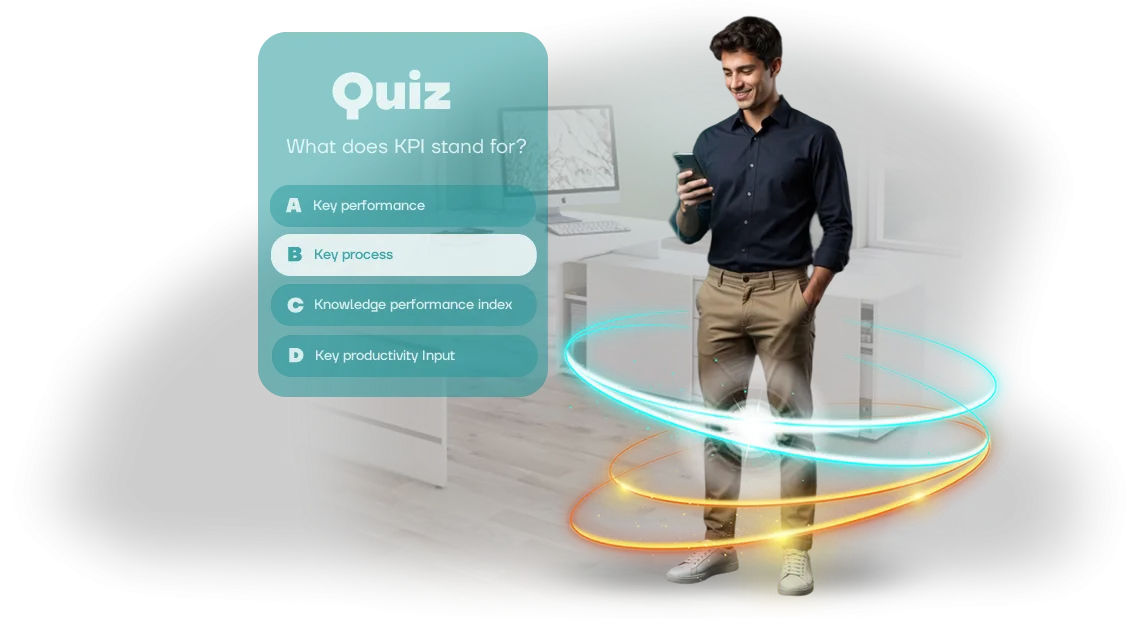
An interactive quiz trainer solves this problem differently. The employee enters a realistic negotiation scenario: they see the counterpart's reaction, choose replies, get instant feedback, and immediately learn the correct behavior model.
This practice is safe — a mistake costs nothing like a deal would, and every unsuccessful answer becomes a step toward skill development.
For the manager, this creates a transparent picture: which mistakes are repeated across the whole team, which scenarios cause difficulties, and where additional work is needed.
Employee training stops being a formality and becomes a measurable process that directly affects negotiation conversion.
We create dialogue-based 3D quizzes on a professional platform that replicate the logic of complex B2B negotiations.
Employees practice scenarios as close to reality as possible, and the business gets a predictable result: a prepared team that does not lose deals over details.
What a quiz gives for employee development
Employees remember better when they participate, not when they listen. Quizzes turn learning into a game: managers practice negotiation scenarios, mistakes are reviewed immediately, and knowledge is reinforced through practice. This works better than lectures and presentations.
A checklist of what the business gets:
- Engagement. Employees complete the training to the end rather than just to tick a box. The competitive element adds excitement, and gamification holds attention even on complex topics.
- Learning through practice. Dialogue scenarios replicate real B2B meetings: the manager trains to handle objections, work with client doubts, and drive negotiations to a result.
- Result control. The manager sees who has absorbed the material and who needs additional preparation. Clear data is available for each employee and for the team as a whole, without manual test checking.
- Staff motivation. Visible progress and recognition of top participants increase interest in development. People see that their training is noticed, and this reduces turnover.
- Growth in deal conversion. A prepared employee negotiates more confidently, handles objections faster, and more often brings the client to signing.
We have been creating learning mechanics for over ten years that deliver measurable results — from higher engagement to higher conversion. We take your negotiation scenario and turn it into an interactive trainer that works for your business.
Formats of interactive trainers for practicing B2B business negotiations
The choice of training format depends directly on the result your business needs: quickly check the knowledge of the whole team or deeply refine the skills of handling complex negotiations.
There is no universal solution, but there are proven scenarios that cover different tasks — from initial training to practicing stressful situations.
Below is a comparison table of popular interactive trainer formats. It will help you compare them by purpose, implementation complexity, and the final effect for your employees.
| Format | Who it suits | What it gives the customer |
|---|---|---|
| Text quizzes with answer options | Beginners, mass personnel, basic knowledge check | Quick coverage of the whole team, clear statistics for each employee, low entry threshold |
| Dialogue trainers with replies and scenario branching | Sales managers, mid-level negotiators | Practicing negotiation techniques in a safe environment, reviewing mistakes right after the session, increased confidence |
| 3D simulators with a virtual counterpart | Top managers, complex B2B negotiations, handling objections | Realistic negotiation simulation, stress-resistance training, practicing non-verbal signals |
| Combined programs (quiz + simulation) | Companies that want a full training cycle | A single system: from theory to practice, progress tracking, flexible customization to business processes |
How to choose the right option? If the main goal is to quickly check how well employees know the product and communication standards, a text quiz is enough.
When the goal is to change behavior in real negotiations in order to win deals, choose dialogue or 3D trainers — they provide practice in conditions as close to real ones as possible.
We will help you choose the right format for your specific task and budget, and if needed, combine several types into one program. The key is that training works toward your business result: higher negotiation conversion, reduced time per deal, and confidence for your team.
How quiz development works for your task
To make a quiz that truly teaches employees to conduct B2B business negotiations, it is not enough to simply upload questions. You need a clear cycle: from your task to a working trainer that fits into current training and delivers a measurable result.
- Brief and task audit. We analyze which negotiation skills need to be improved, who your managers work with, and in what situations. We define success criteria — what should change after training: confidence, reaction speed, meeting conversion.
- Scenario and mechanics. We propose a quiz structure: realistic negotiation cases, scenario branches, and short explanations after each answer. You see and adjust everything before development begins.
- Quiz approval. Together with you, we approve the wording of questions, answer options, and expert comments. It is important that the material matches your regulations and corporate communication style with clients.
- Development and testing. We build a prototype, check the logic and usability on real scenarios. You receive access to a demo version and make edits before the quiz goes to employees.
- Training launch. We connect the quiz to your system or provide access links. We set deadlines, reminders, and rules — everything according to your training plan.
- Post-launch support. We monitor statistics: we see where employees make the most mistakes and which questions are harder. If needed, we add new cases and update scenarios.
This cycle helps you control every stage of development and the launch of training without missing deadlines. As a result, you get not "a quiz for the sake of a quiz", but a tool that closes specific gaps in the team's preparation for negotiations.
What is included in the delivery of the finished solution
You get not just a program file, but a working tool that can be launched a few days after handover. The package includes everything needed to train employees in B2B negotiation skills: from scenarios to analytics for each participant.
- Scenarios and dialogue branches for your tasks — we model real situations from your business: cold calls, meetings with decision makers, handling objections, bargaining. Employees train on the cases they face every day.
- Interactive 3D simulator with a dialogue engine — the employee talks to a virtual counterpart rather than choosing answers from a list. This creates a sense of presence and forces thinking under time pressure, just like in real negotiations.
- Adaptation to your corporate identity — we use your colors, logo, and tone of communication. The training does not look like a third-party trainer — it becomes part of the corporate culture.
- Methodological materials for employees and HR — instructions for using the simulator, negotiation memos, and self-preparation checklists. You reinforce knowledge without involving developers.
- Personal dashboard with results and analytics — you see each employee's progress: number of completed scenarios, response speed, repeated mistakes. You understand who is ready for real negotiations and who needs additional practice.
- Integration with your learning system — we export results in a format that suits your HR department or LMS. No need to retrain your team — you simply include the simulator in the current process.
- Support and content updates — after launch, we help with setup and answer employees' questions. When the market or product changes, we update scenarios — the quiz stays relevant.
In the end, you get a closed loop: you set the task, employees complete the training, you see the result in numbers. No "black box": every stage is clear to both the customer and the HR team.
Case study: how a quiz prepared a sales department for a major deal
A company was preparing for strategic negotiations with a major federal partner — the sales plan for the half-year depended on the outcome of the meeting.
The manager understood that the team knew the product but felt insecure in tough negotiations, and every mistake in the dialogue cost money.
Standard lecture-style training did not provide the needed preparation — employees lacked practice in handling complex objections in conditions close to reality.
We proposed a dialogue-based 3D quiz simulator built on a professional game engine — a trainer that recreates a negotiation scenario with a prospect and reacts to every word the manager says.
The employee does not just answer questions; they experience a full meeting: they hear objections, see the counterpart's reaction, learn to control the conversation, and drive it to a deal.
Results the business saw
The quiz became a mandatory stage of preparation: the whole team completed the training before the important meeting. The simulator showed which managers were ready for tough questions and who needed to strengthen their arguments. Within two weeks, each participant practiced dozens of dialogue variations.
After the launch, conversion to scheduled meetings grew by a third, and the deal with the partner closed successfully — the company confirmed its sales plan and received a repeat order from the client. For the business, this means a direct link between training and revenue.
Return on investment and long-term effect
The project paid for itself from the first deal, and the quiz remains in the department's arsenal: new employees take it when onboarding, and experienced ones take it before important negotiations. The measurable result is higher sales and team confidence in handling objections.
This is not a one-time initiative, but a tool that systematically improves managers' qualifications and reduces risks in negotiations. If you want your employees to be ready for any scenario, tell us about your task — we will find a solution for your business.
Frequently asked questions about developing training quizzes
Before ordering a training quiz, many clients ask the same questions: how complex is it, how to integrate it into current training, and what to do after launch.
We have collected answers to the most common ones so you can see the process in advance and understand what result you will get.
How do you guarantee the quality of the quiz?
Every project goes through several review stages: internal testing, a scenario run-through together with you, and then final adjustments before launch. We guarantee our work and quickly make edits after launch if any inaccuracies appear. You receive a tool that works reliably and never lets you down at the critical moment.
Can the quiz be adapted to our scenario and corporate identity?
Yes, the quiz is fully customizable to your needs. We fill it with your questions, cases, and translations, and style it in your brand colors and tone. As a result, employees see familiar elements, and the quiz looks like part of your corporate culture.
What technical requirements are needed to launch it?
Nothing complicated. The quiz works in a browser on computers, tablets, and smartphones — employees do not need to install additional software. We handle hosting and support; all you need to do is send the link to participants. All that is required from you is an internet connection and a few minutes for setup.
How long does development take?
The timeline depends on the amount of content, but on average it takes 5 to 10 business days to create a quiz. This includes collecting materials, approving the scenario, testing, and launch. You receive a ready-to-use tool with clear instructions for the administrator.
If you still have questions, write to us. We will advise how the quiz fits into your training system and propose an option based on your request.How is a dialogue simulator different from an ordinary test?
An ordinary test checks whether an employee remembers the theory. A dialogue simulator teaches applying knowledge in a live situation: the employee conducts negotiations, counters objections, and immediately sees the counterpart's reaction. This is learning by doing — the skill is not declared, but practiced until confidence is built.
In a test, the correct answer can often be guessed; in a simulator, it cannot: every move changes the scenario, and a mistake becomes an experience that is lived through and remembered.
The employee tries different strategies in a safe environment, makes mistakes without reputational risks, and enters real negotiations prepared.
| Format | Ordinary test | Dialogue simulator |
|---|---|---|
| What it checks | Knowledge of theory | Ability to conduct negotiations |
| How it works | Choosing an answer option | Live dialogue with a counterpart who reacts to every word |
| Reaction to a mistake | Score reduction | A response and consequences — the employee sees where the decision leads |
| Engagement | Low, "just to tick a box" | High, the scenario holds attention to the end |
| Result for the business | Percentage of correct answers | Employee readiness for real B2B negotiations |
What does this give a manager? Instead of a "tick that the course was completed", you get measurable growth in negotiation skills. The results show who confidently handles objections and who needs additional training: decisions are made based on data, not intuition.
The team trains on scenarios close to your real counterparties and transfers these skills to work the very next day.
Order a quiz for your team
To order a quiz, you don't need to think long — start the project with a short request. We handle the entire process from idea to launch, and you get a ready tool for employee training.
Here's how the process works:
- Send a request — name the topic and number of participants, and we'll handle the rest.
- We have a short call — we clarify the training goals and format; you don't need to prepare anything in advance.
- We calculate the cost after audit — within one business day, we send you the cost estimate and timeline.
- We develop the quiz — write questions, build the mechanics, and fill it with meaning tailored to your business negotiations.
- We test and hand it over — you get the completed scenario, instructions, and access to results.
- We support you after launch — we advise on how to engage employees and measure the impact.
After contacting us, you will receive not just a commercial proposal, but a concrete plan: how long development will take, what stages we will go through, and how the quiz will help train your team. This gives you a clear basis for deciding on next steps.
Fill out the form or write to us in a messenger — we'll respond within one business day, help calculate the cost after audit, and offer a solution for your employee training task.
Start your project — and within a few weeks, your team will be practicing skills in an engaging format.