

Why Standard Training Cannot Replace Surgical Preparation
Standard employee training usually comes down to lectures, presentations, and tests. Formally, staff complete the program, but within a couple of weeks most of the knowledge evaporates.
Employee engagement stays superficial: people sit through the hours rather than immerse themselves in the material. Training effectiveness in this format is extremely low.
For business, this translates into double losses. First, the company spends budget and time on the training itself, and then it gets recurring staff errors in real work.
In the medical field, where surgical preparation matters, every uncertain action can lead to serious consequences for patients and the clinic's reputation.
Why does this happen? Because traditional methods don't give employees practical experience. A person listens to instructions but never encounters a situation requiring a quick decision.
They don't see the consequences of their actions and don't receive feedback until a mistake happens in reality.
For employee training to actually change behavior, you need to create an environment where people can act, make mistakes, and correct themselves right away. Interactive scenarios simulating work situations involve staff in the process and force active thinking. Such practice increases employee engagement and reinforces correct algorithms at the skill level.
This is exactly the approach behind effective surgical preparation. Instead of passive memorization — immersion in virtual situations where a doctor makes decisions and sees the result.
This reduces the number of staff errors and provides confidence that cannot be gained from a textbook. We build training so that every employee leaves the program with a ready skill, not just a checkbox for completing the course.
What You Get from Training Quizzes for Your Team
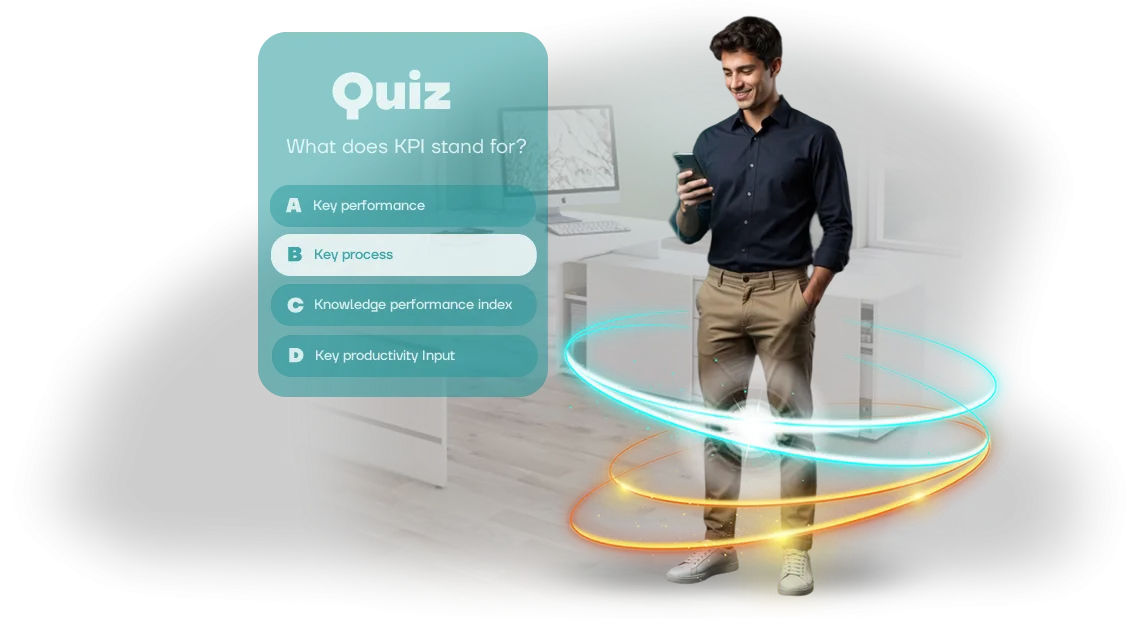
Training quizzes are not just entertainment but a tool that solves business tasks: increases employee engagement, accelerates knowledge retention, and allows safe skill practice. Unlike lectures and tests, the interactive format holds attention and turns training into practice.
For Medical Organizations
In surgical preparation, the cost of a mistake is high, so safe training is a priority. Our dialogue-based 3D quiz simulator on Unity allows doctors and medical staff to practice complex scenarios without risk to the patient.
An employee goes through virtual situations, receives instant feedback, and remembers the correct action algorithm at the level of muscle memory.
This approach increases engagement: instead of passively watching material, the doctor actively solves tasks. According to research on the effectiveness of simulation-based learning, interactive simulators increase knowledge retention by 30-40% compared to traditional formats. This confirms: a quiz is not a game, but a measurable training outcome.
For Corporate Universities
If your task is corporate employee training in any field, from sales to service, quizzes help package knowledge into an engaging format. We adapt scenarios to your business processes, add competitive elements and ratings — this strengthens engagement and motivation.
Employees compete, discuss results, and return to materials on their own, which improves training outcomes.
The technological foundation is the professional Unity engine, which ensures smooth simulator operation on any device: from PCs to tablets. The client receives a finished product that easily integrates into a distance learning system and can be reused multiple times.
In the end, quizzes solve a comprehensive task: they improve team qualifications, reduce risks, and save resources on organizing training. And most importantly — employees perceive the process as a game rather than a boring obligation, so results stick for a long time.
Quiz Formats for Surgical Preparation
In surgical preparation, it's important not just to transfer knowledge but to practice actions to the point of automation. Mistakes in a real operating room are costly, so training must be as close to practice as possible, yet safe for the patient.
A regular lecture or paper test doesn't give a doctor a sense of responsibility and doesn't reveal their reaction at a critical moment.
We offer three basic quiz formats that cover different training tasks. The table will help you choose the right option for your clinic's or training center's goals, and our methodologists will adapt any of them to your scenarios.
| Format | For whom | What it gives the client |
|---|---|---|
| Classic quiz | All staff, from interns to experienced surgeons | Quick check of basic knowledge, identifying gaps, engagement through a competitive element |
| Dialogue simulator | Surgeons and assistants honing complex algorithms | Practicing action sequences without risk to the patient, instant reaction to mistakes, building confidence |
| Team tournament | A department, shift staff, or several clinics | Team cohesion, practicing interchangeability, healthy competition between shifts |
In the dialogue simulator, we create an interactive operating room where the doctor makes decisions and the system evaluates every step. This is not just memory testing but a full-fledged workout of clinical thinking.
For surgical preparation, this format is valuable because it allows modeling rare complications that are uncommon in real practice — the doctor gains experience before encountering real complexity.
The classic quiz is the fastest way to implement regular training without interrupting shifts: 15-20 minutes, and the team has refreshed the protocols. The team tournament adds emotional release and turns mandatory professional development into an event people look forward to.
We work on professional equipment and a refined platform, so connecting any format takes days, not months.
To choose a format, simply describe your task: number of participants, frequency of sessions, and the topic that needs to be practiced. We'll offer an optimal solution that fits into employees' schedules and delivers a measurable result after the very first session.
How We Create a Quiz for Your Task
We've structured the process so that you understand what's happening and why at every stage. No "black box": you always see intermediate results, make edits, and control timelines. The outcome is a quiz that genuinely improves employee qualifications, not just a formal test.
Typical Project: From Brief to Launch
For most tasks, six clear steps are enough. You get a ready tool in a couple of weeks — and can immediately evaluate how employees absorb the material.
- Brief. We discuss your task, audience, and training scenario. We define the goal: what the employee should be able to do after completing it. You provide questions and topics — we turn them into a structure.
- Scenario plan. Our methodologists and production team propose the quiz structure: difficulty levels, dialogue branches, a hint and feedback system. You approve the logic before development begins.
- Approval. We show a prototype of the upcoming quiz: texts, answer options, screens. At this stage, edits are inexpensive, so we specifically separate this step out.
- Assembly. We create the interactive part on a professional platform, connect graphics, sound, and animation. You receive working versions for testing on real employees.
- Launch. We deploy the quiz on your equipment or in the cloud and set up access for the team. We conduct a brief orientation for administrators so they can manage settings themselves.
- Support. After launch, we stay in touch: update questions, add scenarios, and help with technical issues. You're never left alone with the product.
Complex Scenario: When Depth Is Needed
If the task isn't just to test knowledge but to practice rare or dangerous situations (for example, in surgical preparation), the process expands. We add a research stage with experts, detailing of dialogues, and multi-variant consequences.
This requires more time at the planning stage, but it's exactly these projects that deliver the maximum learning effect: the employee doesn't just choose an answer but sees what the decision leads to.
Everything else is the same — you receive a ready scenario, test it, and launch it with full support.
What's Included in the Ready-Made Training Solution
The ready-made solution isn't just a quiz but a turnkey tool for training surgeons and medical staff. You receive a delivery package that starts working immediately and requires no technical knowledge from your team.
We handle the development of scenarios, interface, and reporting — all you have to do is invite employees.
Here's what's included in every project:
- Training scenarios. Dialogue branches, correct and incorrect decisions — employees practice real cases without risk to patients. Scenarios are adapted to doctors' skill levels.
- 3D simulator mechanics. Game elements hold attention, and visualization brings the process closer to a real operation. Powered by Unity — stable on any device, growing interest in training.
- Employee interface. Intuitive navigation and clear prompts: staff don't need additional training to use the system. Just open a link and start.
- Instructions and regulations. Detailed guides for administrators and users: how to launch the quiz, configure groups, and view results. Shift handover happens without loss of knowledge.
- Results reporting. The system collects statistics for each employee: completion time, success rate, typical mistakes. This is objective data for certification and adjusting the training program.
- Implementation support. We help deploy the solution on your equipment, check compatibility, and conduct a test run. If questions arise, we stay in touch.
Additional Options
On request, we refine the package to fit the clinic's specifics: add your own scenarios and cases, change difficulty levels, create a corporate visual style.
We can connect advanced analytics for comparing results between departments or branches — convenient for large medical centers with multiple locations.
In the end, you get a working solution that covers the entire training cycle — from setting the task to objectively assessing employee knowledge. With it, you can easily plan certifications, track skill growth, and confirm staff qualifications before inspections.
Case Study: How We Strengthened Surgeon Training
A real example: a network of medical centers with branches in three cities approached us to strengthen knowledge control for surgeons after a theoretical course.
The usual end-of-training tests didn't show how ready staff were to act in an unusual situation, and manually reviewing results took methodologists entire days. We proposed a training quiz with clinical scenarios and automatic analytics for each participant.
The Task
The client needed a tool that wouldn't just check factual recall but would help reinforce action algorithms for complications and rare diagnoses.
In two days, we assembled a quiz of 40 questions broken down by difficulty level and set up access for 120 specialists through their internal portal. Doctors completed tasks at convenient times, and the system immediately showed which topics caused difficulties.
The Result
A month after launch, the share of employees who passed the control test on the first attempt grew by 35%.
The group's average score rose from 68 to 86, and methodologists began spending a third less time analyzing mistakes — all recorded in the internal report of the training center.
"Surgeons started reviewing difficult topics on their own after the quiz — that never happened before," notes the head of the training center.
She added that employees perceived the format as a game rather than another check: the number of retry attempts doubled, and typical mistakes from the first test almost disappeared.
The center not only renewed the license for subsequent cohorts but also ordered an expanded version with new scenarios — the quiz is now part of the mandatory surgical preparation program before practice.
Common Doubts Before Ordering a Quiz
Before ordering a quiz, managers ask the same things: will it work, how long will launch take, can questions be changed, and will it fit into internal training. Let's answer these questions in order.
What if the quiz doesn't resonate with employees?
We don't deliver a "raw" product. Before launch, we show a prototype and adjust the scenario based on future participants' reactions. After launch, we monitor initial results and quickly make edits if needed.
The contract includes a launch guarantee and support, so the risk of being left with a non-working tool is minimal.
Content is easy to update: you change questions, answers, and hints through a simple admin panel or send us a list of changes. This keeps the quiz relevant when new regulations and instructions appear.
Integration with your training platform is also solvable. The quiz embeds into a portal via a link or an embeddable block, and completion results can be included in your reporting if needed. For closed systems, we prepare a separate access configuration and instructions.
As you can see, the main fears are addressed before the project even starts. All that's left is to make the decision — and we'll handle everything from there.
Start Training That Delivers Results
Surgical preparation rarely fits into lectures and tests — employees need practice and feedback. If you're looking for a tool that genuinely improves team qualifications, start with a simple step: leave a request, and we'll prepare a proposal for your task.
We work according to a clear scenario that doesn't take up extra time from your team:
- Request — you describe the topic and audience, we record the initial data.
- Consultation — we discuss goals, formats, and training success criteria.
- Proposal — we send a work plan, timeline, and budget with no hidden conditions.
- Training — we create the quiz, integrate it, and train your employees.
- Qualification improvement — based on results, you see progress and decide what to strengthen.
After ordering, you receive:
- a ready training quiz embedded in your distance learning system;
- scenarios for different skill levels — from beginners to experienced surgeons;
- clear analytics: how many employees completed it and which topics caused difficulties;
- the ability to quickly update questions without developer help;
- support at all stages — from launch to full implementation.
Leave a request today — and tomorrow we'll send preliminary options. Training that delivers results starts with a single message.
How to Choose a Quiz Format for Your Task?
Before choosing a quiz format, ask yourself: what exactly should your employees learn and under what conditions will they apply this knowledge? This determines whether a simple theory check will suffice or full immersion in the work process is needed.
If the task is to check knowledge of protocols or regulations, text questions with answer options will work. But surgical preparation is a special case: the cost of a mistake is high, and decisions are made under stress.
Therefore, a format that simulates real actions and allows seeing the consequences of each step in a safe environment is more effective.
The key selection criterion isn't technical equipment but alignment with the business task. Consider: will the training be one-time or regular? Do you need to track each participant's progress? Are different clinical scenarios planned?
Answers to these questions will indicate which format will deliver a measurable result for your team.
We help you decide during the discussion stage: we analyze the audience, training goals, and available scenarios. Then we propose a solution — from a compact test for quick checks to a full-fledged simulator embedded in a surgeon preparation program.
This approach guarantees that you get exactly the tool that solves your task, not just a flashy novelty.
The main thing is not to chase trendy formats but to choose what actually changes employees' skills.
The dialogue-based 3D quiz simulator on Unity turns training from a lecture into practice: a surgeon practices action sequences to the point of automation and enters the operating room with confidence. That's the format that pays for itself.