

Customer Service Failures Are Immediately Visible: How to Eliminate Them
Customer service is the first thing a buyer sees and the last thing they forget. One crumpled operator response, a couple of extra minutes of waiting, or an unsure "let me check" turns a potential regular customer into a one-time transaction.
Moreover, the problem is rarely in bad people — it's that employees haven't practiced typical situations to the point of automaticity.
Explaining rules on paper or in a lecture means hoping the newcomer will connect them to live dialogue on their own. In a stressful conversation, the brain reverts to old patterns, and all training is forgotten.
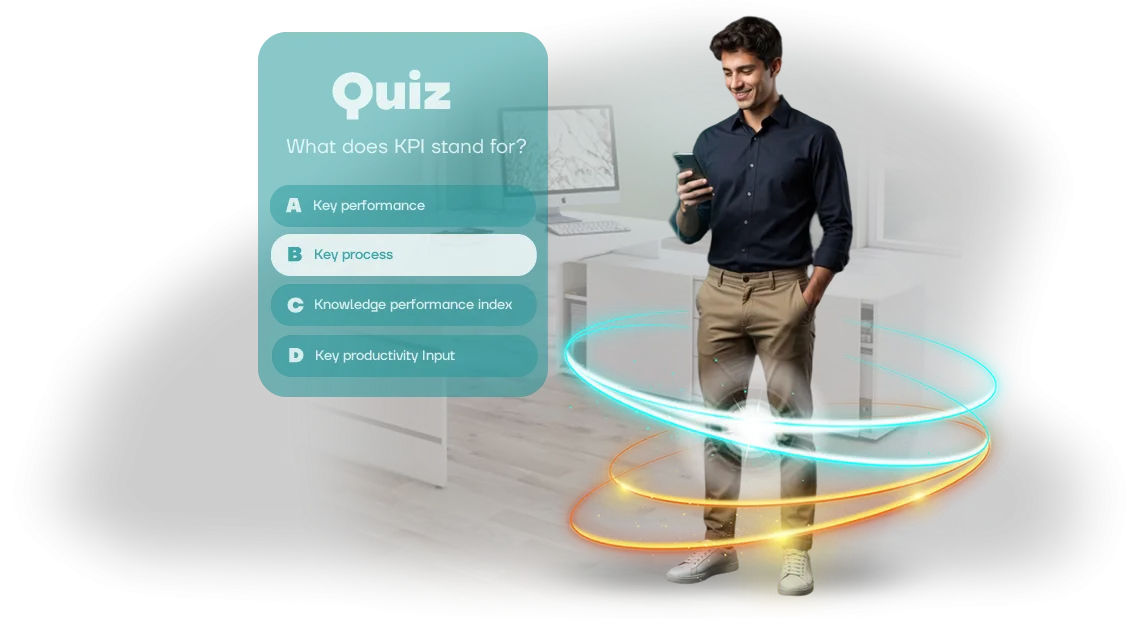
Training quizzes close this gap: the employee plays through difficult customer service scenarios, makes decisions, and sees whether they would have answered the client well or poorly. Without risk to the real reputation.
The key difference between a quiz and an ordinary test is the simulation of a live dialogue. The employee chooses a phrase, gets a response, enters a new branch of the conversation, and at the end sees how many clients they "retained" and how much trust grew.
This is how a skill is formed: through practice, error, and analysis, not through rote memorization of instructions.
We develop such quizzes for your service tasks: onboarding newcomers, practicing difficult calls, handling objections, responding to complaints. Employees complete the course at a comfortable pace, and you get reports on team progress and growth points.
As a result, customer service becomes predictably polite and competent — and that means direct repeat sales and recommendations.
What Benefits Does Business Get from Training Quizzes
Training quizzes turn the employee preparation process from a formal procedure into a tool that brings measurable benefits to the business. The first benefit is fast onboarding of newcomers.
Instead of long lectures and voluminous regulations, employees go through short interactive scenarios where they immediately see correct and incorrect actions. This reduces ramp-up time and allows new specialists to start full-fledged work faster.
The second benefit is a uniform service standard. Quizzes reinforce identical customer handling algorithms in employees' memory: from greeting to resolving difficult situations.
As a result, the client receives a predictable level of service regardless of which team member they talk to. For a manager, this is an understandable way to control quality without constant personal involvement.
The third benefit is increased customer loyalty. When employees confidently and kindly answer questions, help choose a product, and solve problems, customers feel cared for and return again.
Regular repetition of material in quiz format keeps skills in shape, even when the company updates its service line or service rules.
Additionally, such training gives the manager a transparent picture: you can see who has already mastered the material and who needs additional attention. If necessary, scenarios are easily adjusted to new business tasks — this makes training continuous and relevant.
Our simulators run on a stable professional platform, so employees can take the training from any device and at a convenient time.
Quiz Formats for Different Employee Categories
Salespeople need one kind of knowledge, newcomers another, and managers need to test not memory but the ability to make decisions. A universal "one-size-fits-all" quiz usually doesn't work: half of the employees get bored, half can't cope. So we've split the formats to suit different tasks and personnel categories.
| Format | For whom | What it gives the business |
|---|---|---|
| Linear quiz: questions and answer options | Salespeople, line staff, trainees | Quickly check product knowledge and standards, close gaps before starting a shift |
| Scenario quiz: dialogue situations with choice of replies | Sales department, customer service, support department | Employees practice communication skills, handle objections confidently, make fewer mistakes in dialogue |
| Team quiz: competition between departments or shifts | Large teams and departments | Repeat material without boredom, boost engagement and team spirit |
| Case simulation: analysis of real work situations | Managers, mentors | Assess managerial thinking, readiness for non-standard situations |
How to Choose the Right Format
We answer the question: "What should change after the quiz?" If the goal is to improve knowledge, take the linear format. If you need to change behavior in dialogue with a client, take the scenario format. If you want to motivate the team, take the team quiz.
The experience of our team — more than 10 years of developing interactive formats — allows us to hit the client's tasks precisely: you get a quiz that solves a specific problem, not just entertains employees. We adapt any format to your specifics, your team's skill level, and the desired result.
How a Quiz Development Project for Employees Works
For a quiz to genuinely teach employees rather than turn into formal testing, a clear process is needed. You see all development stages and control key points — from the brief to launch and support.
Stages of Working on the Quiz
-
Brief and immersion into tasks. You tell us about the specifics of your customer service, difficult situations, and typical mistakes. We determine what knowledge needs to be reinforced and in what format it is convenient to present it.
-
Scenario approval. We work out questions, answer options, and explanations. You see the scenario before development begins — this eliminates surprises and guarantees compliance with service standards.
-
Prototype and design. We prepare the quiz's appearance: screens, question flow, navigation. You understand how employees will take the test and can make edits before development starts.
-
Development and testing. We build the quiz on a professional platform, check all answer scenarios and display correctness. You get a finished product with clear logic.
-
Quiz launch. We place it on the internal portal, messenger, or learning system. We set up access so employees can start without technical difficulties.
-
Quiz support. We track results, help with questions, update content — add new situations and change questions as the service evolves. The quiz remains up-to-date.
What's Included in a Ready-Made Quiz for Customer Service
A ready-made quiz for customer service is not just a set of questions. It is a comprehensive solution that covers employee training: from scenarios to analytics. You get a ready-to-launch tool without needing a technical team.
What's Included in the Kit
- Quiz scenario. Broken-down dialogues: a client calls with a problem, complaint, or question — the employee sees realistic reply branches. The scenario is built on your typical situations, so employees practice on exactly what they face every day.
- Question bank. Several dozen test tasks on the product, regulations, and communication standards. The questions are designed to assess not memorization but the ability to apply rules in dialogue.
- Learning analytics. After each session, you see a summary: who passed, which topics cause difficulty, which questions are most often failed. With this data, you adjust both training and the regulations themselves.
- Update instructions. A set of guides allowing your employee to change questions, add new scenarios, or adjust answers without a developer. Updating the quiz takes no more than an hour.
- Methodological recommendations for the mentor. A guide on how to use quiz results: who should get additional training, how to discuss mistakes with the team, what topics to bring up at the planning meeting.
- Integration scheme. A description of how the quiz connects to your learning system and what technical support is needed at launch.
After launch, you get not a static product but a living system: scenarios are updated as processes change, and questions follow new products. Analytics shows training effectiveness in numbers, and you see how employee confidence in customer dialogues grows.
Case Study: How a Quiz Improved Customer Service Quality
Poor training of customer service employees is expensive: some respond quickly but without empathy, others are polite but get lost in non-standard situations. Clients leave, and internal audits show that standards are only met on paper. What's needed is practice that turns knowledge into a lasting skill.
An example — a quiz for a chain of mobile phone stores called "Связь-Контакт". We designed an interactive quiz based on real customer dialogue scenarios. Employees took it after introductory training, and then every month to keep their edge.
The quiz didn't test theory; it simulated difficult situations: a conflict client, a question not covered by regulations, a return without a receipt. For each scenario, the employee had to choose a reaction, and the system explained why that option was better.
What Changed After Implementation
- Customer service quality scores in mystery shopping rose by 23% within the quarter after launch.
- The number of complaints about employee performance decreased by 17% — clients contacted the control department less often.
- New trainees reached the target service level in 2–3 weeks instead of six weeks.
This training result is achieved by practicing decisions in a safe environment. The employee makes mistakes in the quiz rather than in a conversation with a real client, and immediately sees the correct option and its rationale. This changes behavior, not just adds points to a report.
The quiz implementation took three weeks — from brief to loading scenarios into the platform. The company got a measurable service improvement and a tool that updates when standards change.
This quiz case shows that even a small training format gives a business clear numbers and a sustainable result.
How to Choose the Right Quiz Format for Your Employees?
There is no universal "right" quiz format — the choice depends on what problem the training solves and what company specifics you are working with.
If you need to quickly check knowledge of a product or regulations, a classic quiz with answer options and explanations is sufficient. But when it comes to customer service, the main thing is not knowledge of theory but the ability to apply it in live conversation.
Here, dialogue simulators come to the fore, where the employee talks to a virtual client and sees the consequences of their decisions.
Pay attention to your company's specifics: how typical requests are structured, which objections are most frequent, what skill level the staff has.
For newcomers, training quizzes with hints and gradual progression are more effective; for an experienced team, simulation of complex conflict dialogues.
If the company has high service standards and it's important to maintain a consistent tone of communication, it's better to choose a format with dialogue analysis rather than just a test on memorizing scripts.
Also consider training duration: short rounds of 10-15 minutes are easier to fit into the workday than long scenarios.
We help choose a format for your tasks and specifics: at the start, we analyze typical customer service situations, employee skill levels, and desired metrics — complaint reduction, growth in repeat contacts, speed of issue resolution.
We assemble the quiz for each scenario so it trains exactly the skills your team needs. If necessary, we combine classic questions with interactive dialogues so training is both fast and practical.
As a result, you get not just a set of questions but a tool that integrates into the training system and delivers measurable results — employees master service standards faster, handle objections more confidently, and make fewer mistakes in customer communication.
If you're unsure which format suits you, we'll discuss your tasks and offer an option that meets the need without unnecessary costs.
Addressing Common Doubts Before Ordering a Quiz
Sometimes, before launching a quiz, you have doubts: will you have time to prepare, will it distract employees from work, and how smoothly will implementation go? These concerns are understandable — it's about team working time and return on investment.
At our team, after years of working on training projects, we've developed a process that addresses each of these questions at the brief stage.
How long does it take to launch a quiz?
The first version is ready in 7-10 business days after the scenario is approved. In parallel, we help create questions and design the mechanics so training doesn't require lengthy preparation.
Will the quiz interfere with core work?
The quiz is embedded in the work process — it runs on any device and takes 5-7 minutes. The employee chooses when to take it, so training happens without interrupting their tasks. Access closes automatically — no "dead-end" links.
Will employees ignore the training?
The mechanics are built on engagement: short rounds, points, a leaderboard, prizes for the best results. In our projects, more than 80% of employees start the training, and many return to improve their result. You can see everyone who completed it or stopped halfway.
This approach provides knowledge control without bureaucracy: after launch, you get statistics for each employee and the team as a whole. We handle the technical side and support at all stages — from the first scenario to reviewing the results. All that's left is to see how quickly the level of customer service grows.Launch a Quiz for Employees and Get Results
Launching training cannot be postponed: the faster customer service employees practice frequent objections and response algorithms, the fewer lost inquiries and the higher the average check.
Our team handles the entire journey — from brief to implementation — and you get a ready-made tool without distracting your specialists with methodological routine.
Typically, a project takes from two weeks: during that time, we collect real cases from your support, turn them into dialogue mechanics, and roll out the first version of the quiz.
The launch happens through an internal training portal or work messenger — employees take the quiz at a convenient time, and you see a summary of results immediately after the first run.
What you get after launch:
- Measurable growth in customer service quality — scripts are learned through practice, not rote memorization.
- Time savings on training: the quiz takes 5–7 minutes, and final knowledge checks happen without a mentor's involvement.
- Transparent statistics for each participant: you see who has mastered the material and who needs additional work.
- Reduced manager workload — the system collects results and shows problem topics by itself.
- Fast onboarding for newcomers: company standards are absorbed in the first days, not after a month of work.
- Easy content updates: change questions and answers through a simple admin panel without developers.
- A ready base for relaunches: scenarios are easy to extend for new products or seasonal promotions.
Take the first step — leave a request for quiz development. We'll prepare a proposal for your tasks and show how the mechanics will fit into your current training.
In a month, you'll see concrete numbers on employee engagement and answer quality — and therefore on your customers' satisfaction.