

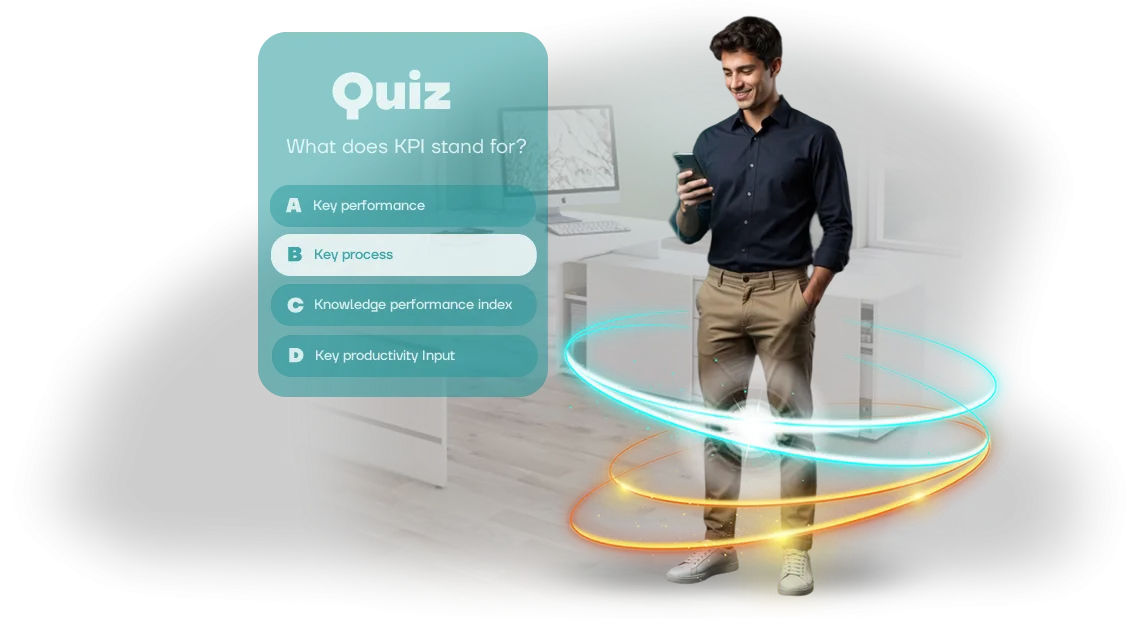
Developing Critical Feedback Skills Through an Educational 3D Quiz
In any team, sooner or later there comes a moment when you need to tell a colleague or a subordinate that their results don't measure up. How do you tell someone that deadlines have been missed? How do you point out a mistake without triggering a defensive reaction?
Most often, such conversations end either in silence or in emotional confrontation. The result — unfinished tasks, mounting tension, and employees who prefer to stay silent about problems.
Critical feedback is a skill, not an innate character trait. It can and should be trained, but in real work the cost of a mistake is too high: one poorly chosen phrase can ruin relationships, demotivate a person, and kill their desire to improve.
That's why employee training should take place in a safe environment where they can try different phrasings, see the interlocutor's reaction, and understand how words affect the outcome. This is especially important for managers and for those who work directly with clients.
An educational 3D quiz with a dialogue simulator solves this problem. The employee finds themselves in a realistic situation, talks to a virtual interlocutor, and learns to deliver critical feedback in a way that gets heard.
Instead of lectures and handouts — hands-on practice: choosing replies, responding to objections, working with emotions. This format engages employees in learning far more than standard tests.
We have been developing such simulators for over 10 years. We help companies turn employee training into a clear, engaging process that delivers tangible results in team management.
Why a Corporate Quiz Boosts Engagement and Changes Behavior
Standard lectures and tests have long stopped working: employees formally attend but don't get involved — knowledge isn't retained, and behavior doesn't change.
A corporate quiz turns training into a game format where each participant lives through a situation rather than just listening to theory. It's precisely this that turns a training session from mandatory routine into an event people look forward to and discuss.
When an employee answers questions within game mechanics, natural excitement and healthy competition kick in.
The company gets a measurable increase in staff engagement already at the training stage: people become active, argue, and discuss answers — which means they genuinely get drawn into the topic.
Game-based learning delivers the key business effect: knowledge is applied immediately in practice rather than staying in memory until the end of the webinar.
Built-in dialogue scenarios with solution options allow safely practicing difficult communication: a conversation with a difficult client, a resentful colleague, or delivering blunt feedback.
The employee tries different strategies and sees the consequences of each choice right here and now, without risking real relationships in the team. This develops team skills and emotional intelligence more effectively than any theoretical case analysis.
The quiz format subtly shifts the focus from the "right answer" to understanding the interlocutor's logic and intentions.
During the game, participants begin to hear each other, negotiate, and seek compromises — conflicts fade out on their own because the team learns to speak the same language.
For the business, this means a healthier atmosphere and fewer lost work hours spent on conflict resolution.
The result of such corporate training is not a temporary burst of activity but a lasting change in communication habits. We track which questions caused difficulties and see the dynamics across teams — this allows us to precisely reinforce weak spots.
A Unity-powered quiz delivers exactly the format that holds attention and converts gameplay into working skills — now let's move on to answers to frequently asked questions about implementation and guarantees.
Training Quiz Formats: Which One Fits Your Task
Each training quiz serves its own task: sometimes you need to quickly check knowledge of procedures, sometimes engage distributed offices, and sometimes practice a difficult dialogue involving critical feedback.
The format determines how much time an employee spends in the simulator and how firmly the skill is retained. We select the type to match your team and learning scenario — here are the basic options.
| Format | For whom | What it gives the client |
|---|---|---|
| Compact multiple-choice test | Small teams of up to 20 people, quick launch | Saves training time, intuitive for everyone, immediately shows the knowledge level |
| Quiz with gamification and leaderboard | Medium teams and distributed offices | Creates healthy competition, engages even remote employees |
| Scenario-based simulator with dialogues and branching | Complex situations: critical conversations, conflicts, negotiations | Practices the skill in a safe environment, prepares for real challenges |
A short test is convenient when you need to check knowledge of regulations or new products.
But developing critical feedback requires a different approach: the employee must, in practice, choose their words, react to the interlocutor's emotions, and see the consequences of their decisions.
That's why, for complex soft skills, we recommend scenario-based formats. The employee enters a dialogue with a virtual interlocutor, goes through several branching points, and at the end receives a breakdown — why one answer worked better than another. This is a simulator that transfers the skill from the screen into real work situations.
If you have distributed offices or several shifts, a quiz with a shared rating comes to the rescue. It doesn't require everyone to be present in one room — employees complete it at a convenient time, and the manager sees statistics for each branch.
This way, you choose the format not by the "the more, the better" principle but precisely for your task and team structure.
Development Stages: From Brief to Launch
Developing a quiz for critical feedback training is not just a multiple-choice test. Employees need safe practice: they try different response styles, see the consequences of their words, and remember effective patterns.
For the project to deliver results, a clear process matters. We've structured the stages so that you control the progress at every step and understand what you're getting.
-
Brief and immersion. We hold a meeting and study real situations from your field. We identify which critical feedback moments are the hardest for your employees and how behavior should change after the lesson. The output — an agreed technical specification.
-
Scenario design. We write the quiz scenario: questions, answer options, and the consequences of each choice. We build in branches from a harsh to a supportive style — the employee sees the difference through clear examples.
-
Prototype. We create a demo version based on your real dialogues. You try it out and make edits before the full development stage — this saves time and budget.
-
Development and integration into training. We build the full version: visual design, scoring, visual hints. We connect the quiz to your training program, and employee results go into the overall reporting. The format can be used both in in-person training and for self-paced completion.
-
Test run. We launch the quiz with a pilot group. We check whether employee behavior changes in real dialogues. We collect feedback from participants and adjust the scenario.
-
Launch and support. We hand the quiz over to your team and provide instructions to trainers. We stay in touch: helping with technical questions and updating content for new situations when needed.
What's Included in the Project Delivery: Scenarios, Mechanics, Development Analytics
After the quiz launch, you get not just a game but a ready-made training tool that works toward results. The delivery package is assembled so that the project can be used immediately, without involving developers or methodologists on your side.
We hand over everything needed for launch, support, and evaluation of employee progress — from scenarios to analytical reports.
Here's what's included in the delivery:
- Ready-made quiz on a professional engine — optimized for computers and tablets, runs in the browser, requires no installation. Employees take it at a convenient time, and you see the results in your personal dashboard.
- Methodologically validated scenarios — all critical feedback dialogue situations are broken down with real examples from practice. Each scenario teaches the employee how to act in a difficult conversation rather than just memorize theory.
- Engagement mechanics — a 3D dialogue simulation with reply choices, interlocutor reactions, and branching storylines. The employee gets instant feedback on every decision and sees the consequences of their choice.
- Development analytics system — automatic reports for each employee and group: completion, mistakes, retries, result dynamics. You see who has already mastered the skill and who needs additional training.
- Methodological materials for managers — recommendations on how to review quiz results with the team, what topics to raise at a general meeting, and how to turn mistakes into a development plan.
- Technical support and updates — during the support period, we monitor stable operation, fix reported issues, and add new situations to the scenarios on request.
The entire delivery is adapted to your company's internal standards: you can edit texts, add your own cases, and configure access for different groups of employees. This is not a one-off game but part of a training system that stays with you for a long time.
Case Study: How a Quiz Reduced Team Tension and Boosted Productivity
For a manufacturing company with three sites, feedback was a weak spot. Site supervisors complained about a "wall of silence," and employees avoided open conversations — they were afraid of conflicts and consequences.
As a result, problems piled up, tension grew, and productivity fell. The HR lead set the task: teach the team to give honest critical feedback so that it works toward results, not against them.
our team engineers developed a 3D quiz with dialogue scenarios from real manufacturing practice. The employee enters a virtual workshop, talks to a colleague or supervisor, and chooses how to respond.
After each answer — instant feedback: what was said correctly, what caused a defensive reaction, and why. This allows practicing the skill in a safe environment, where a mistake costs nothing but teaches a valuable lesson.
What Changed After Implementation
After two months, we measured the result. The share of employees who regularly give constructive critical feedback grew from 31% to 78%. The number of prolonged conflicts within shifts dropped by half, and plan completion at the sites with the most difficult climate rose by 18%.
Managers noted: fewer complaints to HR, issues are resolved on the spot, and teams reach agreements faster.
Why did the quiz work? Instead of boring theory — practice on real-life situations. The employee chooses the wording themselves, sees the consequences, and tries again until they find a working approach.
The skill is reinforced through repetition, and this happens before the person enters a real dialogue. There's no need to wait for things to "sort themselves out" — the training works proactively.
The result was confirmed by a repeat order: the company asked to expand the program for young managers. Such trust is the best indicator that the quiz solves a real business problem rather than just entertaining employees.
How to Choose a Quiz Format Based on Your Team's Specifics?
The choice of quiz format depends on the size of the team, its geography, and corporate culture. There is no universal solution: what works for a small offline department doesn't work for a distributed team. First, answer two questions: who will take the training and what result do you want to achieve?
For a remote team working across different time zones, a flexible schedule for completing dialogue scenarios is convenient. Each employee takes the quiz at their own pace, and the system records mistakes and successful decisions.
This way, you cover everyone without disrupting the workday and without being tied to a common schedule.
For a small team that meets in person regularly, a live group review of scenarios is a better fit.
Participants discuss the consequences of answers and hear alternative points of view — this develops the critical feedback skill in a safe environment and immediately shows how colleagues perceive different phrasings.
Also account for the specifics of the training. If the goal is to teach employees to give constructive feedback, the scenarios should be as close as possible to real work situations: a conflict with a client, a colleague's mistake, a difficult conversation about work results.
It's important that each situation offers a choice of answer options and clearly shows the consequences — then the employee sees the direct link between their behavior and the outcome.
The main thing is that the format addresses your team's specific needs. If you're in doubt, start with a quick diagnostic: what matters more — completion speed, depth of skill practice, or engagement of all participants? Describe your situation, and we'll help you find the most suitable quiz format.
Answers to Frequently Asked Questions About Implementing Training Quizzes
Implementing training quizzes raises the same questions among managers: how long it will take, whether it will fit into existing training, and how employees will react. These are normal doubts — better to ask in advance than to face surprises. Here are answers to the most frequent ones.
How long does it take to develop a quiz?
On average, the first quiz is ready in 2–4 weeks. The timeline depends on the scope of the scenario and the number of questions, but we know how to meet the deadline without losing quality. At the start, you receive a clear plan with dates — and then you simply monitor the result.
Is it difficult to integrate the quiz into our training system?
No. The quiz runs in the browser — an employee completes it from a computer, tablet, or phone. You don't need to install anything, and if necessary, we connect the quiz to your learning platform or simply provide a link to send by email. All data is collected automatically in your personal dashboard.
Won't employees treat the game as something frivolous?
If the quiz looks like an "exam," then yes — and we avoid that. A properly built quiz is perceived as an opportunity to test yourself and compete with colleagues.
In our practice, 80–90% of employees complete the quiz, and repeated launches show that people return to the game even after the mandatory program.
Submit a Request for Quiz Development for Your Team
Tell us what task you want to solve with training, and we'll propose a format that will work specifically in your team. You don't need to understand technical details — we'll help you formulate goals, choose quiz mechanics, and estimate the development budget.
After your request, you'll receive:
- Scenario consultation: we'll determine which critical feedback skill needs to be developed and how to distinguish the result before and after training.
- Preliminary project estimate: timelines, development stages, and possible formats — from a short quiz to a multi-level scenario with branching.
- A demo version on your example: we'll show what the dialogue looks like, what answer options are built in, and how the employee sees the breakdown of their mistakes.
- A clear work plan: what happens at each stage, who participates from the company's side, where your feedback is needed, and what we take on ourselves.
- A clear list of final materials: a ready scenario, question setup, administrator instructions, and access to results.
Submit a request with a brief attached, or simply describe your task in your own words. We'll respond within one business day, ask clarifying questions, and prepare a proposal for your team.