

Mistakes in driver training cost businesses money and reputation
Scattered lectures and tests with ready-made answers do not build safe driving skills. An employee can answer exam tickets flawlessly, but in a real situation acts out of habit—and habit is often dangerous.
Mistakes that have not been practiced in training will sooner or later show up on a route, and then the business pays for them out of its own pocket.
The price of such a mistake is not retaking an exam, but damaged vehicles, missed delivery deadlines, injuries, and disputes with insurers. Every accident involving an employee behind the wheel hits profits and reputation: repair and compensation costs rise, customer trust falls. Accident rates directly affect a company's image—one high-profile incident can erase years of work.
Classic tests do not check the main thing—how a driver will behave in an unexpected situation: a sudden pedestrian, a slippery section, brake failure. Knowing the rules and being able to apply them under stress are different skills.
This is exactly where traditional driver training breaks down: it evaluates memory, not readiness for the real road.
Driver training should include practicing decisions in a safe but realistic environment. Then a mistake during training does not lead to an accident, but becomes experience.
We build training exactly this way: we simulate typical and complex situations, let the employee act, and immediately show the consequences of their decisions. That is how a skill is reinforced before it is needed on a route.
Key benefits of an interactive quiz for corporate training
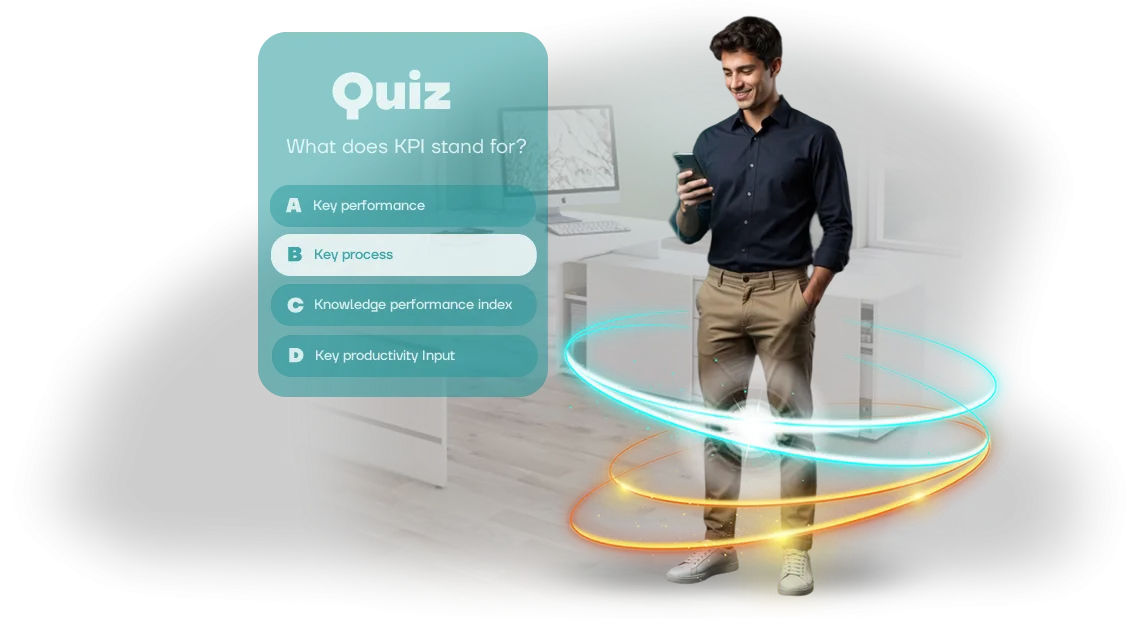
Employees get bored at standard briefings, and a week later they forget half the requirements. An interactive quiz changes the mechanics: a person does not read passively, but answers, makes mistakes, and immediately sees the correct option.
This way the material stays in memory—including on the road, where the cost of a mistake is high. This is exactly the area where we, our team, have been helping transport companies for many years.
What the business gets from the quiz
- Employee engagement. The game format with points and a leaderboard creates healthy competition. Drivers complete training not just to check a box, but with interest, and almost all of them finish.
- Material retention. Short questions with instant feedback reinforce traffic rules and internal regulations. Repetition in a game format works more effectively than reading long instructions.
- Accident reduction. When an employee practices complex situations in a quiz, they act more confidently on the road. Regular testing helps reduce the number of incidents and related costs.
- Manager time savings. The quiz runs on any device, and results are collected automatically. No need to review each person manually—the system shows who has absorbed the material and who needs extra attention.
- Transparent control. Reports for each employee and for the group: problem topics, percentage of correct answers, dynamics. This is a ready-made basis for improving the entire corporate training program.
The quiz is not just entertainment, but a working tool that pays off through reduced risks and increased discipline. Companies that adopt this format see changes in employee behavior and the quality of their training faster.
Quiz formats for driver training: for any task
Here is the latest version of the dialogue scenario for clarifying an ADHD diagnosis. Use it to update the bot:
const conversation = [ { role: "assistant", content: "Здравствуйте! Я уточнил ваш диагноз.
Вот актуальная информация, которая поможет вам разобраться: https://example.com/adhd-diagnosis-explained" }, { role: "user", options: [ { id: 1, text: "Что означает мой диагноз?" }, { id: 2, text: "Какие обследования мне нужно пройти?" }, { id: 3, text: "Как это влияет на мою жизнь?" } ] }, { role: "assistant", condition: { optionId: 1 }, content: "Ваш диагноз СДВГ означает, что у вас есть особенности внимания и гиперактивности.
Это не приговор, а особенность, которую можно скорректировать с помощью терапии и поддержки." }, { role: "assistant", condition: { optionId: 2 }, content: "Обычно рекомендуется пройти нейропсихологическое тестирование и консультацию психиатра.
Это поможет уточнить детали и подобрать лечение." }, { role: "assistant", condition: { optionId: 3 }, content: "СДВГ может влиять на концентрацию, организацию и эмоциональную регуляцию.
Но с правильной поддержкой вы можете успешно управлять этими проявлениями." } ]; How quiz development works: from brief to launch A clear process is what distinguishes a reliable contractor from a "black box".
We work in stages: you always know what stage the project is at, what is ready, and what decisions are needed from you.
This approach is especially important in driver training—here, mistakes in a scenario cost more than in an ordinary quiz, so we coordinate every step in advance.
Here is how a standard workflow looks:
- Brief and immersion. We gather the input: who we are training, which skills and rules to test, and in what format employees will take the quiz. If needed, we study your internal regulations and training materials.
- Scenario and questions. We develop the quiz structure: topics, difficulty, scenario branching, answer explanations. You approve the texts—or we prepare them ourselves based on your data.
- Plan and interface mockup. We lock down timelines, module composition, and appearance. We align the style so the quiz fits your brand and works well on the devices where it will be used.
- Prototype and demonstration. We build a working version with key mechanics. You go through it as a user and see how the dialogue simulator behaves before all resources are invested.
- Full development. We connect all modules, set up completion statistics and reports for managers. At this stage you receive a finished training tool.
- Testing with a group. We test the quiz with real employees: question accuracy, clarity, stability. We gather feedback and make corrections.
- Launch and support. We deploy the quiz for all participants, train your administrators, and hand over instructions. We stay in touch for refinements and question updates.
What is included in the delivery of a staff training quiz
After the project is completed, you receive not just a working program, but a complete set of materials with which your team can start training immediately, without involving developers or contractors.
We hand over source files, documentation, and ready-made content—everything needed to launch the quiz and, if necessary, develop it with your own specialists.
Here is what is included in the delivery:
- Ready-made training quiz — a compiled application that works on your computers, tablets, or in a browser. Employees start the training and immediately see the result.
- Source project — all files and assets, so you are not dependent on us. Any modification, question changes, or addition of new scenarios can be done by your team or any other contractor.
- Question and scenario builder — a simple admin panel where your training methodologist or training department head can independently edit questions, answers, and explanations. No need to be a programmer—the interface is clear after a short instruction.
- Training content base — texts, diagrams, and short explanations for each question. After answering, the employee sees not just "correct/incorrect" but an analysis of the situation, so the material is absorbed faster.
- Instructions for launch and use — step-by-step guides for the administrator and for employees. They are written in plain language with clear tips—the team will figure it out without separate training.
- Technical documentation — a description of the project structure, equipment requirements, and update procedure. This is your safety margin in case of staff changes or system evolution.
- Testing report — we check the quiz before handover and include a document with results: how testing went, what errors were found and fixed. You don't need to double-check us—you receive a product that already works.
- Post-launch support — within the contract, we stay with you: we answer questions, help with launch, and quickly fix any issues in the first weeks of operation.
Case study: how we built a quiz for a transport company
When the transport company AutoTrans-Logistics contacted us, the problem was typical: drivers formally completed briefings, but a month later made the same mistakes on their routes.
Regular tests in the electronic portal were filled out on autopilot, while real knowledge remained at a low level. The goal was not to test memory, but to change safe driving habits—repair costs and insurance payments directly depended on it.
We proposed a dialogue-based 3D quiz simulator instead of standard questions. Inside it, the driver does not choose an answer from a list, but enters a virtual situation: they need to react correctly to a pedestrian, a slippery road, or sudden braking.
Every decision affects how the scenario develops—so training becomes experience, not rote memorization. We also added competitive elements: drivers see their results and compare them with their colleagues' performance.
The results were telling. The average score on the final test increased by 34% compared to pre-implementation levels, and the number of repeat traffic violations decreased by 27% in three months.
Managers noted that drivers themselves asked to return to the simulator—training was no longer a mandatory chore. Six months later, the company ordered new scenarios for winter conditions and long-distance routes.
The development process itself took three weeks—we quickly built a prototype and refined it after a pilot launch. For the company, this meant that training never stopped for a single day.
The case confirms the main point: the game format works not for entertainment, but for results. Drivers absorb the material faster, make fewer mistakes in real situations, and are more willing to complete refresher training.
This is exactly why we include simulation of work situations in quiz development—it pays off in lower accident rates and reduced repair costs.
How to choose a quiz format for employee training?
There is no universal format: choosing a quiz starts with the question of what result you want to achieve. For driver training, this could be testing knowledge of traffic rules and internal instructions, or practicing actions in an emergency situation. The answer to this question determines the type of quiz.
The classic "question — answer" format handles quick checks: the employee takes the test, sees errors, and remembers the correct option. This is convenient for initial control and knowledge updates, but it does not show how a driver will behave in a real road situation. If the goal is only to identify gaps in theory, this format is enough.
A dialogue-based 3D simulator immerses the driver in a scenario: they see the road, make decisions, react to other road users, and immediately experience the consequences of their actions.
This format builds skill, not just memory, so it is better suited for accident prevention and risk reduction. This is where choosing a quiz becomes strategic: you influence employee behavior, not just check their awareness.
The practical guideline is simple. If the task is to quickly communicate a regulation and check whether employees have absorbed it, a light test is enough.
If it is important to change driver habits and reduce the number of violations, you should choose an interactive scenario with branching, where each answer leads to a new development in the road situation.
We help you decide on the format at the brief stage: we analyze the audience, work specifics, and evaluation criteria, then propose a solution that saves budget and delivers measurable results.
This way you do not overpay for a complex quiz where a simple one is enough, and vice versa—you get a simulation where nothing else can change driver behavior.
Frequently asked questions about implementing quizzes in training
Any new tool in training raises questions: will familiar processes have to change, will employees cope, how quickly will everything work. The doubts are understandable—companies often postpone implementation for fear of stopping the training cycle. So we answer the main questions honestly and to the point.
How long does it take to implement a quiz?
We prepare a turnkey basic version in 2–3 weeks. Within this time you get a polished format that is already integrated into your training program. From then on, the quiz works independently: you assign employees, change questions, and get results in a convenient format.
How difficult is it for employees to take the quiz?
The interface is simple and clear—access via browser or app, nothing to install. Basic computer skills are enough to complete it. Even drivers who rarely work with technology, in our experience, master the format in a couple of minutes.
Will the quiz fit into our current training system?
The quiz works as a standalone tool and does not require replacing your platform. It can be used separately or integrated into existing training programs—result exports and document export are supported. We help you configure the process to match your internal regulations.
Who will support us after launch?
We do not abandon the project after handover. For the first month we oversee the launch, then you get technical support: updates, fixes, consultations. If you need to add new questions or change a scenario, we will align and deliver it quickly without downtime.
Let's discuss your quiz for employees?
Tell us which skills need to be strengthened in drivers or other employees, and together we will turn them into a quiz scenario that will not let anyone get bored.
After you contact us, you will receive not generic words but a concrete plan: scenario, structure, mechanics, and implementation stages.
We will ask a few clarifying questions so that the quiz integrates into your current training and solves exactly your tasks. No fluff—only practical work that helps you absorb requirements, regulations, and safe practices faster.
- We will call you back within one business day and clarify your training objectives
- We will suggest a format: test, dialogue simulator, or team game
- We will propose a quiz structure and question options tailored to your specifics
- We will agree on timelines and work stages—from scenario to launch
- We will show examples of similar projects and their results
- We will document the work plan and control points at each stage
- We will answer questions about technical support and updates after launch
To order a quiz, simply leave a request—we will discuss the details, and you will understand exactly how the quiz will work in your training system.