

Why managers lose real estate sales even with good scripts?
It is not enough to simply hand managers a script and wait for revenue to grow. When selling real estate, the client asks uncomfortable questions, hesitates, compares with competitors — and if the employee gets lost at that moment, the deal slips away. Everyone has a good script, but few know how to flexibly apply it in a live dialogue.
The problem is not laziness or weak motivation. Sales technique cannot be absorbed in one evening of reading a memo: what is needed is training in a safe environment where you can make mistakes, try different options, and see the consequences of your words.
Without such practice, managers memorize generic phrases but get lost on real objections — the buyer senses uncertainty and goes to a better-prepared competitor.
Every lost deal is not only a lost commission, but also time spent finding a new client, as well as a damaged reputation for the company in the real estate market.
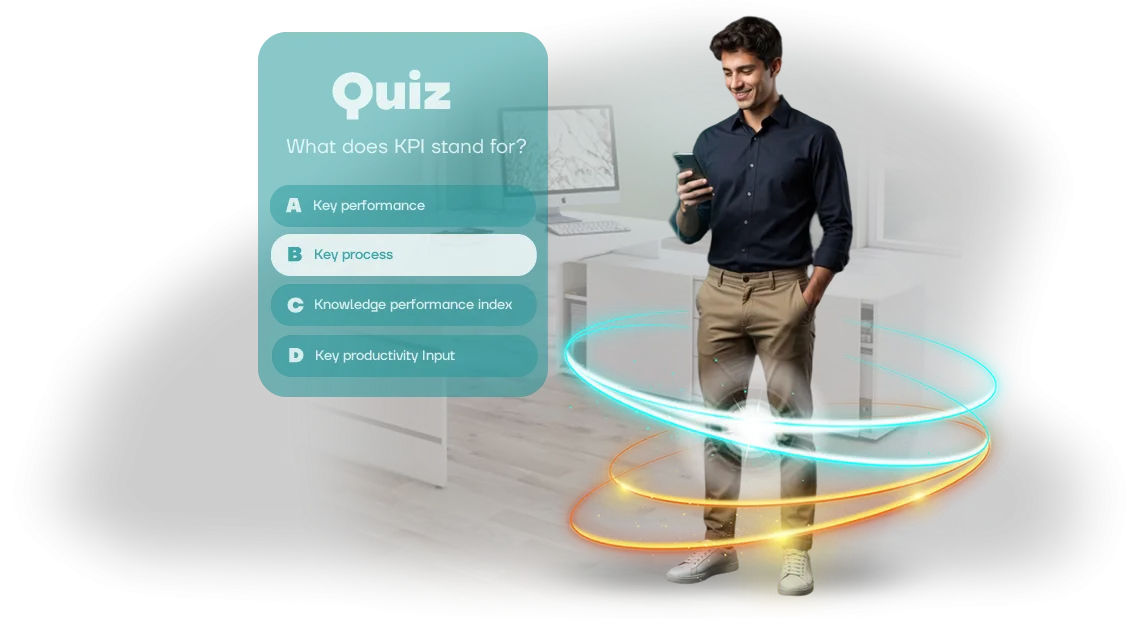
Training managers in the format of quizzes and simulations changes the situation: the employee experiences dozens of scenarios “here and now” and brings their skills to the point of automaticity.
Such a training system increases conversion because the manager stops operating by the book and starts listening to the client. Instead of dry theory — interactive cases with feedback.
And it is precisely such practical tools that form the foundation of our development of training programs for sales departments.
What an interactive training system gives the sales department
A real estate sales department needs not just knowledge of scripts, but the ability to handle objections and present the property. Ordinary lectures and tests do not provide practice — an employee may learn the material but freeze in front of a live client.
Interactive training closes this gap: it immerses learners in real sales scenarios and lets them act in a safe environment.
A 3D quiz simulator turns the training into a game where the employee conducts a dialogue with a virtual buyer and immediately sees the consequences of their decisions.
This format holds attention and motivates learners to repeat the training — material is absorbed faster and more deeply.
In the simulator, you can practice difficult situations: refusal, doubts, bargaining, counteroffers. Mistakes do not cost the deal — the employee can calmly try different tactics and remember which approach leads to success. This is especially important in real estate sales, where the cost of an error is high.
The manager immediately sees each person's results: who has mastered the technique and who needs additional training. Instead of lengthy inspections — clear progress statistics. This allows you to quickly adjust training and raise the overall level of the department.
The team at our team develops such simulators on professional equipment, using refined dialogue scenarios. We handle all stages — from idea to implementation — so that you get a tool that truly increases sales.
Interactive training formats for growing real estate sales
Interactive training formats differ not in their names, but in the result they deliver to the sales department. A classic test reinforces the basics, a case study teaches decision-making, and a deal simulator transfers knowledge into a live dialogue with the buyer.
Choosing the right format directly affects how quickly a manager will start selling, not just answering questions.
We compare formats on three parameters: speed of implementation, depth of skill practice, and impact on revenue.
For growing real estate sales, the “test + simulator” combination works most often — it provides both knowledge control and objection training without risk to the company's reputation.
| Format | For whom | What it gives the client |
|---|---|---|
| Short test | Newcomers, mass hiring | Quick check of the basics: terms, deal stages, work procedures |
| Case task | Experienced managers | Practice of difficult situations: bargaining, deal failure, non-standard buyer request |
| Role-play | The entire sales department | Dialogue and argumentation training in a question-answer format |
| 3D deal simulator | Sales leaders | Full immersion in dialogue with a virtual buyer, practicing objections to the point of automaticity |
Each format serves its own purpose. If the goal is to raise the average ticket and conversion to deal, the deal simulator delivers the greatest effect: a manager experiences 5–7 scenarios in an hour instead of one “generic” training.
At the same time, tests and case studies remain useful additions to regular training — they help reinforce standards between sessions.
Choose a combination of formats for your current task: a test for knowledge control, a case for mental flexibility, a simulator for growing real estate sales. During a consultation, we will select a combination tailored to your team and processes.
How development of a quiz for employees works
Work on a quiz for employees is structured so that you see the result at every stage. We start with a brief and finish with the launch of training and ongoing support — no “black boxes” and no surprises in timelines.
- Brief and immersion. You tell us about the specifics of real estate sales, customer objections, and complex properties. We record training goals and criteria by which we will evaluate the quiz's effectiveness.
- Scenario analysis. We review successful deals and typical mistakes to embed real situations from your managers' practice into the quiz.
- Mechanics and storyline. We design the dialogue format: how the conversation with the buyer develops, which answers lead to a deal, and which lead to a loss of interest.
- Alignment. You see the scenario and prototype before final development starts. Edits at this stage are fast and without extra cost.
- Training launch. We test the quiz with real users, place it on a convenient platform, and grant access to all employees.
- Support. We collect feedback, analyze completions, and update content when market conditions or product lines change.
The result is a working tool for regular training instead of a “one-off test.” Employees train on safe real estate sales scenarios, and you see who is ready for deals and who needs a refresher. The first launch is possible within a few weeks after the brief.
What you get after launching the quiz
After launching the quiz, you get not just a game, but a complete real estate sales training system. Employees practice real dialogues with buyers in an interactive format and remember key arguments faster than when reading instructions.
The delivery package includes everything needed for work:
- Quiz scenarios — well-developed dialogues with objections like “too expensive,” “I’ll think about it,” “I’ll compare with another company.” The employee practices responding confidently and closing the deal.
- Professional 3D scenes — realistic visualizations of apartments, houses, and neighborhoods. Visuals help to remember properties and their advantages without memorizing tables.
- Assessment system — automatic calculation of scores, errors, and time for each question. You immediately see who is ready for client communication and who needs to review the material.
- Employee reporting — a summary of each participant's results: difficult questions, typical mistakes, response speed. This is the basis for training plans and individual tasks.
- Post-launch support — we do not abandon the project: we help adapt scenarios to new properties, promotions, and product changes, and answer the team's questions.
The main result is measurable growth in competencies. Managers start losing fewer clients at the “I'll think about it” stage, speak more confidently about projects, and secure more meeting agreements.
And the manager saves time: there is no need to personally check knowledge — the full picture is in the reports.
The delivery is assembled as a single product: scenario logic, graphics, assessment system, and report interface are already configured.
Launch takes minimal time, and from then on the tool works independently — training happens without interrupting work and without involvement of an IT specialist.
Case study: plan fulfillment growth after implementing a training quiz
We implemented a training quiz for a real estate agency with three offices and a staff of about forty agents. Before the project, the plan was fulfilled at about 60%: newcomers took a long time to get up to speed, and experienced employees worked according to old scripts. The manager wanted a tool that would quickly level the team's knowledge and directly affect sales.
We created a short training scenario: in game form, the agent goes through dialogues with the buyer, chooses answers, and receives an analysis of mistakes. our team took on the scenario, implementation, and launch.
Two months after implementation, they began exceeding the plan, and the share of new construction deals grew by 30% — this was confirmed by the agency's management reports.
The head of sales noted: “The quiz doesn’t let anyone slack off. Each agent sees exactly where they lose the client and immediately practices a new approach.
We felt the result already in the first quarter.” Importantly, the training did not require time away from work: agents went through 15–20 minute modules before the scheduled meeting.
Payback came quickly because the quiz became part of regular work, not a one-off training. We updated scenarios for new properties, and the agency received a tool that continues to work for every subsequent deal.
How to choose a quiz format for your company’s specifics?
There is no single “correct” format — it always depends on your goals and business specifics. A company selling apartments in new developments and an agency working with suburban real estate will need different scenarios.
It is important to understand what exactly employees need to be trained in: handling objections, understanding legal nuances, or confidently presenting the property.
Several factors influence the choice of format. The level of your team's preparation, typical difficulties in negotiations, the funnel stage where clients are most often lost.
For example, beginners benefit from a format with hints and error analysis, while experienced managers benefit from a tough scenario with unexpected buyer questions and time limits on answers.
It is also important where exactly the employee undergoes training: in the office at a computer, or on a tablet on the go.
We take an individual approach to choosing the format. At the start, we conduct a short audit: we listen to call recordings, study your sales scripts, and discuss typical failures with the department head.
Based on this, we offer several options — from a simple text quiz to a dialogue simulator where the manager communicates with a virtual buyer. You see the difference in price, timelines, and results, and we recommend the optimal option, not the most expensive one.
It is important not only to choose a format, but also to fill it with the right content. We adapt questions to your property portfolio: typical floors, installment terms, common objections about location or infrastructure.
Such a quiz does not look abstract; it immediately gives the employee knowledge they will apply on the very next call.
If you are unsure where to start, just write to us. We will consult with you, show examples of similar projects for the real estate sector, and help you choose a format for your task.
It will take no more than 30 minutes, and you will receive a ready-made solution adapted to your specifics.
Order a quiz development and get training that sells
Standard real estate sales trainings rarely change manager behavior: after a lecture, employees get lost again when the client says “too expensive” or “I'll think about it.” A training quiz with 3D dialogues is a simulator in which your manager practices scenarios on virtual properties: meeting the client, presenting the apartment, handling objections, and closing the deal. It is precisely these skills that increase conversion in the sales department.
To order training, you do not need to prepare a technical specification — just leave a request on the website. We will set up a call, clarify the tasks, and prepare an individual proposal for the format of your business. Then we work according to a proven algorithm:
- You leave a request — we contact you within one business day and discuss which sales stages need improvement.
- We conduct an audit of your materials: scripts, call recordings, real customer objections.
- Together with your business trainer, we describe the successful sales dialogue: from greeting to contract.
- We develop the quiz scenario with 3D dialogue simulation: locations, characters, answer options.
- We align on the scenario, make edits, and launch training for the team.
- We provide post-launch support: we update scenarios to match changes in sales.
The result is not another test, but a training tool that sells. Managers go through scenarios as many times as needed and bring the virtual client to a purchase.
You see detailed statistics: who is succeeding, at which stage employees get lost, and which objections cause difficulties.
Leave a request — we will prepare an individual proposal with the scope of work, timelines, and cost. This is the best way to order training that will pay off through growth in repeat sales and conversion.