

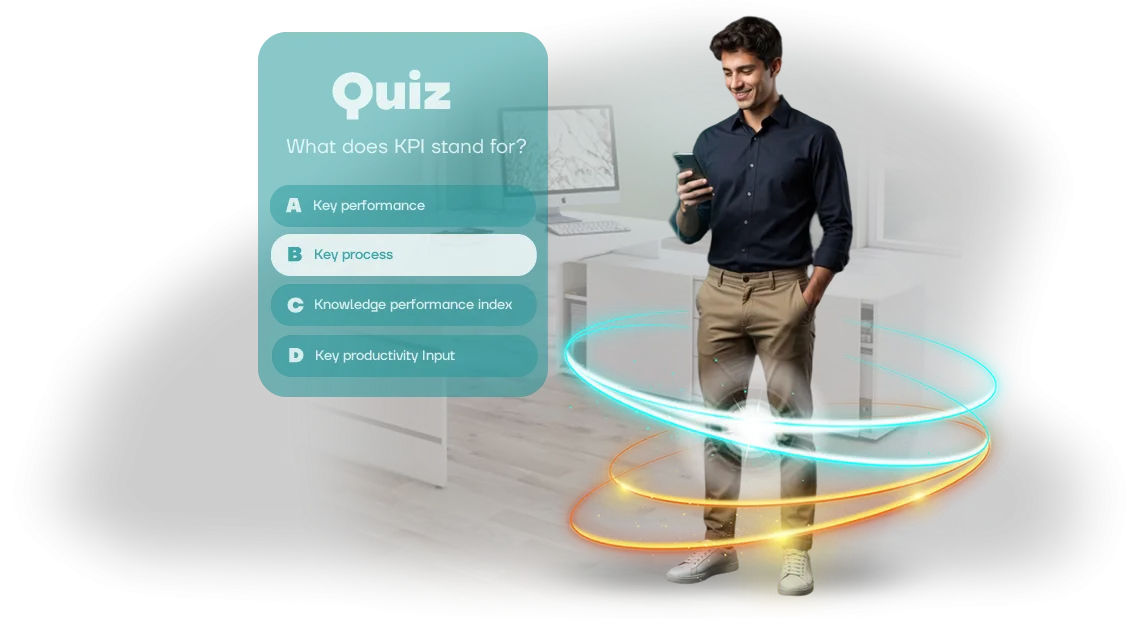
SaaS sales are stalling: customers don't understand the product's value
SaaS sales don't break down at the demo stage, but much earlier — when a salesperson can't explain in two minutes why the customer needs your product at all.
A complex product with many scenarios, pricing tiers, and integrations turns into a stream of jargon: the customer nods, leaves to "think it over," and never comes back.
The sales cycle stretches out, and the conversion rate from meeting to payment drops, even though the product is objectively stronger than competitors'.
A familiar picture: the sales team knows the functionality but can't speak the language of customer benefits. New employees are onboarded to the product through presentations and documentation — they memorize what to click but don't understand what pain each capability relieves.
As a result, every conversation with a customer turns into improvisation, and the outcome depends on whether you happened to have a strong salesperson.
We solve this problem by training the sales team on interactive scenarios: the employee doesn't read about the product but lives through real dialogues with a customer — from first contact to handling objections about price and implementation.
Professional delivery of the material holds attention and drills the skill to automaticity, while the manager gets a transparent picture of who on the team is truly ready to close deals.
The result for the business — a shorter sales cycle, higher conversion, and less dependence on individual "stars" on the team.
What an interactive simulator for selling SaaS services provides
The average SaaS sales manager reaches consistent results after months: the product is complex, the client is meticulous, and every conversation requires confident command of scenarios.
While a person learns on live deals, some deals are lost — not because the manager is weak, but because they haven't worked through objections and haven't felt the logic of the product.
An interactive simulator removes this problem: the employee goes through dialogue scenarios in a safe environment, makes mistakes where they cost nothing, and comes to a real client prepared.
The main effect is conversion growth. When a manager has already lived through typical situations in advance, they conduct the conversation more confidently, answer questions about value more precisely, and less often lose the initiative.
A learning quiz in dialogue format reinforces not theory but behavior: what to say at the right moment, how to turn interest into the next step. The learning effect is visible already in the first weeks — by the number of scheduled meetings and the quality of objection handling.
The second result is a shorter onboarding period. A new employee doesn't wait to gain experience on clients: they train on scenarios close to real ones and reach their target faster.
The manager, in turn, sees exactly where the team has a gap and closes it in a targeted way, rather than conducting a general training "for everyone."
The third is a unified sales standard. All managers go through the same conversation logic, so the client gets an equally strong experience of interacting with the company, regardless of who picked up the phone. This directly affects repeat deals and the reputation of the service.
Training quiz formats for your team's tasks
The format determines not the "beauty" of the quiz, but what skills an employee will actually take with them to the workplace.
That's why we first break down your task — what needs to be improved in the team and how you'll know it has gotten better — and only then propose a format. Below are the typical scenarios that clients most often come to us with.
| Format | Who it suits | What it gives the client |
|---|---|---|
| Quick product knowledge quiz | Sales department, support, new hires in onboarding | A verifiable level of knowledge on services and pricing, you can see who is ready for the client |
| Branching dialogue quiz | Sales managers of SaaS services | Practicing objections and conversation scenarios in a safe environment, without risk to the deal |
| 3D simulator of a work situation | Teams where live communication and presentation matter | The employee goes through a scenario "like in real life," the manager sees where contact is lost |
| Team competition quiz | Entire departments, internal events | Engagement and a common language between teams, awareness of new services |
| Regular series of quizzes | Companies with turnover and rapid growth | Knowledge doesn't become outdated, new hire onboarding follows a single standard |
How to choose a format for the task
Focus on three things: whom we're teaching, what skill is needed as an output, and how often the knowledge changes.
If the product is complex and sales happen through conversation — a 3D simulator and a dialogue quiz work: the employee practices exactly the phrases they will hear from the client.
If you need to quickly check the basics on services — a short quiz with automatic checking is enough.
We build the format around your task, not the other way around: a single scenario or a series, with reports for the manager and a clear picture of progress for each employee.
Let's discuss the task — we'll come back with an assessment and a plan for which format will deliver results fastest.
How development works: from brief to launch
The process is structured so that you see results at every step and don't waste time on unnecessary approvals. Below is the path from the first conversation to a working quiz that helps sell SaaS services.
- Brief and goals. We discuss the task: who we're training, which products we're promoting, what result we expect — higher conversion, faster onboarding for newcomers, reduced load on mentors. We lock in the success criteria we'll use to check our work later.
- Quiz script. Our instructional designers and scriptwriters build the logic: questions, branching, feedback, dialogues with virtual clients. You receive a document where every line and every choice is visible — before assembly begins.
- Approval. We show the script and storyboard, make edits, and approve the final version. At this stage, changes are cheap and fast, so we don't move forward without your "ok."
- Assembly. Our engineers build the interactive 3D environment: characters, lines, reactions to answers, a scoring and progress system. We work on professional equipment, so the result is stable on any of your employees' devices.
- Testing. We run the scenarios with real employees, see where they stumble, and fix the wording and difficulty. You receive a report: how many people completed it, where difficulties arose, and what we improved.
- Launch. We deploy the quiz in your environment, connect it to your learning system, and train administrators. Employees start taking it without additional instructions.
- Support. After launch, we monitor metrics, update content for new products, and add scenarios. The quiz stays relevant instead of becoming outdated a month later.
Each stage ends with a clear result that you can review and evaluate. This way you control the process and get a tool that genuinely impacts sales of SaaS services.
What is included in the delivery
You receive not a set of files and instructions, but a working product that your sales team uses from day one. Below is exactly what is included in the delivery and which customer task each item addresses.
- Ready-made sales scenarios. Dialogues tailored to your services and typical customer objections — from first contact to closing the deal. We write the scenarios together with you, based on real calls and correspondence, not on generic templates.
- Interactive simulator. An employee goes through a dialogue with a virtual client and sees the consequences of their decisions: where they lost the buyer's interest, where they gave up too early. Training takes place in a safe environment, with no risk to real deals.
- Evaluation system. Each run is analyzed against clear criteria: maintaining initiative, handling objections, articulating value. The manager sees who is ready for calls and who needs more work.
- Reporting for the manager. A summary for the team: who completed the training, with what result, where the common weak spots are. This is the basis for planning the next training sessions, not a report for the sake of a report.
- Training for your team. We show mentors and managers how to conduct debriefs and assign training sessions on their own, so that you don't depend on us in day-to-day work.
- Post-launch support. We support the first weeks of use, update scenarios as the product changes, and answer the team's questions.
We work with professional equipment and well-tuned tools — the result is consistent regardless of the number of employees and does not depend on where they are located. We hand over the kit with clear instructions so that the launch does not stretch out over months.
Case study: how a simulator accelerated SaaS service sales
One of our clients — a service company selling subscriptions to its online platform — came with a typical pain point: managers memorized scripts but froze in real conversations with clients, and newcomers only hit their targets by the third month.
We proposed not another training program, but a conversational simulator: an employee goes through a sales scenario with a virtual client who objects, haggles, and asks uncomfortable questions — just like in real life.
What changed after implementation
The onboarding time for a new manager was cut almost in half: a person was closing deals independently not in months, but in weeks.
The conversion from trial period to paid subscription grew noticeably — employees stopped "fumbling" the conversation at the objection stage because they had already worked through them dozens of times in a safe environment.
A separate effect was reduced churn. Clients were leaving not because of the product, but because the manager didn't guide them to a result.
When the team learned to carry a dialogue through to the end, the share of repeat renewals grew, and the number of cancellations in the first months of subscription dropped.
Why it worked
The simulator provides what no training program can: the opportunity to make mistakes without consequences and repeat a scenario until a confident result.
A manager can see for each employee exactly where they stumble and close that gap precisely, rather than running the whole team through a generic program.
Client came back to us with an expansion: we added new scenarios for adjacent products and roles. For us, that's the best indicator — when the result is visible in sales numbers, not in a training report.
How to choose the right format for the task?
The quiz format is always chosen based on the business goal, not the other way around. If the task is to quickly communicate product changes to employees, short regular surveys with instant feedback are enough.
If you need to practice the skill of selling SaaS services in a live dialogue with objections, you need a branching scenario with roles — then the employee doesn't memorize answers but trains behavior.
Therefore, the first step in selecting a solution is to formulate what should change in the team's work after completing the quiz.
Next, we look at the audience and context. For newcomers, a safe environment and hints are more important; for experienced employees — complex scenarios and a competitive element.
A SaaS services sales department benefits from simulating real negotiations, a support service — from reviewing typical requests, and management — from clear statistics for each employee.
The same quiz engine is configured differently for these scenarios, and there is no universal "best" format.
During a consultation, we analyze your business goal and offer 2-3 format options with the pros and limitations of each. You see how much content will be required, what reporting for the manager will look like, and in what timeframe the team will achieve its first result.
We give recommendations honestly: sometimes a light format is enough, and we will say so directly, rather than increasing complexity for the sake of budget.
Describe the task and audience — we will come back with an estimate, a plan, and a format recommendation for your goal.
Common customer concerns
A manager's concerns are almost always the same: "what if employees don't use it," "what if it breaks mid-quarter," "how much time will implementation take from my team." These are normal questions — they're about risk, not technology. Below we address them directly, without vague wording.
"And if it breaks — who fixes it and how fast"
We don't hand over the project and disappear. After launch, we stay on support: we monitor stability, update content to match product changes, and respond to requests according to a pre-agreed protocol. If something goes wrong — you write to us, not search for a new contractor. The warranty covers both the launch stage and the support period.
"How hard is it to implement internally"
We need a minimum from you: access to product materials and a person who confirms the messaging. Everything else — scenarios, question structure, results logic — is on us.
Usually implementation doesn't require a separate project from your team and doesn't stretch over months: employees get a ready-made tool and instructions, the manager gets a clear picture of engagement and results.
"Will employees even play this"
This is the main fear, and it's justified. That's why we design the quiz not as a "test," but as a short game session with clear benefit for the participant themselves: progress, feedback, a sense of momentum.
When a person sees the point of going further, they come back on their own — and you get regular practice instead of a one-off event.
What happens if we need to refine the quiz after launch?
This is a routine situation, not an emergency. The product changes, sales priorities change — we update the content and logic as part of support. We define in advance what's included in support and what counts as a separate task, so there are no surprises for you.
Do you guarantee that employees will start taking the quiz?
You can't guarantee people's behavior — and we say so honestly. But we're responsible for the tool being designed around the participant's real motivation, not a checkbox. At the start, we help with the launch and look at the first results together with you.
Let's discuss your task and come back with a plan
You can start with a short, businesslike conversation: you describe who we're training and what result is needed — growth in sales of SaaS services, quickly onboarding newcomers to the product, or regularly testing the knowledge of an existing team.
We ask clarifying questions and define what we consider success: the share of employees who complete the course, growth in sales conversion, a reduction in the number of errors when working with clients.
From there, the work follows clear steps — you always know what stage the project is at and what the output will be.
- Request and introduction. You submit a request in a convenient form, we get in touch and discuss the task: the audience, learning goals, timelines.
- Work plan. We prepare the course structure and quiz scenarios tailored to your products and sales processes.
- Estimate. We send a cost estimate and a calendar plan with stages — no hidden work and no extra charges along the way.
- Approval. Together we refine the scenarios and logic until we get a result that works for you.
- Development. We build the quizzes, dialogue scenarios, and a 3D simulator on Unity, and test them on real cases from your team.
- Launch and training. We hand over the finished course and show you how to view statistics and add new questions.
- Next step. We provide support after launch and propose further development: new modules, industry-specific scenarios, integrations.
After ordering, you get not a set of files but a working learning tool: employees go through quizzes and the simulator, while you see who has mastered the material and who needs help.
This format speeds up how quickly newcomers reach results and makes sales of SaaS services more predictable.
Describe your task — we'll come back with an estimate and a plan, and you'll immediately understand whether this approach works for you.