

How to increase insurance sales through training
Managers often lose deals not because they do not know insurance products well, but because they fail to orient themselves in the conversation.
A client asks an unexpected question about the deductible or coverage exclusions — and the employee starts giving template answers or falls silent. Trust melts, conversion drops, and sales training in the form of lectures and presentations does not solve this problem.
At a training session everything is clear, but in a real conversation there is stress, time pressure, and objections that were not in the textbook. Knowledge is there, but there is no skill to apply it quickly in a live dialogue.
Therefore, increasing conversion does not depend on the amount of theory, but on practicing scenarios until they become automatic.
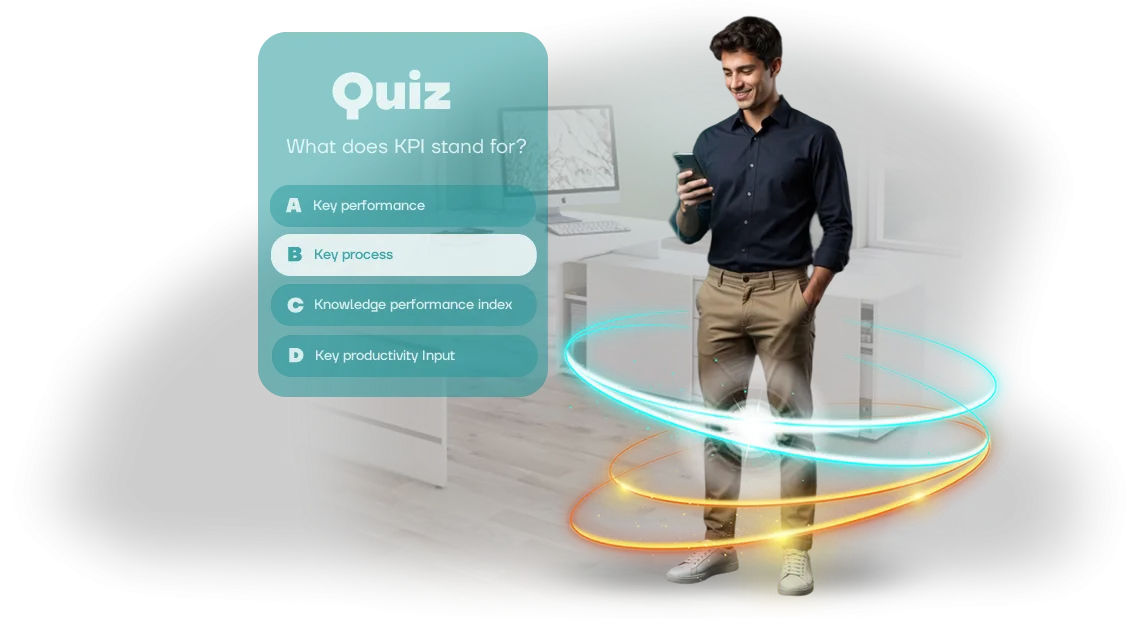
An interactive quiz closes this gap. The employee finds themselves in a simulated dialogue with a client, makes decisions, sees the consequences, and immediately receives feedback.
This is sales training embedded into real business processes: the manager trains on situations that actually happen when selling insurance products.
Webuild such quizzes on a professional platform — this allows us to create scenarios of any complexity and update them as insurance products change.
The company gets employees who confidently handle objections and, as a result, a measurable increase in conversion without raising the advertising budget.
What an interactive quiz gives a business
An interactive quiz turns learning from a mandatory procedure into a lively game that people want to participate in. Employees do not just listen; they immediately apply knowledge in practice, so engagement grows and the material is remembered for a long time.
The company gets a team that truly understands the product, not one that formally goes through the course.
It is especially valuable that the quiz provides an opportunity to safely practice handling client objections. The manager trains to answer difficult questions in a game-like setting, without the risk of losing a real customer.
By the time they meet a client, they already have ready-made phrases and confidence in their actions, which directly translates into sales growth.
A seller who can communicate competently and explain the value of an insurance product inspires trust. Clients stay satisfied, are more willing to take out a policy, come back for new services, and recommend the company to their acquaintances. This is how an interactive quiz works for customer loyalty and creates a long-term reputation.
A manager gets a transparent picture: the results of the quiz show which topics are well understood and which cause difficulties.
This allows you to quickly adjust the training program, paying attention to problem areas, and increase the overall efficiency of the sales department. Each game becomes a measurable development tool, not just entertainment.
In the end, the business gets an integrated system that combines training, skill practice, and result control. An interactive quiz solves several tasks at once — from employee engagement to sales growth and client loyalty — and performance indicators always remain under control.
Quiz formats for insurance services
For insurance sales training to really affect revenue, it is important to choose a format that matches the task and the audience. Each option has its own depth of immersion, duration, and result. Compare the three main formats and choose the one that will lead your team to sales growth faster.
| Format | Who it is for | What it gives the client |
|---|---|---|
| Dialogue scenarios | Sales managers who need to practice typical objections and face-to-face conversation | Confident work with scripts, less fear of cold calls, predictable behavior in dialogue |
| 3D simulator | Experienced employees and team leaders who need to rehearse complex negotiations | Full immersion in a real situation, emotional involvement, the ability to handle non-standard situations without risk to the client |
| Quiz trainer | The whole team, especially newcomers and remote employees | Quick review of rules, healthy competition, instant feedback on each person's results |
How to choose a format? If the team is just learning the product line, start with dialogue scenarios — they quickly create a basic skill.
For practicing complex objections and working with client doubts, a 3D simulator is more effective: it allows the employee to make mistakes in a safe environment and see the consequences of decisions.
When you need to regularly maintain momentum and test knowledge, add a quiz trainer — it is short, engaging, and easily fits into the work schedule.
We help you choose the optimal format for your business task, and if necessary, combine all three: scenarios provide the foundation, the quiz reinforces the theory, and the 3D simulator brings the skill to automaticity.
At the same time, the content is built on your real cases and products, so employees train not on abstract examples, but on situations they face every day.
How turnkey quiz development works
We take on the entire process — from the initial brief to launch and support. You do not need to dive into technical details: we understand your product, audience, and business metrics so that the quiz solves the main task — increasing insurance sales.
- Brief and product immersion. We discuss which insurance products you sell, what objections managers face, and what the quiz should achieve: knowledge reinforcement, skill practice, or preparation of new employees.
- Strategy and structure. We choose the appropriate format: a dialogue trainer, a quest, or an exam. We think through the storyline and motivation system so that training is interesting, not just “for show”.
- Scenario and content. We write real dialogues with clients, break down typical insurance sales situations, and include questions on product knowledge and objection handling. We adapt all materials to your terminology.
- Approval. We show the scenario and prototype on an understandable platform, collect edits from your experts, and approve the final version before development starts. You see in advance what you will get at the output.
- Development and testing. We build the quiz on a professional platform, check that it works correctly on different devices, and give it to your pilot employees for testing — we receive feedback before the mass launch.
- Launch and support. We place the quiz on your portal or connect employees, train administrators, and stay in touch. We refine questions, add new scenarios, and track completion results.
The entire cycle takes two to four weeks depending on the amount of content. You get a ready-made training tool that increases managers’ confidence and, as a result, insurance sales conversion.
What is included in the quiz delivery
You get not just a “quiz”, but a ready-made training tool that can be launched into operation immediately. We assemble a complete package — from the scenario to integration with your learning management system. Everything needed for launch and control is already included in the delivery.
- A ready-made training scenario. A storyline in which the employee practices selling insurance products: from first contact to objections. The scenario is written taking into account your products and typical client situations.
- Game mechanics that motivate. Points, levels, feedback, and visible progress — the employee sees their result immediately and wants to complete the quiz to the end.
- Design in your brand style. The layout, characters, and interface match the corporate identity and are perceived as part of the training, not as an external tool.
- Instructions for employees and administrators. Simple guides on how to take the quiz and how to track results. Nothing needs to be explained manually — employees will figure it out on their own.
- Integration with your learning management system. Results automatically go into the LMS: you see who has completed, who has passed, and who has not. You can export reports to evaluate effectiveness.
- Technical support at launch. We help deploy the quiz, check its performance, and stay in touch to ensure everything works stably.
The entire package is delivered as a single product — you do not need to assemble it from different contractors. We adapt the scenario to your insurance products and set up the integration for your learning platform. As a result, you get a tool that is quickly implemented and starts working to increase sales.
Case study: conversion growth after implementing a quiz
Before the quiz was introduced, an insurance company faced a typical pain point: managers knew the products well, but got lost in a live dialogue with a client.
Template presentations did not create trust, the objections “expensive” and “I’ll think about it” ended the conversation, and sales conversion remained low.
Wedeveloped an educational quiz-simulator of real dialogues. The employee goes through scenarios with different types of clients — from the thrifty to the skeptic — and in a safe environment learns to ask the right questions, identify needs, and handle objections. The quiz immediately shows where the sale is lost, so training stops being abstract.
Result in two months: sales conversion increased by 27%, and the number of successfully completed dialogues grew by almost a third. Managers became more confident, the number of missed leads decreased, and the insurance company managed to increase the share of repeat requests.
Most importantly, the skills remain after training, because the quiz turns knowledge into automatic behavior.
Today the company uses the same approach for onboarding newcomers. Instead of a long introductory course — several short quizzes that in a week raise a new manager to the level of an average employee in terms of dialogue quality.
A repeat order for expanding the quiz to cover new insurance products confirms that scenario-based learning produces a measurable business effect.
How to choose the right quiz format?
Choosing a quiz format is not a matter of fashion, but a matter of the result your business needs. If you need to quickly introduce a product, a light text quiz is enough.
If you need to change sales behavior and practice real conversations with clients, you need an immersive scenario close to the work situation.
What should you look at? At the goal, the audience, and the depth of skill practice. Short tests with instant feedback are suitable for mass training.
For insurance sales managers, simulating a conversation is more important: not just recalling policy characteristics, but responding to the objection “expensive” or “I’ll think about it”. Dialogue formats with branching scenarios help here.
We usually compare along three axes: development complexity, employee engagement, and result measurability. Here are typical options.
| Format | When to choose | What it gives the business |
|---|---|---|
| Text quiz | To quickly check knowledge of regulations and product facts | Automatic statistics for each topic, low launch cost |
| Video quiz | To teach complex scenarios when a visual example is important | Attention retention, a single standard for demonstrating the correct technique |
| Dialogue 3D simulator | To practice real sales skills: objections, presentation, closing the deal | Training in a safe environment, growth in employee confidence, metrics for each skill |
Expert advice: do not chase a complex format. If you have a small team and a simple product, a text quiz with error analysis is enough.
For a large team and high competition, a dialogue simulator is suitable: it shortens introductory training and reduces mistakes in the first deals. The right format is the one that solves the task without unnecessary costs, and we will help you choose it.
Frequently asked questions about implementing quizzes
Implementing a training quiz usually comes up against three barriers: fear of technical failures, uncertainty about timelines, and the question of how quickly managers will master the new format.
This is especially acute in insurance sales, where every day of training directly affects the sales plan.
We remove these barriers at the very start. The dialogue 3D quiz simulator runs on ordinary computers and tablets without any setup, and the scenario is built on real dialogues with the client.
The employee does not just answer questions — they train the sales skill in a safe environment. Below are answers to the most frequent client questions.
What happens if the quiz breaks down in the middle of a training session?
The simulator is designed for connection interruptions and accidental tab closures: progress is saved automatically, and the manager continues from the same question. During the launch period, we stay in touch and provide help within the business day.
How long does it take to implement the quiz?
We make a standard version for your products in 2–3 weeks. This period includes writing the scenario, preparing questions on your insurance products, and setting up reports for the trainer. You see intermediate versions and can make edits right away.
How quickly will employees master the new format?
No special training is required. The interface is intuitive, and hints are built directly into the quiz. For the trainer, we provide a guide and a short video — that is enough to start training the very next day.
Still have doubts? Ask them at a consultation — we will show live examples and discuss how to adapt the quiz to your team.Submit a request for quiz development
Submit a request for quiz development — and within a couple of days we will prepare an individual proposal for your insurance company’s task. You will receive not an abstract cost, but a concrete plan: format, content, timeline, and budget. It gives you a clear basis for your decision.
We have already made training quizzes for sales departments and know how to turn learning into revenue growth.
Describe your situation in the request — we will take care of the rest: analyze the product, the audience, and client objections, and propose a scenario that employees will actually want to complete.
How we work after your request:
- We contact you within one business day and clarify your tasks and audience.
- We analyze your insurance products and typical client objections.
- We propose 2–3 quiz formats based on your timeline and goals.
- We calculate the exact cost and show you what results you will get.
- We agree on the plan, scenario, and visual style.
- After the launch, we train your team and stay in touch for refinements.
Each item reduces risk for you. You see what you are paying for and understand what you will get: employee engagement, objection handling, and confidence in insurance sales.
Submit your request through the form below — and in a couple of days we will return with an individual proposal and a cost estimate. our team has been doing such projects remotely for 10 years, so you can be in any city.