

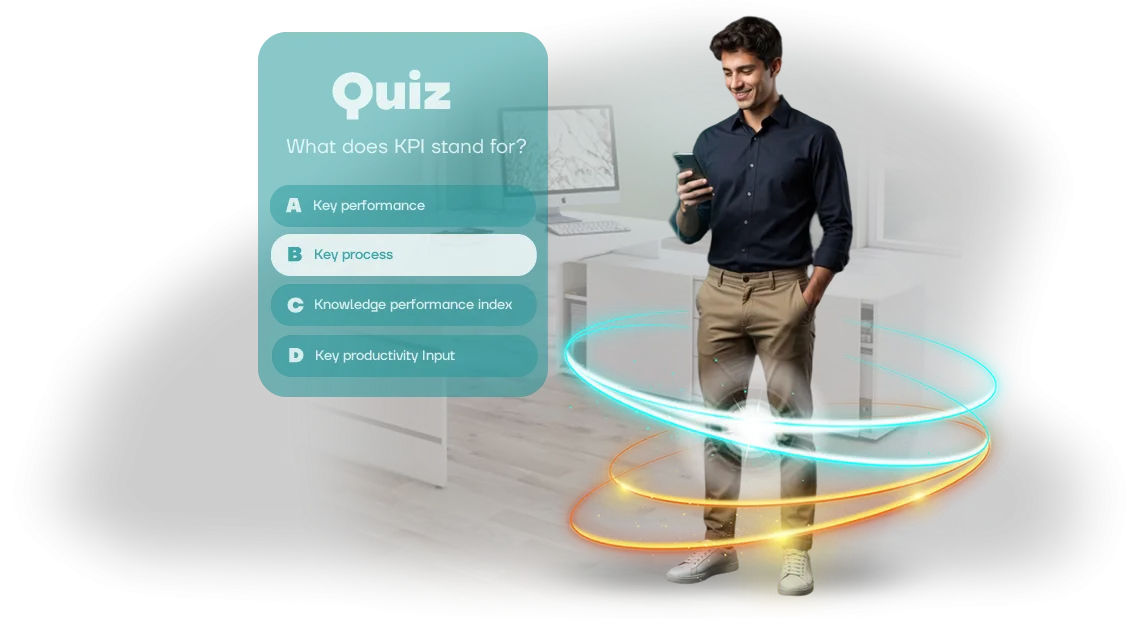
Why Standard Trainings Don't Prepare Employees for Working with VIP Clients
Standard trainings provide general rules and theory, but in a real conversation, a VIP client is always more complex than a training example. An employee memorizes scripts, but the first non-standard question — and the dialogue falls apart.
This is exactly where employee training problems begin: they gain knowledge but aren't ready to act in an unusual situation.
Ineffective trainings reinforce the illusion of preparation. Role-playing with a colleague doesn't convey the tension and pace of a live conversation, and feedback comes down to generic phrases.
As a result, a meeting with an important client becomes an exam where the cost of a mistake is the company's reputation and a major contract.
When an employee hesitates or dodges the question, the VIP client instantly loses trust. They're used to impeccable service and can easily switch to a competitor.
So, because of one uncertain dialogue, the company loses not just the deal but also a long-term client — and that's a loss of VIP clients in the most literal sense.
We solved the problem at its root: instead of lectures and scripts, we offer an interactive 3D quiz simulator where employees train on realistic copies of difficult situations. They learn to listen, counter objections, and find a way out when standard answers don't work.
That's how skills are cemented to the point of automation — and in meetings with VIP clients, your team acts confidently and drives profit.
What the Developed Quiz Gives Your Business
Traditional courses provide theory, but the manager is left one-on-one with a difficult VIP client. The educational quiz from our team closes that gap: the employee solves real tasks and sees the consequences of their decisions.
Here's what the quiz gives your business:
-
Safe skill practice. Managers learn from mistakes without risking client relationships. They try different strategies — every mistake becomes experience, not a lost contract.
-
Confidence growth. More scenarios — calmer conversations. A confident manager closes deals faster.
-
Measurable KPIs. The system shows each person's progress: how many scenarios completed, which topics lag. You see the real effectiveness of training.
-
Faster onboarding. New hires get up to speed in a week instead of months: typical situations are practiced on the simulator.
-
A unified standard. All managers work by the same algorithms — service stays consistent and doesn't depend on "stars."
-
Engagement. The game format creates excitement; employees return to scenarios on their own. Knowledge sticks for the long term.
Each point impacts sales growth: confident managers sell better, clients come back more willingly. Tell us about your task — we'll select scenarios tailored to your specifics.
3D Simulator Formats for Working with VIP Clients
Training for working with VIP clients isn't just about transferring product knowledge. An employee must confidently lead a dialogue, read the conversation partner's mood, respond correctly to objections, and preserve the brand's image in any situation. It's impossible to test such skills with a standard test.
That's why we've developed three educational quiz formats — from classic questions to an interactive 3D simulator. Each solves its own task, and together they let you build a complete training program: from theory checks to practicing difficult conversations with VIP figures.
| Format | Who it's for | What it gives the client |
|---|---|---|
| Classic test | For quick knowledge checks after a lecture or briefing | A clear picture: who got the material and who needs to review |
| Dialogue 3D simulator | For practicing conversations with a picky or demanding client | Practicing replies and reactions in a safe environment, without reputational risk |
| Full client scenario | For final assessment or immersion in a realistic situation | Testing comprehensive skills: from greeting to conflict resolution |
How do you choose a format? If you need to quickly refresh employee knowledge, a classic test is enough. When the key goal is to teach confident work with a VIP figure, choose the dialogue 3D simulator. The full scenario suits assessing an employee's readiness for real work or reviewing complex cases.
We'll help you combine formats into a unified training program and recommend the best option for your task.
How Quiz Development for Employees Works
For a manager, it's important to understand how the work will proceed in order to control timelines and results. That's why the process follows a transparent scheme: you participate at key points, and we handle the implementation. No unnecessary iterations — only steps that lead to a working quiz.
Quiz Development Stages
-
Brief and analytics. We gather the input: training goals, employee profiles, typical mistakes in communicating with VIP clients. The output is a clear technical specification.
-
Script and mechanics. We build the quiz logic: questions, answer options, difficulty levels, scoring system, and feedback. The script is written around real situations from your industry.
-
3D graphics and design. We create the visual part: characters, interface, environment. This turns learning into an engaging dialogue rather than a boring test.
-
Development and integration. We assemble the quiz into a finished product and connect it to your learning system. Employee results appear in a convenient report.
-
Testing. We verify it works on different devices — computers, tablets, touch panels. We fix all issues before launch.
-
Launch and support. We install the quiz, train administrators, and provide instructions. After launch, we provide ongoing support: updating questions, adding characters or levels.
Project timelines are fixed at the brief stage. On average, development takes 3–5 weeks, but the exact schedule depends on the script's scope and graphic complexity. You always know what stage the work is at and when you'll get the result.
What's Included in the Educational Quiz Delivery
The educational quiz delivery is a ready-to-use tool, not just a program with an installer. We hand over a complete package that lets you launch employee training right after installation.
- Script with dialogue branches — models real communication situations with VIP clients: objections, non-standard requests, conflict moments. Employees train in a safe environment, not on a live client.
- Character interlocutors — 3D figures with different personalities. They get fussy, doubt, and demand an individual approach, just like real guests. This helps employees practice flexibility and stress resistance.
- Library of phrases and answer options — ready-made formulations employees learn and take into their work. This speeds up onboarding for new team members and makes service consistent.
- Scoring system with points and explanations — transparent criteria for why one answer is better than another. Employees immediately understand their mistakes, and managers see each person's real level of preparation.
- Administrator guide — step-by-step instructions for launching, configuring, and updating questions. No programmer needed to change a scenario or add new situations.
- Technical support at every stage — we help with installation, answer questions, and quickly make changes if work standards evolve or new tasks arise.
This composition turns the quiz into a systematic training tool: you get not a "semi-finished product" but a complete learning cycle. All that's left is to launch the quiz and track your team's results.
Case Study: How We Trained Managers and Increased Sales 1.4 Times
We worked with an electronics retail chain where managers were losing high-value customers from the very first conversation. VIP clients demand a different approach: they need attention, speed, and product knowledge — and standard scripts don't work here.
The client asked us to create training that actually changes employee behavior, not just delivers theory.
What We Developed
Instead of lectures, we built a dialogue 3D simulator on Unity — a virtual VIP buyer with different personalities, objections, and non-standard requests.
The manager carries on a live dialogue with it, gets real-time reactions, and immediately sees where they lose the client: didn't listen, interrupted, didn't offer additional services. Every session is automatically analyzed, and mistakes turn into skills.
250 managers from 40 stores completed the training. No time away from work: employees trained in short 15–20 minute sessions, right between shifts.
Results and Client Feedback
Within a quarter, sales conversion among participants grew by 40%, and the average transaction for VIP clients increased 1.4 times. The client received not "test scores" but measurable revenue growth in the target segment.
The head of learning and development noted: "Previously, we ran trainings and hoped the knowledge would be applied.
Here, managers build skills to the point of automation, and you can see it in the sales figures." After the first phase, the chain ordered an expansion of the simulator to cover the new product range — training became part of their permanent staff development system.
ElectroLife retail chain — an example of how a properly built simulator pays for itself within one quarter and turns one-off training into long-term growth.
How to Choose a Format for Your Task?
Choosing a training format starts not with the question "which tool should we use" but with three simple questions: what should the employee be able to do after training, how much time is available, and which outcome is critical for the business.
Working with VIP clients requires the ability to conduct complex negotiations, maintain emotional balance, and quickly adapt to non-standard situations — ordinary multiple-choice tests only check knowledge of instructions, not actual skill.
So before choosing a format, it's worth identifying which mistakes employees make most often and how those mistakes affect revenue.
Dialogue simulators, where an employee converses with a virtual interlocutor and immediately sees the consequences of their words, train the reactions needed in real practice.
This format costs more and requires more preparation time, but delivers measurable results: fewer complaints, more repeat visits, greater employee confidence in negotiations.
If the goal is to quickly bring the team up to speed on new service standards or product lines, a lightweight quiz with explanations of the correct answer is enough.
Audience scale matters too. For a group of up to ten people, individual scenarios with detailed error analysis after each attempt are more effective.
For a flow of several hundred employees, a modular structure makes more sense: a basic test for everyone, an advanced scenario for those who work with key clients, and a final assessment with skill evaluation.
For example, mass training can be covered with a quiz, while key employees get a dialogue simulator — this provides transparent statistics for each participant and the entire team.
Budget is not the only criterion, but it determines how quickly you can launch. If training needs to be delivered within a week, we choose a quiz with ready-made scenarios and automatic grading.
If the planning horizon is a quarter or more, investment in a dialogue simulator pays off by reducing mentors' workload and decreasing mistakes in real negotiations with VIP clients.
The funds invested come back through specific business metrics, not through "interesting content."
The selection rule is simple: the higher the cost of an employee's mistake and the more complex the communication, the deeper the training format needs to be. There's no universal "best" option — only the one that fits your task.
We'll help you match goals, participant count, timeline, and budget, then propose a format that doesn't overpay for unnecessary features or leave gaps in training. Describe your task in two sentences — that's enough to get a precise recommendation.
Frequently Asked Questions About 3D Quizzes for Employees
We understand that doubts arise before launching 3D training: how long will development take, how hard will implementation be, and how will employees react? We answer these questions directly — the same way we'd discuss them in a personal meeting.
How long does 3D quiz development take?
On average, two to four weeks. The exact timeline depends on the number of dialogue scenarios and the depth of employee action practice. We work in iterations: we show intermediate results, you comment, the team adjusts and moves forward.
In the end, you get a ready-to-use quiz with instructions for employees and administrators — not just "material" in a presentation.
Is it hard to integrate the quiz into current training?
No, it's a simple and understandable format for your team. An employee opens a link in the browser on a work or personal device, signs in with their credentials, and starts going through scenarios. No external update is needed: all materials are already inside.
We help set up access, connect results to your learning system, and show the administrator how to track progress within a day or two.
What if employees don't like the format?
We design the quiz as a game, not a test: live dialogues with VIP clients, choosing replies, instant feedback, and clear error analysis. This makes training easier to absorb and more engaging.
Before a full launch, we run a pilot with a small group, collect feedback, and refine the scenario. So the risk of "rejection" is minimal, and the benefit to skills is visible from the first days.
Still have doubts? Write to us — we'll send scenario examples or show you how the dialogue simulation works.Order Quiz Development for Your Employees
Order a quiz for your employees, and we'll develop it around your scenario. You don't need to understand technical details — just describe the tasks your team faces daily. A consultation helps clarify details and get a cost calculated after audit, with no obligation.
A cost estimate and an individual proposal come from the very first step. Here's how the work proceeds:
- Consultation — we clarify tasks, audience, and VIP client interaction scenarios;
- cost estimate — we prepare a quote for your scope and preferred format;
- individual proposal — we lock in timelines, task composition, and final deliverables;
- approval — you make changes to the plan and approve the quote;
- development with intermediate demos — you see progress and can adjust details;
- launch and support — we hand the quiz over to employees and help with setup.
You get a ready-to-use tool — with an administrator guide and launch support. No hidden costs: the final price is fixed in the contract and doesn't change during implementation.
Don't put off the launch — from idea to finished quiz usually takes a few weeks, but timelines depend on scope.
Leave a request on the website or message us: we'll send a cost estimate, answer your questions, and advise on how to quickly prepare employees for communicating with VIP clients.