

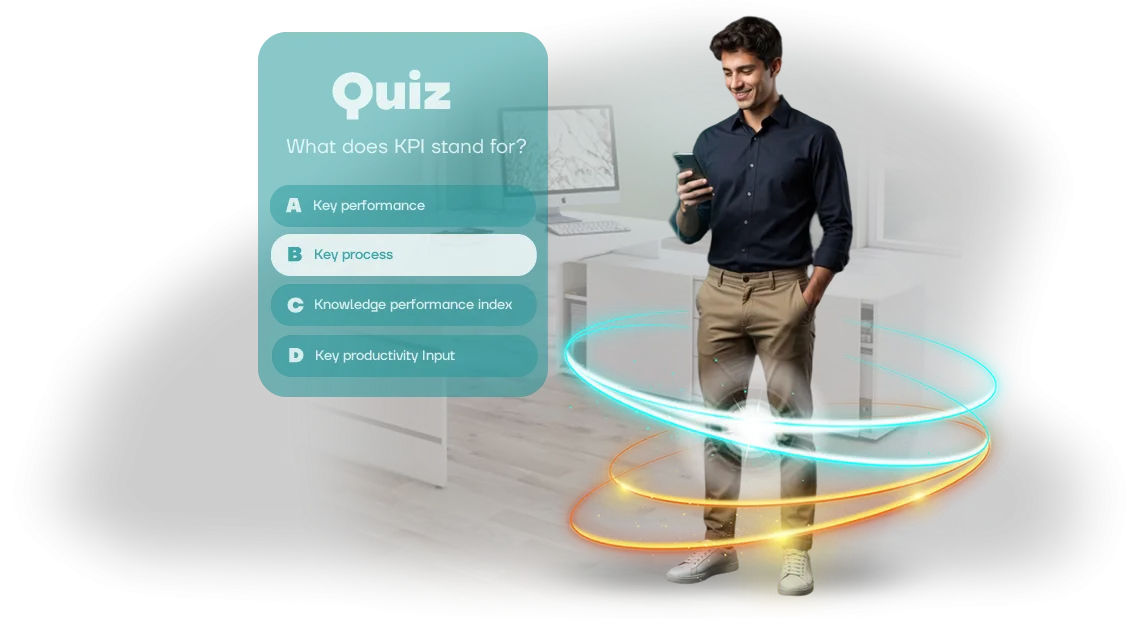
Working with Objections: Why Training Doesn't Change Behavior
Sales training often looks the same: a manager listens to theory, sees examples, and agrees with the correct answers on a test. But when a real client stands before them with a complaint or doubt, the knowledge doesn't click — they freeze and fall back into old patterns.
The problem is that classic training teaches you to answer "the right way," not to act in the moment of pressure. The skill of handling objections is built only through practice — where there are consequences and emotions.
This is exactly where interactive learning changes behavior: an employee experiences a difficult conversation in a safe environment, makes mistakes, corrects course, and sees the scenario through to a result.
Instead of lectures, the manager gets a dialogue simulator where the client responds naturally, hesitates, argues, and doesn't give in on the first try. This is training in conditions as close to reality as possible — but without the risk of losing a deal.
After several such scenarios, behavior changes not because the employee memorized a script, but because they learned to hear the client and respond flexibly to their objections.
This format holds attention, turns training from an obligation into a game, and delivers a measurable result — greater manager confidence and repeat sales.
What a 3D Quiz Delivers for Employee Training
Ordinary employee training often turns into watching presentations: attention drifts after 10 minutes, and skills never make it to real client conversations.
An interactive 3D quiz turns the boring "must study" into a live game where employees immediately see the consequences of their words.
At our team we build these scenarios from your real objections — from "too expensive" to "I'll think about it." Let's look at the benefits for your business.
Engagement Without Coercion
Gamification works where lectures fall short. The employee doesn't passively listen — they choose their response, react to the virtual client's behavior, and see the outcome.
Competitive elements — points, levels, leaderboards — spark healthy enthusiasm, so training is engaging rather than a checkbox exercise.
Practicing Objections Without the Risk of Losing a Client
In a real conversation, one mistake can cost the deal. In a 3D simulator you can make as many mistakes as you like: the virtual client reacts naturally, but doesn't take offense or walk away to a competitor.
The employee refines their arguments, asks follow-up questions, tries different approaches — and walks into real meetings with the experience of dozens of difficult conversations behind them.
Instant Feedback and Skill Assessment
After each response, the employee gets feedback: what worked, where the mistake was, and how to answer better. This is faster than waiting for a mentor's debrief and more objective than self-assessment. Skills are reinforced right away, not after several failed attempts in the field.
Clear Statistics for Every Employee
Managers get a clear report: who confidently handles objections and who avoids difficult scenarios. You can compare progress before and after training, identify weak spots in the team, and adjust the program. The quiz becomes more than a trainer — it's a tool for quality control of your training.
Quiz Formats for Handling Objections
When it comes to objection-handling training, companies often choose between a simple test, a dialogue simulator, and a gamified scenario. Each format has its own purpose: one checks knowledge, another trains skills in real time, and the third engages and reinforces behavior.
The right choice determines whether employees see results in real negotiations or everything stays at the theoretical level.
We design quizzes for specific needs: to quickly close knowledge gaps, we use a multiple-choice test; to practice objections in conversation, a dialogue simulator; to engage an entire department and hold attention, a gamified scenario. Below is a clear comparison of the formats.
| Format | For whom | What it gives the client |
|---|---|---|
| Multiple-choice test | For beginners and mass training | Quick knowledge check, clear stats for the whole team, closing gaps before real negotiations |
| Dialogue simulator | For sales managers and specialists who handle objections | Live dialog practice without risk to the client: the employee learns to respond to difficult questions and gets feedback |
| Gamified scenario | For team motivation and skill reinforcement | High engagement, a competitive element, and material repetition in game form, which improves retention |
Not sure which format fits your team? We'll analyze your tasks and suggest the optimal option, taking into account your budget, timeline, and employee skill level.
How We Build a Quiz Around Your Goal
Every project starts with a brief, not with "writing code": first we figure out which objections trip up your employees and in what situations they arise. At every stage you see the quiz evolve from an idea into a working tool — no black box.
At our team, the process is structured so that you make the key decisions while we handle deadlines and quality.
- Brief and task analysis. We dive into your specifics: collect typical client objections, practice scenarios, and audience profile — then determine which skills need to be developed.
- Training scenario. Together with you, we write dialogues and questions based on real cases so employees train on situations close to their day-to-day work.
- Prototype and mechanics. We show how the quiz will look on screen, how users answer and receive feedback. Here you can adjust the logic before full development begins.
- Development and design. We build the 3D dialogue simulator: refining visuals, animations, and the answer-scoring system to keep the experience engaging.
- Employee testing. We launch a pilot version on a small group — collect feedback, check whether the scenario is clear, and make final adjustments.
- Launch and rollout. We connect the finished quiz to your training system: helping with setup, access, and staff instructions.
- Support and results analysis. After launch, we review completion statistics, analyze weak points, and update scenarios as new needs arise.
In the end, you get not a "quiz for the sake of a quiz" but a practical tool that genuinely trains employees in handling objections. You know which stages are complete, what's ready, and what comes next — including how to measure training effectiveness.
What's Included in Quiz Delivery
We deliver more than just a game — it's a ready-to-use training module for developing objection-handling skills. Everything you need to launch training as early as next week and track its results is included.
- Quiz scenario — a well-structured dialogue framework based on typical client objections. You get ready-made questions and answer options — no need to create content.
- 3D scenes and virtual characters — realistic situations for practicing objections. Employees train in a safe environment without the risk of losing a client.
- Dialogue system — interactive answer-selection mechanics. Reflects different buyer behavior patterns and helps master flexible sales strategies.
- LMS integration — results flow automatically into your learning management system. You see each employee's progress and can generate reports.
- Administrator and user guides — clear instructions for setup and launch. Employees get the hang of it in 10 minutes; administrators in an hour.
- Source code and modification rights — you get the full project code and can change questions, scenes, and logic for new tasks. You won't be locked in to us down the road.
- Post-delivery support — for an agreed period, we make corrections based on your feedback and answer questions.
All components are packaged into a single bundle and delivered with a handover certificate. You receive a working tool, not a "half-finished product" — all that's left is to assign employees and start training.
Case Study: How We Trained a Sales Department
A home appliance retail chain TechnoMarket came to us: their managers knew the product well but lost customers at the objection stage.
"Too expensive," "I'll think about it," "I'll find it cheaper" — standard phrases crashed against template responses, and deals fell through.
Instead of another lecture, we proposed a training quiz built on Unity — a dialogue simulator where a salesperson talks to a virtual customer. Employees see the customer's reaction, learn to justify the price, and handle doubts without risking real clients. Mistakes are reviewed right away, not after a failed meeting.
After two weeks of training, losses at the objection stage dropped by a third, and sales conversion grew by 27%.
Store managers noticed the difference during the first mystery shopping checks: salespeople held pauses with more confidence, asked the right questions, and didn't slip into justification.
The quiz proved more effective than typical role-playing exercises: it can be completed at any time, and the statistics show which employees get stuck on specific objections.
The company is now scaling the format to new stores and using it in hiring — it's a ready-made tool for verifying skills before an employee's first shift.
Frequently Asked Questions About Quiz Implementation
Having doubts before implementation is normal: any new training format raises questions. We've gathered the most common ones so you can understand how it works in practice, what timelines are realistic, and how the quiz fits into your current training system.
How long does it take to implement the quiz?
On average, two to four weeks, depending on the amount of material and the number of scenarios. At the start, we run a short brief, agree on scenarios, and immediately show a working prototype. Then you provide feedback, and we polish the quiz to its final version.
A clear stage plan is set out in the contract, so you always see the dates and know what happens at each step.
Is it difficult for employees to complete the quiz? Is special training required?
No, everything works in the browser — no software installation or extra setup needed. Employees receive a link, open it, and run through the scenario — the interface is intuitive, with hints and clear buttons.
One scenario takes 5–10 minutes, so it's easy to fit the quiz into a workday without disrupting regular tasks. It's more of a game than an exam, so the entry barrier is minimal.
Is the quiz compatible with our LMS?
Yes, the quiz easily integrates with most learning management systems. Employees can take it directly from your training portal, and results are saved in the overall statistics.
If you have a corporate portal or your own platform, we'll set up the integration so you don't have to change your usual processes. You get ready-made reports: who completed the quiz, how many attempts they made, and where they made mistakes.
What if employees don't want to take the quiz?
The key to motivation is the format, not force. We design the quiz as conversations with characters, similar to real client interactions. This sparks interest and a desire to finish — not the feeling of yet another test.
Plus, you can add competitive elements: ratings, points, rewards for the best results. In our experience, completion rates reach 80–90% of those invited when the quiz is announced as a game rather than an exam.
What happens after launch? Who handles support?
After launch, we don't disappear. A project manager stays in touch to help with anything: from technical issues to adding new questions. If you need to update a scenario or add a dialogue branch, it's done quickly without rewriting the entire quiz.
We also guarantee stable operation for the agreed period and, if needed, train your administrator to make changes independently.
How to Choose the Right Quiz Format?
The quiz format should be chosen for a specific goal, not just "to check a box." So before starting, answer four questions: how many employees need training, what's the goal — memorizing rules or practicing objections — how much time the team has, and whether you need to see each person's progress.
| Criterion | What matters | Suitable format |
|---|---|---|
| Number of employees | 20–50 people | Live quiz with a host |
| 50 or more | Automated quiz with individual links | |
| Goal | Memorize rules and regulations | Classic test with points |
| Teach objection handling | Dialogue simulator with error breakdown | |
| Time available | 15–20 minutes a day | Blitz round of 5–7 questions |
| 1–2 hours of focused time | Full scenario with levels | |
| Progress needed | Overall result matters | Simple completion statistics |
| Individual dynamics matter | Personal dashboards and reports |
The key criterion is the goal. If you need employees to respond correctly to client objections, a simple test won't work: it checks knowledge, not behavior.
A dialogue simulator plays out a real conversation, lets you choose a response, shows the consequences, and explains which answer is better and why.
Second in importance is scale and progress tracking. When training 20 people, a general session and a spreadsheet are enough.
When it's a whole chain or sales department, you need automated checking and reports for each employee — otherwise, it's impossible to tell who's ready to work and who needs extra practice.
There's no one-size-fits-all answer, but there is a working logic: start with the goal, then assess the number of employees and the time available.
We help you pick the format before development starts — send us your task, and we'll show which option will solve it faster and at lower cost.
Order Your Training Quiz Development
To order a quiz, you don't need to describe technical details. Just tell us about your task: what objections your employees encounter, where they get stuck, and what outcome you want to achieve. We'll analyze your business context and propose a solution that genuinely changes team behavior.
When you submit a project request, you get more than just a commercial proposal.
We'll send a task breakdown, the right interactive format, an estimate, and a training development plan — at this stage it will already be clear how the training quiz fits into your training system and what impact it will deliver.
What you get with your request:
- Task breakdown — we define training goals, key objections, and current employee pain points.
- Format proposal — we match the option to your team: a test, a dialogue trainer, or a combined scenario.
- Transparent estimate — you see the scope of work, timeline, and milestones before we start.
- Development plan — stages, milestones, and launch date — you stay in control.
- Post-launch support — support, refinements based on initial completions, and results analysis.
Training development with us is a predictable process: you know what you'll get, when, and how it will impact your employees. No unnecessary approvals — only the decisions that matter.
Submit your project request right now, and we'll get back to you with a task breakdown, format, and work plan. Take the next step toward a team that handles any objection with confidence.