

Why Employees Without Communication Skills Lose Clients
Clients rarely leave because of price or assortment — more often, it’s a conversation with an employee that pushes them away. An uncertain answer, indifference in the voice, an inability to quickly grasp the question — and the person is already thinking about a competitor. That’s how weak communication skills quietly turn potential profit into lost deals.
Imagine a typical situation: a manager knows the product but doesn’t hear the client. They interrupt, use template phrases, and don’t ask clarifying questions. The visitor leaves without buying, and a week later writes a negative review.
The company loses not only current revenue — its reputation suffers, and attracting new clients becomes more expensive.
Service quality directly determines whether a person will come back and recommend the company to friends. Research shows that most clients are willing to pay more for service where they are understood at a glance. But where communication leaves a bad aftertaste, loyalty melts and repeat sales stop.
Training employees in communication skills is no longer an option — it’s the foundation of stable revenue.
Practicing dialogues in a safe environment, working through difficult objections, and seeing your own mistakes from the outside — this is often what even experienced teams lack. A practical training format allows you to close gaps before they cost the company another client.
We solve this problem with interactive simulators: an employee talks to a virtual interlocutor, gets instant feedback, and gradually improves their communication skills.
Training happens without stress for newcomers and without taking time away from real clients — the company gets a prepared team, and clients get truly quality service.
Developing Communication Skills Through Game-Based Quizzes
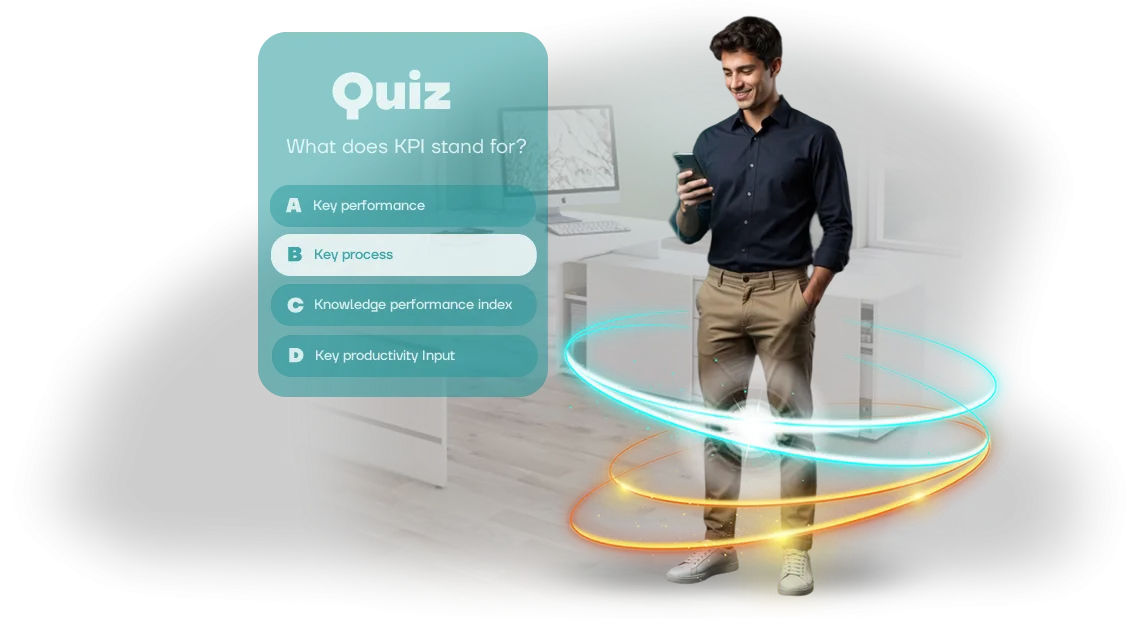
Employees rarely finish standard courses, and communication skills remain theory. Client communications suffer — service quality and sales decline. Our team develops educational quizzes that turn boring theory into an engaging game.
Instead of lectures, employees solve tasks, act out dialogues, and receive instant feedback. As a result, learning becomes a natural part of the workflow.
- Higher engagement — the quiz feels like a game, not an obligation. Employees complete training voluntarily, and the competitive element boosts interest.
- Communication practice — tasks model real dialogues with clients, including difficult objections. This allows scripts to be refined without risking reputation.
- Service quality — confident employees communicate properly, find common ground faster, and leave a positive impression.
- Sales growth — practicing argumentation and objection handling directly affects conversion and average ticket size.
- Transparent results — you see which skills are already sharpened and where additional work is needed. This allows you to develop staff precisely without wasting time on general training.
- Speed of launch — the quiz can be adapted to your specifics and launched quickly, without disrupting the workflow.
Implementing a quiz is an investment in staff development that pays off through greater client loyalty and profit. Employees actually use new skills in their work, and you get a clear picture of progress and the ability to influence service quality.
Quiz Formats for Different Levels and Objectives
Educational quizzes solve different problems: some teams just need a quick knowledge check, others need skill practice in real dialogues. The format determines how much employees trust the training and start applying its results. We use three format levels — from a simple test to full immersion in a 3D environment.
Simple tests for employees are clear and quick to launch, interactive simulators add a competitive element, and a 3D simulator allows you to play out a difficult conversation without the risk of an error.
Among all quiz formats, the 3D simulator delivers the greatest depth of immersion. On real projects, we work with Unity — this gives realistic character behavior and lively reactions to user actions.
Comparison of Three Formats
| Format | Who it’s for | What it gives the client |
|---|---|---|
| Question-and-answer test | All employees, entry-level diagnostics | Quickly assesses knowledge level, understandable for any user |
| Interactive quiz | Teams where thinking speed and team spirit matter | Boosts engagement, reinforces material through competition |
| 3D dialogue simulator | Developing communication skills and working with clients | Immerses the employee in a real situation: they practice and get feedback |
We recommend choosing a format based on your specific goal: a test for a quick check, a quiz for regular repetition, and a 3D simulator for complex skills that cannot be learned from an instruction manual.
We will help you combine formats to ensure training delivers measurable results — higher conversion in dialogues, fewer mistakes, and confident employee behavior.
How We Create an Educational Quiz: Stages and Deadlines
Developing a quiz is not just a set of questions. We structure the process so that you get a ready-made tool within the agreed timeframe and understand the logic of each stage. The standard cycle is 2–4 weeks, and the exact schedule is fixed after the brief. Below is what a typical turnkey project looks like.
- Brief and immersion. We study the specifics of your business, real client communication situations, and employee skill levels. We define goals and success metrics. The result is a clear technical specification.
- Scenario and content. Together with your experts, we write questions, answer options, and explanations. We model dialogues so that communication skills are trained specifically.
- Prototype and design. We create a mockup and navigation logic. You see the structure before development: screens, question order, and feedback.
- Assembly and testing. We build the quiz, test it on a small group, and smooth out any rough edges. We check compatibility with your devices. You receive a stable version.
- Launch and integration. We place the quiz in your learning management system or provide a standalone version. We train administrators and add participants.
- Support and growth. We analyze results, add new questions, and update content — the quiz stays relevant. We track trends and suggest improvements.
What’s Included in the Quiz Delivery Package
When we hand over the project, you get more than just an application — you receive a complete quiz delivery package with everything needed to launch training and monitor its effectiveness.
All materials are packaged so that training can begin the very next day, without involving developers or extra approvals.
- Quiz scenario — ready-made questions, answer options, and error explanations. The scenario is verified with methodologists and reflects real work situations, so employees immediately see the value for their practice.
- Quiz application — works on computers, tablets, and smartphones, launched through a browser or corporate portal without installing additional software.
- Administrator guide — a short manual: how to launch the quiz, divide employees into groups, change completion deadlines, and export results. Suitable for a manager without a technical background.
- Participant memo — simple access steps, an interface description, and rules. Employees don’t need anything explained separately.
- Training analytics — a manager’s dashboard with each employee’s progress, time spent, and difficult topics. It’s immediately clear who needs extra support.
- Results report — summarized team-wide metrics in a clear format. Ready-made material for presenting to leadership and planning the next stage.
- Guaranteed support — after launch, we stay in touch, answer questions, and make edits to the scenario and settings as needed.
This package covers all manager needs: training launches quickly, employees work without unnecessary questions, and you see the real picture of communication skill development for each group.
Case Study: How a Quiz Increased Sales in a Retail Chain
Retail Chain Case Study
A retail chain of 40 stores faced a typical pain point: salespeople knew the product perfectly but lost clients during the conversation stage. Sales conversion was below the market average, and regular briefings didn’t turn theory into a living skill.
Managers understood: the issue wasn’t product knowledge, but the ability to listen, ask the right questions, and gently guide the conversation toward a purchase.
We developed a dialogue-based 3D quiz simulator on Unity to develop exactly these communication skills. An employee enters a virtual sales floor, holds a dialogue with a shopper, chooses responses, and reacts to objections.
The quiz immediately shows the mistake and suggests the correct model — learning happens through practice, not rote memorization.
What Changed After Launch
The simulator was embedded into daily training: 15 minutes at the start of a shift, without interrupting work. Within a month, the team was completing scenarios almost twice as fast and, more importantly, started applying the practiced phrases in real dialogues.
Internal analytics showed that after training, salespeople began asking open-ended questions and were less likely to “lose” the shopper mid-conversation.
After a quarter, the chain achieved measurable results: revenue grew by 18%, average ticket size by 12%, and sales of additional items increased by a third.
Managers also noted an increase in repeat visits — clients remember an employee who knows how to listen and recommend the store to friends.
The company ordered a second quiz module — for handling objections during returns and conflict situations. A repeat order is the best sign for us: the format works both for the business and for employees, and communication skills start delivering measurable profit.
How to Choose a Quiz Format for Your Company’s Goal?
The choice of format directly affects whether training solves your business problem. If you simply need to check knowledge of regulations — a test is enough. If the goal is to change employee behavior in a client conversation, you need a dialogue simulation.
The main thing is not to chase “trendy” mechanics, but to start from the result you want to measure.
Before choosing a format, answer three questions: what should the employee be able to do after training, how often is the material updated, and how will you know the training worked. The answers determine the mechanics, the level of engagement, and the depth of practice.
We help with this at the brief stage — you get not a “pretty toy,” but a tool for a specific business metric.
Which Format Solves Your Problem
| Format | When to choose | What it gives the business |
|---|---|---|
| Classic test | When you need to quickly check knowledge of products, regulations, and internal procedures | A transparent picture: who has absorbed the material and who needs retraining |
| Case-based quiz | When an employee must apply knowledge in a typical work situation | Develops analytical thinking and understanding of how to act in real conditions |
| Dialogue-based 3D simulator | For practicing communication skills: sales, negotiations, objection handling, customer service | Automated training without a mentor, repeatability, and feedback for each employee |
| Gamified quiz | Team motivation, onboarding newcomers, team building | Engagement and retention through competition |
If your goal is specifically to develop communication skills, a standard test won’t produce the needed effect: a person can know the right answers but get lost in a live conversation.
A dialogue simulator solves this — it imitates a conversation, reacts to responses, and shows where the employee loses the thread of the negotiation. This way the skill is practiced safely, without risking relationships with real clients.
Often, a combination of formats is optimal: a test checks theoretical knowledge, while a simulator checks the ability to apply it in conversation.
This gives a complete picture — from “knows” to “does.” We select the combination for your task, deadlines, and budget, and show what results you’ll get in numbers — by reach, learning speed, or the share of employees who pass the final assessment.
Frequently Asked Questions About Quiz Development and Implementation
We know what clients worry about: whether we’ll make the deadline, how difficult it will be to integrate the quiz into work processes, and what happens after launch. Below we answer these questions — so that cooperation is smooth and predictable.
How long does quiz development take?
A standard project takes two to three weeks. At the start, we set a calendar plan and agree on it with you: you always see what stage the work is at. If you need training completed by a specific date, we discuss priorities in advance and allocate resources accordingly.
Is it difficult to integrate the quiz into our learning system?
We make it so that an employee can take the quiz without extra steps: via a direct link or from your training portal. We handle all technical issues — content loading, access, and configuration of completion tracking — ourselves.
We guarantee that the integration will follow the agreed scenario and will not require restructuring your current processes.
What happens after launch? Who supports us?
After project delivery, we don’t disappear. The first month includes mandatory support: we monitor quiz performance, make fixes promptly, and answer your team’s questions.
If needed, we continue working under a support agreement — updating scenarios, adding new questions, and ensuring the quiz evolves together with your goals.
If you have any other questions about deadlines, integration, or quiz content, write to us. We’ll show you examples, guide you through the stages, and help you launch training that actually works.Let’s Discuss Your Task — Book a Consultation
Communication skills directly affect sales, negotiations, client retention, and team performance. But developing them with lectures and trainings alone is difficult: employees lose engagement, and the result isn’t always measurable.
An interactive quiz format helps practice the needed skills safely and through game mechanics — the key is that the scenario matches your specific goals. So let’s start with a consultation.
During the consultation, we’ll identify the problem you want to solve: negotiations, presentations, objection handling, or internal communications. We’ll clarify how many employees will participate, what devices they’ll use for training, and how often you plan to run the quiz.
This allows us to propose a solution that delivers measurable results, not just a “game for the sake of a game.”
After you reach out, you’ll receive:
- a clear quiz development plan — goals, stages, deadlines;
- a format and mechanics selection tailored to your employees, not a one-size-fits-all approach;
- a demonstration of similar solutions we’ve already built for other companies;
- a transparent estimate of the budget and team workload — with no hidden items;
- a practical example of how to measure quiz results and embed it into your current training system.
You can submit a request through the form on this page or by phone. We’ll call you back within one business day, clarify a couple of details, and suggest a convenient time for the consultation — in person or by video call.
The consultation gives you expert ideas even if you decide not to start development right now.