

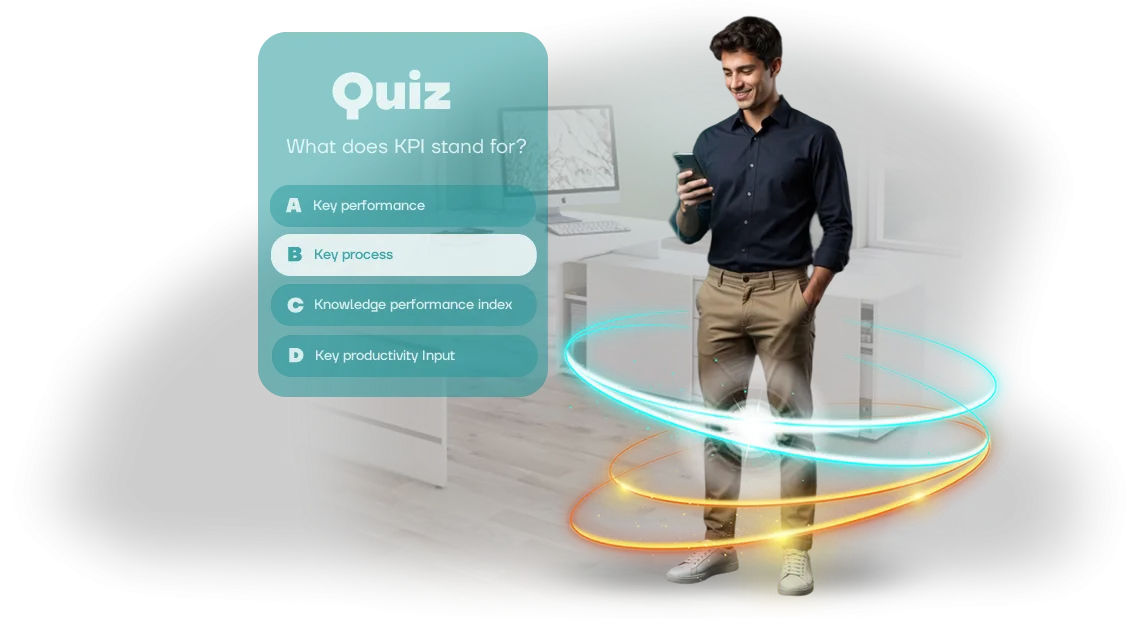
Why does construction safety training often fail?
Formal instruction is when an employee signs a logbook, listens to a lecture, and a week later no longer remembers how to work safely with a tool.
In construction, such a "check-the-box" approach costs dearly: it is precisely inattention and lack of knowledge of the rules that cause most accidents.
Workplace injuries not only ruin people's lives but also result in downtime, inspections, lawsuits, and serious fines for the company.
The problem is that traditional staff training is built on memorization rather than understanding.
A newcomer does not have time to integrate the rules into real actions on the site, while an experienced employee begins to let familiar requirements go in one ear and out the other.
As a result, occupational safety becomes a formality: paperwork is filled out, but real risks remain. Audits and inspections quickly expose this — and then the conversation is no longer about improving processes but about protecting the company's reputation and budget.
The human factor makes the situation worse. People tend to underestimate danger, especially when it is not visible to the eye: the hard hat is on, the briefing is completed, but the habit of cutting corners remains.
Therefore, training must not simply inform — it must change behavior, forcing the worker to experience the situation and draw conclusions on their own.
We close this gap: we turn the briefing into an interactive scenario where the worker makes decisions themselves and immediately sees the consequences.
This type of employee training holds attention, makes people think, and leaves a trace in memory rather than just in the logbook.
As a result, the likelihood of injuries decreases, and management gets confirmation that employees actually know the rules — and the business is protected from fines and downtime.
What interactive quizzes for employees deliver
Standard briefings and lectures often fail to produce the expected effect: employees are formally present, but a week later they forget most of the material.
An interactive quiz flips this process — instead of passive listening, every employee becomes an active participant, and training turns into a clear game with clear rules.
Employee engagement is the first and main benefit. When a person answers questions, solves situational tasks, and receives instant feedback, their attention is held naturally.
People compete, care about the result, and genuinely get involved in the process — rather than sitting in the corner. This also increases engagement with the topic of safety itself: the rules stop being abstract and start to feel personally relevant.
The second benefit is material retention. Quizzes are designed so that knowledge is reinforced through practice: the employee encounters typical situations and learns to make the right decisions.
The brain remembers not text but a scenario, and in real work a person acts on the level of habit. Based on the experience from our projects, material retention grows many times over compared with traditional tests.
But the main thing for business is the reduction of injuries. Training with interactive scenarios directly affects safety: employees not only know the requirements but also know how to apply them in non-standard situations.
Each practiced scenario reduces the likelihood of an error on a real site, which means it reduces the risks, downtime, and costs associated with incidents.
Training effectiveness is directly linked to time savings. The quiz runs at a convenient time, does not require gathering groups or pulling people away from work.
An employee can complete a scenario in 10–15 minutes, and the system itself shows who has grasped the topic and who needs additional preparation. You get a clear picture of knowledge levels without extra manual checks and paper red tape.
Finally, an interactive quiz delivers a measurable result. You see how completion metrics change, which topics cause difficulty, and where repeated training is needed. This allows you to continuously improve the training system and make it truly effective.
These benefits are exactly what reduce errors, raise the safety culture, and protect your business from the serious costs associated with violations.
Quiz formats for different tasks
There are more training quiz formats than it may seem: from short polls to full immersion in a virtual construction site. The choice depends on what a specific group of employees needs: to check knowledge, to practice an action algorithm, or to reinforce a safety culture. Below is a comparative table of typical scenarios.
| Format | For whom | What it delivers to the business |
|---|---|---|
| Classic multiple-choice quiz | New employees after the introductory briefing | Quick knowledge check, automatic report, identification of weak topics |
| Quest trainer with scenario branching | Experienced personnel, line specialists | Practice of actions in an emergency situation, fewer errors |
| Dialogue 3D simulator | Construction workers, operators, engineering and technical staff | Full immersion in the work environment without risk, high retention |
| Team quiz-quest | Crews, shifts, contractors | Team involvement, rule review in a competitive format |
We develop any of these formats to match your internal regulations and safety procedures. The key is a scenario close to real life: the employee does not memorize abstract answers but experiences the situation firsthand.
That is why production topics most often choose quests and 3D simulators: they deliver action, not just reading.
To make the choice easier, use a checklist: the scenario covers your instructions, questions can be updated without a programmer, results are collected in a table for each participant, and the duration fits the work schedule.
If you are not sure which format will deliver results faster, start with a pilot quiz: within a few days you will get data on your team and understand whether a deeper 3D training is needed.
How we develop a quiz: 6 steps
Quiz development is not a "black box." We structure the work so that you see the result at every stage: from the first brief to launch and support. These are the six steps we go through together with you.
-
Brief and immersion in the task. We collect information about your employees, training goals, and current materials. We determine which construction safety knowledge needs to be checked and how to present it so the quiz delivers real value.
-
Concept and scenario development. We create the question structure, dialogue scenario, and delivery mechanics. We agree on the format with you so it matches the corporate style and the company's real tasks.
-
Preparing the content. We develop the questions together with your experts: correct answers, explanations, and error analysis. We phrase the tasks so they test understanding rather than formal memorization of instructions.
-
Design and solution assembly. We build the quiz on a professional tool, create a clear interface, and adapt it to the devices your employees use. You see intermediate versions and make edits before launch.
-
Testing and approval. We test the quiz with real users, fix inaccuracies, and refine the difficulty level. After that, you receive the final version that can be shown to management and approved.
-
Launch and support. We deploy the quiz, help integrate it into your training system, and train administrators. After launch, we keep it running, collect analytics, and update questions and scenarios as needed.
This process gives you full control without diving into technical details. You always know what stage the project is at and can influence the outcome.
What is included in the delivery: a package for the training department
The delivery is not just a game but a complete package for training and knowledge control. Inside is everything needed to integrate the quiz into the learning process without involving developers.
This approach eliminates manual test checking and disputes over results, and each element of the package is aimed at reducing the number of violations and saving the training department's time.
The package includes:
- Scenario and content: construction safety questions, analysis of typical mistakes, and explanation of consequences;
- Quiz result: automatic assessment, a completion record with date and time, and a pass mark if required;
- Analytics for the training department: summary reports by employees, groups, and departments — progress and weak spots are visible;
- Methodological materials: recommendations for delivery, a lesson scenario, and an instructor's guide;
- Launch instructions: a step-by-step guide for installation and use on work computers;
- Technical documentation and source files: project files with explanations so you can hand them over to your own support team.
You save time on preparation and get a transparent picture of employee knowledge for audits and accreditation. If necessary, we adapt the scenario to your regulations and update the questions — you are never left alone with the content.
Case study: how a quiz raised the level of construction safety
Construction safety is not a set of instructions but the daily behavior of people on the site. At one construction company with several sites, briefings were a formality: employees "marked their presence," and violations kept repeating.
The client wanted not just to train people but to change their habits and reduce the number of incidents.
Our team developed a quiz in which dialogue scenarios replaced dry questions: workers found themselves in familiar situations — choosing a route, working at height, using protective equipment.
Each answer was accompanied by an explanation, so an error immediately became a learning moment. Completion took 10–15 minutes and could be built into a shift without stopping work.
The numbers the client saw
- The number of violations of key safety requirements dropped by 38% in the first quarter after launch.
- 92% of employees completed the quiz — including those who had previously ignored briefings.
- Time for the introductory briefing was cut in half, and the company places repeat orders for scenario updates every season.
The main result was not the number of completed tests but the change in behavior: foremen began stopping work on their own when a violation occurred. For the client, this means less downtime, lower injury risk, and peace of mind about the contractor's reputation.
After the first stage, the company expanded the quiz to all sites and included it in the onboarding program for new employees.
Frequently asked questions about implementing training quizzes
Many managers and occupational safety specialists have doubts before launching a training quiz: will development drag on, will powerful equipment be required, will the budget go beyond limits.
Here is how these issues are resolved in practice — taking into account the specifics of construction safety.
How difficult is it to adapt a quiz to the real tasks of construction safety?
The quiz is built on your regulatory documents, instructions, and real situations from the site. We do not insert "generic questions from the internet" — each scenario is developed together with your occupational safety engineers.
Adaptation takes minimal time because the format has already been refined across dozens of projects. You get a tool that checks precisely the knowledge that is critical for your company.
What are the equipment and hardware requirements for employees?
No special requirements at all. The quiz runs on ordinary computers, tablets, and even smartphones — employees complete it in a convenient format: at a stationary workstation, in a mobile office, or on the site. We handle the server side and access configuration, so you do not need to buy or upgrade anything.
What is the cost and how do we stay within budget?
The cost depends on the volume of content and the number of scenarios, but for every project we provide a transparent estimate before work begins — no hidden surcharges. You can start with a pilot module for one crew and then scale it to the entire organization. This approach lets you control expenses and evaluate the result before full implementation.
What are the development and launch timelines?
On average, the first version of the quiz is ready within a few weeks of signing the brief. This time includes scenario development, testing with your employees, and final configuration.
If training needs to be launched urgently — for example, before a scheduled inspection — we can speed up the process using standard modules.
Implementing a training quiz does not require restructuring processes and does not create additional workload for your team. You get a ready-made tool that quickly pays for itself through fewer violations and better discipline on site. If you still have doubts, ask us directly, and we will show how it works using your specific situation as an example.Order a demo quiz for your training center
For the head of a training center, it is important that employees absorb the rules of construction safety rather than simply pass a formal test. Paper briefings do not hold attention, and violations on a construction site cost too much.
An interactive quiz checks knowledge in real situations and shows who is truly ready to work on the site.
Leave a request for a demo — within one business day we will prepare a cost estimate and an implementation plan. You will not have to dig into technical details: we will propose the format that fits your training program.
What you get after contacting us:
- A consultation with a methodologist: we review your construction safety regulations and identify weak spots in employee preparation.
- A demo quiz on topics from your real instructions — you will see how the mechanics work on typical site situations.
- Cost calculated after audit based on the number of employees and training frequency — a clear estimate with no hidden surcharges.
- Recommendations on how to integrate the quiz into the introductory briefing and scheduled inspections.
- An example of adaptation to your brand: logo, colors, facility names, so the quiz feels native.
After the demo, you will see how the quiz works on your own examples and can decide whether to keep it or refine it for specific professions. We work on professional equipment and proven tools, so the result is stable regardless of the number of employees in your training center. Leave a request — in two days you will receive a ready demo, not vague promises.
What if we have specific training requirements?
Specific requirements are the norm, not the exception. Every industry has its own regulations, internal instructions, and real situations that are not covered by standard courses.
That is why we do not offer a "boxed product" but design the quiz from the ground up around your tasks: your terminology, your examples, your work scenarios.
Adaptation begins with immersion in your specific context. We study your existing occupational safety instructions, analyze typical violations, and base the content on real cases from your practice.
This way, employees are not just answering abstract questions — they are learning to make the right decisions in conditions as close as possible to real work. This improves retention and reduces the risk of formal test completion.
The individual approach also applies to the delivery format. If your employees find it more convenient to train in the form of short on-screen scenarios, we will build a dialogue simulator.
If the quiz needs to be integrated into an existing learning management system, we will account for that. We adapt the interface, question difficulty, and session length to your audience and corporate rules.
Importantly, we consider not only content but also completion regulations: how many attempts are allowed, which results count as successful, and how progress is recorded for reporting.
You get clear data on each employee and on the team as a whole, without manual collection and reconciliation. All adaptation happens at the brief stage and is agreed with you before launch.
In the end, you get a tool that fits into your training system rather than requiring it to be rebuilt. Industry specificity stops being a limitation — we turn it into the foundation of an effective knowledge check. Tell us about your requirements, and we will propose a solution for your regulations.