

Why security training in financial institutions doesn't work
Every year, financial organizations spend dozens of hours on mandatory security briefings. Employees formally mark their presence, nod at slides with regulations—and within a week they are back to old habits.
Violations at the bank repeat, and the regulator issues fines that hit both the budget and reputation.
The root of the problem is the format. A linear lecture doesn’t create an emotional trace and doesn’t let the employee experience the situation. They know the theory, but in a stressful situation they act on autopilot—and that is exactly where the mistake is born. Security training requires testing decisions, not memorizing instruction points.
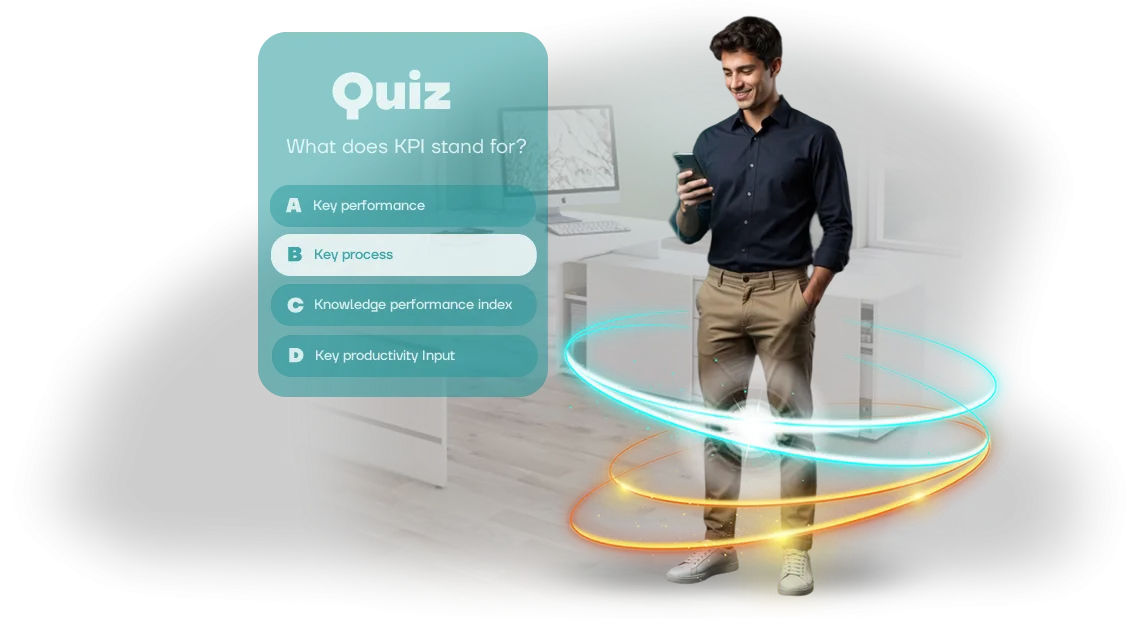
our team turns staff training from passive listening into active practice: the employee enters a simulated incident and chooses a course of action. Mistakes are reviewed immediately, and correct actions are reinforced through a game scenario. This is how a quiz turns regulations into a skill that is actually applied in real work.
The result for business is fewer incidents and a clean record before inspections. Instead of an abstract “be careful,” you get refined algorithms based on specific cases from your organization. This covers both the requirement for formal reporting and actual protection from regulatory fines.
Three reasons to choose a quest quiz for staff training
Employees of financial institutions work with a large volume of regulatory requirements every day, but classic lectures and presentations don’t hold attention.
Information becomes outdated, and engagement stays low—and this directly affects the frequency of violations and the quality of customer service.
A quest quiz changes the approach to learning: instead of passive listening, the employee becomes an active participant in a scenario close to real work situations.
The first reason is engagement. When training is built as an interactive game with a storyline and decision-making, attention is held naturally.
The employee doesn’t get distracted by unrelated matters but immerses in the process because they are interested in completing the scenario. This is especially important for topics that seem “boring”—security, compliance, handling personal data.
A quest quiz turns a mandatory briefing into an activity that employees complete with enthusiasm, not “for show.”
The second reason is memorization effectiveness. In a game format, employees make decisions themselves and see the consequences, so the material is absorbed deeply and retained longer.
They don’t just memorize rules; they train behavioral algorithms in typical and non-standard situations.
This is exactly the form of interactive learning that gives a measurable result: after a month or two, employees recall key rules without cheat sheets and apply them in daily work.
Development on the professional Unity engine makes it possible to build scenarios of different complexity—from short express checks to multi-step quests—and adapt them to the specifics of a particular institution.
The third reason is fewer violations. When staff truly internalize the rules, the number of client-related errors and internal procedural failures noticeably drops. That means fewer regulatory fines, fewer incidents, and a calmer life for managers.
A quest quiz works as a preventive tool: it identifies typical employee mistakes in a safe game environment, and you can adjust training in advance instead of dealing with consequences after a real incident.
In the end, you get not just “training,” but risk management through personnel preparation—exactly what a security program in a financial institution is designed for.
Quiz formats: from onboarding to annual certification
Training employees in the financial sector is not just about transferring information—it is about managing risk. Every unlearned regulation or missed threat signal can turn into an incident.
That is why we choose the quiz format not “for show,” but for a specific business task: a newcomer needs to get up to speed quickly, an experienced employee needs to refresh knowledge and close gaps, and a manager needs a transparent picture of team readiness.
All formats run on the professional Unity engine, which guarantees correct rendering on any device—from a desktop computer to a tablet in the banking hall. Below are typical scenarios that we deliver turnkey: from scenario design to analytics for each employee.
| Format | For whom | What it gives the client |
|---|---|---|
| Onboarding quiz | New bank employees | Reduces time to independent work: key security rules are learned in 2-3 sessions instead of a week of studying instructions |
| Knowledge check with error review | Experienced staff, long-tenured employees | Identifies real gaps and immediately explains the correct course of action—without interrupting work |
| Certification quiz | All employees before annual certification | Creates an objective knowledge rating and automatically prepares a report for HR and the security department |
| Quiz on new regulations | All departments when instructions change | Quickly introduces the team to updates and checks how well they are understood—before a mistake becomes an incident |
| Competitive team quiz | Branches, departments, project groups | Increases engagement and creates healthy competition, while knowledge is reinforced through emotional experience |
Each format includes built-in analytics: you can see which topics cause difficulties for most employees and strengthen training in those areas. There is also a “no room for error” mode for critical scenarios—for example, when practicing actions during a fraud attempt.
We help you choose the format at the briefing stage and adapt it to your corporate culture: language, cases, and level of strictness. As a result, you get not just a test but a tool that actually reduces risks and saves mentors’ time.
Turnkey quiz development stages: what the client sees
Turnkey quiz development is a transparent process of six steps. At each stage, you understand what is happening and make decisions: you approve the scenario, see the demo, and test the trial version. All we need from you is expertise in financial security rules and feedback.
-
Brief and task immersion. We study your regulations, typical employee mistakes, and internal instructions. We determine who will take the training and what results management expects.
-
Scenario approval. We prepare questions with answer options and explanations, based on real cases from financial practice. You edit the wording, remove debatable points, and finalize the version.
-
Mechanics and design development. We build the quiz structure: difficulty levels, question flow, error review. We design it in your corporate style and show an interim demo version.
-
Testing on real cases. We check how the quiz works on different devices and whether it calculates results correctly. You receive a test version and evaluate it as a future user—whether it is convenient to complete and whether the answers are clear.
-
Launch and implementation. We help place the quiz in the required system and prepare instructions for the HR department. Employees complete the training, and you see statistics: who completed it and which topics caused difficulties.
-
Support after launch. We update questions when regulations change, collect feedback, and refine the quiz when needed. Support is built into the project, so the quiz remains a relevant training tool.
What is included in the delivery of a corporate quiz
A complete launch package—you get not a “bare” program but a working training system with materials, reporting, and support. Below is everything included in the delivery and how it works in practice.
- A ready-made quiz on a professional engine — runs on employees’ computers without complex installation. Adapted to corporate requirements of financial institutions: closed loop, data protection, and the ability to work offline.
- Methodological materials — the quiz scenario, questions with explanations, employee memos, and an administrator guide. Everything is prepared by security experts, so you don’t need to create anything from scratch.
- Administrator dashboard — you can see who completed the training, how many attempts were needed, and which topics cause difficulties. Results are saved automatically, and a report can be exported in a couple of clicks.
- Training reporting — summary data by department, branch, or the entire organization: completion rate, average score, typical mistakes. This data can be used for control and planned professional development.
- Technical support for the entire period of use — we help with launch, answer questions from employees and administrators, and promptly resolve any issues. You are never left alone with the product.
How this simplifies work
Employees complete the training at their own pace—the quiz can be split into short sessions or completed in full. Managers don’t need to collect signatures or manually check understanding: the system records the result automatically.
What you get for control
Unlike an ordinary lecture or presentation, after the quiz you have concrete numbers: what percentage of staff mastered the material and which rules cause questions. This allows you to repeat difficult topics in a targeted way and reduce risks linked to the human factor.
The complete package covers the entire cycle—from the first launch to confirming training for internal audit. If you need to refine questions for your specifics or update the scenario, we make changes quickly as part of support.
Case: financial security quiz for a bank
In the financial industry, the cost of an employee’s mistake is measured not by fines but by reputation and customer trust. Banks invest in regulations, but even a perfect instruction doesn’t work if the staff haven’t internalized it.
We encountered this in a case for the bank “Finance-Garant”: 2,000 employees spread across branches and standard training completed “for show.”
Instead of another presentation, we proposed an educational quiz on the internal portal—short scenarios with decision-making in situations similar to real work. Employees completed it at a convenient time, 10–15 minutes a day, without interrupting work.
They immediately saw their mistakes and received explanations of why the correct answer was correct. Department heads received a progress summary and problem topics rather than just a final score.
The result exceeded expectations: in the first quarter after launch, the number of violations related to financial security dropped by 40%. At the same time, 95% of employees completed the training in the first two weeks—with typical courses, this figure rarely reached 60%.
The quiz not only provided knowledge but also showed which topics cause difficulties, making future training more precise.
The bank received a tool that is easy to update: new fraud patterns appear quickly, and we refine scenarios within a few days.
The first prevented violation covered the entire project, and after the first quarter, the client extended the cooperation permanently and expanded the program to adjacent areas. The case proved that game-based formats reduce risks where ordinary briefings are powerless.
Answering common questions about corporate quizzes
Customers’ questions usually concern not the technical side but the result: will employees understand the material, will the quiz fit into existing training, and will testing cause rejection.
We answer these concerns directly—without complex details and with a focus on benefit for your team.
How can we verify that an employee actually internalized the material?
The quiz shows not just the fact of completion but the level of understanding for each topic. The report reveals which questions cause difficulty for most people—this helps adjust training and repeat complex points.
If necessary, an employee can take the quiz again. This mechanic reinforces knowledge and turns one-time testing into a cycle of continuous skill improvement.
Is it difficult to integrate the quiz into our LMS?
We build a format that connects easily to most learning platforms. You won’t have to change familiar processes or transfer data manually.
Results automatically enter the common system and are considered in course evaluation. This saves your specialists’ time and eliminates double administration.
Employees dislike tests. Won’t motivation drop?
The quiz is built as a game, not an exam. Short sessions, clear scenarios, a competitive element, and a bit of excitement change the attitude: it becomes part of the work routine that people actually look forward to.
Managers see the team’s progress and can reward the best performers. This way, training turns from an obligation into an understandable and useful activity, and engagement grows.
Can we update questions after implementation?
Yes, the content is easy to extend and modify when regulations change or new requirements appear. You are not left alone with a static product.
Just let us know about the changes—and we will update the quiz within a short time. This is especially important in financial security, where rules change frequently.
If you still have questions about the format, timeline, or integration, we’ll discuss the details and find a solution for your task. We help at every stage, from planning to launch.What if you need a quiz for training on specific instructions?
We understand what you’re asking about. In financial institutions, standard training programs often don’t fit: internal instructions are unique, and security requirements are stricter than average in the market.
A ready-made quiz from a catalog is unlikely to cover your tasks—it doesn’t know your regulations, process specifics, or typical employee mistakes. That is why we don’t offer a template solution but build a quiz around your actual instructions.
It all starts with immersion in your materials: policies, orders, and action algorithms for different situations.
We break them down into concrete scenarios that an employee faces every day—for example, how to act on a suspicious transaction or what to do in the case of an unauthorized access attempt. Each scenario becomes the basis for questions and tasks.
The quiz mechanics are adapted to your logic: it can be a sequence of actions, choosing the right solution from several similar options, or even simulating a dialogue with a client.
We take individual requirements into account at every level—from the terminology used in your organization to the format and difficulty of questions.
If you need a multi-level knowledge check for different roles, that’s also possible: the quiz will adapt to the employee’s position so that everyone receives a relevant workload.
You won’t have to explain the difference between an operations officer and a cashier—we will see it in your regulations and reflect it in the scenarios.
This approach brings measurable results: employees stop acting on instinct and start following your instructions. The number of errors in standard and non-standard situations drops sharply, and knowledge checks become a quick process rather than a separate project.
Ultimately, you get a tool that works for your institution’s security every day, not a one-time game for show.
If your task falls into this category of non-standard cases, just start with a conversation. We’ll ask a few clarifying questions about your processes and propose a mechanics option that fits your regulations without losing meaning. Tell us about your requirements—and we’ll show you how to turn them into a working quiz.
Order your quiz — let’s discuss the details
Every financial organization faces the need to train employees on security rules and fraud protection. Standard courses are perceived as a formality, and knowledge is quickly forgotten.
That is why we develop interactive quizzes that integrate into real work scenarios and help reinforce correct actions.
After your request, we conduct a short briefing: we define the target audience, current threats, and desired difficulty level. Then follows a clear process in which we handle all stages:
- We study your internal regulations and typical employee mistakes so that training addresses real problems.
- We design the quest storyline and logic: questions, hints, and error review after each block.
- We develop the quiz in your corporate style and, if needed, integrate it with your internal learning system.
- We test it on a small group of pilot users and adjust the difficulty to make it comfortable for everyone.
- We deliver the final solution with an administrator guide and technical support for the entire period of use.
- We support the first launches and update content when new fraud schemes appear.
In the end, you get a turnkey quest quiz that employees complete with interest, and the company sees measurable results: fewer incidents, a higher share of correctly made decisions, and complete statistics for every participant.
Want to see how it works? We’ll prepare a demo version based on your scenario and show it in a short meeting. We’ll discuss the details, timeline, and format—without obligations. Leave a request, and we’ll get in touch within one business day.