

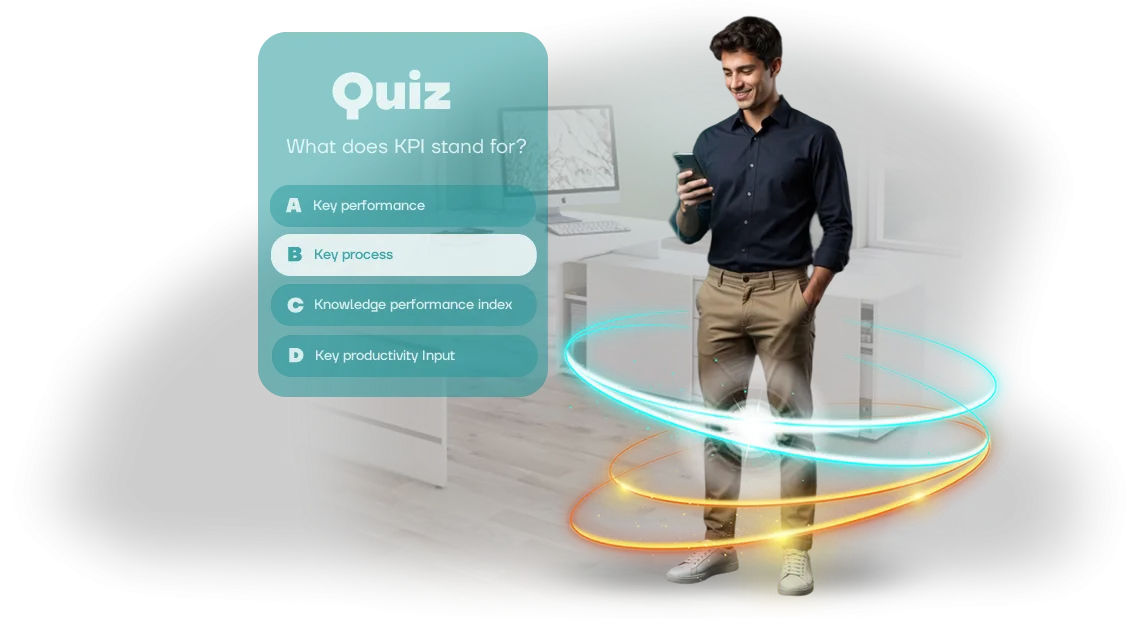
Employees Fail Linux Training — We'll Fix It with a Quiz
Corporate training often turns into a formality: employees flip through presentations, take tests just for show, and a week later forget the key rules.
On Linux, this process is even harder — materials have to be adapted, hardware is finicky, and people have no desire to return to training. Managers see zero results: regulations are ignored, mistakes repeat, and time and budget are wasted.
The problem is not employee laziness — it's the format. Presenting information without engagement does not create motivation. A quiz solves this differently: short rounds, a competitive element, instant feedback.
Employees absorb the material through play, and the company gets clear statistics — who actually learned it and who needs extra work. And all of it runs reliably on Linux from any device.
We build educational quizzes that integrate into your learning management system and run in a browser on any workstation. The client doesn't need to understand the tech — we handle development, adaptation to your corporate standards, and launch.
You get a ready-made tool that boosts engagement and delivers measurable results — higher course completion rates and fewer errors in workflows.
If your current training isn't working, a quiz on Linux is a simple way to turn a mandatory chore into a habit. Start with a demo on your real materials and see the difference in engagement.
What Gamified Learning Delivers: 5 Key Benefits
Employees often see training as mandatory routine: material is forgotten, engagement drops, and results are invisible. A gamified quiz changes that approach — it turns training into an engaging game that benefits both the business and the employees themselves. This format solves several problems at once: from improving knowledge to strengthening team spirit.
The first benefit is higher engagement. Game mechanics, competition, points, and leaderboards motivate employees to go through the material voluntarily, not under compulsion.
Employees strive to show their best result, so training stops being a punishment and becomes an event they look forward to.
The second benefit is knowledge retention. A quiz makes employees actively recall information rather than just read text. This triggers memory processes, and regular repetition in game form cements the material for the long term.
As a result, new skills are applied faster in real work, and employees don't waste time on retraining.
The third benefit is transparent assessment. The system shows who has fully mastered the topic and who has fallen behind. A manager sees an objective picture for each employee or department and can adjust the program in time, without waiting for formal certification. This saves resources and makes the learning process manageable.
The fourth benefit is flexibility and time savings. You can take the quiz from any device — computer, tablet, or phone — at a convenient time. There's no need to gather everyone in a classroom or pull a department away from work tasks.
Training easily fits into the company's rhythm, even if employees work remotely or in different time zones.
The fifth benefit is team building. Joint sessions, team scores, and a shared leaderboard create a healthy competitive spirit.
Colleagues discuss questions and help each other understand difficult topics, which strengthens corporate culture and improves communication within the team. Employees start talking more often and about business, which has a positive effect on the atmosphere.
Introducing a quiz is not just entertainment; it's a working tool that strengthens training, saves managers' time, and boosts staff motivation. This approach pays off quickly and delivers measurable business results.
With a ready-made scenario, you can launch training right away, adapting it to your company's specific needs.
Quiz Formats for Employees to Match Your Task
Every team is unique: some have five employees in an office, others have thousands of people in different cities and time zones. That's why quiz formats need to be flexible — in duration, participation method, and level of engagement. We choose the right option for your task so training runs smoothly and results stay measurable.
Below are the main quiz formats we use in corporate projects. All of them run on laptops, tablets, and smartphones, including Linux devices — employees join without installing additional software or changing settings.
| Quiz format | Who it suits | What the client gets |
|---|---|---|
| Live office quiz | Teams of up to 30 people at a corporate event or training | Engages the team, creates a competitive spirit, participant reactions are visible immediately |
| Online quiz with personal account | Medium teams and distributed offices, from 30 to 300 people | Employees take it at a convenient time, results are collected in a single table |
| Company-wide marathon | Large companies from 300 people, branch offices in different cities | Covers all employees, builds a habit of regular training |
| Micro-quizzes for remote teams | Remote employees and freelancers | 5–7 minutes a day, high completion rate, quick onboarding for newcomers |
Choose the format that suits you, and we'll adapt it to your specifics: add branding, adjust question difficulty, and configure access times.
If you're not sure, we'll advise which corporate quiz option will deliver quick results within a week — for a team of any size and schedule.
How Quiz Development Works: 7 Steps
Developing an educational quiz for employees is not a one-time purchase of a ready-made box; it's a structured process. We've broken it down into seven clear steps so you can see where the project stands and understand what you'll get at each stage. We handle all the work — you don't need to understand technical details.
-
Project brief. You describe the learning objectives, audience profile, and expected outcome — we propose the format, timeline, and work plan. It's immediately clear how long the project will take and what materials we need from you.
-
Scenario and questions. Together with you or your experts, we prepare a pool of questions, answer options, and explanations. We adapt the content to employees' day-to-day tasks so the quiz actually improves skills rather than just being entertainment.
-
Prototype. We build a visual sample: how the screens, flow logic, and styling will look. You see the product in advance and can make changes before main development starts.
-
Development and testing. We create the full quiz and test it on various work computers, including Linux machines. Our goal is for the game to work reliably on launch day and not fail at the most critical moment.
-
Integration and setup. We install the quiz on company devices or connect it via a link, and set up employee access. We run a pilot on a small group and collect feedback.
-
Rollout to all employees. The quiz becomes available to the team, and you get completion and result statistics. You can see who has mastered the material and who needs additional training.
-
Support. After launch, we stay in touch: we update questions, add new rounds, and fix inaccuracies. The quiz evolves with the company's needs and doesn't become outdated after its first use.
What's Included in an Educational Quiz Delivery
Once development is complete, you get not just a game but a ready tool for training, knowledge assessment, and progress analysis. The entire delivery is built around your task and runs on employees' Linux computers — without surprises or complicated setup.
- Quiz scenario and content. Questions, answer options, explanations, and learning blocks are prepared based on your materials. You approve everything before launch rather than getting it "as is".
- Interface styled to your company. The design is adapted to your corporate colors and logo so employees see the quiz as an internal tool rather than a third-party program.
- Admin personal account. A simple web interface for managing questions, assigning quizzes to employees, and viewing results. No files or forwarding — everything in one place.
- Reporting system for each employee. You can see who has completed the quiz, who hasn't started, how many correct answers they had, and how long it took. This helps you spot knowledge gaps in time.
- Overall team statistics. Summary data by department, trends in repeat attempts, and typical mistakes. Based on this data, you decide which topics to cover in a meeting or include in the next course.
- Launch and operating instructions. A short document for your administrator: how to add an employee, change a question, and export results. No separate training needed.
- Post-launch support. We stay in touch to fix content, add new questions, or update settings if your training objectives change.
All artifacts — the scenario, settings, interface, and reports — remain yours. You're not dependent on the developer for day-to-day work: your employee can update questions or add a new quiz without special knowledge.
Case Study: How a Linux-Based Quiz Trained 300 Managers
The quiz trained 300 managers from a retail chain of 40 stores — with different levels of experience, different work paces, and almost no way to gather them in one hall.
Training had to be launched within two weeks, and the results had to be measured for each employee: who learned the rules, who made mistakes in difficult situations, and who needs additional training.
We suggested a mobile quiz format on the tablets managers already use for work. The Linux-based platform ensured stable operation on all devices without glitches — even when devices were handed off between employees throughout the day.
No installation on personal phones, nothing extra: open it, answer the questions, and see your results immediately.
What Changed in Numbers
In the first week, all 300 managers took the quiz. The average completion time was 12–15 minutes, which fit into breaks between shifts. The share of correct answers rose from 62% to 88% after the training, and 74% of participants passed the test on their first try.
Exercises with error explanations after each question let employees close their own gaps — without a separate "examiner".
A month later, we checked how well the knowledge stuck in real work. In stores where managers completed the quiz, the number of customer service regulation violations fell by 30%.
The network head noted that for the first time they saw such a debrief without resistance from staff — employees themselves asked for access to additional rounds.
Why This Story Is Relevant to Your Project
The chain ordered repeat training for new employees after three months and extended the quiz to cashiers. For us, this is not a one-off campaign but a working tool that can be easily adapted to different roles and scales.
The project's success confirms: a properly packaged Linux-based quiz solves a real business problem — it quickly and measurably improves staff competence.
How to Choose a Quiz Format for Your Company?
Choosing a quiz format starts not with the latest mechanics trend but with a question: what business problem are you solving? For quickly getting new hires up to speed on a product, short, dynamic rounds with instant feedback work well.
For certification and knowledge assessment — scenarios, case studies, and error reviews. The key is that the mechanics match the learning objective.
The second factor is audience specifics. A company with remote employees needs a mobile version and flexible completion time. For a small office, in-person team sessions are more effective and boost engagement.
Look at how much time people have, what devices are available, and how motivated they are — that's the framework for the future format.
The third point is the nature of the training itself. Complex professional topics are best broken into short modules: an employee completes a block in 5-7 minutes and immediately reinforces the material.
Simple topics can be combined into a competitive quiz with a rating to spark interest. The more difficult the material, the shorter the rounds and the clearer the reward system.
Also consider the technical environment. Our educational quizzes run on Linux as well — this eliminates compatibility concerns if your company uses open-source software.
Employees launch the quiz on work devices without installing additional programs, and you don't need to invest in a new hardware fleet.
In short, there's no one-size-fits-all quiz, but there is a clear selection process. We start by analyzing your tasks, audience, and technical environment, then propose a format that will work specifically for your company.
You get not "a game for the sake of a game" but a tool that can be measured by business metrics.
Frequently Asked Questions About Corporate Quiz Development
Before ordering a corporate quiz, clients have the same doubts. We've gathered the most common ones — about timelines, cost, guarantees, and support.
What are the development timelines for a quiz?
A standard quiz with 20–30 questions is ready in 2–3 weeks. If you need custom design, game mechanics, and integration with your learning platform — allow 4–6 weeks. We fix the exact timeline in the contract and stick to it.
How is the cost calculated?
The price depends on the amount of content, the complexity of the mechanics, and the design. After the brief, you receive a transparent estimate broken down by stage — no hidden fees or unexpected surcharges.
What quality guarantees do you provide?
Every stage undergoes testing, and before launch we create a beta version for your team. If an error is found after delivery, we'll fix it free of charge during the warranty period.
Can the quiz be updated and what devices does it work on?
Yes, you'll be able to change questions and add new ones through a user-friendly control panel. Employees can take the quiz from a computer or smartphone, including Linux devices, right in the browser — without installing additional software.
If your question isn't covered — write to us and we'll answer in detail. Or let's discuss your task right away on a short brief.Ready to Create a Quiz Your Employees Will Love?
You already know what you want: for employees to actually absorb the material instead of just sitting through the training. A quiz solves this problem — it holds attention, creates healthy competition, and shows who understood what. All that's left is to discuss the details.
Leave a request for quiz development — and within one business day you'll receive:
- A consultation — we'll analyze your task, audience, and learning goals, and suggest suitable formats.
- A preliminary quiz structure — topics, question types, completion flow, and employee motivation mechanics.
- A work plan and timeline — clear stages so you know when and what you'll receive.
- Examples from our projects — you'll see what a quiz looks like from an employee's perspective and what results it delivers.
- A pilot launch — we'll test the quiz on a small group before full deployment.
You can order a quiz without lengthy approvals: just leave your contact details, and we'll come back with concrete ideas for your task. The consultation is non-binding — you'll get value right after the first conversation.
The pilot launch is especially important: you'll see employee reactions, understand whether the format suits your team, and make an informed decision about purchasing the full version. Start with one step — we'll handle the rest.