

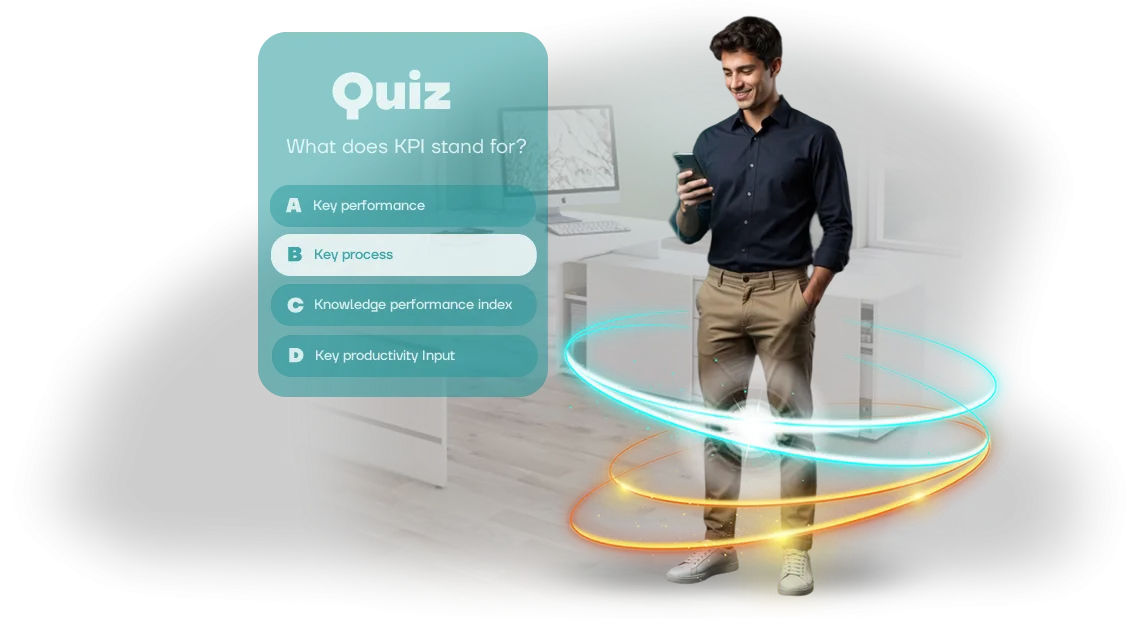
Employees get bored in training — Pico quizzes change that
When training is run as a regular lecture or a test in a spreadsheet, employees lose attention within a few minutes.
Information isn't retained, and training itself is perceived as a duty to simply "sit through." As a result, the company spends time and budget but gets neither higher engagement nor real changes in staff performance.
Pico quizzes solve this problem: training becomes a lively, interactive process. The employee doesn't just read theory but takes part in a game — answers questions, sees results, competes with colleagues.
This format activates natural mechanisms of excitement and curiosity, so material is absorbed more deeply and stays in memory longer.
We build quizzes on the professional Unity stack for Pico — this ensures stable operation on devices and a user-friendly interface that requires no training for your employees.
For business, this means a measurable result: higher engagement in training, faster knowledge retention, and the ability to quickly verify what staff have actually learned.
Quizzes can be adapted to any specific field — from safety regulations to service standards — and integrated into a company's existing training system.
Employees perceive this format not as punishment but as entertainment with a benefit — so their overall attitude toward training changes for the better.
The key point: each quiz is built around your business objectives. We immerse ourselves in your product, collect real cases, and formulate questions that reflect exactly your standards and procedures.
In the end, you get not an abstract trainer but a working tool that closes specific knowledge gaps in your employees. Pico quizzes are a way to turn training from a formality into a clear, fast, and effective process that benefits both the team and the company.
What a quiz delivers: engagement, retention, control
Traditional training often becomes a formality: employees skim through slides, mechanically tick answers, and forget the material within a week. A quiz solves this problem — it forces people to engage with the process instead of sitting it out.
In a game format, information is absorbed naturally because the person actively searches for the right answer rather than just reading theory.
The main value of a quiz is engagement. Competitive elements, points, and feedback after every question create a thrill that prevents distraction. Employees return to the material on their own to improve their results — you don't need to push them or monitor every step.
This also works for large teams: a quiz can be launched simultaneously on all devices, including virtual reality headsets.
The second effect is speed of retention. When a person answers questions and immediately sees the correct answer, information sticks several times faster than with passive reading. A quiz breaks a complex topic into short blocks that can be repeated as many times as needed.
Training thus stops being "read and forgot" and becomes a skill the employee actually applies on the job.
Knowledge control is another benefit that matters to managers. Instead of scattered tests, you get a full picture: who has mastered the material and who needs additional explanation. Statistics show typical mistakes and topics that cause difficulty for most of the team.
Based on this data, you adjust the training program without spending time on manual answer checking.
Finally, a quiz saves resources. Once launched, it works automatically: new employees can complete it without a mentor's involvement, and updating questions takes minutes rather than retraining the entire team.
We develop such quizzes on the professional Unity platform and adapt them for Pico devices — this ensures stable performance and easy scaling to any team size. As a result, you get a tool that quickly pays for itself through greater training efficiency.
Pico quiz formats: from test to VR trainer
Employee training rarely fits into a single scenario. Some need to quickly verify knowledge of regulations, others need to engage the team in corporate values, and still others need to practice emergency response.
That's why we offer different quiz formats — from a quick test to a full-fledged VR trainer on Pico. The choice of format depends on the training goal and the audience.
| Format | For whom | What it gives the client |
|---|---|---|
| Employee test | For safety briefings, standards, and regulations | Fast knowledge assessment for the whole team, automatic reports, clear results |
| Quiz | For a team that needs to be united and engaged in corporate culture | Higher interest in training, emotional connection with the brand, team spirit |
| VR trainer on Pico | For practicing sales, service, or emergency response skills | Risk-free practice, lasting skills, fast employee preparation |
VR training on Pico is not just knowledge testing — it's full immersion in a situation. The employee operates in a safe virtual environment and receives immediate feedback.
For companies, this means fast preparation of staff for real tasks — without involving mentors or renting premises.
Which format should you choose? If you need to cover all employees without purchasing equipment — start with a test or quiz. If you need to practice skills until they become automatic — we'll add a VR trainer to the program. We'll help you combine formats to fit your task and budget.
How a quiz is created: 6 steps
To ensure the quiz solves business tasks rather than being mere entertainment, we structure our work into six clear stages. At each stage you understand what's happening and can influence the outcome — from the first idea to the training launch.
Six steps: from brief to launch
-
Brief and goals — we meet with you and determine who is being taught and what: new employees, the sales department, or safety regulations. We record evaluation criteria so that after launch you can measure how much the team's knowledge has grown.
-
Scenario and plan — based on the brief, we propose the quiz structure: number of questions, difficulty levels, game mechanics. You see in advance how an employee will move through the training and understand what kind of experience they'll get.
-
Content approval — you review the wording of questions and answer options and make edits. We adapt the text to the corporate style so the quiz speaks your company's language and doesn't cause resistance.
-
Quiz development — we build the quiz on the professional platform for Pico: questions, timers, points, instant explanations. Everything runs reliably, and launching on devices happens without a technical specialist on your side.
-
Testing and refinement — we run the quiz through real scenarios, check how text is displayed, how points are calculated, and what happens when an error occurs. We smooth out all the rough edges before training begins.
-
Launch and support — we install the quiz on Pico and help employees complete their first sessions. We stay in touch after launch: if questions need to be changed or a level added, we'll do it promptly.
This approach eliminates surprises and downtime: you get a working training tool within the agreed timeframe, and employees get a clear, engaging format that genuinely sticks.
What's included in delivery: a complete launch package
The quiz delivery package is more than just a program file. You get a ready-made solution that can be launched within days: scenario, design, content, integration, and analytics — all in one package.
- Scenario and questions. A well-thought-out quiz structure for your task: knowledge assessment, onboarding newcomers, or certification. Questions with answer options, timing, and explanations.
- Design and styling. An intuitive interface with your logo and brand colors. Employees immediately recognize the brand and stay focused on training.
- Content and teaching materials. Texts, videos, and infographics that help retain the material. Hints for difficult questions and error breakdowns after each round.
- Build and integration. A ready-made build for Pico devices, configured for your network and training system. Updating questions and difficulty levels without involving developers.
- Instructions for the team. Quick-reference guides for administrators, facilitators, and employees: how to launch the quiz, how to connect devices, what to do in unusual situations.
- Training analytics. A report for each participant: number of correct answers, completion time, mistakes, and progress. You see which topics have been mastered and which need to be reviewed.
The final package covers the entire cycle: from preparation to results evaluation. You don't need to refine anything — just pick a date and invite employees.
Case study: Pico quiz raised training completion by 68%
For a manufacturing company with line-level staff, we developed a training quiz on Pico — instead of the usual lectures and PDF guides, employees went through scenarios in a game format.
The client faced a typical pain point: perfunctory course completion, poor retention of regulations, and difficulty monitoring actual knowledge.
What we did
The quiz included questions on safety regulations, work procedures, and emergency response. The employee answered questions, received immediate feedback, and saw their own progress.
The mechanics were designed so an incorrect answer was explained right away — learning happened through the game itself, not rote memorization.
Results
The key metric — completion of mandatory training grew by 68% compared with the previous period.
The average score of employees who passed the test on the first attempt reached 91% — confirming that the material was truly absorbed rather than "clicked through." In addition, time spent on reviewing results dropped by 40%: managers received ready-made statistics for each employee without manually gathering reports.
After the annual staff rotation, the client ordered a second phase of the quiz — the system was adapted for new employees and the questions were updated. This shows that Pico training became a working tool, not a one-time initiative.
For business, this case means measurable growth in training discipline and reduced risks associated with the human factor.
FAQ: is it expensive, does it take long, is it safe
Every project starts with questions: how much will it cost, how quickly can we launch, will we have to restructure existing processes. So you know what to expect, we answer the most common concerns — simply and without fine print.
How much does quiz development cost?
The cost of quiz development depends on the volume of questions, the format (text, graphics, video), and whether results need to be exported to your learning management system.
We provide an estimate after a short brief: you know the final amount in advance, and it doesn't change during the work. No hidden fees — only what you approved.
How long will creation take?
A typical project takes 2 to 4 weeks — longer than putting together a presentation, but much faster than building a full game from scratch. The base templates, mechanics, and shell are already ready; all that's left is filling them with your questions. The exact schedule is fixed in the contract and doesn't shift.
Is it difficult to integrate the quiz into the current system?
The Pico quiz runs as a standalone application or via a link — employees don't need to install or configure anything. Results are automatically uploaded to your learning management system or to a report convenient for HR.
In most cases, integration takes one to two days, and it's already been refined in our previous projects.
Who will support the quiz after launch?
We don't disappear after project delivery. The first year includes technical support: we help with setup, answer employee questions, and update content for free.
If you want to expand the quiz — we'll add new questions, topics, or languages; this will be priced separately but according to a clear estimate.
Is the training safe for employees?
We use short 5–7 minute sessions with smooth transitions and mandatory pauses to avoid fatigue or discomfort. This format has been proven across many corporate projects: most employees complete the quiz successfully and absorb the material without any unpleasant sensations.
Order a Pico quiz and get training that works
You submit a request — and within a few hours you receive a cost calculation and a format proposal. We don't make you wait and don't retreat into "we'll think about it": you immediately see what the business will get, how much it costs, and when work begins.
After your inquiry, you receive:
- A response within one business day — no weekend pauses or automated replies.
- Cost calculation for your task — accounting for the number of employees, complexity level, and timelines.
- A vision of the quiz scenario — so you understand before the start how the game will teach and motivate.
- Examples of similar projects — with real implementation results in other companies.
- A clear rollout plan — from brief to launch, with dates and responsible parties.
- A personal manager — available at every stage: from approval to final handover.
Then we follow a short path: align the details — build the quiz — you test and launch. You get training that is measured in reach, engagement, and growth in employee qualification.
Submit a request for Pico quiz development — and we'll prepare a specific proposal with figures and timelines for you.
How to choose a quiz format for your task?
Choosing a quiz format always starts not with technical capabilities but with the question: what do you want to achieve in the end? If the goal is to introduce newcomers to the product or internal regulations, a short quiz with hints and answer explanations works well.
If you need to test the depth of knowledge of experienced employees, it's better to use a scenario with time limits and open-ended questions. Define the main outcome, and the format becomes obvious.
Pay attention to the audience. Younger employees feel more comfortable with a competitive format with points and rankings, while a more mature team values a calm quiz with error analysis.
If you want to bring the team together, choose a team mode — it creates healthy competition and improves communication between departments. There's no universal solution, but there is proven selection logic.
When you're in doubt, the best approach is a consultation with an expert. We analyze your task, look at the audience and goals, and then propose two or three formats that suit you.
We calculate how much time the quiz will take, how to integrate it into existing training, and how to measure the result — for example, the percentage of correct answers or completion speed. All of this without unnecessary technical complexity, in business language.
Remember: the right format is not entertainment for entertainment's sake but a tool that genuinely increases engagement and retention. We've built dozens of such quizzes for different companies, so we know for sure that a simple, effective solution exists for your task. Start with a brief description of your goal — we'll build the rest during the consultation.