

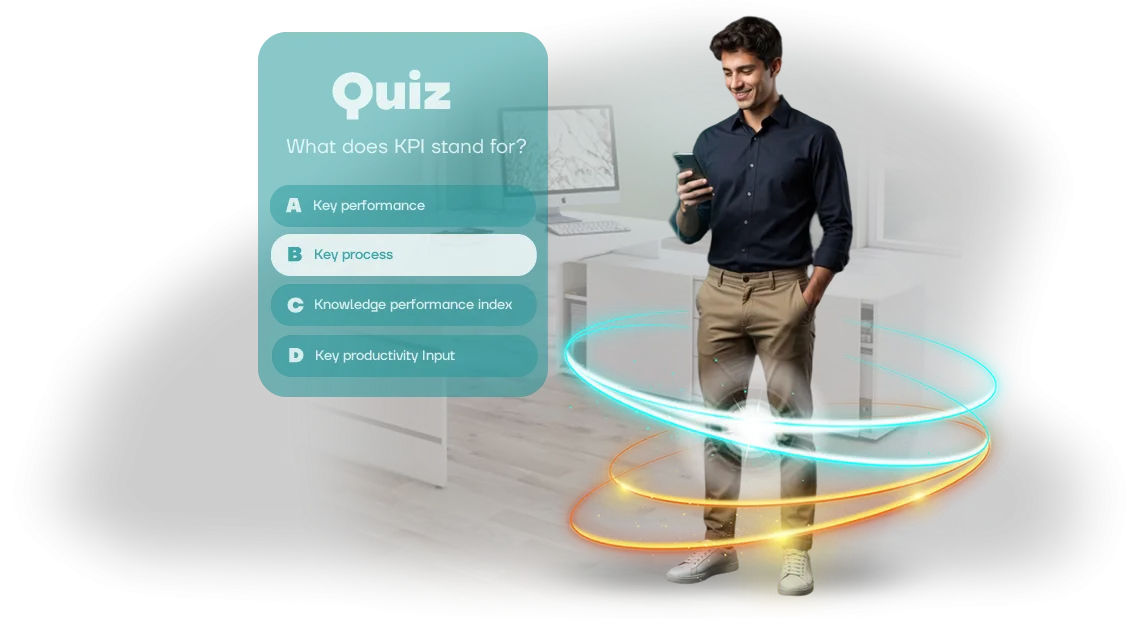
Why Call Center Agents Lose Skills and How to Stop It
Call center operators are the most fluid category of employees: training a new person takes weeks, and within a few months part of the knowledge fades. Errors in scripts, forgotten procedures, and lost objection-handling skills directly hit service quality — and revenue.
At the same time, classic lectures and post-exam tests stop working: an employee formally passes the check but acts out of habit in a real conversation.
The problem is that knowledge doesn't stick in working memory. The agent hears the instruction once and applies it in stressful situations a week later — by which point only a general idea remains.
Add to that the constant turnover that takes experienced employees away, and newcomers learn from their own mistakes instead of using ready-made best practices.
As a result, the manager is forced to invest endlessly in training, but service quality doesn't grow, and the number of repeat contacts on the same issues increases.
The solution is training quizzes embedded in daily work. Short interactive sessions of 5-7 minutes don't let knowledge fade: the operator repeats complex cases in a game-like format, breaks down dialogues, and gets immediate feedback.
This way skills are reinforced without taking time away from work and without the feeling of "one more mandatory task." The manager sees the team's real gaps — which topics agents make mistakes on most often — and can strengthen weak points precisely instead of teaching everyone everything.
Wehave been making training quizzes for call centers for more than ten years, and we see the main thing: a systematic approach to repetition delivers measurable results.
Request processing speed grows, mistakes become rare, and newcomer onboarding time shrinks by a third — because the quiz shows what a person has truly absorbed and what needs to be reviewed again.
This covers both turnover and service quality: employees speak to customers with more confidence, get less tired of monotonous work, and stay with the company longer.
What a Training Quiz Gives the Manager and the Team
Classic call center training is lectures and "for show" tests. Employees sit through hours, but within a week they forget scripts, procedures, and objections, and the mistakes repeat. The manager invests time and budget, but service quality doesn't grow.
A training quiz changes the approach: knowledge is practiced in a game format that employees actually complete. It's not a replacement for simulators, but a tool that turns routine into competition and delivers measurable results.
Here's what the manager and the team get:
- Shorter onboarding time. Newcomers master products and scripts faster because the quiz immediately reveals gaps and reinforces material in action, not just in theory.
- Higher service quality. After regular game rounds, employees make fewer objection-handling mistakes and follow procedures more accurately — visible in fewer complaints and higher sales conversion.
- Better team motivation. Leaderboards, points, and rewards create healthy competition. Employees return to training on their own because it's engaging, not because they "have to."
- Training without taking time off work. A round takes 5–10 minutes — it can fit between calls or at the start of a shift. No need to gather groups or pull the line away from customers.
- Transparent analytics for the manager. You see who has absorbed the material and who needs extra support. Instead of guesses — data on each employee and the team as a whole.
We develop such quizzes for your call center's needs: scenarios, typical objections, products, and service standards. You get a ready-made tool that is easy to update and reuse for new employees.
If you want training to stop being a formality and start delivering measurable value — this is that checklist you can close within a couple of weeks.
Quiz Formats for Call Centers: From Onboarding to Certification
Each stage of an operator's work requires its own training logic: a newcomer masters the product and scripts, an experienced employee refreshes knowledge, a manager checks the team's readiness. The same quiz won't cover all these tasks — the format must match the stage and the goal.
We match the quiz type to the specific task: onboarding, regular training, or certification. Here's how it looks in practice.
| Format | For whom | What it provides |
|---|---|---|
| Training quiz | New employees | Fast immersion in the product, less load on the mentor |
| Quick checks | Line operators | Regular script review, engagement at shift start |
| Scenario quizzes | Experienced employees | Practice of complex dialogues, higher sales and service quality |
| Certification exam | Entire department | Objective knowledge assessment, clear results for the manager |
The formats combine easily: a newcomer takes the training quiz, then joins the quick checks, and within a month passes certification. We design such a scheme for your department so training doesn't interrupt work and gives the manager a clear result.
How Quiz Development Works: Stages and Control
We build quiz development as a managed process — with checkpoints, transparent timelines, and clear results at every stage. You don't need to dig into technical details: you see progress and make decisions about content.
- Brief and immersion — we define training goals, audience, and success criteria. You get a plan with timelines and areas of responsibility.
- Scenario alignment — we create questions, answer options, and a scoring system in your employees' language. Edits are made without changing the budget.
- Development and setup — we assemble the quiz on proven tools and connect the formats you need: single choice, cases, timed blitz.
- Pilot launch — we run the quiz on a limited group, collect feedback, and adjust difficulty. This reduces the risk of failure at full-scale launch.
- Full-scale launch and monitoring — we launch the quiz for all call center employees and track completion and results in real time.
- Post-release support — we stay in touch: update questions, fix issues, add new topics as your base grows.
Thanks to this sequence, you control every stage and get a product that solves the training task. The pilot launch is especially important: it lets you see employee reactions before the quiz goes out to all teams.
What's Included in the Project: A Complete Kit for Launching the Quiz
A quiz project is not just a game, but a complete kit for launching training. You get everything you need: scenarios, interface, reports, and instructions — and you can launch the quiz without involving your own development team or designers.
Here's what's included in the project:
- Ready-made quiz scenarios — questions and answer options adapted to your call center's specifics: products, scripts, difficult customers, procedures. The scenario can be built from 50 to 200 questions.
- Clear employee interface — a simple and intuitive system: employees will figure it out on their own, without instructions. The game runs on your call center's regular computers.
- Reporting module for the manager — you see who completed the quiz, what results they got, and which topics are lagging. Data is shown in convenient tables — no manual collection needed.
- Customization to your KPIs — points, response time, and number of attempts are counted. You can set a passing score and conditions for retakes.
- Administrator instructions — how to launch the quiz, update questions, and view results. Everything is written in plain language, without technical details.
- Help at launch — we deploy the system on your computers, check that it works, and train the administrator. You're not left alone with the tool.
The kit covers the entire training cycle: from the first launch to reinforcing knowledge among employees.
The manager sees the dynamics, employees go through the material in a game format, and the company keeps a tool that can be used again and again — for newcomers and for keeping the experienced team sharp.
Case Study: How a Quiz Improved Customer Service Quality
We'll share one of our most illustrative cases — for a network of call centers serving customers of a large online store.
The problem was typical: even after a series of introductory lectures, operators got confused with scenarios, lost patience in difficult dialogues, and the customer satisfaction metric stayed flat.
The department head ordered a training quiz to move knowledge from "memorized — forgotten" to a real skill.
What changed after the launch
Three months later, the first measurements were taken. Average call duration dropped by 20% — operators stopped floundering on questions, and customers no longer waited while an employee searched the instructions for an answer.
Service quality scores from an independent survey rose by 15 points, and the share of customers who made a repeat purchase after their contact increased by 12%.
A 100% quiz pass rate was made a mandatory condition for an operator to go on the line. Thanks to short 10–15 minute rounds, training fit into the work schedule without stopping the flow of calls. Previously, such trainings took days, and the result was unclear.
What customers say
"We expected the quiz to simply diversify training, but we got a measurable effect. Mistakes became less frequent, and customers even praise operators for confident answers. And this is without hiring new employees — just a change in the training format."
Head of training center, call center
This project paid for itself within the first months: training time was reduced, turnover from overload decreased, and positive customer feedback translated into repeat orders.
After the first success, the company ordered three more quizzes from us for other departments — this practice became part of their standard training system.
Frequently Asked Questions About Implementing a Quiz in Training
Before launching a training quiz, call center clients ask the same common questions: adaptation to their processes, reliability guarantees, employee reaction. We answer these concerns — so you can decide calmly.
How does the quiz adapt to our training processes?
The quiz doesn't replace your training system — it integrates into it. We tailor scenarios to your procedures: launch after a lecture, a check before passing standards, or monthly review of difficult topics.
At the requirements-gathering stage, we take your materials, call reviews, and typical mistakes — and turn them into questions. The quiz works by your rules, not by abstract templates.
What if employees don't want to take the quiz?
In call centers, training is often perceived as a burden. We remove the resistance with a game-like presentation: short rounds, clear wording, visible progress, and a team rating.
The quiz provides instant feedback — the employee sees what they already know and what's worth reviewing. Based on our launch experience, completion rates reach 80% without coercion.
What guarantees that the quiz will work reliably?
We use proven tools and professional equipment, so the quiz handles all operators taking it simultaneously. The contract sets launch timelines and support: in case of a failure, we resolve the issue quickly so training doesn't stop.
How is employee feedback taken into account?
The quiz collects answers and reactions: question clarity, difficult topics, completion time. We analyze the data and update scenarios together with you. You see the team's knowledge growth and adjust the program in time.
What If You Need a Non-Standard Quiz for Your Team?
The short answer: yes, a non-standard quiz is our regular work. We regularly build projects for clients with special requirements, including for sales departments and contact centers.
If the ready-made mechanics from the catalog don't fit — that's not a problem, but a reason to build a quiz that solves exactly your task.
Non-standard scenarios can look different. For example, instead of a simple "question-answer," we build a branching storyline: the operator goes through a dialogue with a "difficult" client, chooses responses, and sees the consequences of each decision.
This allows training not just knowledge of instructions, but real communication skills, which directly affects service quality.
We cover special requirements individually: non-standard mechanics, specific rules, work with the company's internal materials, support for unusual delivery formats — from short warm-ups to full tournaments.
We don't force your request into a template; we develop a structure that fits your team and your training goals.
The individual approach starts with a brief: we clarify who your employees are, what result the training should produce, and which scenarios are relevant for them. Then we propose a scenario, align on it, and implement it. At every stage you see how the quiz evolves and can make edits.
So, if you have a non-standard idea or constraints that don't fit into ready-made solutions — that's no reason to skip the quiz. Tell us about the task, and we'll propose an option that covers it with all the details taken into account.
Launch Training That Actually Works
You already know what typical corporate training looks like: boring slides, low engagement, and a "checkmark" instead of a real skill. In a call center, this directly hits sales conversion and service quality.
But it can be done differently: turn employee preparation into short interactive quiz sessions that are remembered and applied the very next day.
Launching such training doesn't require dedicating a separate specialist or digging into technical details. One request is enough — we handle the rest. Here's what you get after the first contact with us.
- Project estimate within 1–2 days. You send the scenario, procedures, and typical objections — we quickly assess the timelines and cost of creating the quiz for your tasks.
- Pilot launch on a group of employees. Not "blind" across the whole call center, but a test on 10–20 operators. You see first results within a couple of weeks and decide on scaling.
- Turnkey training and support. We assemble the content ourselves, set up the game to your procedures, and keep it up to date after release.
- Clear analytics for the manager. See who has already absorbed the material and who is answering at random — and work on weak employees precisely.
- Game mechanics without overload. Operators compete in the rating, earn points for correct answers, and get into work faster.
- Respect for your internal schedule. The pilot launches in free windows between calls — training doesn't stop sales.
Leave a request for an estimate, and we'll show you what your pilot launch will look like. After a short brief, you'll get a plan, timelines, and a cost estimate — no obligations and no fluff.
Introducing interactivity into the daily routine of a call center pays for itself through higher sales within the first months. When would be a convenient time for a 15-minute call to discuss your task?