

Why Corporate Universities Fail to Keep Employees Engaged
Corporate universities exist to systematically develop team skills. But too often, training turns into mandatory routine: lectures, presentations, post-course tests.
Employees sit through the hours, nod along on quiz questions—and a week later, they don't remember what it was about. Managers see that the course was completed, yet work hasn't changed.
The reason isn't a weak program but the format. The brain is wired to ignore monotonous information delivery: without emotion and practice, knowledge doesn't stick. Engagement in learning drops, and with it, the return on investment in personnel.
The corporate university spends its budget but gets no measurable result: skills don't change, mistakes repeat, deadlines are missed.
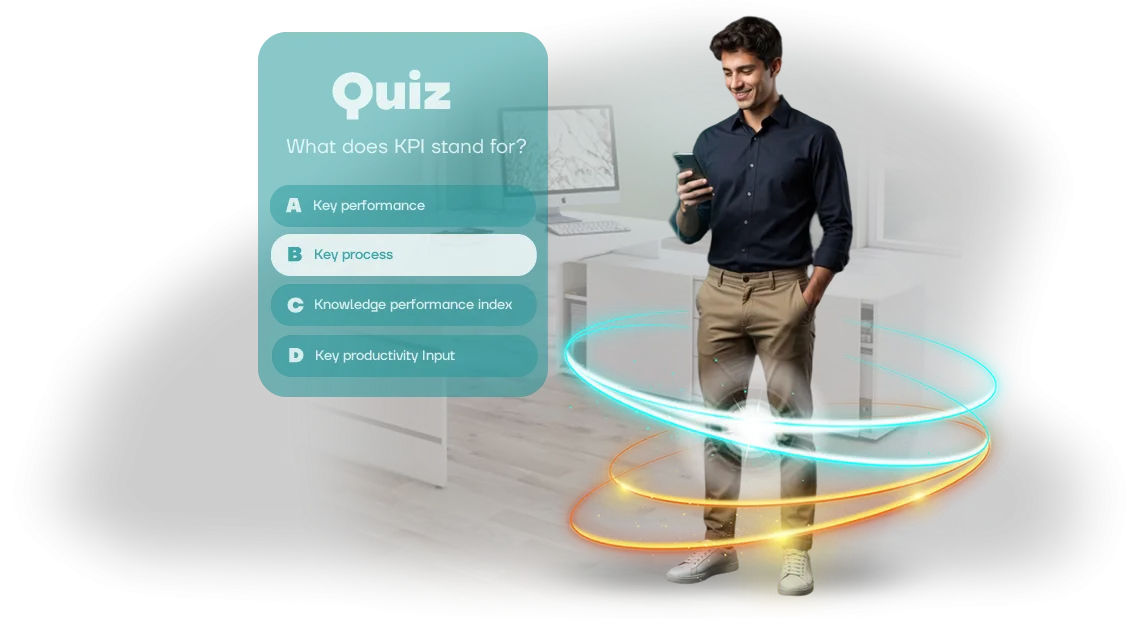
Game formats shift attention and trigger the natural desire to win. A quiz is not just entertainment: it makes an employee actively recall, apply, and reinforce the material. Such employee training delivers quick results and leaves a lasting impression.
We turn training programs into engaging quizzes that people play with enthusiasm. The client gets a ready-made tool that's easy to integrate into an existing corporate university and measure its impact.
This is how we solve the problem of boring lectures and turn training from a formality into a working mechanism for team growth.
What a Game-Based Quiz Delivers for Employee Training
A game-based quiz for staff turns training from mandatory routine into an event people look forward to. Gamified learning adds a competitive spirit: employees engage in the process on their own instead of clocking hours in front of a screen.
This directly affects employee engagement—they complete the course more actively, return to it repeatedly, and apply knowledge in practice with greater interest.
The second key result is knowledge retention. Bright question formats, clear feedback on right and wrong answers, and scenarios from real work situations help consolidate material more effectively than a standard lecture or test.
The employee doesn't just memorize facts—they learn to make decisions in a safe game environment, which means they handle real work tasks better.
Finally, the company gets clear analytics. The quiz results show which topics are well understood and where employees are making widespread mistakes.
The corporate university manager sees the progress of teams and individual specialists, understands where additional training is needed, and can assess the effectiveness of the training program based on objective data rather than impressions.
Thus, a game-based quiz solves three key tasks: it raises interest in learning, improves material retention, and provides transparent metrics for management decisions. It's a tool that pays off through increased employee competence and less time spent on repeated explanations.
Formats of Training Quizzes for Corporate University Needs
Each training quiz solves a specific task: sometimes a quick knowledge check is enough, and other times you need to immerse employees in a narrative and spark lively discussion.
To ensure that choosing a format doesn't become a compromise between 'do it quickly' and 'train effectively,' we compare three typical scenarios for corporate university needs.
| Format | For whom and when it fits | What it gives the client |
|---|---|---|
| Short test | Interim check after a module, mass rollout to 500+ employees | Quick knowledge snapshot, automatic result collection, low load on organizers |
| Team game | In-person or online meetings, team building, discussion of complex topics | Live interaction, soft skills development, engagement even of passive participants |
| Full scenario PC game | Key training programs, new-hire onboarding, certification | Deep immersion in the material, realistic cases, clear analytics per employee |
Short quizzes save time and are suitable for regular material review. Team games turn training into an event: employees discuss answers, argue, and remember rules through emotions.
A full scenario PC game is a standalone learning game with a story and levels that holds attention for 30–40 minutes and lets you model work situations without business risks.
We help you choose a format for a specific goal: increasing product awareness, testing safety knowledge, or onboarding new employees. First, we analyze the audience and learning objectives, then we propose the optimal option—from a light quiz to a comprehensive game.
As a result, the corporate university gets a tool that employees complete with interest, and managers see measurable results in the percentage of correct answers and the dynamics of repeated completions.
How We Design a Quiz for Your Learning Center
We don't start work 'blindly'—first we dig into your learning center's objectives and how employees currently go through training. The result isn't just a game, but a tool that fits into your personnel development system and solves a specific business problem.
Next comes a transparent six-stage process. At each stage, you know what's happening, what you're getting, and how long approval takes. No 'black boxes'—just clear steps and checkpoints.
- Quiz Brief — we meet with you and gather requirements: topics, difficulty, audience, desired outcome. You get a structured questionnaire that captures all agreements.
- Concept & Scenario — we propose a question format, game mechanics, and visual style aligned with your corporate brand. We align the scenario so it precisely serves the learning objectives.
- Quiz Development — we build a prototype and fill it with content. You see intermediate versions and make edits before final approval.
- Testing & Debugging — we test the game on different devices, ensuring everything works reliably and results are saved correctly.
- Training Launch — we host the quiz on your platform or deliver a ready-to-install file. We help integrate it into the learning process and set up access for employees.
- Maintenance & Support — after launch, we stay in touch: we quickly address feedback, update questions based on new materials, and help with results analytics.
This sequence lets you control every stage and influence the outcome in time. You always know where the project stands and what comes next—while we handle all the technical work so you can focus on the training content.
What You Get After Launching a Training Quiz
The results of developing a quiz for a corporate university are visible right after launch: employees go through training with interest, and you get data on material comprehension.
This isn't a one-time entertainment but a working tool that stays at your disposal and supports the training program's goals.
Full Delivery Package
- Scenario and questions. A ready-made base adapted to your program. Methodologists can independently update questions and add new topics without developer involvement.
- Game mechanics. Thought-out task formats—from quick tests to situational cases—hold attention and help memorize key rules.
- Interface and design. The quiz is intuitive for employees of any age, works on computers and tablets, and requires no separate installation.
- Administrator materials. Step-by-step instructions for setting up, launching the game, and adding participants. You'll be able to run new rounds without technical support.
- Content rights. All scenarios, questions, design, and software materials are legally assigned to your company. Use them in training without restrictions or extra payments.
- Results reporting. The quiz collects completion data: which topics cause difficulties, which employees succeeded, and who needs additional training. These results will form the basis for the next training modules.
The main result is saving your training team's time and budget. You get a ready-made tool that can be replicated across departments, branches, and even new-hire onboarding. Everything is already configured, tested, and handed over to you 'turnkey.'
Case Study: How a Game-Based Quiz Boosted Learning Engagement
The corporate university Sokol, which trains staff for a chain of 54 stores, came to us with a typical pain point: training had become a formality.
Employees completed courses in five minutes just to tick a box, without remembering the material, and final testing showed a steady decline in scores. Managers saw the budget being wasted but couldn't figure out whether the problem was the content or the delivery.
What We Did
We didn't rewrite the training program; we changed the knowledge-check format. We developed a game-based quiz with real work scenarios: time limits, progress, and a leaderboard among colleagues.
Employees completed it on a smartphone or computer—without a separate classroom and without stepping away from their workflow. Integration with the internal portal took just two weeks.
Business Impact
A month after launch, training participation rose from 61% to 94%—people were playing even during breaks, not just under manager pressure. The average score increased by 34%, and the share of employees who fully completed the course grew 2.2 times.
After a quarter, repeated testing showed that 87% of staff retained the knowledge—previously, that figure never reached 40%.
Effectiveness Evaluation
The key outcome of the case is that the game-based quiz gave the client measurable growth in engagement and transparent analytics for each branch. The leaderboard was even used as a factor in bonus decisions.
After that, the client ordered the next course modules because they saw a direct connection between the game and real learning outcomes.
Frequently Asked Questions About Developing Quizzes for Employees
We know that before launching corporate training, clients have the same questions: timelines, security, and post-launch support. Here's how we address them—so you can plan a quiz without risks or surprises.
What are the development timelines for an employee quiz?
A standard project takes 2–4 weeks: from brief to launch. We set the exact timeline in the plan after the first discussion, so you know the start date in advance and can fit the quiz into the overall training schedule.
How secure is the quiz for corporate data?
The quiz runs on a protected server architecture, accessible only to authorized company employees. Results are stored for internal analytics but are not shared with third parties or used outside the training program.
What if we need refinements after launch?
The process is iterative: after a pilot launch, you give feedback, and we make edits before the final release. At the start, we lock in the scope and cost of work, so you understand what's included in the project and what is paid for separately, and how much.
How is quiz content updated?
You can change questions and answers yourself through a simple control panel—without developer involvement, in just a couple of minutes. We also offer ongoing support: we check system performance, help update the question base, and respond promptly to requests.
How to Choose a Quiz Format for Your Training Goals
Each quiz format solves its own task, so there is no one-size-fits-all 'best' option. To decide, assess what matters more to you: launching a tool quickly, engaging new employees, or testing comprehension of complex material.
We've prepared a table that helps you see the differences and choose the right format for your goal.
| Format | For whom | What it gives the client |
|---|---|---|
| Short 'quick-start' quiz | For embedding in training and initial checks | Launch in a couple of days, clear mechanics, employees aren't afraid to make mistakes |
| Themed quiz with a narrative | For deep immersion in a topic and holding attention | Employees complete the scenario to the end and absorb most of the material |
| Team quiz tournament | For uniting departments and practicing skills through play | Competitive spirit, team statistics, high employee reach |
| Individual marathon with a leaderboard | For regular review and building a learning habit | Systematic engagement, visible dynamics for each employee |
If you're short on time, choose a short format: it adapts quickly to your topic and doesn't require lengthy approvals. When your goal is deep learning, a narrative quiz works better: it holds attention from start to finish.
And if it's important to unite the team and add competition, a team tournament delivers not only knowledge but also positive feedback from participants.
In any case, we start with a brief: we analyze the audience, learning goals, and expected results. Then we propose a format that fits your specific task, without extra spending on mechanics you don't need.
Along with the project, you get clear numbers: the share of employees who completed the quiz, the average score, and the trend in repeated completions.
Shall We Discuss Your Quiz? Get a Quote and Work Plan
You submit a request for a quiz—and within one business day, you get not general words but specifics: a project estimate tailored to your task, a work plan, and personal format recommendations.
No 'let's see, we'll study it'—only numbers, timelines, and the logic behind the game for your employees.
Our team has been creating learning games for corporate universities and internal communications for over 10 years.
During that time, we've built a library of scenarios that lets us offer a solution right away—from a compact one-hour quiz to a multi-stage game for a quarter.
What you get after your request:
- A cost and timeline estimate tailored to your content volume and number of participants.
- A step-by-step work plan: from task definition to launch and analytics collection.
- Format recommendations—quiz, team game, or interdepartmental competition.
- Suggestions for questions, scenario, and motivation system.
- A consultation with a producer: you can clarify details and discuss non-standard tasks.
How the process works. On the day of your request, we have a short consultation—20–30 minutes—to break down the learning goals and audience profile. The next day, you receive a project estimate and work plan. After approval, we lock in the stages and start development.
All of this is non-binding—you get a clear solution map even if you ultimately choose another vendor. Submit a quiz request, and in a day you'll have the full picture: what we'll do, what it costs, and when we'll launch.