

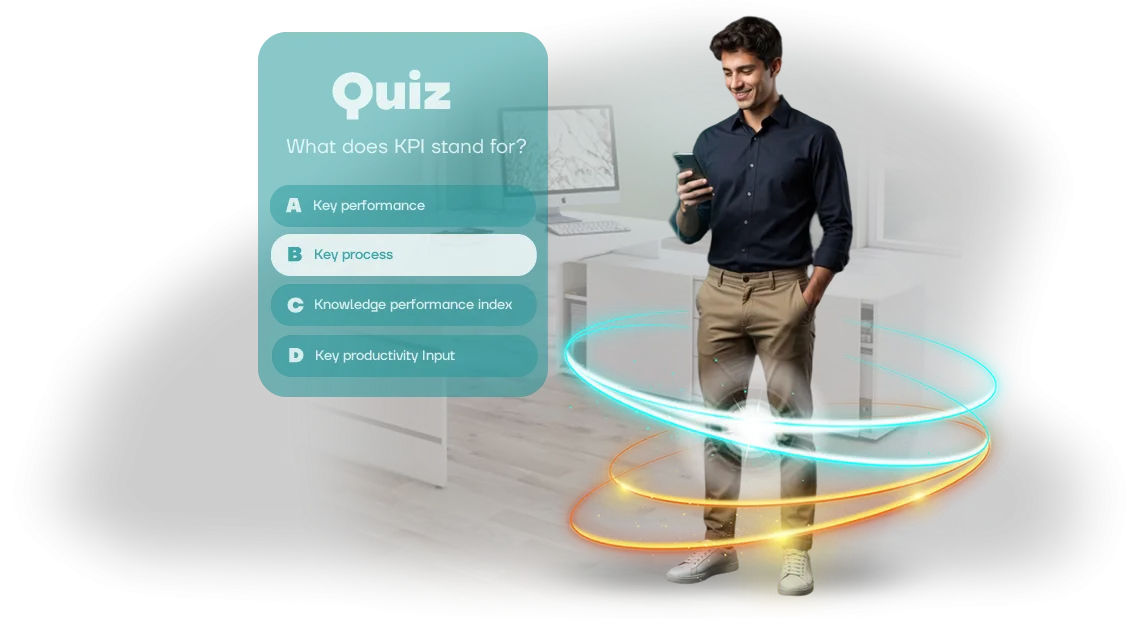
Metallurgical Plant Employees Lose Skills Without Practice
Every occupational safety and industrial safety briefing is a page of regulations that an employee is expected to master on the spot.
In practice, however, the information fades within days, and assessment questions become a mere formality: correct answers are memorized mechanically rather than internalized through experience.
Mistakes repeat themselves, and each one at a metallurgical plant is a risk to people’s health and a shutdown of expensive equipment.
It is not about the volume of material or the strictness of checks. The issue is that traditional training doesn’t create internal engagement: a person flips through slides or listens to an instructor — and attention doesn’t last more than a few minutes.
As a result, knowledge stays on paper, and in a real work situation, when danger needs to be assessed quickly, the employee acts out of habit rather than according to instructions.
For metallurgical production this is critical: the cost of an error here is higher than in any other industry.
For knowledge to stick, practice in safe conditions is needed. An interactive quiz turns rule revision into a game-like task: the employee seeks the correct solution, gets instant feedback, and remembers the logic of safe behavior — rather than simply memorizing wording.
This is how you can reduce violations and speed up response to emergencies without taking staff away for long courses.
We develop training quizzes for the specific needs of metallurgical plants: checking knowledge of technological instructions, occupational safety requirements, and emergency response actions.
The employee goes through short quiz scenarios, gets feedback on weaknesses, and you see an objective picture of staff readiness. This is not a test for the sake of assessment — it is a tool that makes training regular, clear, and measurable.
What Changes After Implementing a Training Quiz
When safety briefings are done “for show,” employees remember only a small part of the rules. At a metallurgical plant, this results not in fines but in injuries and downtime.
Retention rates after an ordinary lecture are one thing, after active revision they are quite another: material stays in memory for months, not until the end of the shift.
A training quiz turns the briefing into a game format that is clear to both an experienced steelmaker and a newcomer. Employees do not listen passively; they answer questions, analyze situations, and see their mistakes immediately.
This engagement creates healthy competition: everyone wants to complete the scenario without prompts — which means truly learning the rules.
The main change for you is reduced injury rates. When an employee mentally replays dangerous situations and correct actions multiple times, in real work they act automatically.
The quiz reinforces algorithms: how to work with equipment, what to do in an emergency, where protective equipment is located. This is not abstract theory but practice in decision-making before it is needed on the production floor.
For managers, it adds transparency: the system shows who has absorbed the material and who answers with errors and needs extra attention. This allows targeted work with underperformers and builds a safety culture without conflicts or moralizing. Training stops being an obligation and becomes a clear tool that people respect and use.
Ultimately, implementing a quiz is not entertainment “just to tick a box,” but a real way to reduce accident rates and improve discipline. Employees remember instructions better, engage in the process, and are genuinely invested in safety. For the plant, this means stable operation without downtime and reduced risks for people.
Formats of Training Quizzes for Metallurgical Plants
A metallurgical plant employs different categories of personnel: shift workers, engineers, and managers. Each group has its own training goals, work schedule, and available time.
Therefore, an effective quiz is not a single universal test but a set of formats that address specific needs.
We develop training quizzes on a professional platform — they work equally well on desktop computers in training classrooms, tablets, and even embedded terminals in workshops.
This makes it possible to train without interrupting work and to collect results in a unified reporting system.
| Quiz format | For whom | What it gives the plant |
|---|---|---|
| Short pre-shift test | Workers in main workshops (steelmakers, rolling mill operators, machine operators) | Quick safety knowledge check before a shift starts, reduced risk of violations |
| Scenario-based quiz simulator | Engineering personnel, process engineers | Practicing emergency actions without stopping production, improved competencies |
| Inter-zone quiz competition | Mixed teams | Greater training engagement, team spirit, and healthy competition |
| Certification test for managers | Supervisors, shift superintendents | Objective assessment of managerial knowledge, identification of growth areas |
The choice of format depends on the goal: improve safety culture, prepare a talent pool, or conduct regular certification.
During a consultation, we select the optimal option and, if necessary, combine different types in one system — so the plant gets not just a game but a convenient training management tool.
How a Quiz Is Developed Around Your Regulations
Production regulations at a metallurgical plant are not a formality but the foundation of safety and quality. Therefore, we structure quiz development so that it fits naturally into your training standards.
You don’t face the task alone: we walk the path from the first discussion to launch together, and at every stage you see the interim result and can influence it.
- Briefing. We start with a detailed discussion: you tell us about the training goals, the audience, and the specifics of the plant’s operations. We record requirements for questions, difficulty, and timelines.
- Plan and concept. Based on the brief, we propose the quiz structure: number of topics, questions, and the logic of completion. You receive a document for approval and make edits.
- Content approval. We hand the prepared questions and scenario to your experts for review. We incorporate comments and approve the final version of the questions.
- Assembly and setup. We package the quiz into a ready-to-use tool that runs on your network computers. We run internal tests and verify compliance with the scenario.
- Pilot launch. We organize a pilot with a small employee group so you can see how it works in real conditions and collect initial feedback.
- Training launch. We place the quiz on the relevant workstations, provide access, and instruct administrators. Employees can start training immediately.
- Support and analytics. After launch, we stay in touch: we collect statistics, help analyze difficult questions, and update content when regulations change.
What the Quiz Delivery for Your Enterprise Includes
Launching employee training at a metallurgical plant requires not just a game format but a complete turnkey solution. We deliver a package with everything needed: the quiz itself, management tools, clear reporting, and materials for organizers.
- Training quiz tailored to the plant’s needs — questions on occupational safety, technological regulations, and internal standards, adapted to the specifics of the enterprise.
- Administrator panel — allows changing questions, adding new topics, and assigning completion to specific workshops or crews without a programmer.
- Training reports — automatic statistics: who passed, who didn’t, how many attempts were made, which topics caused difficulties.
- Methodological materials for organizers — instructions for running the quiz, a facilitation scenario, and recommendations for employee engagement.
- Integration with training records — completion data can be exported to a unified record system to satisfy internal control requirements.
- Support and updates — fine-tuning for new regulations, technical support, and question updates throughout the entire lifecycle.
- Backup and data protection — employee results are preserved, access is restricted, and data loss is impossible.
This package addresses the enterprise’s main need: you get not a one-off game but a tool that lives inside the training system and works on a regular basis.
The plant administrator controls the process, sees results, and can quickly adjust content when needed — without contacting the developers.
Case Study: How a Quiz Improved Exam Pass Rates at a Plant
At a plant with a five-thousand-strong workforce, implementing new regulations kept hitting one wall — exams. Paper tests were perceived as a formality: employees memorized answers and within a month were violating requirements again.
The training department understood they needed a format that would actually make people engage with the material rather than mechanically tick options.
We suggested a quiz in the style of a team game: workshop scenarios appear on the screen, and you need to choose the right actions, with a time limit for each answer. Employees competed between departments, which immediately sparked enthusiasm.
The first pilot was run for JSC Ural Metallurgical Plant — and a month later the safety department requested a rollout to all divisions.
What Changed
Over two months, 1,240 employees from five workshops completed the quiz. The share of first-time passes rose from 74% to 95%, and the average score increased to 4.7 out of 5.
Most importantly, follow-up checks showed that knowledge retention lasted three times longer than after classic lectures.
Client Review
“For the first time in ten years, we saw people re-taking exams on their own and asking when the next game would be. The passing score — 95% — was reached without a single complaint about difficulty,” comments the head of the training center.
After that, we developed the format further: added seasonal updates and adapted questions to new standards. Within six months, the plant ordered a quiz for new-hire onboarding, and later for related sites.
How to Choose a Quiz Format for Your Workshop’s Specifics?
The quiz format is always adjusted to two parameters: how many employees work in the workshop and how specialized the knowledge to be tested is.
For a small shift of 10–15 people, a live game with a facilitator and discussion works well — it brings the team together and provides instant feedback.
For a large production site with hundreds of workers, it is more effective to split training into short sessions by department so that each participant can complete the test at a convenient time without stopping the shift.
The second criterion is equipment specifics. For workshops with unique machinery, it’s better to build questions around real situations: how to act when a mechanism malfunctions, which parameters to monitor first.
For general competencies — safety or regulations — you can take universal blocks and adapt the wording to your terminology. We always start with an audit of your instructions and process charts so that the quiz speaks the language of your employees rather than abstract concepts.
The third factor is difficulty. If training is for newcomers, we include more hints and explanations after each answer. For experienced workers, we emphasize speed, non-standard scenarios, and video-based error review.
This way, the same material is mastered by both a foreman with twenty years of experience and a trainee who started yesterday.
We help you decide on the format at a briefing: you describe the headcount, shift composition, and typical tasks — we propose a quiz structure with sample questions specific to your workshop.
As a result, you get not an abstract game but a tool that closes real knowledge gaps and easily fits into your existing training system.
Frequently Asked Questions About Implementing Quizzes in Workshops
Before launching a training quiz in workshops, clients ask the same questions. We answer directly — about timelines, support, and content updates. These answers remove the main doubts and make the launch predictable.
How quickly is a quiz implemented?
Usually one to two weeks: we gather questions from your specialists, adapt the scenario to the plant’s processes, and test the game on your computers. We don’t stop production — we launch the quiz by the required date.
What if the workshop has old computers?
The game runs on regular office and industrial PCs. We configure the project for your existing equipment — no need to buy new hardware. The only requirement is a screen where employees can see questions and results.
Who handles technical support during the game?
We support the launch remotely and, if necessary, visit the site. Before the event we run a test, and on the day of the game we monitor stability. Any failure is fixed within minutes — without stopping the training.
How are questions updated after launch?
You send new material — we add it to the interface or record instructions so your employee can update questions themselves. This way, the quiz always stays aligned with current regulations and remains useful for its entire lifetime.
Won’t the game break at the most important moment?
We build quizzes on Unity, a proven platform for stable operation on different computers. The project is tested before delivery, and after launch we stay in touch and make adjustments promptly. The tool won’t fail on launch day.
Order a Quiz Development for Your Enterprise
To launch a training quiz at your enterprise, you don’t need to prepare a complex technical specification or wait for approvals from several departments.
A request for a quote is enough — we’ll take on developing a quiz for your metallurgical plant’s needs and prepare a commercial proposal with clear stages and timelines.
- Cost and timeline calculated for your scenario — we discuss what employees need to reinforce: safety, equipment handling procedures, quality standards. Cost and timelines are calculated for these tasks, not by template.
- Pilot launch on a group or a separate workshop — we check how employees accept the format and refine the quiz before full deployment.
- Individual commercial proposal — it specifies the scope of work, timelines, and the result. You see in advance what you will receive and when.
- Integration into the work environment: training room, workshop terminals, or employee computers. Training takes place at a familiar pace, without leaving the plant premises.
- Post-launch support — we collect feedback, adjust questions, and add new blocks when regulations change.
- Summary statistics for managers — breakdowns by workshop and topic show where material is absorbed and where it needs revision.
To order a quiz, fill out a short request form — in response, we’ll send examples of projects for industrial enterprises and clarify your tasks by email or phone. Based on the brief, we’ll prepare a commercial proposal and give you the exact launch date.
We have hands-on experience with interactive training on production sites: we understand the specifics of shift schedules, access rules, and personnel training requirements.
Developing a quiz on a professional game platform typically takes two to four weeks, depending on the volume of material.
While you are deciding, colleagues at neighboring enterprises are already using interactive learning — submit your request today, and within a month the first groups can be trained in the new format.